In the dynamic landscape of e-commerce, businesses that incorporate rental services often face a critical decision: which platform best serves their unique operational needs? Shopify, a titan in general e-commerce, and Booqable, a specialist in rental management, represent two distinct approaches. While seemingly different, many businesses find themselves weighing these two against each other, particularly when rentals form a significant part of their offering. This in-depth analysis, drawing from over 60 hours of hands-on testing, aims to provide a clear recommendation, acknowledging that the optimal choice hinges entirely on whether rentals are a core business function or a supplementary service.
The core divergence between Shopify and Booqable lies in their fundamental design philosophies. Shopify is engineered for broad e-commerce applications, excelling in direct-to-consumer sales, omnichannel retail, and the general sale of goods. Its robust ecosystem supports a vast array of product types and sales models. Conversely, Booqable is purpose-built for the intricacies of rental operations. Its architecture is centered around date-based bookings, availability management, and the entire lifecycle of renting out equipment and products. This fundamental difference dictates their strengths and weaknesses across key business areas.
Shopify vs. Booqable: A Quick Overview
To understand the nuances of each platform, a direct comparison is essential.
| Feature | Shopify | Booqable |
|---|---|---|
| Primary Focus | General e-commerce and omnichannel retail | Equipment and product rentals with date-based bookings |
| Rental Features | Requires third-party apps | Built-in rental logic, contracts, deposits |
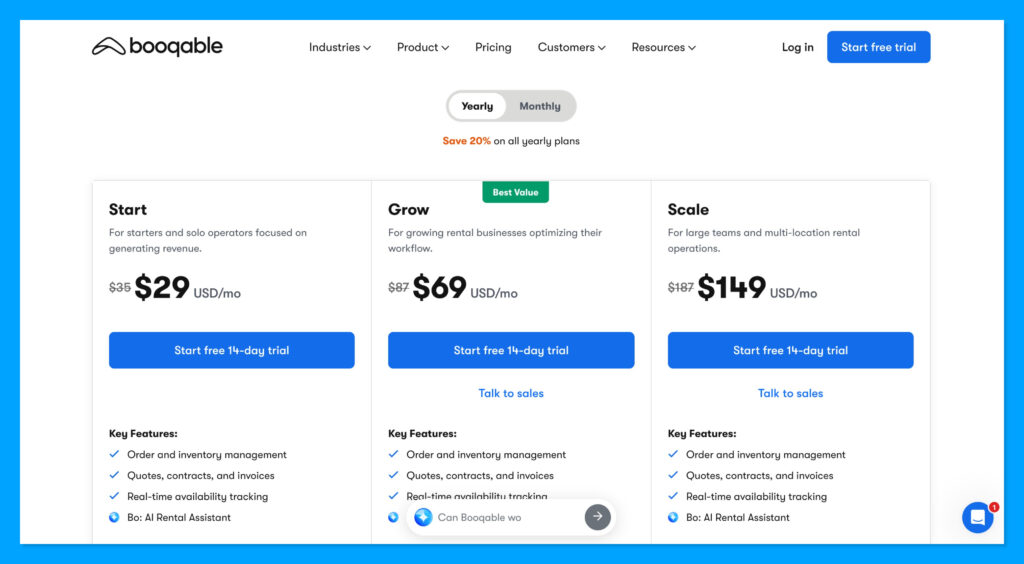
| Starting Price | $29/month (Basic, annual billing) | $29/month (Start) |
| Higher Tiers | $79, $299/month, Shopify Plus from $2,300/month | $69 and $149/month |
| Free Trial | 3 days | 14 days |
| Inventory Model | SKU stock per location | Time-based availability with rental calendars |
| Checkout | High-converting e-commerce checkout | Rental-specific checkout with deposits |
| POS/In-Person | Full retail POS (Lite and Pro) | Mobile rental check-in/check-out workflows |
| App Ecosystem | Over 8,000 third-party apps | Smaller integration list, API on higher tiers |
| Best For | Product-led brands, DTC, omnichannel retail | Rental-first businesses or hybrid via Shopify integration |
Pricing Strategy: A Close Match, Divergent Scalability
At the entry level, both Shopify and Booqable present a compellingly similar price point, each starting at $29 per month. However, a deeper examination of their pricing structures reveals significant differences in scalability and long-term cost-effectiveness.
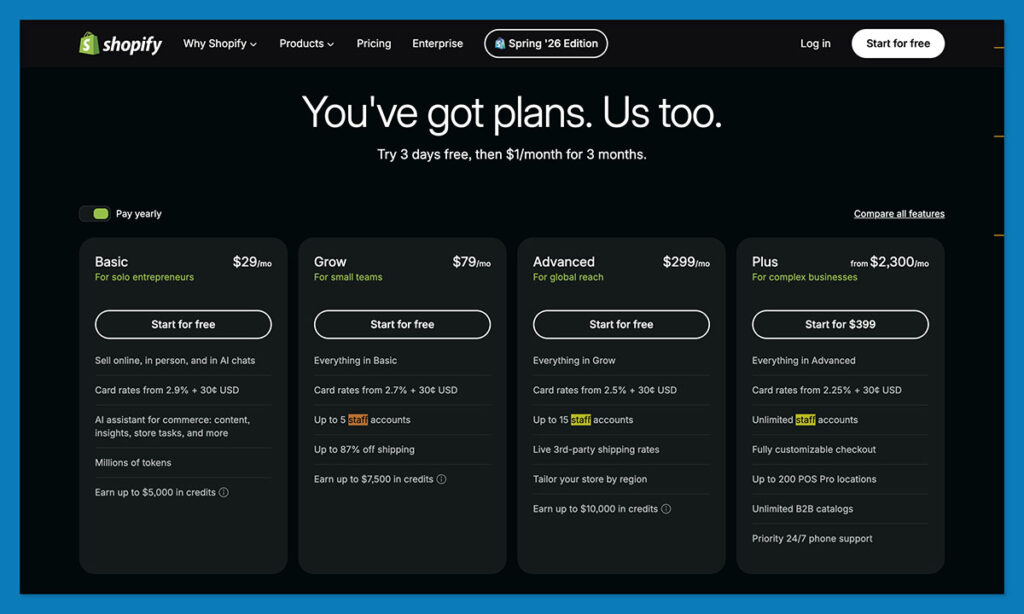
Shopify’s tiered pricing, when billed annually, offers several options: Basic ($29/month), Shopify ($79/month), and Advanced ($299/month). For enterprises, Shopify Plus begins at $2,300 per month. Beyond the subscription fee, Shopify imposes payment processing fees. These typically start at 2.9% + $0.30 per transaction for the Basic plan when using Shopify Payments, decreasing slightly with higher tiers. Crucially, if a third-party payment gateway is used, Shopify adds its own transaction fee on top, which can significantly increase costs for high-volume businesses.
Booqable, on the other hand, adopts a more straightforward, flat-rate tiered model. Its plans are structured as: Start ($29/month), Grow ($69/month), and Pro ($149/month). A key differentiator is that Booqable does not charge transaction fees or take a commission on bookings. Businesses pay their chosen payment gateway directly, offering a more predictable cost structure as rental volume increases. Higher Booqable tiers unlock advanced features such as multi-location support, increased user access, API capabilities, and detailed activity logs, catering to growing rental operations.
Regarding trial periods, Booqable offers a more generous 14-day free trial, allowing businesses ample time to explore its rental-specific functionalities. Shopify’s standard trial is only 3 days, though it frequently offers promotional deals, such as a $1 per month introductory rate for the first three months. Neither platform requires a credit card to initiate a trial.
For businesses considering a hybrid approach, integrating both platforms, the combined subscription cost will naturally increase. A minimum configuration would involve Shopify Basic ($29/month) and Booqable Grow ($69/month) to leverage the Shopify integration effectively. This amounts to approximately $100 per month before accounting for payment processing fees and any additional app subscriptions.
The Verdict on Pricing: While both platforms offer an identical entry price point, Booqable emerges as the more cost-effective solution at scale. Its predictable, flat-rate pricing and absence of transaction fees provide a significant advantage for businesses experiencing substantial rental growth. Shopify’s costs can escalate rapidly due to payment processing fees and the cumulative cost of necessary third-party apps.
Rental Functionality: Booqable’s Purpose-Built Advantage
The most profound divergence between Shopify and Booqable lies in their native rental capabilities. Shopify’s inventory management system is fundamentally designed around Stock Keeping Units (SKUs), quantity counts, and physical locations. It answers "how many units do I have?" but lacks the inherent understanding of time-based availability – crucial for rentals. Booqable, conversely, is architected from the ground up to manage time-based availability, which is the very essence of rental software.
Rental Inventory and Booking Logic
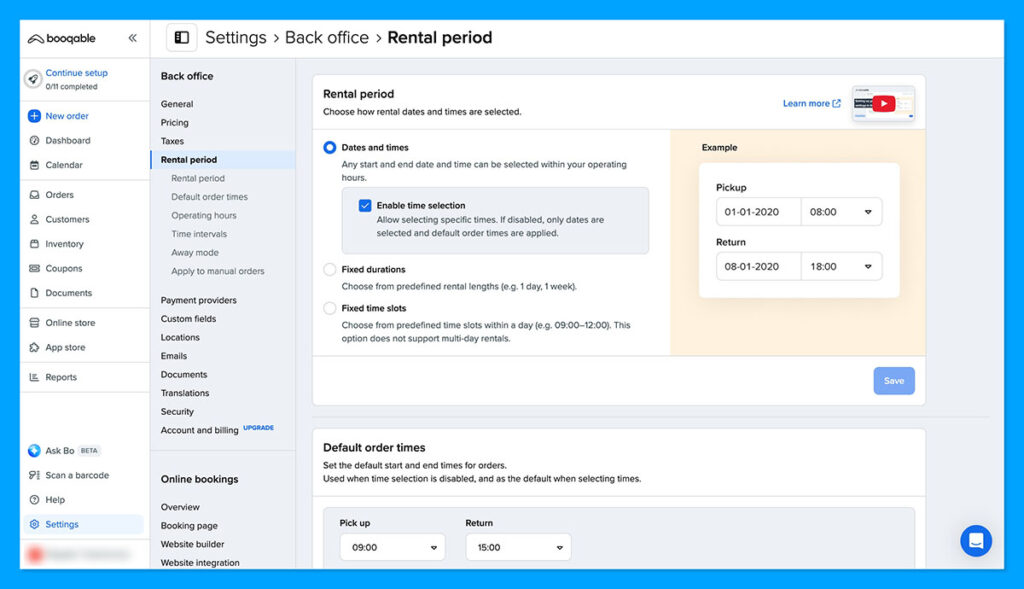
During testing, Booqable demonstrated exceptional proficiency in managing rental inventory. Each product added could be precisely configured with specific date and time windows, ensuring real-time availability checks during the checkout process to prevent double bookings. The platform adeptly handles both individually tracked items, such as high-value equipment with serial numbers, and bulk stock, like a fleet of identical chairs. Its intelligent handling of product bundles ensures that when a bundle is reserved, all its constituent components are automatically marked as unavailable for the same period.
Recent enhancements to Booqable have further refined its rental features. These include more granular time selection for stock availability, improved management of bundles within orders, and enhanced calendar filtering for better visibility and control.
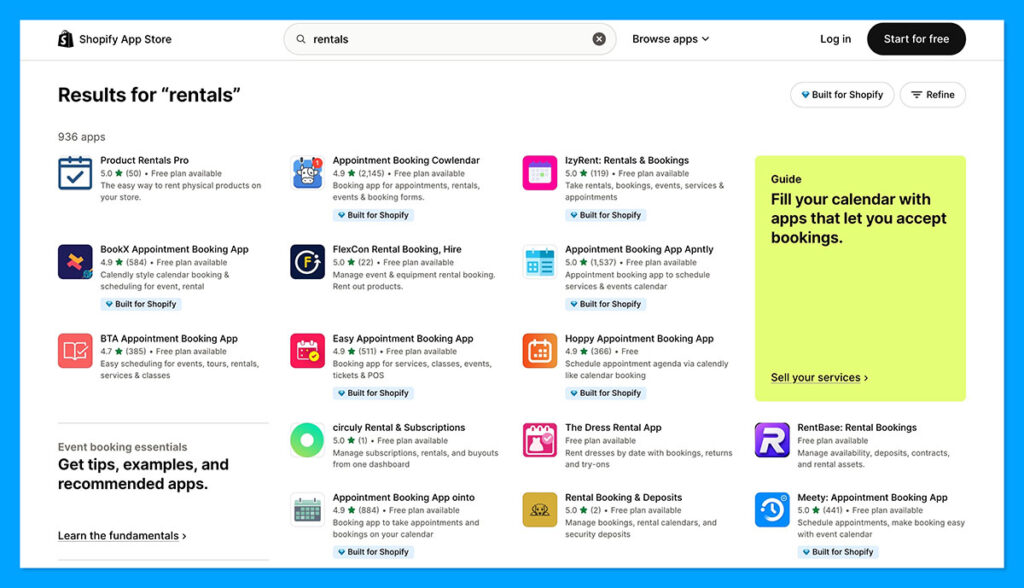
Shopify, in contrast, does not offer these native rental functionalities. Rental apps available on the Shopify App Store typically attempt to layer simplified rental logic onto Shopify’s existing SKU-based inventory model. While these apps can provide basic rental capabilities, they often fall short of the seamless, integrated experience offered by a dedicated rental platform.
Quotes, Contracts, and Deposits
Booqable streamlines the essential rental workflow from quote generation to contract signing and deposit collection. Customers can request quotes, which can then be reviewed and approved by the business. Contracts can be generated and sent for electronic signature, and deposits can be collected separately from the final rental payment. While Shopify can approximate some of these functions through third-party applications, the experience often feels fragmented and less intuitive compared to a system designed with these workflows in mind.
Check-in and Check-out Workflows
Booqable’s mobile applications are specifically designed to facilitate the daily operations of a rental business. They support efficient check-in and check-out processes, enabling businesses to inspect returned items, document any damages, and track inventory status. Shopify POS, while highly effective for retail transactions, lacks these specialized workflows for items that leave and return. For businesses with a physical presence managing rentals, these daily operational efficiencies are paramount.
The Winner for Rental Features: Booqable is unequivocally the superior choice for businesses where rentals are a core operation. Its purpose-built design, encompassing time-based availability, quote management, contracts, deposits, and mobile check-in/check-out workflows, provides a native and integrated solution that Shopify, relying on third-party apps, cannot fully replicate.
Product Sales: Shopify’s E-commerce Prowess
When the primary business objective is the outright sale of products – be it apparel, electronics, cosmetics, or any other tangible good sold through a one-time transaction – Shopify operates in a class of its own. The platform has dedicated over a decade to refining the e-commerce experience, and nearly every aspect of its design reflects this commitment.
Sales Features and Conversion Optimization
Shopify offers a comprehensive suite of sales features essential for modern online retail. This includes sophisticated product variant management, discount code creation, abandoned cart recovery mechanisms, gift card functionality, customer account management, and robust multi-channel selling capabilities. Its checkout process is consistently recognized as one of the highest-converting in the industry, a testament to its continuous optimization for user experience and sales conversion. Furthermore, Shopify Magic, an AI-powered tool, assists merchants in generating product descriptions, blog posts, and email content from simple prompts, enhancing content creation efficiency.
While Booqable does possess a cart and checkout system, it is tailored for rentals, managing deposits and date-based pricing. It is not optimized for the promotional cross-sells, subscription upsells, or the nuanced conversion strategies typical of product sales. Though Booqable’s checkout can technically process outright sales, it will not provide the same conversion-focused experience as Shopify.
The App Ecosystem: An Unparalleled Advantage
Shopify’s app store is a monumental asset, boasting over 8,000 third-party integrations. This vast marketplace covers virtually every conceivable business need, from email marketing and subscription management to loyalty programs, customer reviews, shipping logistics, accounting, and beyond. Many apps are available for free or offer free tiers, while others are paid monthly. The sheer breadth and depth of Shopify’s app ecosystem represent one of its most significant competitive advantages, allowing businesses to customize and extend their store’s functionality almost limitlessly.
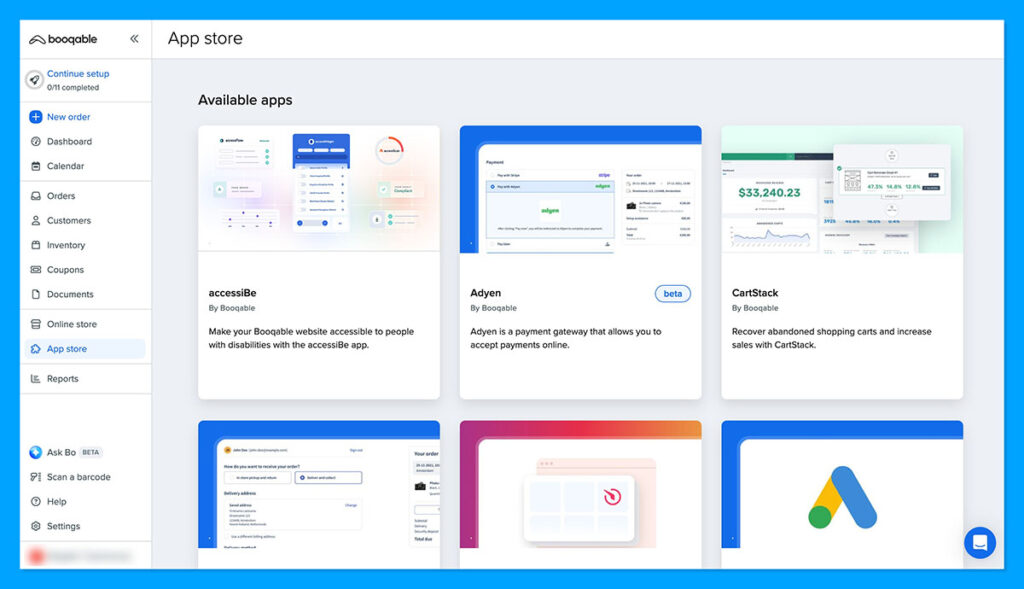
Booqable, in contrast, has a more limited integration list. It connects with major website platforms (Shopify, WordPress, Squarespace, Wix), popular payment gateways, and accounting software. API access is available on higher tiers for custom integrations. While this is sufficient for many dedicated rental businesses, it can be restrictive for companies seeking a deeply customized online presence with advanced marketing automation, loyalty programs, and sophisticated merchandising layers.
Payment Options and Internationalization
Shopify supports over 100 payment methods, including widely used options like PayPal, Apple Pay, and Google Pay, alongside its own Shopify Payments gateway. This extensive selection is particularly beneficial for businesses operating internationally or requiring region-specific payment methods such as Klarna or iDEAL.
Booqable integrates with Stripe, Mollie, and a select group of other gateways. While functional for many, it lacks the breadth of options available through Shopify, which can be a consideration for businesses targeting diverse global markets.
The Winner for Product Sales: Shopify is the undisputed leader for businesses focused on selling products outright. Its highly optimized checkout, comprehensive sales features, extensive payment gateway support, and unparalleled app ecosystem provide a significantly more powerful and flexible platform for product merchandising, marketing, and overall e-commerce performance.
Marketing and SEO: Shopify’s Strategic Edge
Marketing and Search Engine Optimization (SEO) represent another area where Shopify’s maturity and investment are evident. The strategies for acquiring customers through marketing channels differ significantly from the operational demands of managing rentals, and Shopify has long focused on excelling in both.
Integrated Marketing Tools
Shopify facilitates direct integration with major social media platforms like Instagram, TikTok, and Facebook, allowing for seamless product catalog synchronization. It also enables syncing with marketplaces such as Amazon and Etsy via the Shopify Marketplace Connect app. The built-in Shopify Email tool empowers merchants to design, dispatch, and track email campaigns directly from their admin dashboard, offering the first 10,000 emails per month free across all plans.
Booqable, while enabling integrations with email marketing tools through Zapier or its API, does not offer the same depth of integrated marketing workflows. Its focus remains on the operational aspects of rentals rather than customer acquisition marketing.
SEO Capabilities and Content Strategy
Shopify provides essential SEO features, including editable meta titles, descriptions, alt text, and automatic sitemap generation. Through its extensive app ecosystem, merchants can access advanced SEO tools. Notably, its partnership with Semrush, integrated via the Ecommerce Booster app, offers merchants actionable SEO recommendations tailored to their business.
Booqable’s hosted rental sites and embeddable widgets offer basic SEO functionality. However, the platform is not inherently designed for content marketing strategies in the same way Shopify is. For businesses where organic search traffic is a primary acquisition channel, Shopify’s robust SEO features and app support present a significant advantage.
Global Reach and Internationalization
Shopify’s internationalization capabilities are extensive, supporting over 30 languages and enabling automatic routing of customers to translated storefronts based on their browser language. Multi-currency selling is a native feature, and Shopify Markets enhances this by providing region-specific pricing, tax, and duty management.
Booqable supports multi-language back-office administration and can be configured for different currencies. However, its capabilities for managing multi-region sales and localized customer experiences are less comprehensive than Shopify’s offering.
The Winner for Marketing and SEO: Shopify holds a substantial lead in marketing, SEO, and internationalization tools. Businesses that prioritize customer acquisition through search engines, social media, and email marketing will find Shopify’s integrated solutions and extensive app support far more advantageous for building and growing their customer base.
Ease of Use: A Tale of Two Specializations
The assessment of ease of use is inherently tied to the user’s primary objective. Shopify’s onboarding and general e-commerce setup are remarkably polished and intuitive. However, once immersed in rental operations, Booqable’s interface becomes more intuitive due to its specialization.
Shopify’s sign-up process is swift and user-friendly, typically involving a few questions about business type and offerings before presenting an admin dashboard with a clear setup checklist. Its clean interface, section-based theme editor (which is easy to learn despite not being a drag-and-drop system), and straightforward product addition process contribute to a smooth initial experience for general e-commerce.
Booqable’s sign-up is equally quick, focusing on essential business details. Its dashboard is logically structured around orders, calendar views, and inventory status, rather than the catalog management emphasis of e-commerce platforms. For users new to rental software, there is a learning curve associated with setting up rental-specific pricing (hourly, daily, weekly) and managing bundles. However, once this model is understood, the interface is well-organized and efficient.
Where Shopify demonstrably excels in usability is in template editing, brand customization, and content management. Conversely, Booqable shines in the day-to-day management of live bookings, resolving availability conflicts, and processing rental orders.
The Winner for Ease of Use: The winner depends on the task. Shopify offers superior ease of use for general e-commerce setup, content editing, and brand customization. Booqable is more intuitive for the specific demands of running a rental operation on a daily basis. For beginners, Shopify provides a faster path to launching a general online store, while Booqable offers a more efficient workflow for rental-specific tasks once the initial setup is complete.
Storefront Design and Templates: Shopify’s Aesthetic Superiority
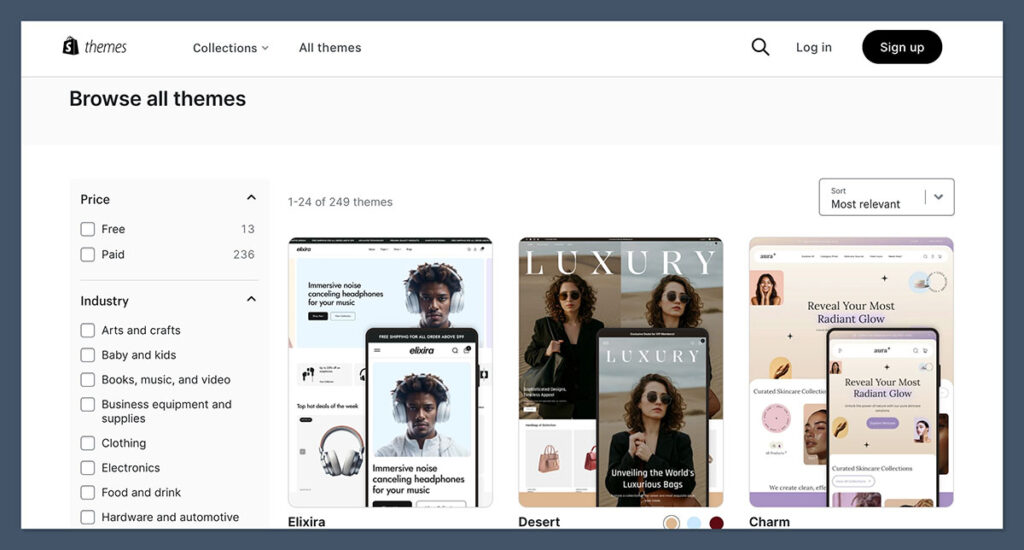
When it comes to website design and template selection, Shopify presents a more extensive and versatile offering. It provides access to over 190 templates, catering to a wide array of industries, with 13 free options and premium themes ranging from $180 to $350 as a one-time purchase. These themes are designed to be modern, mobile-optimized, and conversion-focused, featuring customizable sections that can be rearranged and adapted without requiring coding expertise. For brand-centric businesses where the online storefront is a critical component of the brand identity, Shopify’s design flexibility is a significant advantage.
Booqable includes a rental-focused website builder with a more modest selection of templates specifically curated for rental businesses. Alternatively, users can embed Booqable’s booking widgets into existing websites built on platforms like WordPress, Squarespace, Wix, or even Shopify. This approach allows for integration into established sites but offers less native design freedom compared to Shopify’s comprehensive theme ecosystem.
The Winner for Templates and Storefront Design: Shopify offers a broader palette of templates and significantly greater design flexibility. Businesses that prioritize their brand experience and require extensive customization of their online presence will find Shopify’s design ecosystem to be far more accommodating. While Booqable’s themes are functional for rental operations, they are comparatively limited in aesthetic range and customization potential.
The Power of Integration: Shopify + Booqable
A particularly valuable insight for businesses navigating this decision is the realization that a choice between Shopify and Booqable is not always mutually exclusive. Booqable offers a native integration with Shopify that effectively transforms Shopify into the primary storefront while Booqable manages the complex rental logic, inventory, and checkout processes in the background. For many hybrid businesses, this combined "stack" represents the optimal solution.

How the Integration Functions
The Booqable Shopify app allows for the seamless embedding of rental products, date pickers, and real-time availability information directly onto Shopify product pages. While product information needs to be maintained in both systems, Booqable synchronizes rental pricing, availability, and inventory data to the embedded elements on Shopify. The rental cart and checkout process can be customized to match the brand’s aesthetic and can even be hosted on the business’s own domain, ensuring a cohesive customer experience.
Advantages of the Combined Stack
- Unified Storefront: Leverage Shopify’s robust e-commerce design and marketing capabilities for your entire online presence.
- Specialized Rental Management: Utilize Booqable’s purpose-built features for accurate availability, booking, and inventory management.
- Seamless Customer Journey: Customers interact with a familiar Shopify interface, unaware of the backend rental engine.
- Hybrid Business Model Support: Effectively manage businesses that sell some products outright while renting others.
- Enhanced Marketing and SEO: Benefit from Shopify’s advanced marketing tools and SEO features for customer acquisition.
Trade-offs of the Combined Stack
- Increased Complexity: Managing two platforms requires more administrative overhead and coordination.
- Higher Cost: The combined subscription fees, starting around $100 per month for basic plans, plus potential app costs, represent a greater initial investment.
- Data Synchronization: Ensuring consistent data across both platforms requires diligent management.
The combined stack is particularly advantageous for businesses with a hybrid model, selling certain items while renting others, or incorporating memberships and subscriptions. It is also ideal for businesses that rely heavily on content marketing, SEO, and brand storytelling to acquire customers, leveraging Shopify’s content management tools alongside Booqable’s operational strengths.
Support and Resources: Shopify’s Broad Reach
Both platforms provide commendable customer support, but Shopify’s scale and resources offer a broader and more accessible range of assistance channels.
Shopify Support: Shopify offers 24/7 live chat, email support, and extensive documentation through its Help Center. Its community forums are vibrant, and a vast network of Shopify Experts and partners is available for hire, providing specialized assistance for everything from theme customization to app development.
Booqable Support: Booqable provides support via email and a comprehensive knowledge base. While responsive and knowledgeable about rental-specific issues, its support infrastructure is naturally smaller in scale compared to Shopify’s global operation.
The Winner for Support: Shopify wins on the breadth and availability of its support. The 24/7 live chat, extensive documentation, and massive partner network are difficult to surpass. Booqable’s support is reliable and rental-focused, but the overall resource pool is smaller.
Rigorous Testing Methodology
The insights presented in this analysis are the result of over 60 hours of dedicated testing. This process involved signing up for trials of both platforms, meticulously building test stores, and simulating real-world rental scenarios. The Shopify + Booqable integration was also thoroughly evaluated to assess its practical performance. Pricing information was verified against current published rates as of 2026. The evaluation was structured across seven weighted criteria: pricing, rental features, e-commerce capabilities, ease of use, design and templates, marketing and SEO, and customer support.
Final Verdict: Choosing the Right Platform for Your Business
In conclusion, Shopify and Booqable are not direct competitors in a zero-sum game; rather, they are complementary tools, each excelling in its specialized domain. The optimal choice hinges on the fundamental nature of your business.
Choose Shopify Alone if: Your primary revenue stream comes from selling products outright, and rentals represent a minor or negligible part of your business. Shopify’s unparalleled e-commerce depth, potent marketing tools, and expansive app ecosystem provide the most robust platform for product sales. Any occasional rental needs can likely be addressed with third-party applications.
Choose Booqable Alone if: Your business is fundamentally rental-first. Whether it’s equipment hire, party rentals, AV gear, or photography equipment, any operation where availability and date-based logic are the core operational drivers will thrive on Booqable. Attempting to simulate these core functions on a general e-commerce platform like Shopify will inevitably lead to operational friction and inefficiencies.
Choose Shopify + Booqable if: You operate a genuinely hybrid business model, selling certain items while renting others, and require both sophisticated marketing capabilities and robust rental operations. This combined stack offers best-in-class tools for both aspects of your business, albeit with a slightly increased complexity in management. It is the ideal solution for businesses that need polished marketing and brand storytelling alongside serious rental management.
Both platforms offer no-obligation free trials, making it prudent for businesses to test the solution that best aligns with their operational model. Experiencing the platform firsthand before committing is the most effective way to ensure it meets your specific needs.
Frequently Asked Questions
Can Shopify handle rentals on its own?
While Shopify can technically manage rentals through third-party apps from its App Store, the experience is often limited. Shopify’s native inventory system does not inherently understand date-based availability, requiring rental apps to work around this limitation with varying degrees of success. This approach may suffice for occasional or simple rentals but is generally not suitable for rental-first businesses.
Can Booqable replace Shopify entirely?
For businesses exclusively focused on rentals, Booqable can indeed serve as a complete solution. It includes a rental-specific website builder, checkout system, and order management capabilities. While it may not offer the same breadth of marketing tools or app ecosystem as Shopify, these are often unnecessary for pure rental operations.
How much does it cost to run Shopify and Booqable together?
The minimum cost for running both platforms together starts around $100 per month, comprising Shopify Basic ($29/month) and Booqable Grow ($69/month), which is the tier where the Shopify integration is most robust. When factoring in payment processing fees, potential paid apps, and theme costs, a realistic monthly budget for a small operation could range from $150 to $250.
Does Booqable charge transaction fees on bookings?
No, Booqable does not charge commission on bookings or impose platform transaction fees. Businesses only incur the standard processing rates from their chosen payment gateway. This is a significant cost advantage over Shopify, especially for high-volume rental businesses.
Is Shopify or Booqable better for in-person rentals?
Booqable is superior for in-person rentals. Its mobile applications and in-store workflows are specifically designed for the practicalities of rental check-in, check-out, item inspection, damage reporting, and return tracking. Shopify POS excels at retail transactions but lacks these specialized rental workflows.
Which is easier to set up for a beginner?
For general e-commerce beginners, Shopify offers a quicker setup process due to its guided onboarding and extensive template library. For beginners to rental software specifically, Booqable’s learning curve is manageable, and the long-term operational efficiencies gained in rental management can significantly outweigh the initial setup time.