Suro Senen

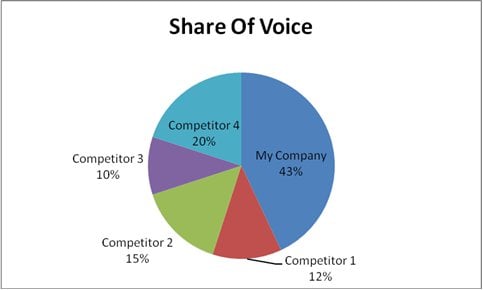
Share of voice (SOV) represents a brand’s visibility and presence within its competitive landscape, quantifying its slice of the overall conversation in a specific market or channel. This critical metric has evolved significantly from its origins in traditional advertising, now encompassing the vast and dynamic digital ecosystem. For businesses aiming to enhance brand awareness, drive sales, and secure a competitive edge, understanding, measuring, and actively growing their SOV is not merely advantageous—it is indispensable. It serves as a powerful indicator, offering insights into a brand’s current standing and, crucially, its future trajectory in the marketplace.
The Evolution of Share of Voice Measurement
Historically, share of voice was primarily confined to measuring a brand’s dominance in paid advertising. Marketing professionals would track ad spend against competitors to gauge their relative share of exposure in print, radio, and television. However, the advent of the internet and the proliferation of digital platforms—social media, search engines, blogs, and news sites—fundamentally transformed this definition. Today, SOV is a far more comprehensive metric, reflecting a brand’s overall online visibility across various touchpoints. This expanded scope includes social media mentions, organic search rankings, paid advertising impressions, and earned media coverage.

This evolution signifies a shift from merely tracking what brands say about themselves through advertising to understanding what people say about brands and how frequently brands appear in relevant online discussions. The digital landscape has democratized the conversation, making it imperative for brands to monitor their presence across all these channels to gain a holistic view of their influence.
Understanding the Core Metric: Formula and Calculation
The fundamental formula for calculating share of voice remains consistent, regardless of the specific digital channel being analyzed. What changes are the "mentions" or visibility metrics used as inputs.
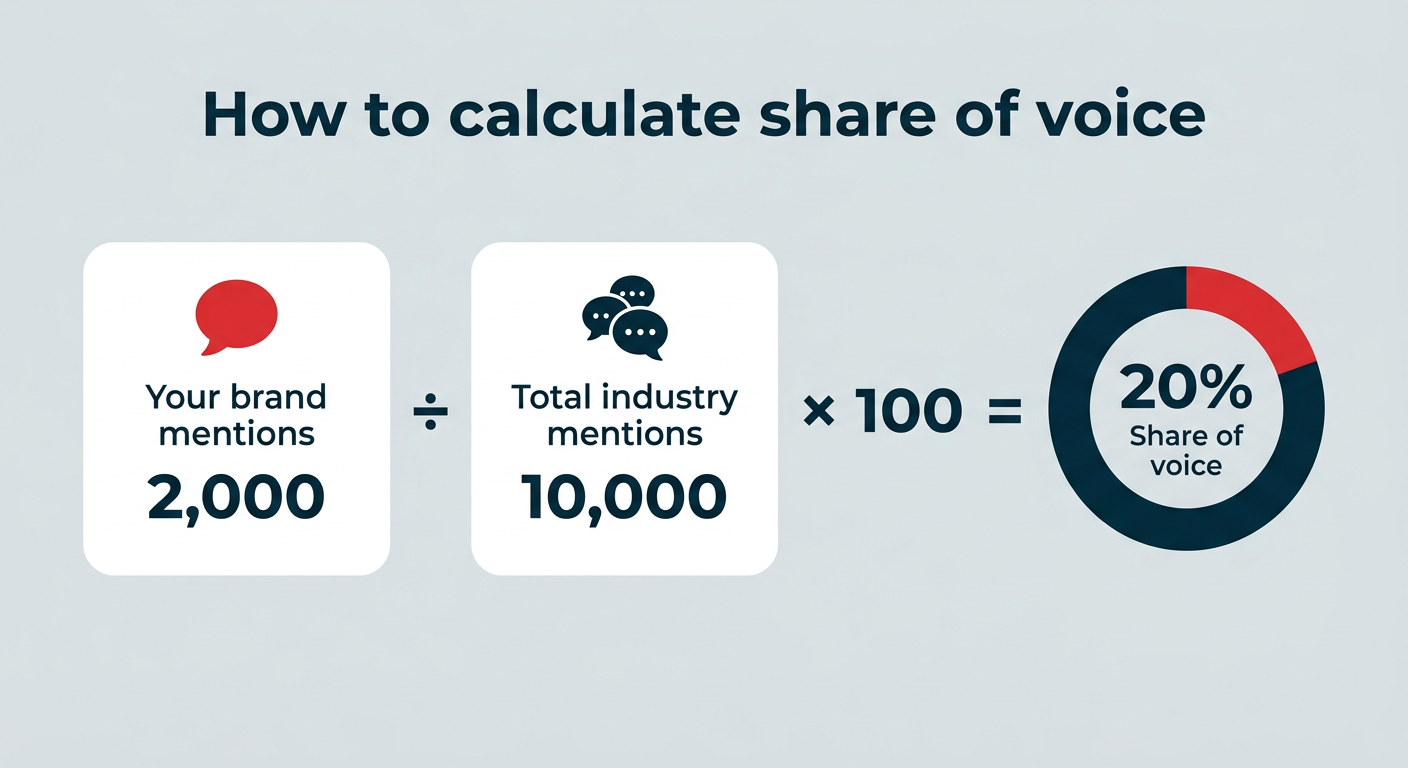
Your Brand Mentions / Total Industry Mentions x 100 = Share of Voice (%)

To illustrate, consider a scenario where Brand A garnered 2,000 mentions across social media platforms last month, while the combined total mentions for Brand A and its defined competitors amounted to 10,000. In this case, Brand A’s social share of voice would be calculated as (2,000 / 10,000) * 100 = 20%. This formula is adaptable; "mentions" can be substituted with "impressions" for paid advertising, "ranking visibility" for SEO, or "article counts" for earned media, maintaining its mathematical integrity.
Before undertaking any calculations, two critical prerequisites must be established:
- Define Your Competitive Set: Accurately identifying direct and indirect competitors is crucial. A too-broad set can dilute your figures, while a too-narrow one might falsely inflate them.
- Define Your Category Keywords/Topics: Determine the specific keywords, phrases, and topics that define your industry or product category. These terms will be used to track mentions and visibility across all relevant channels.
Consistency in these definitions is paramount for generating meaningful month-over-month or quarter-over-quarter comparisons, allowing for accurate trend analysis. Measuring SOV should ideally be a continuous process, reviewed weekly or monthly, to capture dynamic shifts in the market.
Share of Voice vs. Share of Market: A Critical Distinction
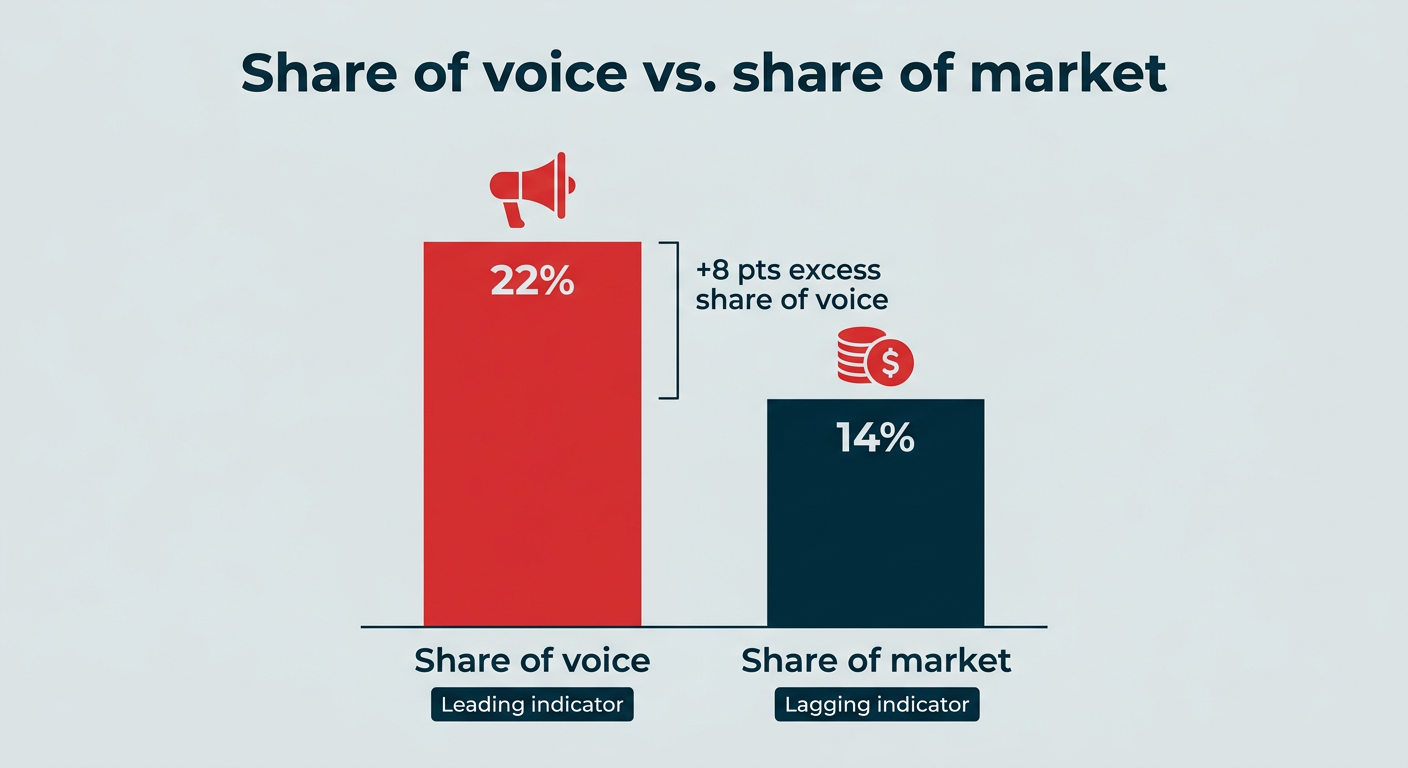
While often discussed in conjunction, share of voice and share of market (SOM) measure distinct aspects of a brand’s performance. Share of market quantifies a brand’s percentage of total sales or revenue within its category, representing its actual economic footprint. Share of voice, conversely, gauges brand visibility and the volume of conversation it commands.
The crucial insight lies in the relationship between these two metrics, particularly the concept of "excess share of voice." Pioneering research by Les Binet and Peter Field, notably published by the IPA in "The Long and the Short of It," popularized the principle that when a brand’s SOV exceeds its SOM, it tends to gain market share over time. This dynamic positions SOV as a leading indicator—a forward-looking metric that often predicts future market share shifts. Conversely, SOM acts as a lagging indicator, reflecting past performance.
For instance, if a brand holds a 22% share of voice but only a 14% share of market, this "excess SOV" suggests a strong potential for future market share growth. This disparity implies the brand is effectively building awareness and engagement that is likely to convert into sales down the line. If the reverse is true—SOV is below SOM—it signals that competitors are capturing attention that the brand will likely need to reclaim, potentially at a higher cost or through more aggressive strategies. Therefore, tracking both metrics concurrently provides a comprehensive view: SOV reveals the effectiveness of marketing efforts in building presence, while SOM confirms the tangible financial payoff.
Strategic Imperatives: Why Measuring SOV Matters
Beyond merely understanding market presence, a robust SOV measurement strategy offers several profound benefits, providing competitive advantage, guiding budget allocation, assessing campaign effectiveness, and deepening customer engagement.
Competitive Advantage: Share of voice provides an objective benchmark against competitors. By tracking both your brand’s and rivals’ SOV, businesses can identify who is leading the conversation, where their strengths lie, and where vulnerabilities exist. Real-time social listening, for example, allows brands to detect sudden spikes in a competitor’s SOV, often attributable to a new product launch, a major PR event, or a successful partnership. This intelligence enables swift, informed decisions on whether to respond, launch a counter-campaign, or maintain existing strategies. It transforms competitive analysis from a retrospective exercise into a proactive strategic tool.
Budget Allocation: Measuring SOV across different platforms and topics illuminates where marketing resources are most effectively deployed and where gaps exist. If a brand dominates conversations on LinkedIn but struggles for visibility on TikTok, SOV data clearly highlights these disparities. This insight informs strategic budget reallocation: channels where the brand is already strong might require less paid support, while underperforming channels may necessitate targeted investment in creative content, community management, or different content formats. It ensures marketing spend is aligned with strategic objectives, maximizing return on investment.
Campaign Effectiveness: Share of voice serves as an excellent metric for evaluating the impact of marketing campaigns. By establishing a baseline SOV in the weeks preceding a campaign launch and comparing it to the SOV in the weeks following, brands can quantitatively assess whether the campaign resonated with the target audience. A noticeable increase in SOV post-campaign is a compelling indicator of success, often more persuasive to stakeholders than mere impression counts, as it directly reflects increased brand salience and public discussion.
Customer Engagement and Sentiment: While SOV is fundamentally a volume metric, its true power is unlocked when paired with sentiment analysis. A high SOV built on a foundation of negative mentions is a red flag, not a victory. Recent data indicates a concerning trend, with negative mentions reaching 20.7% in Q1 2026, up from 15.6% two years prior. This underscores the necessity of understanding the nature of conversations. By analyzing sentiment and prevalent topics, brands can refine their brand voice, optimize engagement strategies, and tailor content to address concerns or amplify positive perceptions. Furthermore, tracking SOV, combined with sentiment, provides concrete data to attribute value to social media efforts in terms of leads, customer acquisition, and conversions, strengthening the case for increased marketing resources.
Measuring SOV Across Digital Channels
Effective SOV measurement requires a multi-channel approach, leveraging specific tools and methodologies for each digital domain.
Social Media Share of Voice
Social media SOV quantifies how frequently a brand is mentioned or discussed on social platforms relative to its competitors. It offers a direct measure of audience engagement and participation in relevant conversations.
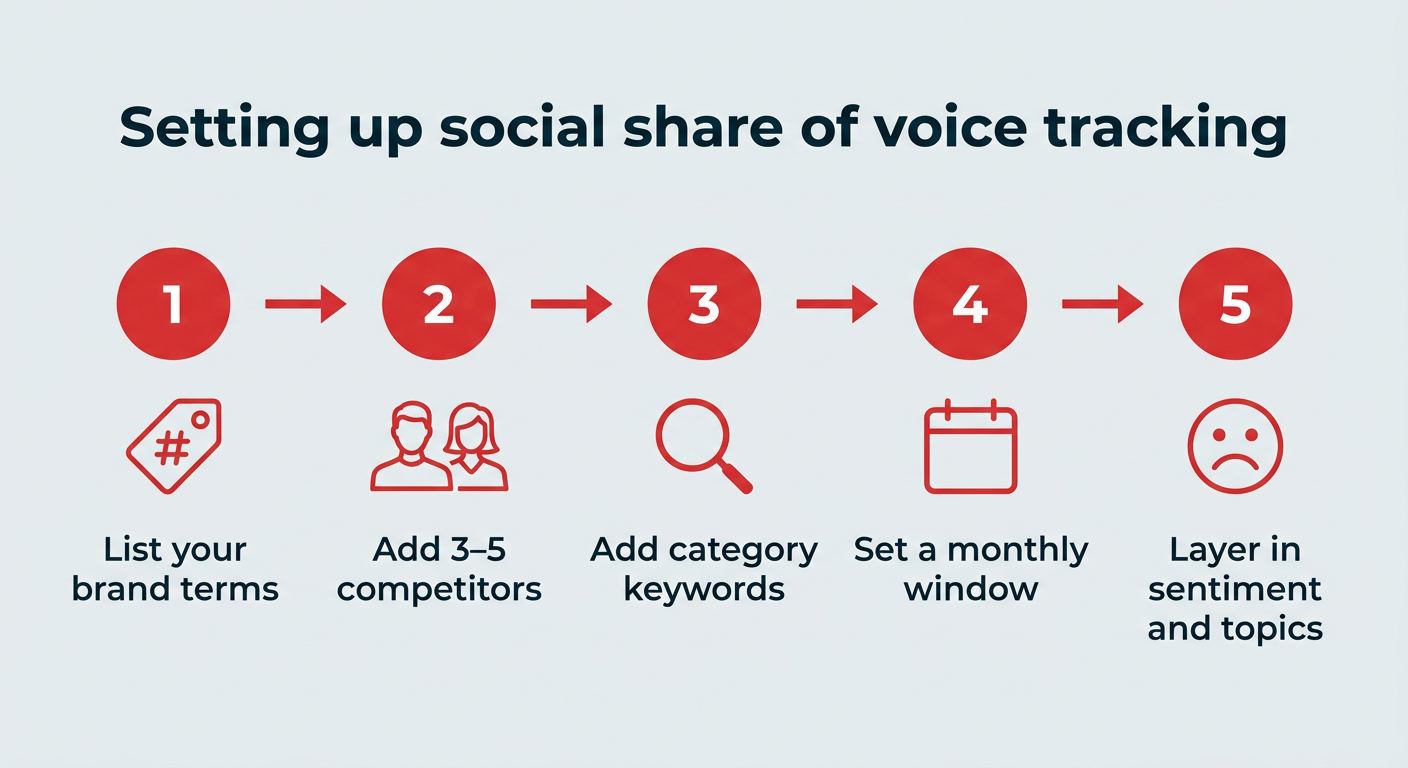
- Setup: Begin by compiling a comprehensive list of brand-specific terms (brand names, product names, hashtags) and similar terms for key competitors. Utilize social listening tools (e.g., Hootsuite’s listening tools) to track mentions across platforms like X (formerly Twitter), Facebook, Instagram, TikTok, and YouTube.
- Analysis: Segment data by location, demographics (gender, age, occupation) to uncover specific audience segments where your brand resonates or underperforms. Critically, overlay sentiment analysis to understand the emotional tone of mentions.
- Benefits: A high social SOV fosters community growth, enhances brand perception, boosts customer loyalty, and can drive website traffic and conversions.
SEO Share of Voice
SEO SOV measures a website’s visibility in organic search results for a defined set of keywords, weighted by search volume and click-through rate potential. It provides a more nuanced understanding of search performance than raw ranking positions.
- Methodology: Identify a core set of 100-300 commercially relevant keywords that buyers use before making purchase decisions, as well as those directly tied to your products/services. Employ SEO tools like Ahrefs’ Rank Tracker to monitor your website’s and competitors’ positions for these keywords. These tools often calculate a proprietary "visibility" score that approximates SOV.
- Interpretation: Focus on trend lines rather than daily fluctuations. A rising SEO SOV coupled with stagnant organic traffic might indicate issues with meta titles or descriptions that fail to entice clicks, rather than poor rankings.
- Benefits: Strong SEO SOV generates consistent organic traffic, establishes thought leadership, builds brand authority, and improves conversion rates through qualified leads.
PPC Share of Voice
For paid search, Google Ads refers to SOV as "impression share." This metric indicates the percentage of times your ad was displayed compared to the total number of eligible impressions for a given set of keywords.
- Measurement: Within your Google Ads account, navigate to Campaigns and add "Competitive metrics" columns. Key metrics to track include Search Impression Share, Search Lost Impression Share (Budget), and Search Lost Impression Share (Rank). These illuminate whether lost impressions are due to insufficient budget or a low Ad Rank.
- Insights: A 50% impression share means your ad appeared only half the time it could have. Understanding whether the other half was lost to budget constraints or a low ad rank dictates the appropriate optimization strategy.
- Benefits: Improving PPC SOV increases ad visibility, drives more targeted traffic, enhances lead generation, and supports overall brand recall.
Earned Media Share of Voice
Earned media SOV quantifies the number of times a brand is mentioned across news websites, blogs, and other editorial content, relative to its competitors.
- Tracking: Social listening platforms (like Lumen within Hootsuite Social OS) are often equipped to monitor mentions across news sites and blogs in addition to social media. Set up searches for your brand name and competitor names.
- Refinement: Weight mentions by publication reach and authority. A mention in a high-tier industry publication often carries more weight for a B2B brand than numerous mentions in smaller, aggregator blogs.
- Benefits: A strong earned media SOV builds brand credibility, enhances public relations efforts, boosts thought leadership, and can drive referral traffic.
Tools and Technologies for SOV Analysis

No single tool provides a universal SOV measurement across all channels, necessitating a multi-tool approach for comprehensive analysis.
- Social Listening Platforms: Tools like Hootsuite’s Lumen, Brandwatch, or Sprout Social are essential for tracking social media mentions, sentiment, and earned media coverage. They offer competitor benchmarking and detailed analytics.
- SEO Tools: Ahrefs, SEMrush, Moz, and Google Search Console provide robust capabilities for keyword tracking, organic visibility analysis, and competitive SEO SOV measurement.
- PPC Platforms: Google Ads (and similar platforms for other ad networks) natively provides impression share metrics, which serve as the PPC equivalent of SOV.
- Media Monitoring Services: Beyond social listening, specialized media monitoring tools (e.g., Cision, Meltwater) can offer deeper insights into traditional news and broadcast media mentions.
For teams with limited budgets, prioritizing social listening is often the most strategic starting point, as it covers the broadest range of public sources and uniquely offers sentiment analysis alongside volume, a crucial qualitative dimension missing from many other channel-specific SOV metrics.
Actionable Strategies to Amplify Your Brand’s Voice
Once SOV is accurately measured, the focus shifts to strategic growth. Several tactics consistently prove effective in expanding a brand’s digital presence and influence.

1. Maintain an Active and Consistent Presence:
Reliability builds recognition. Brands that consistently post engaging content on their social media channels are more likely to attract and retain audience attention. Developing a detailed social media content calendar helps plan for important dates and ensure a steady stream of diverse content. Posting at optimal times when the target audience is most active further maximizes reach and potential for interaction. Brands like Merriam-Webster on X demonstrate the power of consistent, timely, and relevant posting, transforming their presence into a go-to resource that users actively tag into conversations.
2. Spark Engaging Conversations:
Directly prompting dialogue is a swift route to increasing mentions and, consequently, social SOV. Taking a clear stance on a topic relevant to the audience can generate significant buzz, as seen with Nike’s partnership with Colin Kaepernick or Gillette’s #TheBestMenCanBe campaign. While such moves can be polarizing, they undeniably amplify voice. Less controversial, but equally effective, are campaigns like Bell’s "Let’s Talk," which consistently drives conversations around mental health. Simpler tactics like question posts, polls, and open calls for ideas can also outperform polished announcements in terms of reply volume, fostering genuine community engagement.
3. Create Highly Shareable Content:
Content designed for sharing inherently expands a brand’s reach and SOV. Three formats are particularly potent: short-form video (e.g., TikTok, Instagram Reels), visually compelling infographics and data visualizations, and interactive content (quizzes, polls, AR filters). Brands with a distinct, recognizable voice, such as Netflix’s regional accounts or No Name’s minimalist product posts, often see their content shared widely because it stands out even without explicit branding, turning individual posts into hundreds of mentions.
4. Responsive Customer Engagement:
Actively participating in conversations about your brand, especially by responding to customers, cultivates stronger relationships and positive sentiment. Prompt and empathetic responses, particularly those showing a human touch (e.g., customer service agents signing off with their names), can significantly boost customer satisfaction and loyalty, as evidenced by Harvard Business Review research on airline Twitter interactions. AI-assisted reply tools can enhance speed and consistency, ensuring that growing mention volume doesn’t lead to a backlog of unanswered queries.

5. Allocate Budget Strategically:
SOV data is a powerful guide for marketing spend. If SOV is low on one platform but high on another, it signals where sponsored content, influencer partnerships, or dedicated support resources are most needed. For example, a low SOV on X might warrant investing in a dedicated support profile rather than pouring ad spend into a channel where organic conversation is lacking. An informed social media strategy, rooted in SOV insights, ensures resources are directed to areas with the greatest potential for growth. It’s crucial to remember that not all conversations happen publicly; many occur in DMs or offline, highlighting the need to integrate SOV with other business metrics.
6. Invest in Employee Advocacy:
Employee advocacy is a powerful, often underestimated, lever for SOV growth. When employees share company content from their personal networks, it taps into audiences the brand’s official channels might not reach. Employees typically have 10x more connections than a company page, and content shared by a known individual often carries more credibility than corporate messaging. To build an effective program: curate relevant content for easy sharing, offer incentives, provide training on brand guidelines, and track engagement to demonstrate impact. Platforms like Parliament (an employee advocacy app) streamline this process, managing content distribution and reporting.
Broader Implications and Future Outlook
Share of voice is more than just a vanity metric; it is a strategic compass in the complex digital landscape. As consumer attention fragments across an ever-growing array of platforms, a brand’s ability to command a significant portion of relevant conversations becomes a crucial determinant of its market success. The insights derived from SOV analysis—from competitive intelligence to audience sentiment—empower businesses to make agile, data-driven decisions that impact everything from product development to customer service.

The continuous measurement of SOV, coupled with a nuanced understanding of its qualitative dimensions (e.g., sentiment and topic analysis), ensures that marketing efforts are not just loud, but also resonant and impactful. In an environment where digital presence equates to business relevance, mastering share of voice is fundamental to sustained growth and competitive advantage.
Hootsuite Social OS: A Unified Approach to SOV Management
Platforms like Hootsuite Social OS integrate SOV measurement with broader social media management workflows, enabling a seamless transition from insight to action. Features such as:
- Unified Listening: Monitor brand and competitor mentions across social media, news sites, and blogs from a single dashboard.
- Competitive Benchmarking: Easily compare your SOV against key rivals across various metrics and channels.
- Sentiment Analysis: Understand the emotional tone of conversations to refine messaging and engagement strategies.
- Content Scheduling & Publishing: Plan and execute content strategies designed to boost SOV.
- Employee Advocacy Integration: Facilitate employee sharing to amplify reach and credibility.
This integrated approach helps marketing teams not only track their brand’s slice of the conversation but actively work to expand it, ensuring that their voice is heard, understood, and ultimately, translates into tangible business outcomes.


 Ammar Sabilarrohman

 Sagoh