Nana
The transition from individual generative AI use to collective agentic workflows marks a pivotal shift in enterprise productivity, moving beyond simple chat interfaces toward autonomous systems that can execute complex, multi-step tasks across shared environments. While building a single AI agent has become relatively accessible through various large language model (LLM) providers, the true challenge for the modern enterprise lies in scalability—ensuring that these agents are available to entire teams, possess the correct permissions, and can integrate seamlessly with existing software stacks. Shared access, governance, and reusable workflows now determine whether an AI agent remains a novelty or becomes a mission-critical corporate asset.
As of early 2025, the market for AI agent collaboration platforms has bifurcated into two primary categories: ecosystem-native tools integrated into existing productivity suites like Microsoft 365 and Google Workspace, and specialized third-party platforms designed to orchestrate multi-agent systems. These platforms address a fundamental friction point in digital transformation: the "siloing" of AI capabilities. By providing a centralized environment for agent management, organizations can avoid the redundancy of team members building identical configurations from scratch, instead favoring a "build once, deploy to many" architecture.
The Rise of Agentic AI: From Chatbots to Digital Coworkers
The evolution of artificial intelligence in the workplace has progressed through three distinct phases. The first phase, beginning in late 2022, was characterized by "Isolated Chat," where individual employees used tools like ChatGPT or Claude for disparate tasks such as drafting emails or summarizing text. The second phase introduced "Retrieval-Augmented Generation" (RAG), allowing AI to access specific company documents. We have now entered the third phase: "Agentic Collaboration." In this stage, AI agents are no longer just answering questions; they are performing actions, using tools, and collaborating with both humans and other agents.
Industry data suggests that the demand for these platforms is surging. According to recent market analysis, the global autonomous AI agent market is projected to grow at a compound annual growth rate (CAGR) of over 30% through 2030. Gartner recently predicted that by 2026, at least 40% of enterprise applications will have embedded conversational AI, up from less than 5% in 2023. This growth is driven by the need for "Human-in-the-Loop" (HITL) systems where AI handles the cognitive heavy lifting while humans provide the strategic oversight and final approval.
1. Microsoft Copilot Studio: The Enterprise Standard for Ecosystem Integration
Microsoft Copilot Studio represents the most significant push toward democratizing agent creation within the corporate world. By allowing users to configure an agent’s instructions, knowledge base, and toolset, and then publish it directly to Microsoft Teams, the platform leverages an existing user base of over 300 million monthly active users.
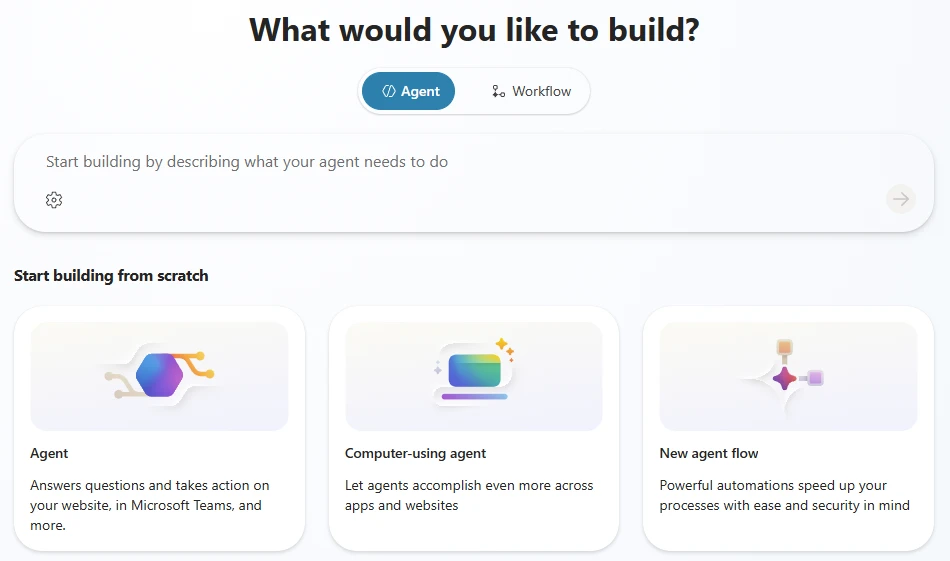
The architecture of Copilot Studio is built on the concept of "Child Agents" and "Connected Agents." This allows for a hierarchical design where a "Master Agent" can delegate specific tasks to specialized sub-agents. For example, a procurement agent might delegate "vendor research" to one sub-agent and "contract analysis" to another. However, the complexity of this ecosystem requires rigorous administrative oversight. Organizations must navigate tenant approval requirements and licensing tiers, as a functional preview created by a developer does not automatically grant access to the broader workforce.
Strategic Implication: Copilot Studio is best suited for organizations already deeply entrenched in the Microsoft 365 ecosystem, offering a "walled garden" approach that prioritizes security and seamless integration with Excel, Outlook, and SharePoint.
2. Google Workspace Studio: Automating the Productivity Suite
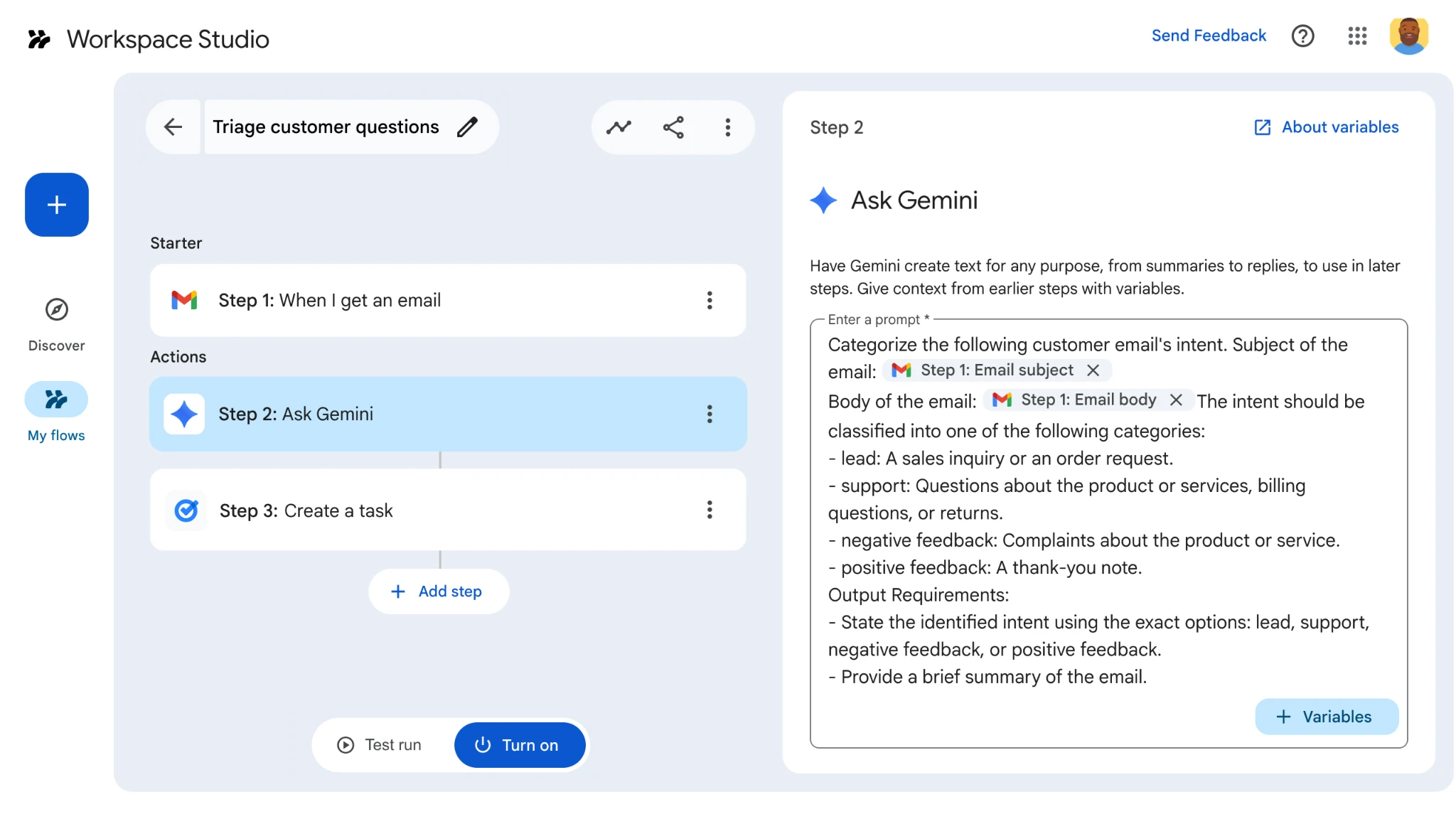
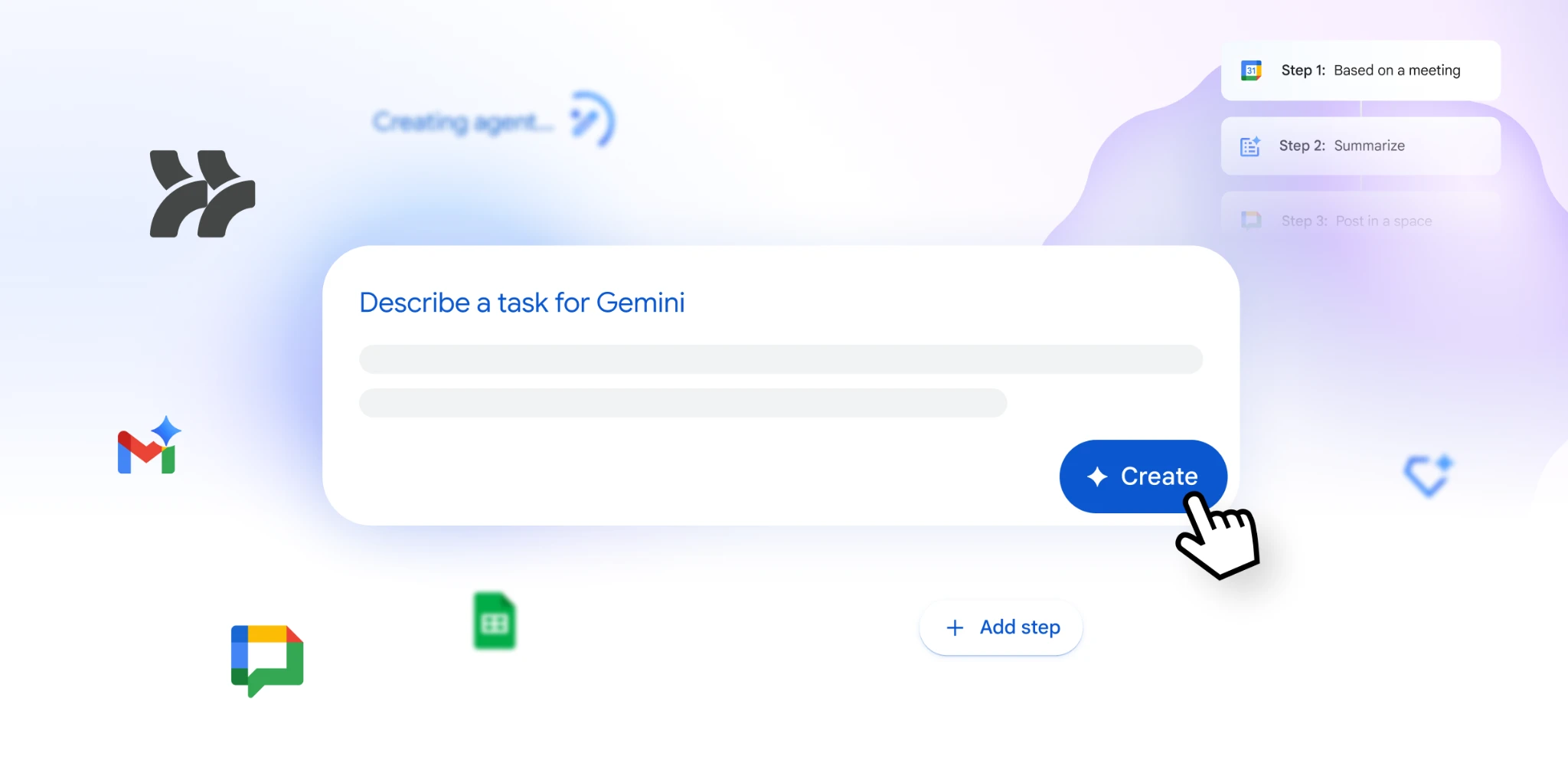
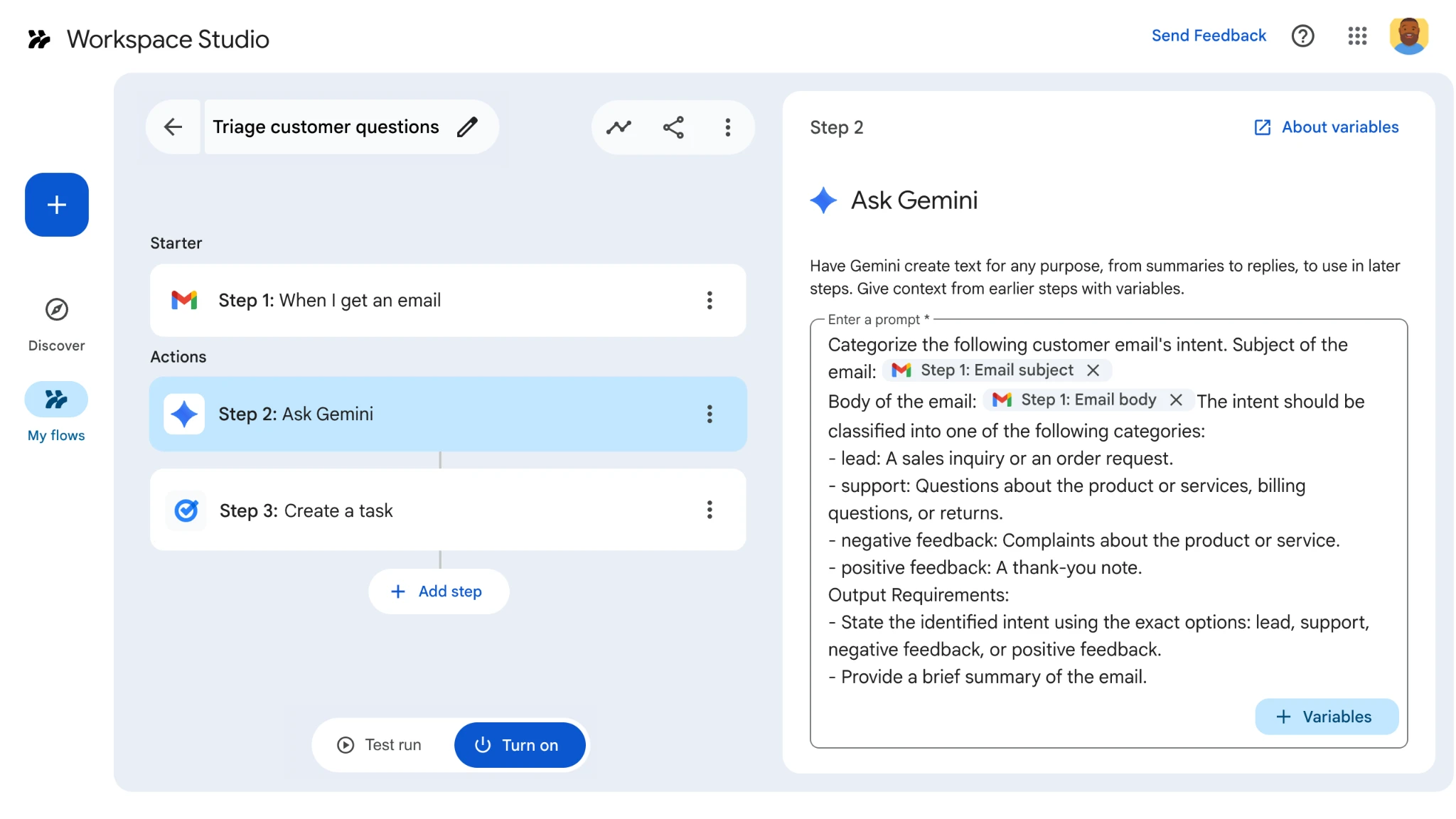
Google’s response to the agentic shift is Workspace Studio, a platform designed to build automated flows across Gmail, Google Chat, Drive, and Docs. Unlike Microsoft’s focus on conversational agents, Google’s approach leans heavily into "scheduled flows." A typical use case involves an agent that monitors unread emails in a specific Gmail folder, summarizes them using the Gemini 1.5 Pro model, and delivers a daily digest to a shared Google Chat room.
A unique characteristic of Workspace Studio is its "Recipe Distribution" model. When a flow is shared within a team, it creates independent copies for each user. While this ensures that colleagues do not inherit the original creator’s run history or private file access, it means that the "context" is not shared across the team. Each user operates their own version of the automation, making it ideal for standardized processes rather than collaborative, evolving research.
Strategic Implication: Workspace Studio is the premier choice for teams looking to automate recurring, high-volume administrative work within the Google environment, particularly for those who prefer natural-language instruction over traditional "if-this-then-that" (IFTTT) logic.
3. Taskade: Merging Project Management with Multi-Agent Orchestration
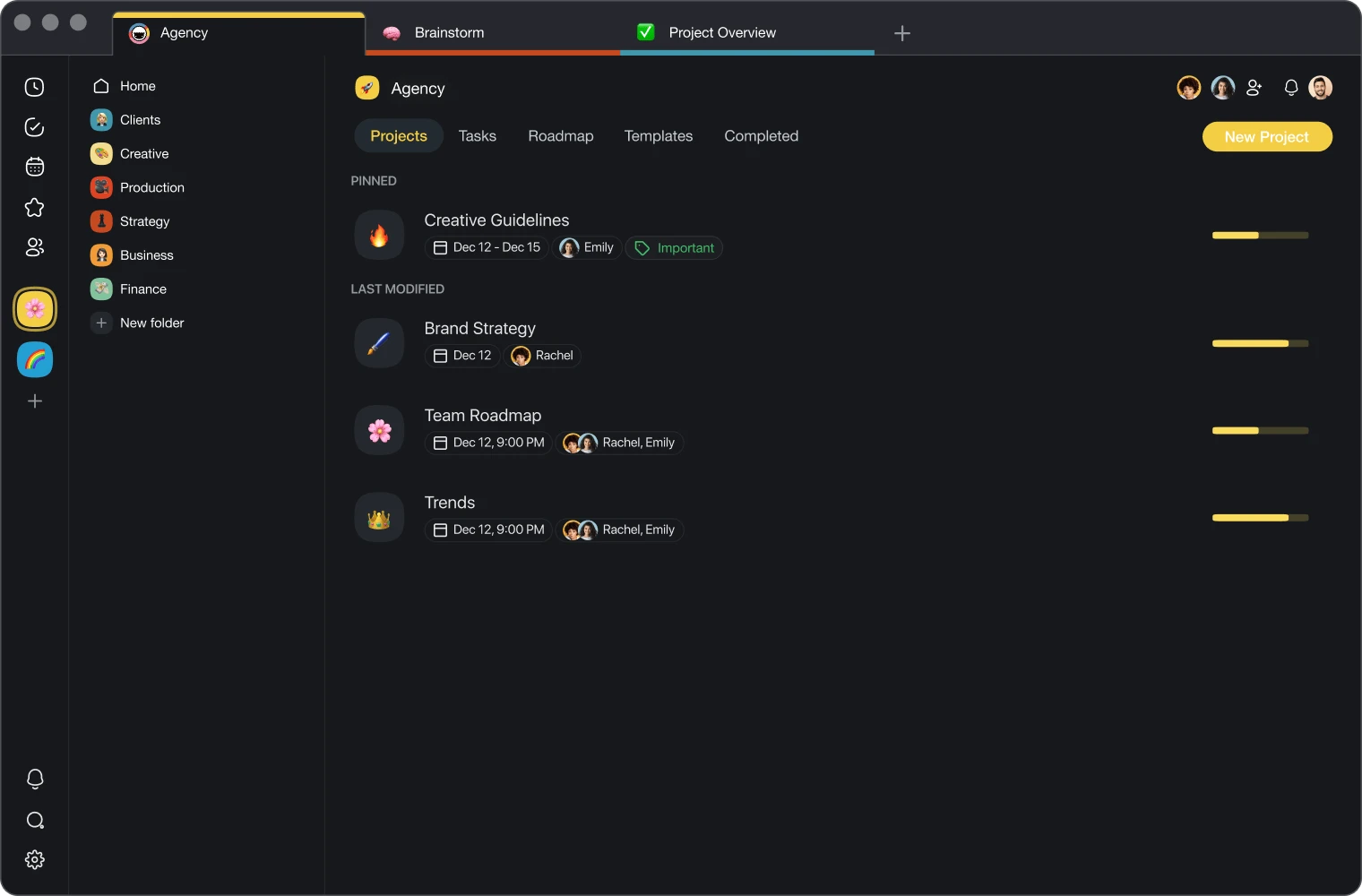
Taskade has carved out a niche by blending traditional project management—tasks, folders, and mind maps—with an "AI Teams" feature. This platform allows a user to route a single request to an entire "orchestrated team" of agents simultaneously. For instance, a marketing lead could submit a product brief, and Taskade’s AI Team would automatically trigger a "SEO Agent," a "Copywriter Agent," and a "Social Media Strategist Agent" to work on the task in parallel.
The platform’s "Ask Agent Team" automation step is a significant advancement in workflow design, as it brings agent collaboration into recurring project cycles. However, this level of sophistication comes with a "token cost" management challenge. Because each responding agent consumes credits, organizations must be judicious in how they deploy multi-agent calls to avoid unnecessary overhead for simple queries.
Strategic Implication: Taskade is best for creative and project-based teams that require a blend of human task tracking and simultaneous multi-agent output.
4. Oasis: The Virtual War Room for Human-Agent Synergy
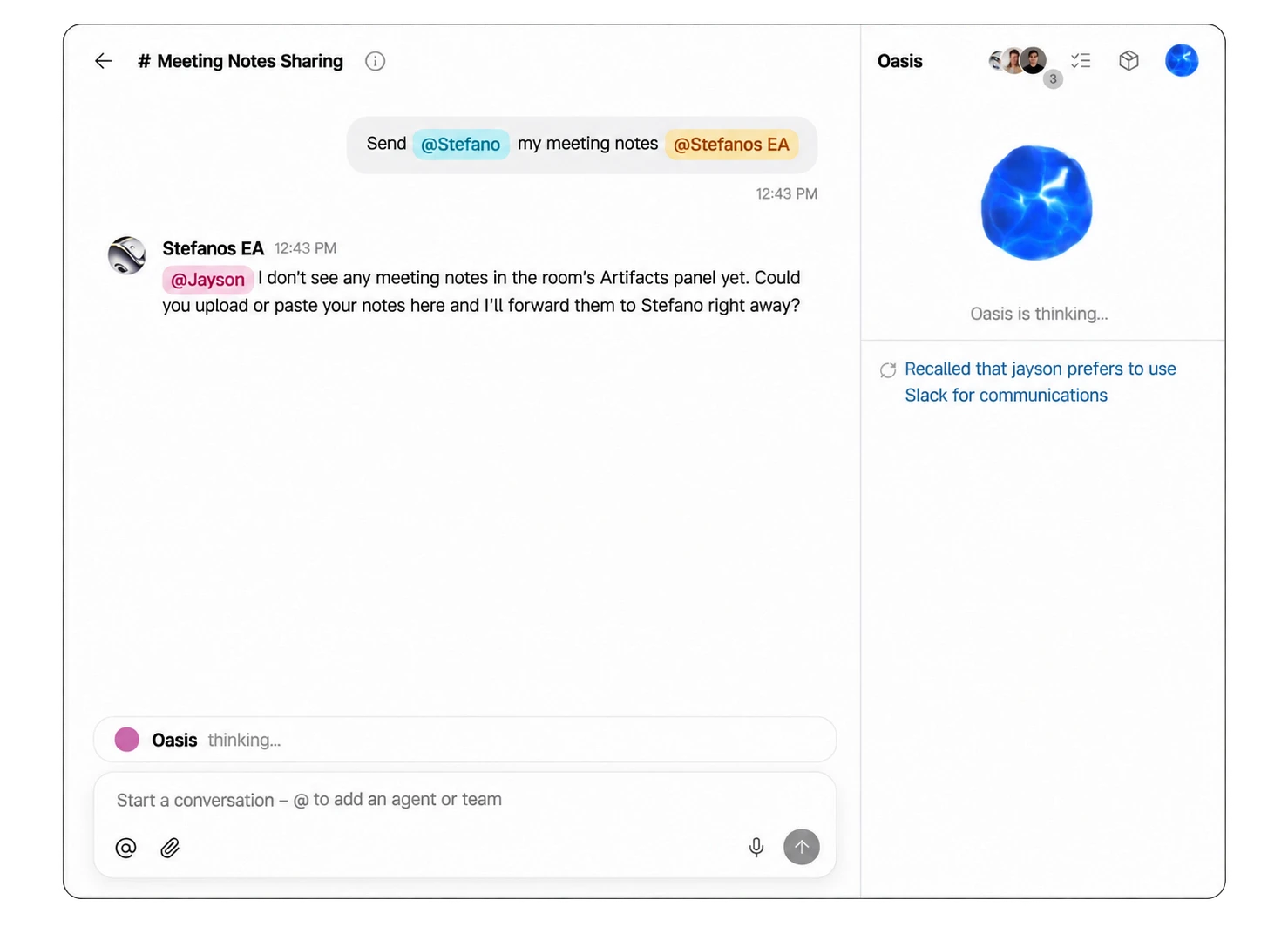
Oasis takes a different philosophical approach by placing people and agents in shared "rooms." This mimics the experience of a digital war room where colleagues can discuss a task in real-time while directing agents to perform sub-tasks within the same chat thread. This ensures that the context of the conversation, the source data, and the agent’s work are all preserved in a single location.
For a research-heavy team, Oasis allows for a handoff culture. A human researcher might find a source, hand it to a "Summarizer Agent," and then have a "Fact-Checker Agent" verify the summary, all while other team members observe and intervene as needed. This transparency is critical for high-stakes industries like legal or financial services where "black box" AI operations are a liability.
Strategic Implication: Oasis is the optimal choice for teams that prioritize transparency and need a shared workspace where humans and AI agents can collaborate in a conversational, iterative manner.
5. Dust: Scaling Internal Knowledge through Custom Agents
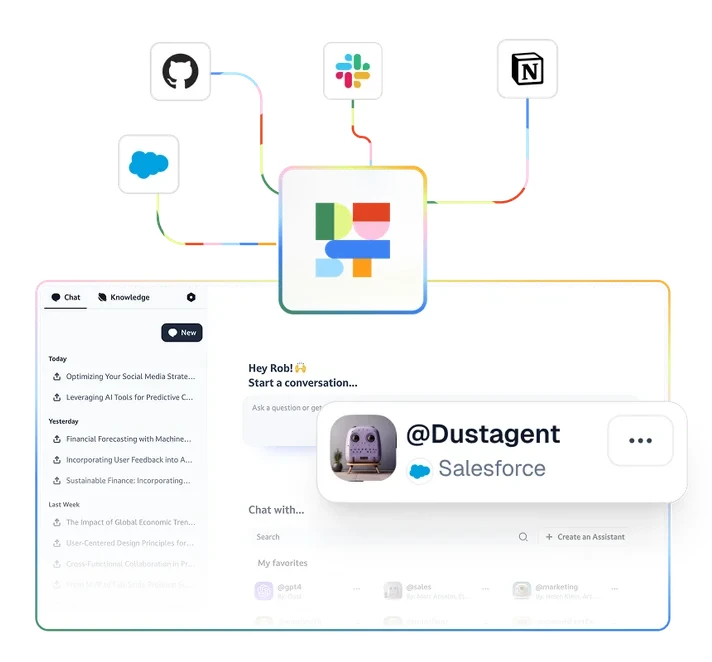
Dust focuses on the "Knowledge Management" problem. Many enterprises struggle with internal data fragmentation across Slack, Notion, and GitHub. Dust allows teams to build agents that are "grounded" in these specific data sources. A support agent, for example, can be trained exclusively on a company’s internal technical documentation, providing a reliable single source of truth for the customer success team.
The platform emphasizes administrator control, allowing leaders to manage which agents have access to which data silos. The primary challenge with Dust—and any RAG-based system—is data hygiene. As industry experts often note, "connecting stale material won’t make it current." Therefore, the success of a Dust deployment depends as much on human documentation maintenance as it does on the AI’s reasoning capabilities.
Strategic Implication: Dust is best for knowledge-intensive organizations that need to turn their internal wikis and communication logs into an actionable, queryable resource for the entire team.
6. Lindy: The "AI Employee" for Business Operations
Lindy positions its agents as "AI Employees" rather than just tools. The platform is designed to handle the "connective tissue" of business operations—following up on emails, managing calendar invites, and coordinating across different SaaS apps. Lindy’s strength lies in its ability to handle recurring coordination work without requiring the user to design a specialist agent for every minute step.
Unlike platforms that focus on complex reasoning, Lindy is built for action. It supports a wide array of integrations and allows for "approval behaviors," where the agent drafts an action (like an email) but waits for a human click before sending. This mitigates the risk of "hallucinated actions" that could damage professional relationships.
Strategic Implication: Lindy is ideal for operational teams and executives who need an autonomous assistant to handle high-frequency, low-complexity coordination tasks across multiple apps.
7. Relevance AI: Building the "AI Workforce" with Explicit Handoffs
Relevance AI is perhaps the most advanced in terms of "Workforce Building." It allows for the creation of highly specialized agents with defined roles and, crucially, "mandatory handoffs." In a sales operations workflow, Relevance AI can be configured so that a "Lead Generation Agent" must pass its findings to a "Research Agent," which then must pass a completed brief to a "Human Sales Rep."
The platform allows for both linear and non-linear workflows. The AI can be empowered to select the "next best step" based on the results of the previous action, or it can be forced to follow a strict, auditable path. This level of granularity is essential for scaling complex business processes where consistency is more important than creative flair.
Strategic Implication: Relevance AI is the platform of choice for operations-heavy teams that need to build "digital assembly lines" with strict rules and specialized roles.
Chronology of the Agentic Shift
The timeline of this technology’s development highlights how rapidly the landscape is shifting:
- Q4 2022 – Q2 2023: The "Chatbot Era." Focus on LLM performance (GPT-4 release). Companies experiment with individual accounts.
- Q3 2023 – Q1 2024: The "Integration Era." API access becomes standard. Early versions of Copilot Studio and specialized tools like Dust emerge to connect AI to company data.
- Q2 2024 – Present: The "Agentic Era." Shift from passive chat to active agents. Release of "Agentic Frameworks" (AutoGPT, CrewAI) leads to the development of the user-friendly collaboration platforms discussed in this report.
Official Responses and Market Analysis
Tech leaders have been vocal about the necessity of this shift. Satya Nadella, CEO of Microsoft, recently emphasized that "AI is not just about a new interface; it’s about a new reasoning engine that can act on your behalf." Similarly, Google’s leadership has pivoted "Workspace" to "Workspace Labs" and now "Studio" to reflect a focus on "proactive intelligence."
However, the rapid deployment of these agents has sparked concerns regarding "Shadow AI"—the use of AI tools without IT department approval. Analysts from Forrester Research suggest that without centralized collaboration platforms, organizations risk "agent sprawl," where hundreds of unmonitored agents perform redundant or insecure tasks, leading to skyrocketing API costs and potential data leaks.
Analysis of Implications: The Future of Knowledge Work
The deployment of AI agent collaboration platforms is fundamentally altering the unit economics of knowledge work. By transforming a "task" into a "reusable workflow," companies are shifting from a labor-based model to an asset-based model. In the past, if a team member left, their "process" often left with them. With these platforms, the "agentic workflow" remains a company asset that can be refined and scaled indefinitely.
Furthermore, we are seeing the emergence of "Multi-Agent Systems" (MAS) as the next frontier. In this model, agents don’t just work for humans; they work for each other. This will likely lead to a "Manager of Agents" role becoming a standard position in the corporate hierarchy, where a human’s primary value is not in doing the work, but in auditing the outputs and optimizing the interactions between various AI entities.
Ultimately, the choice of platform depends on the organization’s existing infrastructure and the specific nature of their work. For those in the Microsoft or Google ecosystems, the native tools provide a path of least resistance. For teams requiring specialized, high-transparency collaboration or complex "digital assembly lines," third-party platforms like Oasis or Relevance AI offer a glimpse into the future of the autonomous enterprise. Regardless of the choice, the message is clear: the era of the solo AI user is ending, and the era of the agentic team has begun.

 Nana Wu
 Ammar Sabilarrohman