


The transition from running isolated A/B tests to managing a high-velocity experimentation program represents a critical inflection point for modern digital enterprises. While a handful of quarterly experiments on high-impact pages can yield measurable gains with minimal tooling, the limitations of this linear approach become apparent as an organization scales. As product lines expand and marketing campaigns diversify, the complexity of testing increases exponentially. Without a robust framework for scaling, businesses often encounter fragmented traffic, elongated implementation queues, and conflicting data signals that stall growth rather than accelerate it.
To achieve sustainable growth, experimentation must evolve from a tactical team activity into a foundational infrastructure. This shift requires a sophisticated blend of statistical governance, centralized management, and technological integration. This report examines the systems and processes necessary to scale A/B testing effectively, ensuring that increased testing volume does not compromise the reliability of data or the speed of decision-making.
The Economic and Operational Imperative for Scaling
Scaling A/B testing shifts the practice from a series of “one-off” wins to a comprehensive growth engine. In a mature ecosystem, decision-making is backed by evidence generated at the pace of the business, moving away from subjective opinions toward data-driven certainty.
1. Compounding Full-Funnel Conversions
At the enterprise level, teams no longer wait for a single test to conclude before initiating the next. By running simultaneous experiments across various touchpoints—including call-to-actions (CTAs), user layouts, checkout flows, and onboarding sequences—improvements begin to compound. This simultaneous execution ensures that revenue impact is realized across the entire funnel rather than being restricted to isolated pages.
2. Compression of Learning Cycles
The ability to test multiple hypotheses concurrently significantly reduces the cost of failed assumptions. Winning ideas are validated and deployed rapidly, while ineffective concepts are discarded before they consume additional resources. This efficiency allows organizations to operate with a higher degree of agility, responding to market shifts with validated strategies.

3. Precision Through Segmentation
As audience diversity grows, aggregate data often masks underlying truths. Mature programs utilize advanced segmentation to understand how specific user cohorts respond to different experiences. For instance, a pricing change might yield a positive average conversion rate but significantly alienate returning power users. Segmentation ensures these nuances are visible, allowing for a more personalized and effective user experience.
4. Mitigation of Deployment Risk
The evolution of A/B testing into feature experimentation allows for progressive rollouts. By testing new features on controlled traffic segments before a full-scale release, engineering and product teams can mitigate the risk of technical failures or negative user reactions, maintaining high confidence in business outcomes.
Identifying the Bottlenecks: Signs of Ineffective Scaling
Before an organization can scale, it must recognize the symptoms of a program that is struggling under its own weight. Identifying these “scaling pains” is the first step toward building a more resilient framework.

- Statistical Stagnation: Tests frequently run for extended periods without reaching statistical significance. This is often a symptom of fragmented traffic caused by too many overlapping experiments.
- The Deployment Queue Crisis: A common operational bottleneck occurs when winning variations remain stuck in a three-week deployment queue. This indicates a failure in release coordination rather than a failure of the experimentation itself.
- Data Reconciliation Issues: When a testing platform reports a significant lift but the primary analytics tool (such as GA4) shows no change, trust in the experimentation program erodes, slowing down the velocity of all future tests.
- Hypothesis Decay: As the volume of tests increases, the quality of ideas may drop. Without a centralized repository, teams often end up re-testing previously invalidated hypotheses or focusing on marginal UI changes that offer low signal and minimal business impact.
A Phased Approach to Scaling Experimentation
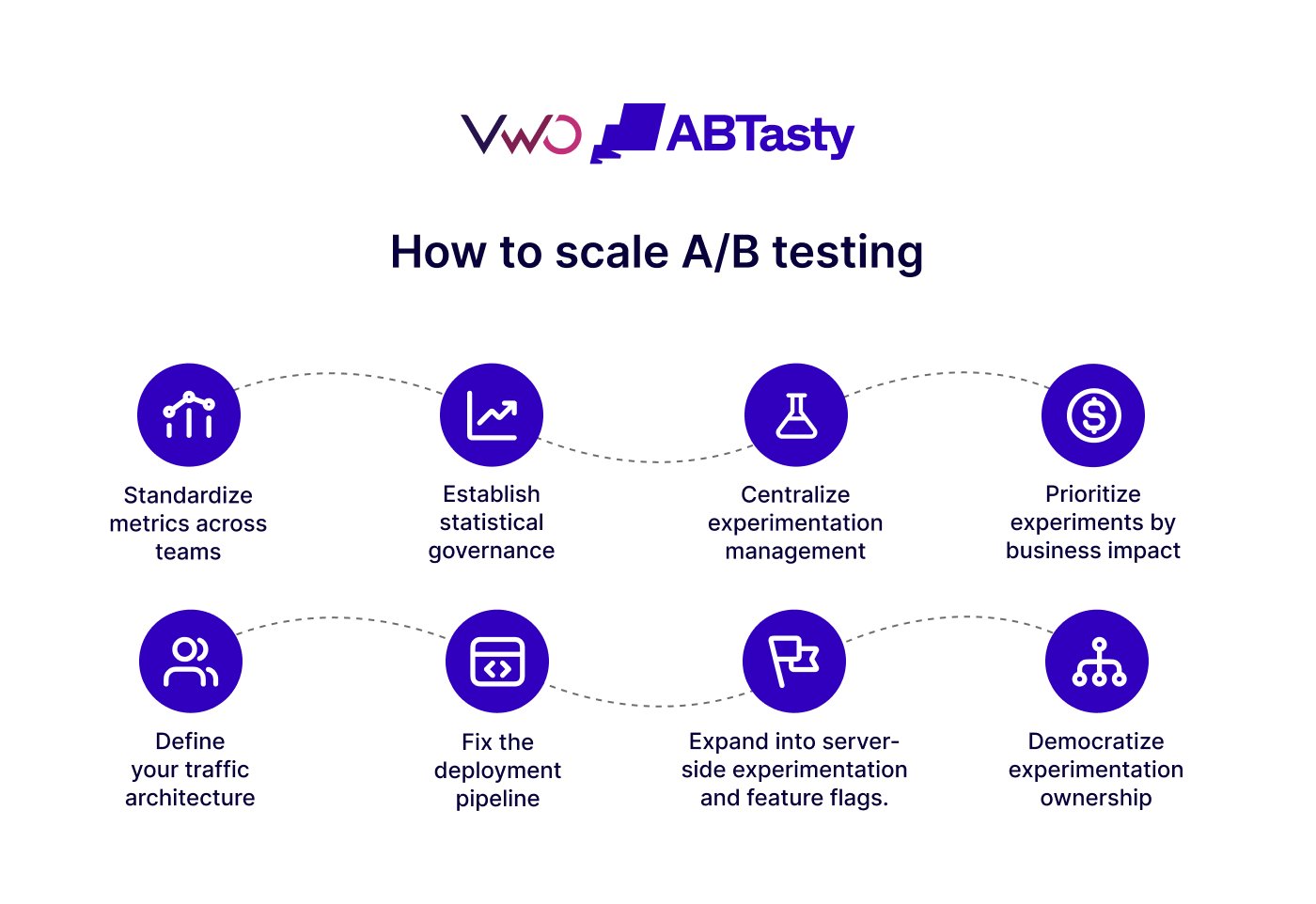
Scaling is an infrastructure and governance challenge. Successful organizations follow a structured methodology to ensure their testing framework remains robust as it grows.
Step 1: Standardization of Metrics and Definitions
Consistency is the bedrock of scale. Organizations must establish universal definitions for conversion rates, activation, and retention across all departments. This includes defining “guardrail metrics”—indicators that ensure a win in one area does not cause a loss elsewhere. For example, an experiment that increases sign-ups but causes a spike in customer support tickets may not be a true success.
Step 2: Statistical Governance
Embedding statistical controls into the workflow is essential to prevent the accumulation of false positives. This includes pre-launch sample size calculations, fixed end dates, and “Sample Ratio Mismatch” (SRM) checks. These controls should be automated within the experimentation platform to remove the risk of manual error by individual analysts.
Step 3: Centralization of Knowledge
A centralized hypothesis repository and a shared log of results ensure that institutional knowledge is preserved. As teams change and grow, this repository prevents the duplication of effort and allows new team members to build upon previous learnings.
Step 4: Impact-Based Prioritization
Not all experiments are created equal. Using frameworks like ICE (Impact, Confidence, Ease) or PIE (Potential, Importance, Ease) allows teams to rank tests based on their potential business value. According to Antonia Grzelak, Manager of Growth & Innovation at FUNKE Works, the goal is to identify “low-hanging fruit”—high-leverage changes that require low effort—and work upward from there.
Step 5: Advanced Traffic Architecture
As concurrency increases, the risk of experiment contamination grows. Organizations must define rules for “mutually exclusive groups,” ensuring that a user assigned to one experiment is not simultaneously exposed to another that could skew the results. This layered architecture allows for high concurrency without compromising data integrity.

Technological Enablers: Server-Side Testing and AI
To move beyond simple UI changes, businesses must invest in server-side experimentation and feature flags. While client-side testing is suitable for front-end modifications, server-side capabilities are required for testing pricing logic, recommendation algorithms, and backend architecture.
Furthermore, the integration of Artificial Intelligence is becoming a force multiplier for experimentation programs. AI-assisted tools can analyze vast quantities of behavioral data to identify friction points, automate the creation of variations, and assist in complex audience targeting. This reduces the manual overhead that typically limits the growth of a testing program.
Case Studies in Successful Scaling
AURUM: Optimizing the Onboarding Pathway
Legal technology firm AURUM utilized VWO Feature Experimentation to address a 10-day trial abandonment issue. By testing guided onboarding flows and backend-enabled data access, the company achieved a 4x increase in trial activation. This success demonstrated the power of embedding experimentation directly into the product development lifecycle.

Eastpak: Multi-Regional Synchronization
Global brand Eastpak faced the challenge of scaling tests across 12 European websites in eight languages. By centralizing their experimentation and utilizing web rollouts that did not require developer intervention, they improved filter interactions by 106% and checkout click-through rates by 14%. The program transformed experimentation from an outsourced activity into a core operational workflow.
Hubstaff: Validating Major Redesigns
Workforce management platform Hubstaff moved from minor UI tweaks to high-stakes homepage redesigns. By using split URL testing and behavioral heatmaps, they validated a new design that resulted in a 49% increase in visitor-to-trial conversions. This case highlights the importance of using experimentation to de-risk major strategic shifts.
Meliá Hotels: Risk Mitigation via Feature Flags
Meliá Hotels International sought to introduce an additional booking step for add-on services. To avoid the risk of increased drop-offs, they used feature flags to roll out the change progressively, starting with 5% of traffic. The result was a 1.85% uplift in revenue per visitor without any increase in funnel abandonment.

Measuring Success at Scale: Program and Business Metrics
To maintain leadership support, experimentation programs must track metrics that reflect both operational efficiency and commercial impact.
Program-Level Metrics
- Experiment Velocity: The total number of tests started and completed per period.
- Win Rate: The percentage of experiments that yield a statistically significant positive result.
- Implementation Rate: The percentage of winning variations that are actually deployed to the live environment.
Business and Revenue Metrics
- Average Order Value (AOV) and Revenue Per Visitor (RPV): Direct measures of commercial success.
- Customer Lifetime Value (CLV): Ensuring that short-term gains do not negatively impact long-term retention.
- North Star Alignment: Connecting every test back to the company’s primary growth indicator, such as recurring revenue or qualified pipeline.
Conclusion: The Path Forward
Scaling A/B testing is fundamentally a challenge of infrastructure and governance. Organizations that invest in traffic architecture, standardized statistical rules, and decentralized ownership are positioned to build a compounding growth engine. Those that attempt to scale without these systems often find themselves overwhelmed by noise and operational bottlenecks.
As the digital landscape becomes increasingly competitive, the ability to rapidly validate ideas through scaled experimentation will be a primary differentiator for market leaders. By shifting from a tactical mindset to an infrastructure-first approach, businesses can ensure that every decision—from the smallest UI tweak to the most complex backend change—is rooted in empirical evidence.







