Siti Muinah

The landscape of the American affiliate marketing industry experienced a seismic shift during the third week of January 2026, as two of the world’s leading affiliate networks, Rakuten Advertising and impact.com, took unprecedented disciplinary action against PayPal Honey. The browser extension and shopping tool, which was acquired by PayPal in 2020 for approximately $4 billion, has been removed or suspended from these platforms following high-profile investigations into its operational methods. The move marks one of the most significant enforcement actions against a major "super-affiliate" in the history of the digital marketing industry, raising urgent questions regarding attribution integrity and the technical compliance of browser-based shopping tools.
Chronology of the Removal and Network Statements
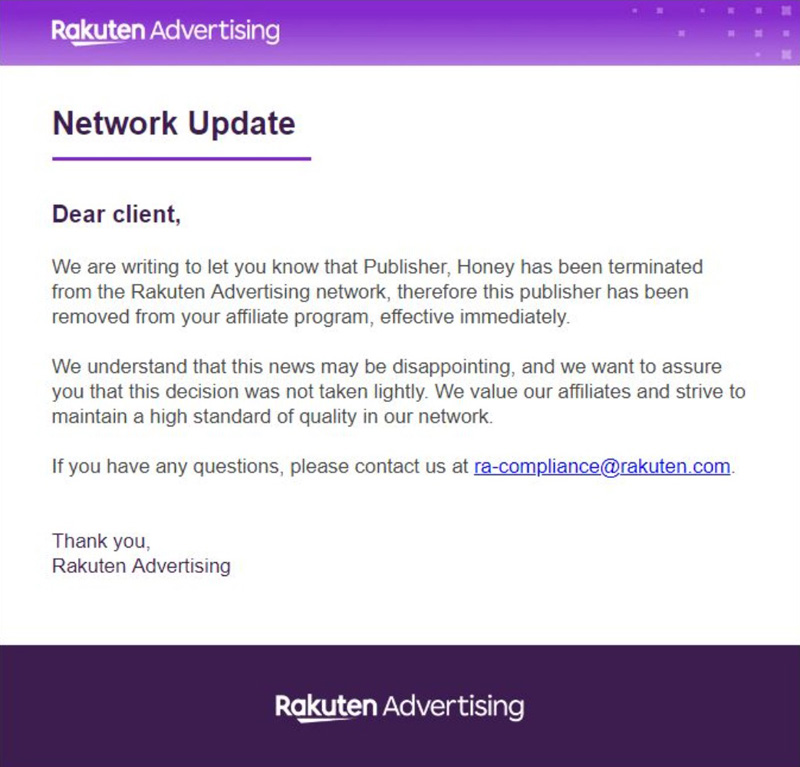
The sequence of events began on Monday, January 12, 2026, coinciding with the commencement of Affiliate Summit West, the largest affiliate marketing conference in the United States. Rakuten Advertising issued a formal announcement stating that PayPal Honey had been "terminated from the network." In its communication to advertisers and partners, Rakuten framed the decision as a necessary measure to "maintain a high standard of quality" within its ecosystem. While the initial statement was concise, industry insiders noted the timing of the announcement served as a powerful signal to the thousands of marketing professionals gathered in Las Vegas for the annual summit.
The situation escalated on Friday, January 16, 2026, when impact.com followed suit. The platform notified its users that PayPal Honey was found to be "out of compliance" with established platform policies. Unlike Rakuten’s outright termination, impact.com categorized its action as a removal from its "Discovery Marketplace" and a suspension of the publisher’s ability to join new programs. David A. Yovanno, CEO of impact.com, addressed the situation by explicitly citing "attribution manipulation" as the primary driver behind the suspension. Yovanno emphasized that the behavior in question undermined the fundamental trust required for a healthy partnership economy.
The Investigations: MegaLag and Ben Edelman
The regulatory actions taken by the networks did not occur in a vacuum. They were preceded by two significant external investigations that brought PayPal Honey’s technical practices under intense scrutiny. The first was a detailed video exposé by the investigative content creator known as MegaLag, whose research often focuses on digital transparency and corporate accountability. The video provided visual evidence of how the Honey browser extension interacted with e-commerce checkout processes, allegedly triggering affiliate cookies in ways that bypassed traditional user-intent requirements.
Complementing this visual evidence was a technical investigation by Ben Edelman, a well-known expert in web transparency and a pioneer in detecting "parasitic" affiliate behavior. Edelman’s research focused on "stand-down" rule violations. In the affiliate industry, stand-down rules are contractual obligations requiring browser extensions to remain inactive if a user has already reached a merchant’s site via another affiliate’s link. Edelman’s findings suggested that PayPal Honey had developed sophisticated methods to detect when it was being monitored by "test bots," allowing it to show compliant behavior to auditors while continuing non-compliant activity for genuine users. This "cloaking" of behavior is considered a severe violation of network terms of service.

Understanding the Technical Violation: Attribution Manipulation
To understand the gravity of these removals, it is necessary to examine the "last-click" attribution model that dominates the affiliate marketing industry. In this model, the last affiliate to "touch" or refer the customer before a purchase is completed receives 100% of the commission. This creates a high-stakes environment where some software-based affiliates attempt to "inject" their cookie at the final second of the checkout process, effectively stealing credit from content creators, influencers, or search affiliates who did the actual work of introducing the customer to the brand.
PayPal Honey was specifically accused of violating "stand-down" protocols. These protocols are designed to ensure that if a customer is already using a coupon from another source or was referred by a blog review, the browser extension must not fire its own affiliate link. By allegedly overwriting these existing cookies—a practice often called "cookie stuffing" or "link hijacking"—Honey could claim commissions on sales it did not legitimately influence. The use of concealment techniques to hide these violations from network compliance teams further exacerbated the breach of trust, leading to the swift removals seen in January 2026.
Broader Implications for the Partnership Economy
The removal of a $4 billion entity from major networks sends a clear message to the broader tech industry: no publisher is "too big to fail" when it comes to compliance. For years, the affiliate industry has struggled with the perception that browser extensions provide "low-value" or "cannibalistic" traffic. Critics argue that these tools often intercept customers who were already prepared to purchase, merely providing a discount that reduces the merchant’s margin while adding a commission cost on top.
However, the specific allegations against PayPal Honey move beyond the debate over "value" and into the realm of "integrity." Attribution manipulation doesn’t just cost merchants money; it demoralizes the "top-of-funnel" affiliates—the bloggers, YouTubers, and review sites—who find their commissions consistently diverted to software tools. This creates a "bad apple" effect where high-quality creators exit the industry because they cannot compete with automated tools that manipulate the attribution sequence.
Analysis of Merchant Risks and the Need for Internal Policing
While the actions of Rakuten and impact.com have been praised by many in the industry, experts at agencies like AM Navigator suggest that merchants cannot rely solely on networks for protection. Network compliance teams are responsible for enforcing network-level rules, but individual brands have unique Terms and Conditions (Ts & Cs) that require localized enforcement.
The Honey case highlights several critical lessons for affiliate program managers:
- Contractual Clarity: Program agreements must explicitly define what constitutes a "stand-down" violation and forbid the use of any technology that conceals affiliate activity from auditors.
- Active Monitoring: Automated tools and manual audits are required to verify that browser extensions are behaving as promised. The fact that Honey’s alleged violations persisted for an extended period suggests that many brands were unaware of the leakage in their marketing budgets.
- Individual Evaluation: Industry analysts caution against "blanket bans." While Honey has been penalized, not all browser extensions or shopping tools engage in attribution manipulation. Some provide genuine incremental value through "closed user groups" or unique loyalty rewards.
Strategic Diversification: Moving Beyond Super-Affiliates
One of the most significant takeaways from the PayPal Honey controversy is the danger of over-reliance on a small number of high-volume affiliates. Data suggests that many affiliate programs see upwards of 50% of their revenue generated by just one or two software-based publishers. When those publishers are removed for non-compliance, the resulting revenue "cliff" can be devastating for a marketing department’s KPIs.
To mitigate this risk, industry leaders are advocating for a diversification strategy that spans at least 28 different types of affiliate partnerships. These include:
- Content-Based Partners: Bloggers, mass media publishers, and podcasters who build brand awareness.
- Niche Influencers: Social media creators who drive high-intent traffic.
- Incentive Partners: Loyalty programs, charities, and card-linked offer platforms.
- Technical Partners: Retargeting solutions, cart-abandonment tools, and post-checkout platforms.
By spreading recruitment efforts across these varied categories, merchants can build a more resilient ecosystem that is not dependent on the survival or compliance of a single "super-publisher."
Future Outlook for PayPal Honey and the Industry
As of late January 2026, the future of PayPal Honey within the traditional affiliate space remains uncertain. While the suspension on impact.com is currently labeled as temporary, the "termination" from Rakuten suggests a much longer road to reinstatement. PayPal has yet to release a comprehensive technical rebuttal to the findings presented by Edelman and MegaLag, though the company is expected to conduct an internal review of its engineering practices to address the compliance gaps.
This incident is likely to trigger a wave of audits across the industry. Merchants are expected to demand greater transparency from all Downloadable Software Publishers (DSPs). Organizations like the Performance Marketing Association (PMA) and the Affiliate & Partner Marketing Association (APMA) have already begun releasing updated guidelines and independent audits to help standardize "stand-down" rules and "soft-click" technologies.
Ultimately, the PayPal Honey removal serves as a landmark case in the professionalization of affiliate marketing. It underscores a shift toward a "quality over quantity" mindset, where the technical methods used to generate a sale are scrutinized as heavily as the volume of the sales themselves. For the partnership economy to thrive, the industry must ensure that the last click is a fair click, earned through genuine influence rather than technical manipulation.


 Lina Hope

 Pevita Pearce