admin
admin
The affiliate marketing industry has been sent into a state of significant upheaval following the sudden removal and suspension of PayPal Honey from two of the world’s most prominent affiliate networks, Rakuten Advertising and impact.com. The actions, which took place during the second week of January, follow a series of high-profile investigations into the browser extension’s technical practices, specifically regarding "attribution manipulation" and the violation of "stand-down" rules. PayPal Honey, which was acquired by PayPal in 2020 for approximately $4 billion, is one of the most recognizable names in the coupon and rewards space, making its displacement from major networks a watershed moment for digital marketing compliance.
The Catalyst: Investigations and Findings
The movement against PayPal Honey was precipitated by two major investigative reports that circulated within the performance marketing community. The first was a detailed video investigation by the technical analyst known as MegaLag, which provided visual evidence of how browser extensions can interfere with the affiliate clickstream. This was followed by a rigorous technical investigation by Ben Edelman, a well-known expert in online advertising and consumer protection.
Edelman’s findings specifically pointed toward "stand-down" violations. In the affiliate marketing ecosystem, a "stand-down" rule is a standard requirement for browser extensions. It mandates that if a consumer has already clicked an affiliate link from another source—such as a blog, a review site, or a social media influencer—the browser extension must not fire its own tracking cookie. This prevents the extension from "sniping" or overwriting the original affiliate’s credit for the sale. The investigation suggested that Honey was bypassing these safeguards, effectively claiming commissions for sales that were already driven by other partners.
Chronology of Network Actions
The timeline of the removals suggests a coordinated or rapidly successive effort by network administrators to address these compliance concerns.
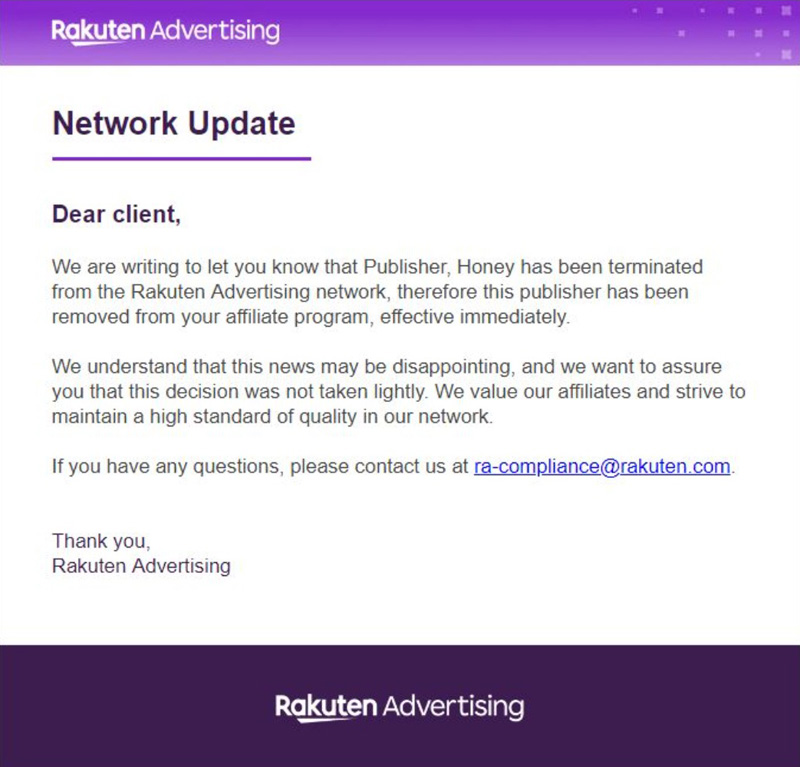
On Monday, January 12, Rakuten Advertising officially announced that Honey had been "terminated from the network." The timing of this announcement was particularly notable, as it coincided with the first day of Affiliate Summit West, the largest affiliate marketing conference in the United States. Rakuten framed the termination as a necessary measure to "maintain a high standard of quality" and protect the integrity of the partnerships within its ecosystem.
By Friday, January 16, impact.com followed suit, though with a slightly different administrative approach. Impact.com’s leadership confirmed that Honey was found to be "out of compliance" with the platform’s specific policies. Consequently, Honey was removed from the "Discovery Marketplace," the platform’s internal directory for connecting brands with publishers. While Rakuten’s move appeared to be a permanent termination, impact.com described its action as a suspension, leaving the door open for potential reinstatement should Honey rectify its technical compliance issues.
Understanding the "Last-Click" Conflict
To understand the severity of these actions, one must look at the mechanics of the "last-touch" attribution model that dominates the industry. In a standard affiliate transaction, the last affiliate to "touch" the customer before the purchase is completed receives 100% of the commission.

When a browser extension like Honey operates, it lives within the user’s browser and often activates at the checkout page. If the extension injects its own tracking link at the very last second—even if the user was brought to the site by a different affiliate—it overwrites the previous "cookie." Industry experts refer to this as attribution manipulation. For content creators and influencers who spend significant resources on top-of-funnel marketing, this practice is devastating, as it strips them of their earned revenue in favor of a software tool that only appeared at the point of sale.
The allegations against Honey suggest not just a technical error, but a "concealed violation," where the software was allegedly designed to appear as though it were standing down while still capturing the attribution data in the background.
Official Responses and Industry Reaction
The CEO of impact.com explicitly addressed the situation, noting that behavior which undermines trust in the "partnership economy" cannot be tolerated. The consensus among network executives appears to be that the long-term health of the affiliate industry depends on a fair playing field where publishers do not engage in predatory technical practices against one another.
Within the halls of Affiliate Summit West, the news became the primary topic of discussion. Marketing managers and brand owners expressed a mixture of relief and concern. While the removal of a "bad apple" was seen as a positive step for transparency, many brands realized they had become overly dependent on Honey for a significant portion of their affiliate-driven revenue.
PayPal, the parent company of Honey, has historically defended its shopping tools as value-adds for consumers, providing savings and driving conversion for merchants. However, the company now faces the challenge of reconciling its growth strategies with the strict compliance frameworks of the major affiliate networks.
Data and Market Implications
The financial stakes are massive. When PayPal acquired Honey for $4 billion, the extension had roughly 17 million monthly active users and partnered with over 30,000 merchants. Since then, it has been integrated into the broader PayPal ecosystem.
The suspension of such a large player highlights a growing trend of "policing the middleman" in digital advertising. Data from The Affiliate & Partner Marketing Association (APMA) in the UK recently highlighted the complexity of these issues. An independent audit of 30 brands across 10 networks revealed that attribution rules are frequently misunderstood or poorly enforced. The APMA study emphasized the distinction between "stand-down" rules and "soft clicks," urging networks to provide better visibility into how technology-based publishers interact with the clickstream.
For merchants, the immediate impact of Honey’s removal is a potential dip in reported affiliate sales. However, analysts argue that much of this revenue was likely "cannibalized"—meaning the sale would have happened anyway, or the credit belonged to another affiliate. By removing a partner that engages in attribution manipulation, brands may actually see an increase in the ROI of their other affiliate partnerships, as content creators are more likely to promote brands where their commissions are protected from "sniping."
Broader Impact on the Affiliate Ecosystem
The fallout from the Honey suspension serves as a cautionary tale for both publishers and affiliate managers. It underscores several critical shifts in the industry:
1. The Rise of Brand-Level Policing
The incident has proven that brands cannot rely solely on affiliate networks to monitor compliance. While Rakuten and Impact took network-level action, the violations had allegedly been occurring for an extended period. Industry experts now recommend that affiliate managers conduct their own independent audits and use third-party policing tools to ensure that their "Terms and Conditions" (Ts & Cs) are being followed at the individual affiliate level.
2. The Necessity of Diversification
One of the most significant vulnerabilities exposed by this event is the lack of diversification in many affiliate programs. A common problem in the industry is the "all eggs in one basket" syndrome, where a handful of large coupon or cashback sites drive 80% or more of a program’s volume. When a major player like Honey is suspended, programs that lack a diverse base of content producers, influencers, and niche publishers face a catastrophic loss of volume.
3. A Shift Toward Multi-Touch Attribution
The controversy may accelerate the industry’s move away from "last-click wins" toward more sophisticated attribution models. By rewarding multiple affiliates involved in the customer journey—rather than just the last one to drop a cookie—networks can reduce the incentive for browser extensions to engage in predatory behavior.
Conclusion and Future Outlook
The removal of PayPal Honey from Rakuten Advertising and impact.com marks a turning point in the professionalization of affiliate marketing. It signals to the market that even the largest, most well-funded players are not immune to the rules of the ecosystem.
As the industry moves into 2026, the focus is expected to remain on transparency and technical integrity. For PayPal Honey, the path forward will likely require a complete overhaul of its "stand-down" protocols and a transparent audit of its software to regain the trust of the networks. For the broader industry, the event serves as a reminder that trust is the primary currency of the partnership economy. Without strict enforcement of compliance, the delicate balance between software-based publishers and content-based creators cannot be maintained.
The coming months will determine if this is a temporary setback for Honey or a permanent shift in how browser extensions are permitted to operate within the global affiliate landscape. For now, the message from the major networks is clear: quality and compliance are no longer optional, regardless of a publisher’s size or pedigree.