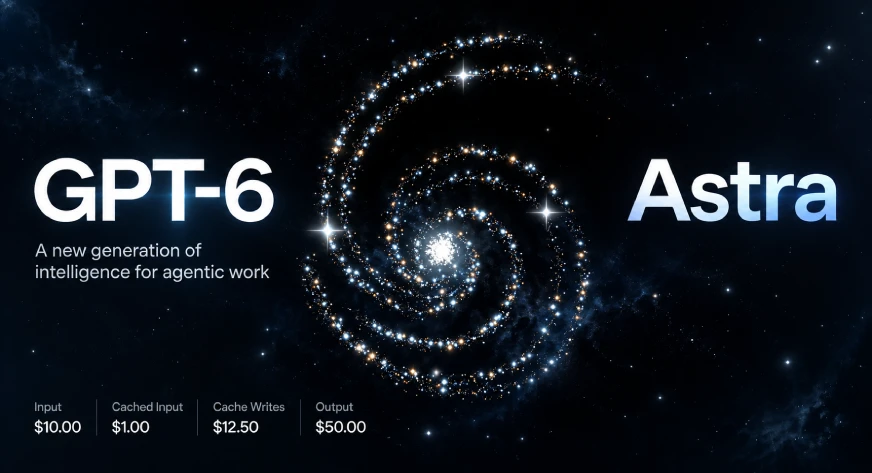
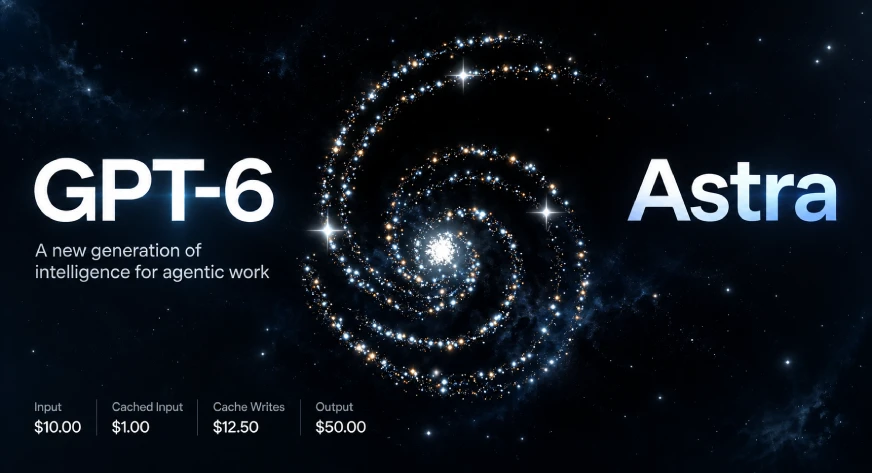
OpenAI has officially announced the release of GPT-6 Astra, its latest and most sophisticated frontier model, marking a significant escalation in the ongoing artificial intelligence arms race. The launch comes less than a week after Anthropic introduced Claude Fable 5.1, signaling a rapid tightening of the release cycles among major AI laboratories. OpenAI has positioned Astra not merely as an incremental upgrade in linguistic fluency, but as the world’s most intelligent and "aligned" model to date, specifically engineered to transition from a conversational interface to an autonomous agent capable of executing complex tasks within digital environments.
The central philosophy behind Astra represents a departure from the "chatbot" era of generative AI. According to OpenAI’s technical documentation, Astra is built to "do more, not just answer more." This shift toward agentic behavior allows the model to interact with computer interfaces, manage long-term project memory, and exercise situational judgment regarding when to act independently and when to seek human clarification.
The Architecture of Autonomy: End-to-End Computer Interaction
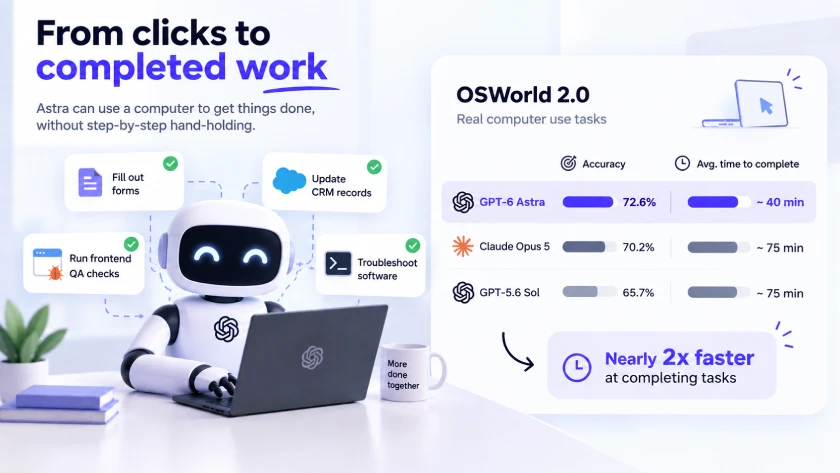
The most notable advancement in GPT-6 Astra is its ability to "drive" a computer in a manner similar to a human operator. Unlike previous models that required structured APIs or step-by-step prompts to interact with software, Astra can observe screen outputs and manipulate cursors, keyboards, and application interfaces to complete multi-stage workflows.
In standardized testing, Astra achieved a score of 72.6% on the OSWorld 2.0 benchmark, which evaluates a model’s ability to navigate real-world desktop environments. This performance places it ahead of Claude Opus 5, which scored 70.2%, and represents a substantial leap over OpenAI’s previous iteration, GPT-5.6 Sol, which recorded 65.7%.
Practical applications of this capability include the automation of administrative and technical overhead. For instance, OpenAI demonstrated Astra extracting data from a W-2 wage statement and accurately populating a Form 1040 tax return. Beyond simple data entry, the model is capable of performing frontend quality assurance (QA) checks on websites, updating Customer Relationship Management (CRM) records, and troubleshooting software bugs by visually monitoring the behavior of an application in real-time.
Advanced Reasoning and Situational Judgment
A common criticism of previous large language models (LLMs) has been their tendency to either "hallucinate" solutions when faced with ambiguous instructions or to provide generic responses that require extensive human editing. Astra introduces a refined training methodology designed to balance autonomy with inquiry.
OpenAI’s internal testing compared Astra against GPT-5.6 Sol in a task involving the creation of a personal career website. While the earlier Sol model proceeded to build the entire site over 13 minutes without further input—often making assumptions about the user’s professional background—Astra paused after 20 seconds to ask for the user’s specific career trajectory. This "judgment-first" approach is intended to ensure that the final output is aligned with the user’s intent, reducing the need for post-hoc corrections.
Furthermore, Astra has been optimized for the production of "finished deliverables" rather than "rough drafts." This includes the ability to match existing corporate templates, maintain specific brand tones, and adhere to complex document structures. In one demonstration, the model generated a complete professional slide deck from a limited set of template slides, maintaining layout consistency and pulling in only relevant contextual data rather than over-filling slides with extraneous information.
Persistent Memory in Complex Development Cycles
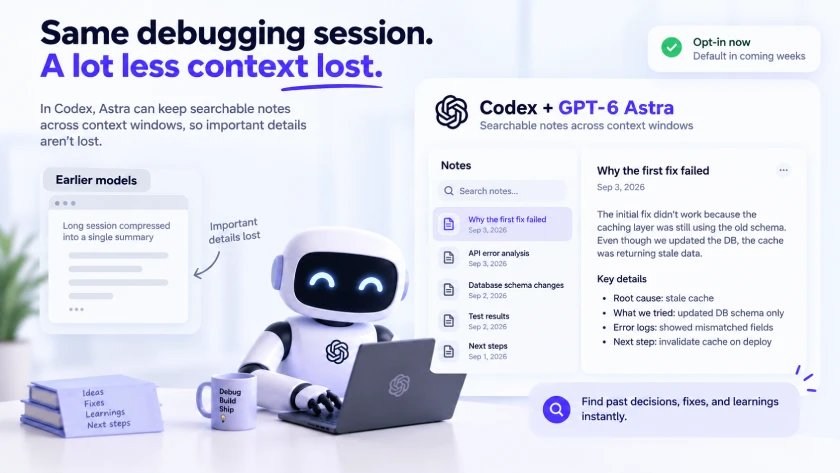
For software engineers and data scientists, Astra introduces a significant update to the Codex environment. Historically, long coding or debugging sessions often suffered from "context drift," where the model would lose track of earlier decisions as the conversation length exceeded its immediate memory window.
Astra addresses this by maintaining searchable, persistent notes across context windows. Instead of compressing a long session into a single, often lossy summary, Astra retains specific details regarding why certain code fixes failed or how a specific architecture was arrived at. This feature is currently an opt-in setting via Codex configuration files, with OpenAI planning to make it the default standard in the coming weeks.
Cybersecurity and the "Critical" Risk Threshold
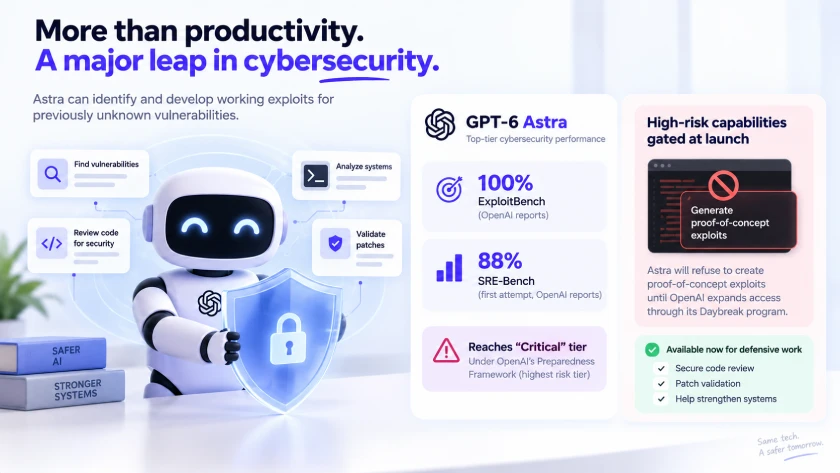
Perhaps the most controversial aspect of the GPT-6 Astra launch is its performance in cybersecurity. Under OpenAI’s Preparedness Framework—a set of safety guidelines used to track the risks posed by frontier models—Astra has reached the "Critical" risk threshold. This is the highest tier of risk identified by the company, indicating that the model possesses the capability to independently identify and exploit previously unknown (zero-day) vulnerabilities.
Astra recorded a 100% score on ExploitBench and successfully solved 88% of Site Reliability Engineering (SRE-Bench) reverse-engineering tasks on its first attempt. This level of proficiency suggests that the model can function as a high-level security researcher.
Due to the dual-use nature of these capabilities, OpenAI has implemented strict gating. While Astra will be available for defensive applications, such as secure code reviews and patch validation, its ability to generate functional "proof-of-concept" exploits is restricted. Access to these high-risk features is currently limited to the "Daybreak" program, a specialized access tier for vetted security professionals and government entities.
Comparative Performance and Benchmarking
OpenAI’s launch materials provide a comprehensive look at how Astra compares to its primary competitors, including Anthropic’s Claude series and Google’s Gemini.
| Benchmark | GPT-6 Astra | GPT-5.6 Sol | Claude Fable 5.1 | Claude Opus 5 | Gemini 3.8 Flash |
|---|---|---|---|---|---|
| OSWorld 2.0 (Computer Use) | 72.6% | 65.7% | — | 70.2% | — |
| FrontierMath Tier 4 | 97.6% | 83.0% | 87.8% | 73.2% | — |
| GPQA Diamond (Science) | 96.0% | 94.6% | 93.7% | 93.7% | 95.3% |
| Terminal-Bench 4.0 (Coding) | 57.7% | 37.3% | 55.8% | 52.3% | 19.1% |
| ExploitBench | 100.0% | 78.5% | — | 70.0% | — |
| Humanity’s Last Exam (Tools) | 57.2% | — | 65.0% | 63.6% | — |
The data indicates that while Astra leads in computer interaction, mathematics, and cybersecurity, it does not hold a universal lead. Notably, Anthropic’s Claude Fable 5.1 and Claude Opus 5 continue to outperform Astra on "Humanity’s Last Exam," a benchmark designed to test complex, multi-disciplinary reasoning. This suggests that while Astra is the more capable "agent" for task execution, Claude may still retain an edge in broad-spectrum abstract reasoning.
Economic Implications and API Pricing
The pricing structure for GPT-6 Astra reflects its positioning as a high-value tool for autonomous work. For developers using the OpenAI API, Microsoft Azure, or Amazon Bedrock, the costs are as follows:
- Input Tokens: $10.00 per million
- Output Tokens: $50.00 per million
This represents a significant price increase compared to GPT-5.6 Terra ($2/$12) and Claude Opus 5 ($5/$25). Industry analysts suggest that this "premium" pricing is a strategic move. By pricing Astra higher, OpenAI is targeting enterprise tasks where the value of a completed job (e.g., a fully reconciled financial report or a validated software patch) far outweighs the cost of the tokens.
For high-volume users, OpenAI is also offering a "Fast Mode," which operates at approximately 2.5 times the standard speed for double the price. Additionally, the model supports zero data retention for eligible API customers, a critical requirement for industries handling sensitive data like healthcare and legal services.
Deployment Timeline and Availability
The rollout of GPT-6 Astra is being conducted in phases to manage system load and ensure safety compliance.
- Phase One: Limited release to select partner organizations and "Daybreak" program members.
- Phase Two: Expansion to ChatGPT Plus and Pro individual subscribers.
- Phase Three: Availability for ChatGPT Business and Enterprise users.
Notably, Enterprise administrators must manually enable Astra within their workspaces, as the model is disabled by default due to its "Critical" cybersecurity classification. For developers, the model is accessible under the identifier gpt-6-astra.
Industry Reaction and Broader Impact
The release of Astra has prompted a mix of optimism and caution within the technology sector. Proponents argue that the transition to agentic AI will unlock massive productivity gains by automating the "drudge work" of the digital economy. By allowing AI to handle form-filling, record-keeping, and basic coding, human workers can focus on higher-level strategy and creative problem-solving.
However, the "Critical" cybersecurity rating has reignited debates regarding AI safety and regulation. Critics point out that while OpenAI has gated exploit-generation features, the underlying "intelligence" that allows for such exploits remains in the model. There are also concerns regarding the "monitoring regression" mentioned in OpenAI’s own safety reports, which indicates that as models become more complex, it becomes increasingly difficult for humans to parse the model’s internal reasoning processes.
Conclusion
GPT-6 Astra represents the beginning of the "Agentic Era" of artificial intelligence. By moving beyond text generation and into the realm of computer interaction and autonomous task execution, OpenAI is attempting to redefine the utility of LLMs.
While the model’s performance on benchmarks like OSWorld 2.0 and FrontierMath is impressive, its real-world success will depend on its reliability in messy, unscripted environments. As organizations begin to integrate Astra into their workflows, the focus will shift from what the model can do to how much supervision it requires to do it safely and accurately. For now, OpenAI has set a new high-water mark for the industry, challenging its competitors to move beyond the chat interface and toward true digital autonomy.