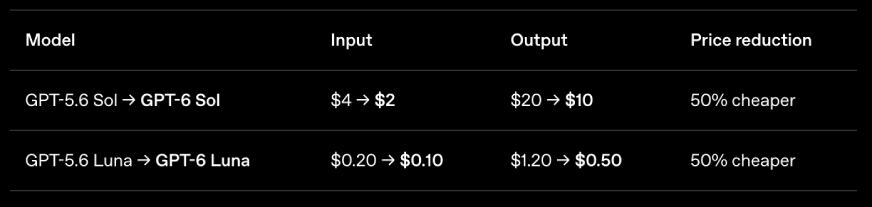
OpenAI has officially announced the release of GPT-6 Sol and GPT-6 Luna, two mid-tier and budget-tier models designed to bring the advanced reasoning and intelligence of its flagship GPT-6 Astra model to a broader range of applications at a significantly reduced price point. This strategic move marks a shift in the artificial intelligence landscape, where the focus is moving from the pursuit of raw computational power to the optimization of cost-efficiency and practical utility. By cutting API prices by 50% compared to the previous GPT-5.6 versions, OpenAI is positioning Sol and Luna as the primary workhorses for developers, enterprises, and high-volume automated systems.
The release follows a period of intense competition in the AI sector, particularly from Anthropic and Google, both of which have been aggressive in lowering the barrier to entry for high-performance models. OpenAI’s decision to pack "frontier-level" abilities into cheaper, faster versions suggests a maturation of the GPT-6 architecture, allowing for more streamlined inference and better resource management. While GPT-6 Astra remains the company’s most capable model, Sol and Luna are intended to handle the vast majority of professional tasks, including coding, factual research, and agentic workflows, without the premium price tag.
The Strategic Evolution of OpenAI’s Model Hierarchy
To understand the significance of GPT-6 Sol and Luna, one must look at the chronology of OpenAI’s model development. Following the success of the GPT-5.6 series, which introduced substantial improvements in multi-step reasoning, the GPT-6 era—headlined by Astra—aimed to solve long-standing issues in factuality and complex computer use. However, the high cost of running Astra limited its use to only the most critical or high-budget projects.
GPT-6 Sol enters the market as the "mid-tier" solution, replacing GPT-5.6 Sol. It is designed for demanding professional work where a balance of speed, cost, and intelligence is required. GPT-6 Luna, meanwhile, replaces GPT-5.6 Luna as the high-volume "budget" tier, aimed at simple, repetitive tasks that require massive scale. This tiered approach mirrors the strategy seen in other industries, such as cloud computing and hardware, where a flagship product is supported by "pro" and "entry-level" variants to capture different market segments.
Financial Breakdown: The 50% Price Reduction
The most immediate impact for developers is the drastic reduction in API costs. OpenAI has confirmed that the cost of input and output tokens for both models has been slashed. For GPT-6 Luna, the output price drop from $1.20 to $0.50 per million tokens actually represents a 58% reduction, exceeding the marketed 50% average. OpenAI attributes these savings to breakthroughs in inference optimization and the implementation of more sophisticated caching mechanisms.
The economic implications for startups and enterprises are profound. A company running a large-scale customer service agent or a code-generation platform could see its monthly AI expenditure halved while simultaneously benefiting from the higher reasoning capabilities of the GPT-6 architecture. This pricing strategy is widely seen as a direct response to Anthropic’s release of the Claude 5.5 series, which had briefly undercut OpenAI’s previous price-to-performance ratio.
Technical Innovations in Caching and Agentic Workflows
A major technical highlight of the GPT-6 release is the overhaul of the caching system. AI agents and long-form conversations typically require the model to process the same context—such as a large codebase or a lengthy document—repeatedly. Traditionally, this resulted in redundant processing costs.
GPT-6 Sol and Luna introduce higher default cache hit rates. When a prompt contains context that has been recently processed, the model can "reuse" that information rather than recalculating it. OpenAI is offering a 90% discount on these cached input tokens. Furthermore, new developer tools have been introduced to manage this:
- Caching Dashboard: Provides real-time visibility into how much input is being cached versus freshly processed.
- Diagnostics Tool: Identifies why certain prompts are missing the cache, allowing developers to optimize their prompt engineering.
- Explicit Breakpoints: Allows developers to define exactly where a cached portion of a prompt ends, preventing small changes at the end of a query from invalidating the entire cache.
GitHub, an early adopter of these improvements, reported that the new caching system reduced the volume of fresh tokens needing processing by over 50% across billions of Copilot requests, significantly increasing the speed of the user experience.
Benchmarking Performance: Closing the Gap with Frontier Models
OpenAI’s internal benchmarks suggest that GPT-6 Sol and Luna are punching well above their weight class. The company’s goal was not to surpass GPT-6 Astra but to match or exceed the performance of rival flagship models from the previous generation at a fraction of the cost.
On the AutomationBench, which measures performance in business workflows, GPT-6 Sol (at its "xhigh" effort setting) scored 33.2%, outperforming Claude Opus 5’s 26.9%. Notably, Sol achieved this while costing only 9% of what Opus 5 charges per task. In the realm of software engineering, DeepSWE v1.1 tests showed GPT-6 Sol scoring 68.8%, placing it within a single percentage point of Claude Fable 5, yet it remains roughly 80% cheaper to operate.
Even the budget-tier GPT-6 Luna showed remarkable resilience. In professional workflow tests, Luna at higher reasoning effort matched the performance of the much more expensive GPT-5.6 Sol. This suggests that for many businesses, the "budget" model of today is as capable as the "premium" model of last year.
Hands-On Testing: Factuality and Coding Reliability
To verify OpenAI’s claims of reduced jargon and increased factuality, independent tests were conducted on GPT-6 Sol and Luna. The results indicate a model that is more concise and less prone to the "hallucinations" that plagued earlier iterations.
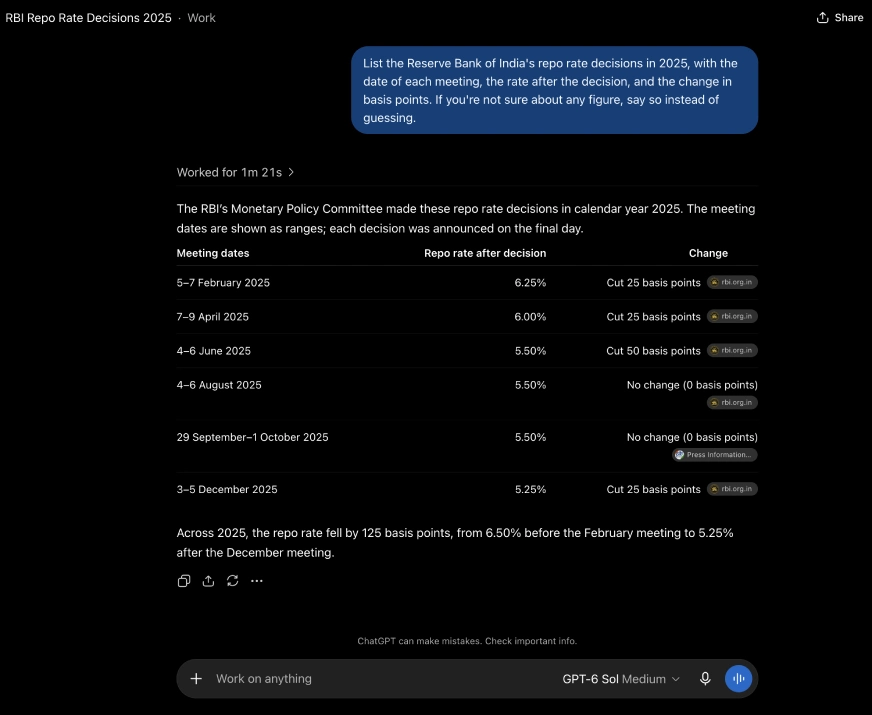
In a fact-checking test regarding central bank interest rate decisions, GPT-6 Sol correctly identified six consecutive repo rate decisions for 2025. Rather than guessing or providing a vague "I am not sure" response, the model utilized its live browsing capabilities to verify the most recent December meeting, providing a cited and accurate figure.
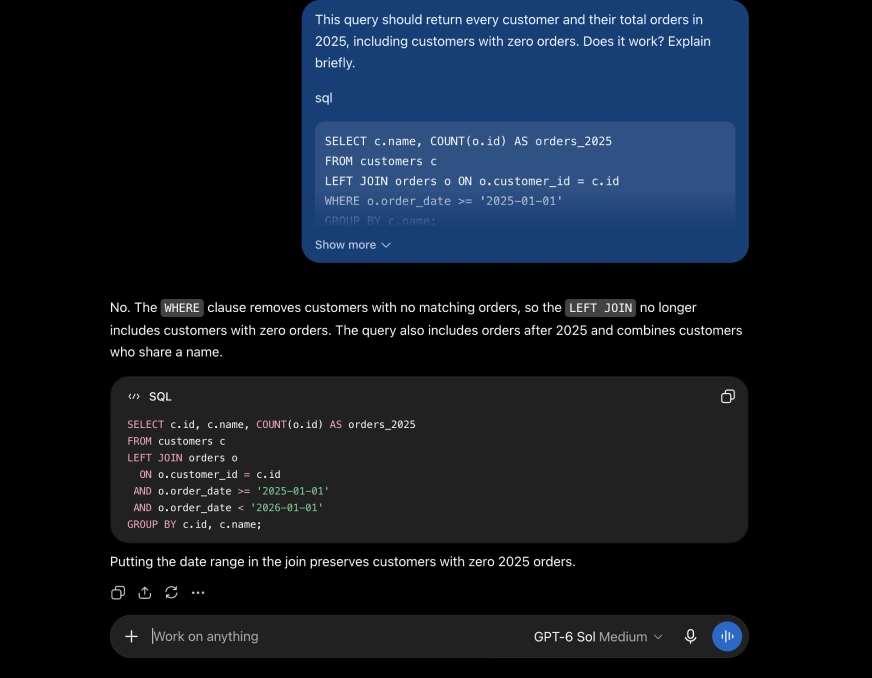
In a coding test involving a SQL query with intentional bugs—including a logic error that turned a LEFT JOIN into an INNER JOIN and a missing date range—GPT-6 Sol not only identified and fixed both intended errors but also flagged an additional architectural flaw. It noted that grouping by "customer name" alone could lead to data collisions if two customers shared the same name, suggesting a group by "customer ID" instead. This level of proactive debugging is a hallmark of the Astra-based training methods used for the Sol model.
Communication Style: The Move Toward Professionalism
One of the most frequent criticisms of previous LLMs was their tendency to be overly verbose, using "filler" language and restating the user’s prompt before answering. OpenAI has explicitly tuned the GPT-6 models to be more direct.
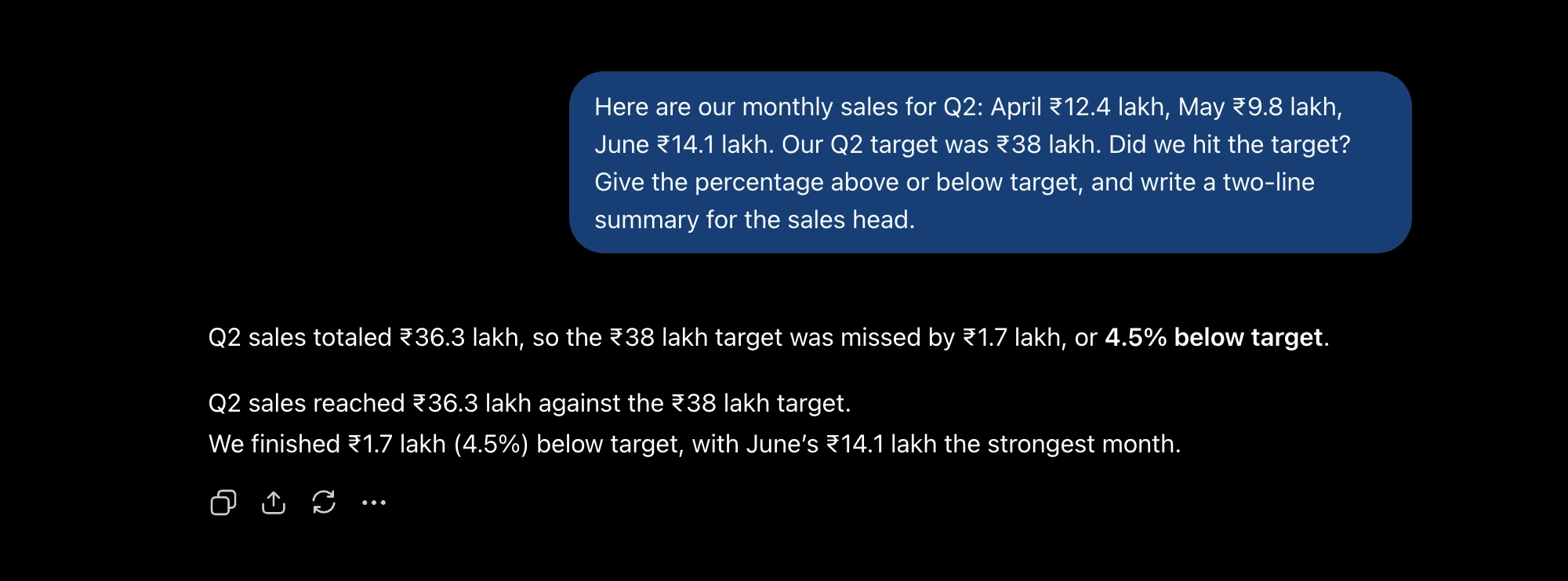
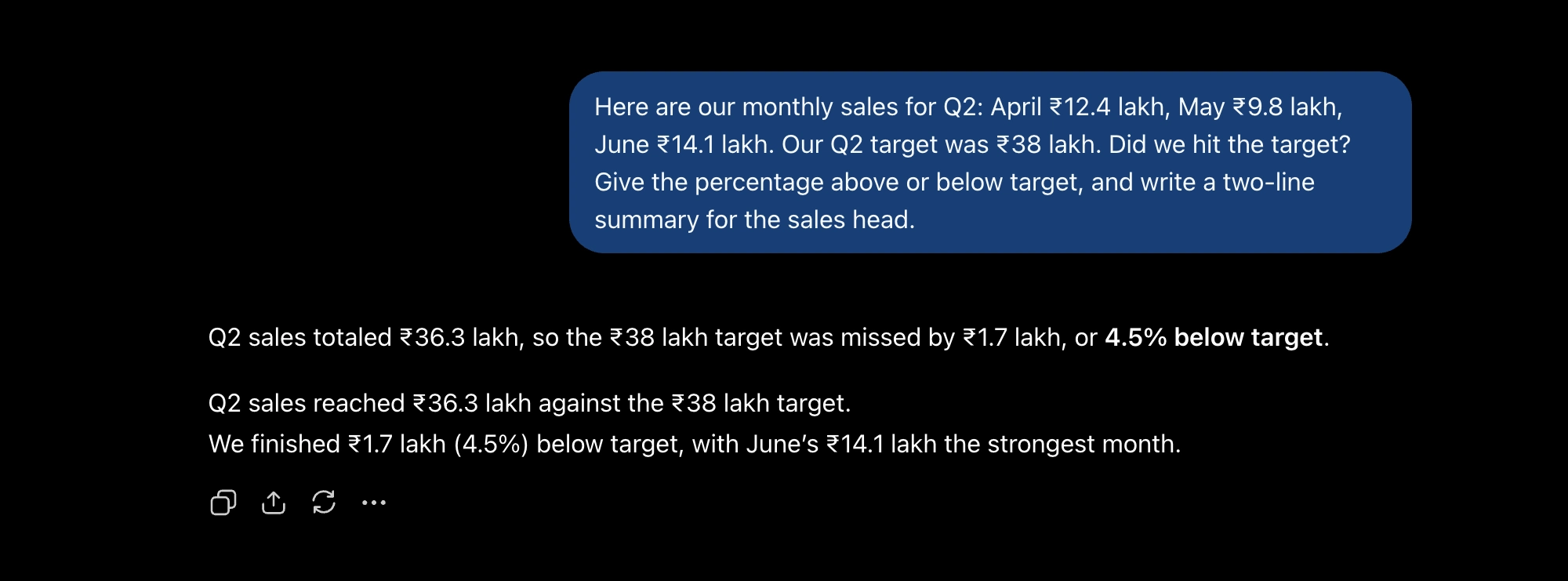
In business math tests, GPT-6 Luna provided a two-line summary for a sales head as requested, avoiding any introductory fluff. The model correctly calculated a 7.6% deficit against a quarterly target and identified the strongest performing month without being prompted to do so. This "clearer collaboration style" is expected to be particularly beneficial in technical environments where brevity and accuracy are prioritized over conversational pleasantry.
Market Implications and Competitive Response
The launch of GPT-6 Sol and Luna has sent ripples through the AI industry. Industry analysts suggest that we are entering a "price war" phase of AI development. While the "frontier" models like Astra and Claude Opus continue to push the boundaries of what is possible, the real market share is being won in the mid-tier.
"OpenAI is essentially commoditizing high-level reasoning," said one industry analyst. "By making Sol and Luna so cheap, they are making it difficult for smaller LLM providers to compete on price alone, while also challenging the value proposition of rival flagship models."
However, there are caveats. OpenAI noted that competitor scores used in their benchmarks were taken from public reports, and since the benchmarks were conducted, Anthropic has released Claude 5.5, which may close the gap. Furthermore, the 50% price cut is currently focused on the API, with availability in ChatGPT restricted to "Work" and "Codex" tiers for paid users, though Luna is available for free users via the desktop application.
Conclusion: The New Standard for Everyday AI
GPT-6 Sol and Luna represent a strategic pivot for OpenAI. By focusing on "intelligence per dollar" rather than just "intelligence at any cost," the company is addressing the primary barrier to widespread AI adoption: scalability. The 50% price reduction, combined with sophisticated caching and the inherited reasoning capabilities of the Astra architecture, makes these models the new standard for developers building the next generation of AI agents.
As the industry moves forward, the success of Sol and Luna will likely be measured not by leaderboard rankings, but by their integration into the daily workflows of millions of users and the cost-savings they provide to the global tech economy. For now, the message from OpenAI is clear: frontier-level AI is no longer a luxury—it is becoming an affordable utility.