An AEO checker serves as a crucial diagnostic tool, identifying whether AI-generated answers, which a growing number of consumers now rely upon, accurately mention and cite a brand. The landscape of information consumption has dramatically shifted with the widespread adoption of generative AI tools such as ChatGPT, Perplexity, and Gemini. Users are increasingly posing questions directly to these AI models and acting on the synthesized replies, often bypassing traditional search engine results pages (SERPs) and the links they contain. This fundamental change means that brand visibility, once meticulously cultivated through search engine rankings, can now effectively vanish into an AI-generated answer, unseen and uncredited.
![AEO checker tools that measure answer engine visibility [2026]](https://53.fs1.hubspotusercontent-na1.net/hubfs/53/aeo-checker-1-20260903-3858273.webp)
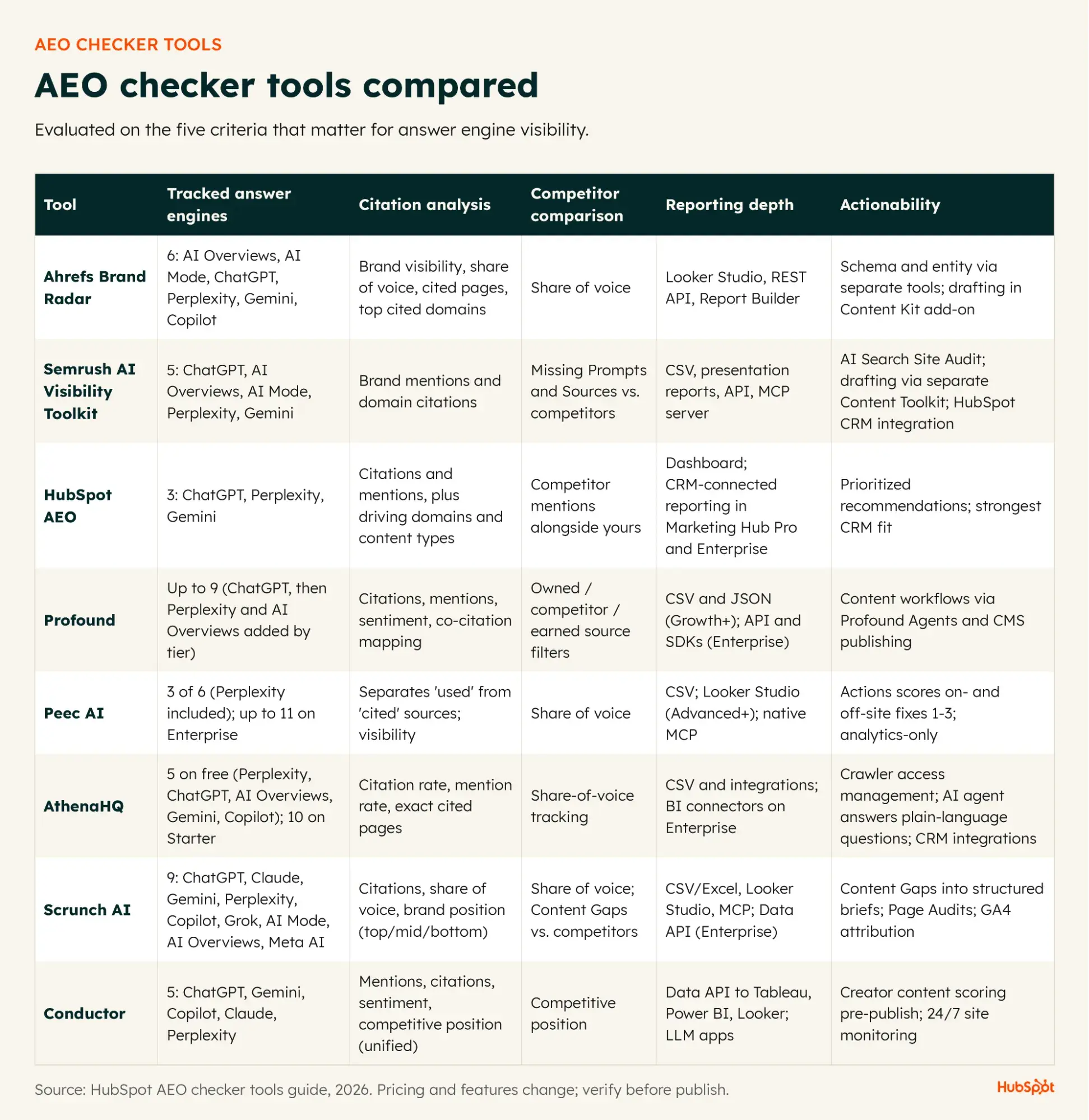
This profound transformation necessitates a new approach to digital presence management. To effectively navigate this evolving environment, businesses must gain insight into which queries their content surfaces, which queries inadvertently promote competitors, and where AI engines might misrepresent their brand. A robust AEO checker is designed to provide precisely this level of intelligence, albeit through a variety of methodologies employed by different tools in the market. This guide will delve into the core functions of an AEO checker, provide practical steps for conducting manual checks across prominent AI platforms like ChatGPT, Perplexity, and Google’s AI Overviews, and offer a comprehensive comparison of the leading automated AEO checkers to aid in selecting the most suitable solution for adapting to this new era of search.
The Paradigm Shift: Understanding Answer Engine Optimization
![AEO checker tools that measure answer engine visibility [2026]](https://no-cache.hubspot.com/cta/default/53/9dd5e54b-fbef-4dd0-bc44-1689feb1ea18.png)
Answer engine optimization (AEO) represents a strategic evolution in digital marketing, focusing on improving the frequency and accuracy with which a brand appears in the AI-generated responses provided by conversational AI and search engines. This concept is intrinsically linked to the broader field of generative engine optimization, which addresses the overarching challenges and opportunities presented by AI-driven content generation and consumption. Unlike traditional search engines that return a list of links for users to explore, answer engines synthesize information from multiple sources to deliver a single, concise answer. This often resolves a user’s query directly within the AI interface, eliminating the need for a click-through to an external website. Google officially embraced this summary-first approach with the launch of its AI Overviews in May 2024, signaling a definitive move towards integrating AI-generated summaries directly into its core search results.
The rise of generative AI began its accelerated ascent into public consciousness with the late 2022 release of ChatGPT, quickly demonstrating the power of large language models to provide human-like responses. This was followed by a rapid proliferation of similar tools from various tech giants, including Google’s Gemini and Perplexity AI. This technological leap has fundamentally altered user behavior; instead of sifting through ten blue links, users now expect immediate, authoritative answers. Data from various industry reports suggest a significant portion of online searches now involve conversational AI, with some estimates indicating that over 50% of online interactions could involve AI within the next few years. This shift presents both a challenge and an immense opportunity for brands.
![AEO checker tools that measure answer engine visibility [2026]](https://53.fs1.hubspotusercontent-na1.net/hubfs/53/aeo-checker-2-20260903-852936.webp)
AEO and search engine optimization (SEO) are not mutually exclusive but rather complementary strategies addressing different facets of the same overarching goal: brand visibility and authority. While SEO aims to elevate a brand’s web pages within a ranked list of links, AEO strives to ensure the brand is explicitly mentioned and its content is cited within the AI’s synthesized answer. A strong SEO foundation remains paramount for effective AEO, as it supplies the critical crawlability and authority signals that answer engines rely upon when determining which sources to trust and cite. Content that is well-structured, directly answers common user questions, and substantiates claims with verifiable primary sources is most likely to be parsed, trusted, and cited by these advanced AI systems.
What Does an AEO Checker Do? A Deeper Dive
![AEO checker tools that measure answer engine visibility [2026]](https://53.fs1.hubspotusercontent-na1.net/hubfs/53/aeo-checker-3-20260903-8904553.webp)
At its core, an AEO checker is a specialized analytics tool designed to quantify and improve a brand’s visibility across various answer engines. It performs several key functions:
- Visibility Measurement: It systematically checks how often and in what context a brand’s name, products, or services appear in AI-generated answers for a defined set of queries. This includes detecting direct citations (links back to the brand’s website) and explicit mentions (where the brand is named in the text without a direct link).
- Content Gap Identification: By comparing queries where a brand is cited or mentioned against those where competitors are featured instead, the checker identifies critical content gaps or areas where a brand’s existing content is not effectively being picked up by AI.
- Accuracy Assessment: It verifies whether the information presented by the AI about a brand is correct, up-to-date, and aligns with brand messaging. This is crucial for reputation management in an era where AI can inadvertently propagate misinformation.
- Source Attribution Analysis: The tool analyzes which specific pages or content types from a brand’s domain are being cited by AI, providing insights into what content resonates most with answer engines.
- Competitive Benchmarking: It monitors competitor performance in AI answers, revealing their strategies, content strengths, and areas where they might be outperforming your brand.
- Actionable Recommendations: Beyond mere data, a sophisticated AEO checker translates its findings into prioritized, actionable recommendations. These might include suggestions for content updates, schema markup corrections, entity optimization, or even outreach strategies to improve citation likelihood.
The workflow of an AEO checker typically follows a continuous loop: Measure brand visibility across AI platforms; Diagnose the reasons for inclusion or exclusion; Prioritize the most impactful fixes; Optimize content and technical aspects based on recommendations; and Report on the effectiveness of these changes, iterating as needed. This iterative process is vital in a rapidly evolving AI landscape.
![AEO checker tools that measure answer engine visibility [2026]](https://53.fs1.hubspotusercontent-na1.net/hubfs/53/aeo-checker-4-20260903-6212698.webp)
Navigating Google AI Overviews: Manual Checks and Their Limitations
For many businesses, initial forays into AEO begin with manual checks, particularly for Google’s AI Overviews (AIOs). This process involves directly querying Google Search and scrutinizing the AI-generated summaries. It’s important to note that AIOs do not appear for every query; Google’s systems are designed to surface them only when they determine a summary provides "additive" value beyond traditional search links. Furthermore, AIO results can exhibit variability across different search sessions or user profiles, underscoring the need for consistent sampling rather than relying on a single lookup. When an AIO does appear, it meticulously cites the underlying pages it drew information from, often placing source links inline with the supporting text and offering a desktop hover preview to identify the source site.
![AEO checker tools that measure answer engine visibility [2026]](https://53.fs1.hubspotusercontent-na1.net/hubfs/53/aeo-checker-5-20260903-8938354.webp)
Step 1: Defining Priority Queries. The first critical step is to compile a comprehensive list of queries that hold significant importance for your brand. This should include direct brand name searches, branded product or service terms, and the key informational questions that your target buyers commonly ask.
Step 2: Executing and Recording Searches. Each defined query should be run in a signed-out or incognito browser session to minimize personalization biases. For each search, three key pieces of information must be recorded:
- Whether an AI Overview was triggered.
- Whether your domain appeared among the inline source links.
- The exact claim or information presented by the AI Overview.
Step 3: Interpreting Results and Identifying Gaps. A comparative analysis of these results is essential. Focus on identifying queries that trigger an AIO and successfully cite your brand versus those where an AIO appears but references competitors. The latter group forms your critical content gap list. Given the session-to-session variability of AIOs, a single absence should prompt further re-checking rather than being definitively interpreted as a lost placement.
Step 4: Building Defensible Reporting. To establish a reliable baseline and track progress, it is advisable to screenshot each relevant AIO result, carefully documenting the query, date, and geographical location. This creates a defensible "before-and-after" record. While Google Search Console offers performance reports, its standard view currently aggregates AI Overview activity into the general "Web" search type, making isolated AIO performance