admin
admin
The digital marketing ecosystem presents an overwhelming array of choices for businesses seeking to connect with their audiences. Among these, email marketing stands as a perennial cornerstone, consistently delivering one of the highest returns on investment (ROI) in the marketing sphere. However, the sheer volume of platforms vying for attention, each promising unparalleled ease, power, or value, can transform the selection process into a protracted and often frustrating endeavor. Choosing the right email marketing platform for a small business should not consume weeks; rather, it should be a strategic decision anchored in a clear understanding of core functionalities and long-term scalability.
At its essence, the ideal email marketing platform for a small business reliably ensures deliverability, aligns with current and projected budgetary constraints, offers intuitive automation capabilities without demanding extensive technical expertise, and provides accessible, human-centric support when challenges inevitably arise. All other features, while potentially beneficial, are secondary to these fundamental requirements. This comprehensive guide delves into the critical questions and considerations that genuinely matter when evaluating email marketing platforms, providing a framework for informed decision-making.
Background Context: The Evolution and Enduring Power of Email Marketing
Email marketing has undergone a significant transformation since its inception, evolving from simple bulk messaging into a sophisticated, personalized communication channel. Initially, platforms primarily facilitated newsletter distribution, but advancements in technology and marketing strategy have propelled them into robust customer relationship management (CRM) extensions. Today, email platforms are integral to lead nurturing, customer retention, sales conversion, and brand building, capable of orchestrating complex customer journeys with minimal manual intervention. The global email marketing software market, valued at billions, continues to expand, driven by businesses recognizing email’s unmatched ability to foster direct relationships and drive measurable revenue. Studies consistently show email marketing delivering an average ROI of $36 to $42 for every $1 spent, underscoring its strategic importance for businesses of all sizes, particularly those with limited resources. For small businesses, email serves as a cost-effective alternative to paid advertising, allowing for direct communication, brand loyalty cultivation, and personalized engagement at scale.
The Six Pillars of Platform Selection: Essential Questions for Business Growth
To navigate the crowded market effectively, small business owners must focus on six critical areas that directly impact their marketing efficacy and operational efficiency.
1. Ensuring Inbox Presence: The Paramount Importance of Deliverability
Deliverability refers to the crucial ability of an email to successfully land in a subscriber’s inbox rather than being diverted to a spam folder or blocked entirely. This is arguably the single most important function of an email platform, yet it is often overlooked by small businesses until a crisis occurs. A platform’s deliverability performance is the bedrock upon which an entire email strategy rests. Without reliable inbox placement, even the most compelling content or perfectly crafted automation sequences are rendered ineffective.
The experience of AWeber customer Coleen Otero serves as a stark illustration of this point. After transitioning to a different platform, her open rates plummeted dramatically from 30-40% to a mere 5%. "As a small business owner, that is detrimental to my ROI, detrimental to the sales," she recounted in an AWeber webinar. Upon returning to AWeber, her rates quickly recovered. This incident highlights that deliverability is not merely a technical setting; it reflects the platform’s commitment to maintaining a robust sender reputation. Platforms that allow "bad actors" to send spam from shared infrastructure inadvertently damage the sender reputation of all customers on that same infrastructure, including legitimate small businesses. Factors influencing deliverability include the platform’s IP reputation, its adherence to email authentication protocols like SPF (Sender Policy Framework), DKIM (DomainKeys Identified Mail), and DMARC (Domain-based Message Authentication, Reporting & Conformance), and its proactive management of spam complaints and bounce rates.
When evaluating platforms, essential questions regarding deliverability include:
- What measures does the platform take to maintain high sender reputation and ensure emails land in the inbox?
- How does the platform manage shared IP addresses to protect clients from "bad neighborhood" issues?
- Does the platform offer tools or guidance for improving individual sender scores and authentication?
- What is the typical deliverability rate across the platform’s user base?
2. Financial Prudence and Scalability: Budgeting for Growth
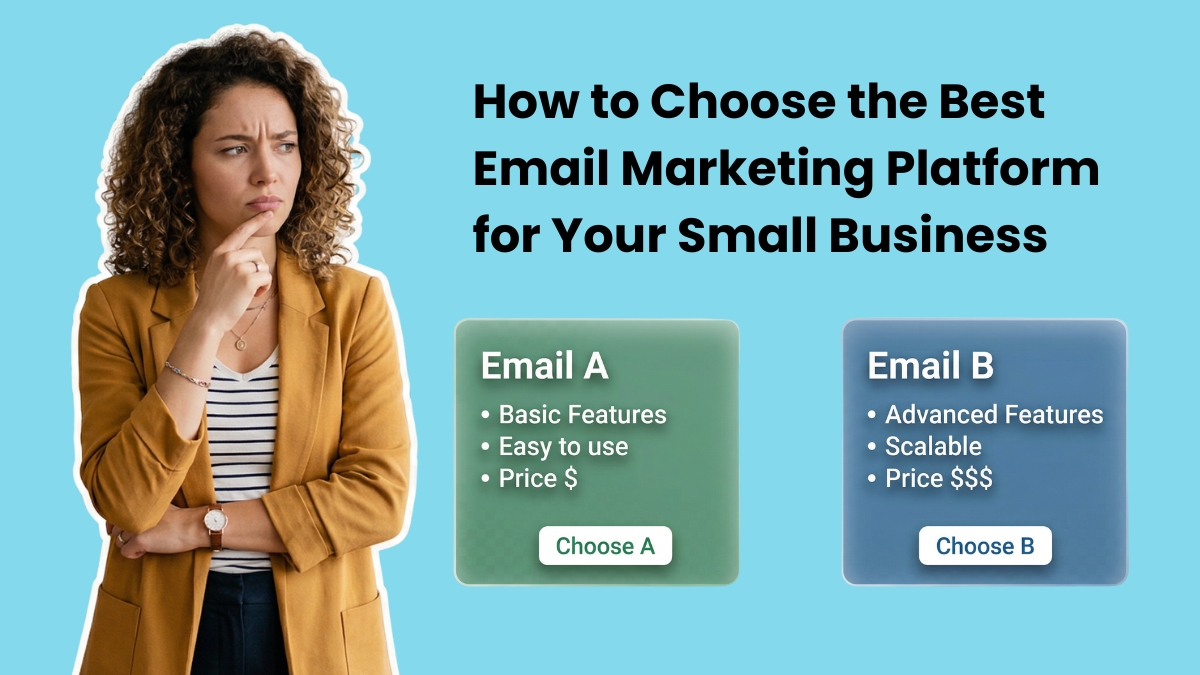
The cost of an email marketing platform is a significant consideration, particularly for small businesses. Most platforms employ a tiered pricing structure, with charges primarily based on the number of subscribers or the volume of emails sent per month. This means the price observed today may not be the price paid in twelve months as a business’s email list inevitably grows.
It is crucial to project costs at various stages of business growth. A useful exercise involves mapping out the estimated cost at current list size, then at 1,000 subscribers, and subsequently at 5,000 subscribers. Some platforms may appear highly affordable for a small list (e.g., under 500 contacts) but experience steep price increases as the subscriber count rises. Conversely, some offer generous free tiers that become restrictive just as a list begins to generate meaningful revenue. While free plans are excellent for starting out, understanding the transition to paid tiers and their respective feature sets is vital. For instance, AWeber’s free plan supports up to 500 subscribers and includes automation, landing pages, and 24/7 support, with paid plans starting at $15/month. A thorough understanding of a platform’s pricing model, including any hidden fees or limitations, is paramount to avoid unexpected expenses that could strain a small business budget. The high ROI of email marketing means that a well-chosen paid plan often pays for itself quickly through increased sales and customer engagement, but only if the pricing is sustainable.
3. Empowering Efficiency: Automation Without Technical Hurdles
Email marketing automation is where the channel generates some of its most impressive returns. Automated sequences—such as a welcome series for new subscribers, a re-engagement campaign for inactive contacts, or a post-purchase follow-up—run continuously in the background once configured, saving invaluable time and ensuring timely communication. However, these benefits are only realized if a business owner can actually build and manage these automations without requiring specialized technical skills or the expense of hiring a developer.
The ideal platform features a visual workflow builder that simplifies the creation of complex sequences. Users should be able to drag and connect triggers (e.g., "new subscriber," "clicked link"), conditions (e.g., "has purchased," "opened specific email"), and actions (e.g., "send email," "add tag") to construct a multi-step sequence within a relatively short timeframe, perhaps under an hour. AWeber’s visual workflow builder, for example, allows for branching paths and behavioral triggers, enabling sophisticated automation without code. It is highly recommended to utilize free trials offered by platforms to test this functionality directly. Attempting to build a basic three-email welcome series during a trial period can quickly reveal whether the platform’s automation tools are intuitive or if they will become a bottleneck for future marketing efforts. Ease of use in automation directly translates to increased marketing agility and reduced operational overhead for small businesses.
4. Unwavering Support: A Lifeline in Critical Moments
No matter how intuitive a platform seems, the reality is that small business owners will inevitably encounter situations requiring technical assistance. These moments often occur at the most inconvenient times: just before a major product launch, on the day of a critical email send, or late on a Friday evening when traditional business hours are long past. The quality and accessibility of customer support can therefore be a make-or-break factor.
Many email platforms offer support via email or chat during standard business hours. However, a select few extend this to 24/7 availability. Even fewer provide 24/7 support from actual human beings who possess deep knowledge of email marketing, rather than relying solely on chatbots that route users to generic knowledge base articles. When evaluating support, a key question to ask is: "What does support look like when I have an urgent problem outside business hours?" The answer to this question often reveals more about a platform’s commitment to its small business users than any feature list. For example, AWeber is known for offering 24/7 human support as a standard feature across all its plans. For small business owners who often juggle multiple roles and work non-traditional hours, readily available, expert human support is not a luxury but a critical necessity for minimizing downtime and resolving issues swiftly, thereby protecting revenue and reputation.
5. Feature Alignment: Matching Tools to Immediate Business Needs
The "best" email marketing platform is highly subjective and depends entirely on the specific needs of a business at its current stage. A solopreneur primarily sending a weekly newsletter has vastly different requirements than an e-commerce store running complex abandoned cart sequences and post-purchase upsells. The danger lies in paying for, and becoming overwhelmed by, features that will not be utilized for months or even years.
Businesses should begin by identifying the top three to five essential functions their email marketing needs to accomplish within the next 90 days. For example, these might be:
- Building an email list from scratch.
- Sending a weekly newsletter to engage subscribers.
- Automating a basic welcome series for new sign-ups.
If these are the primary objectives, then advanced features like enterprise-level CRM integration, predictive AI send-time optimization, or complex multi-channel orchestration are unnecessary and could lead to "feature bloat" and confusion. The focus should be on a platform that reliably executes these core tasks without getting in the way. Complexity can always be added as the business’s needs evolve and mature. Switching platforms later is often less painful and costly than investing in an overly complex system that leads to confusion and, ultimately, the abandonment of email marketing altogether—a far greater financial and strategic loss. Understanding the specific functionalities that drive immediate value is paramount.
6. Streamlined Transition: The Ease of Platform Migration
For businesses already utilizing another email marketing platform, the decision to switch involves an additional layer of complexity: migration. A technically superior platform may not be the right choice if the process of moving years of subscriber data, meticulously crafted templates, and established automation sequences proves to be a painful and time-consuming ordeal. The potential for data loss, disruption to ongoing campaigns, and the effort required to rebuild existing assets can deter businesses from upgrading, even if their current solution is suboptimal.
It is crucial to inquire specifically: "Does the platform offer migration support, and who performs the actual work?" Some platforms might claim to "support migration" but merely provide an export guide, leaving the business owner to figure out the intricate details of data mapping, template recreation, and automation rebuilding. Others offer a genuine "done-for-you" migration service, where their dedicated team handles the transfer of lists, recreates templates to match branding, and rebuilds automation workflows, minimizing the burden on the business. For example, AWeber’s migration service is free, with their team handling the transfer from the current platform, often completing most migrations within a few business days.
Key aspects to verify before migrating include:

- How subscriber data, including custom fields and segments, will be transferred.
- The process for recreating existing email templates and landing pages.
- Whether automation workflows can be replicated or need to be rebuilt from scratch.
- The impact on email history and analytics during the transition.
A clean, efficient migration sets a business up for immediate improvement and growth, rather than spending the first month merely trying to get back to square one.
Strategic Prioritization: Tailoring Platform Choice to Business Stages
The "right" platform evolves with a business. Understanding these stages helps align features with current needs.
The Startup Phase: Building Foundations (Under 500 Subscribers)
At this initial stage, the priority is foundational: establishing an email list and getting a basic welcome sequence operational. Advanced segmentation or intricate automation workflows are not yet critical.
- Look for: A free plan that includes essential automation capabilities, an integrated landing page builder (to avoid needing separate tools), and a user-friendly drag-and-drop email editor. Such features allow businesses to start collecting leads and engaging them immediately without significant upfront investment. Tactics for growing an email list from zero are readily available, making a robust yet accessible free tier invaluable.
The Growth Trajectory: Expanding Reach (500 to 5,000 Subscribers)
Once a business’s list begins to grow and generate measurable revenue, the needs shift towards optimizing engagement and converting subscribers more effectively.
- Look for: Features like behavioral tagging for more precise segmentation, visual automation workflows with greater flexibility, and seamless integration with e-commerce platforms or CRM systems. This is the stage where upgrading to a paid plan becomes a clear investment with a tangible ROI, as the enhanced capabilities directly contribute to revenue generation and operational efficiency.
The Established Enterprise: Scaling Operations (5,000+ Subscribers)
For businesses with large, established lists, the focus transitions to robust infrastructure, advanced personalization at scale, and the ability to manage multiple complex campaigns simultaneously without encountering technical breakdowns.
- Look for: Dedicated deliverability support, a robust API for custom integrations and advanced data synchronization, and priority customer support. At this scale, platform problems translate directly into significant financial losses, making reliability, advanced capabilities, and premium support non-negotiable.
Identifying Red Flags: Navigating the Market with Caution
While evaluating features, it’s equally important to recognize warning signs that a platform might not be the right fit for a small business:
- Feature Overwhelm on the Homepage: If a platform’s website prominently highlights thousands of integrations, AI-powered predictive send time optimization, or highly niche enterprise-level functionalities, it often signals that the product is primarily designed for large marketing teams with dedicated resources, not for small business owners who are simultaneously managing all aspects of their operations.
- Opaque Pricing Structures: Beware of platforms that advertise a deceptively low monthly price while burying the fact that it only covers a minimal number of contacts (e.g., 500 subscribers). Always read the pricing page thoroughly, paying close attention to subscriber tiers and feature limitations at each level, to understand the true cost as your business grows.
- No Mention of Deliverability: If a platform’s marketing materials or website conspicuously omit any discussion of inbox placement, sender reputation, or email authentication standards, it is a significant red flag. Deliverability is too critical to be an afterthought; it should be a core feature and a point of pride for any reputable email service provider.
- Support Limited to Business Hours: Small business owners frequently operate outside the traditional 9-to-5 workday. Their email marketing problems are equally unlikely to adhere to standard business hours. Platforms offering support only during conventional business hours may prove inadequate when urgent issues arise late at night or on weekends, causing significant disruption.
Broader Implications and Strategic Outlook
Choosing an email marketing platform is more than just selecting a software vendor; it is a strategic investment in a business’s long-term growth and customer relationship management. The right platform serves as a foundational partner, enabling consistent communication, fostering loyalty, and driving revenue. Conversely, a poor choice can lead to wasted resources, missed opportunities, and frustration. By focusing on the critical pillars of deliverability, scalability, ease of automation, robust support, feature alignment, and migration ease, small businesses can make an informed decision that supports their immediate needs and scales effectively with their aspirations. The ultimate goal is to leverage email marketing as a powerful, efficient tool that strengthens customer relationships and contributes meaningfully to sustainable business success.
Frequently Asked Questions
What is the best email marketing platform for a small business?
The "best" platform is subjective and depends on specific needs, but for most small businesses, it’s one that prioritizes inbox deliverability, includes essential automation features even on entry-level or free plans, fits the budget as the subscriber list grows, and offers reliable, human-centric support when required. Platforms with a generous free tier that simplifies list building and welcome series setup without requiring a developer are often an excellent starting point.
Is free email marketing good enough for a small business?
A free email marketing plan can be an excellent starting point for a small business, particularly for building an initial list and setting up basic automation. The primary limitation typically lies in subscriber count or email volume, not necessarily in core features. As a business’s list grows beyond the free tier limits (e.g., 500 subscribers) and email marketing begins to generate measurable revenue, upgrading to a paid plan becomes a strategic investment that quickly pays for itself through expanded capabilities and greater reach.
How long does it take to get started with email marketing?
With a well-designed, intuitive platform, a small business can often set up a signup form, a landing page, and a basic welcome email sequence in under an hour. Many platforms offer templates and drag-and-drop editors to streamline this process. Additionally, some providers, like AWeber, offer "Done For You" services that can build a full email marketing system—including branded templates, landing pages, welcome automation, and even AI-generated newsletter drafts—within a few business days for a one-time fee, significantly accelerating the launch process.