The landscape of digital advertising, particularly within the realm of paid social media, is undergoing a seismic shift, driven by Meta’s latest innovation: Andromeda. This advanced AI-powered ad retrieval and ranking system represents the most significant overhaul of Meta’s advertising infrastructure in over a decade, fundamentally altering how campaigns are structured, creatives are developed, and ultimately, how brands connect with their audiences. The implications are profound, demanding a strategic re-evaluation from marketers and advertisers worldwide.
The genesis of Andromeda lies in Meta’s ongoing commitment to leveraging artificial intelligence for enhanced user experience and advertiser effectiveness. Launched officially in late 2024, Andromeda is not merely an incremental update; it is a paradigm shift. It replaces the previous ad serving infrastructure, a system that had been in place for years, and introduces a retrieval-based model that dynamically matches ads to users with unprecedented precision and scale. The name “Andromeda,” a poetic nod to the vastness of the galaxy, reflects the system’s immense capacity to sift through tens of millions of potential ad-to-user matches in real-time, identifying the most relevant opportunities with remarkable speed.
From Micro-Segmentation to Galaxy-Scale Signals: The Andromeda Imperative
Historically, Paid Social managers have operated under a model of intricate segmentation. Campaigns were meticulously structured around audience demographics, interests, lookalike audiences, and retargeting segments. Each ad set typically contained a limited number of creative variations, often between five to six. This approach aimed to provide granular control, allowing advertisers to tailor messages to specific audience slices. However, Andromeda’s architecture renders this micro-segmentation strategy increasingly obsolete.
Andromeda operates on a principle of signal consolidation. It analyzes a vast array of data points – encompassing audience characteristics, placement behaviors, and user interactions – to identify conversion efficiencies at scale. To effectively leverage this system, advertisers need to provide it with a substantial volume of data and a diverse library of creative assets. The previous constraint of 5-6 ads per ad set is no longer sufficient. Instead, the focus shifts from micro-managing performance to designing robust systems that generate strong, clean signals for Andromeda to interpret.
This fundamental change necessitates a move towards consolidation. By concentrating data and creative efforts, advertisers enable Andromeda to detect patterns more clearly, leading to faster learning cycles and more efficient scaling. The traditional practice of spreading budgets thinly across numerous campaigns and ad sets is being supplanted by a strategy that rewards concentrated investment and unified messaging towards overarching business objectives.
Restructuring for Business Goals, Not Audience Niches
A cornerstone of adapting to Andromeda is the recalibration of campaign structures. The emphasis is shifting from organizing campaigns by audience segments (such as Top-of-Funnel, Middle-of-Funnel, and Bottom-of-Funnel) to aligning them directly with overarching business goals. This goal-oriented approach provides a more cohesive and scalable framework, unifying signals towards the ultimate desired outcome for the business.

For example, instead of creating separate campaigns for brand awareness, lead generation, and direct sales, advertisers are encouraged to consolidate these objectives within broader campaign structures. This allows Andromeda to understand the interconnectedness of different stages of the customer journey and optimize accordingly, rather than treating each stage in isolation. The system’s ability to process complex interdependencies means that a singular focus on the ultimate business outcome provides a clearer directive for the AI.
Embracing the Expanding Universe of Broad Targeting
The need for consolidated data naturally leads to a strategic embrace of broader targeting parameters. As Andromeda possesses a more comprehensive understanding of user behavior and predictive patterns than any human advertiser can realistically process, granular, manually defined audience segmentation becomes less effective. The system is designed to identify the right users through its sophisticated retrieval mechanisms, making rigid audience-based targeting increasingly redundant.
In this new paradigm, a strong and diverse creative strategy emerges as the primary targeting layer. Andromeda’s retrieval engine prioritizes creative signals to determine ad delivery. The system aims to identify a “shortlist” of highly relevant ad variations that resonate with different user segments, rather than a single universally “winning” ad. This means that the advertiser’s creative execution – the hook, the message, and the visual appeal – becomes the primary driver of audience qualification.
Creatives as the New Frontier of Audience Qualification
The shift in emphasis from audience segmentation to creative prowess is a critical development. Andromeda utilizes creative signals to ascertain which users are most likely to engage with an advertisement. The system’s objective is to deliver personalized experiences by ensuring that the right ad variation reaches the right user. Even within seemingly homogenous audience segments, individual preferences and receptiveness vary significantly. Andromeda is designed to recognize these nuances, delivering personalized variations of ads that might appeal differently to individuals who share the same declared interests. For instance, a user interested in “oily skin beauty products” might respond to different creative approaches based on their specific concerns or desired outcomes, a distinction Andromeda is equipped to discern.
The concept of “winning” ads is also evolving. Andromeda learns not only from direct conversions but also from nuanced engagement patterns and interaction behaviors. Minor tweaks to existing creatives – such as changing copy, swapping backgrounds, or adjusting overlays – are increasingly being interpreted by Meta as variations of the same ad. This signifies a departure from the era of “spot the difference” creative testing. True differentiation now requires genuinely distinct approaches that explore different facets of a product or service.
Structured Creative Diversity: The Engine of Scalability
The ability to scale advertising efforts is now intrinsically linked to structured creative diversity. Different consumers are motivated by different factors, even when they exhibit interest in the same general category. By presenting Andromeda with a variety of motivators or “hooks,” advertisers increase the chances of the AI identifying successful matches with a broader spectrum of users. Internal Meta analyses have suggested that diverse motivators can unlock new audiences with remarkable frequency, a phenomenon that aligns with practical observations in the field. Creative variation is not just about reaching more people; it’s about expanding the reach into previously untapped segments by appealing to their unique needs and desires.

A robust scaling system, therefore, incorporates a structured approach to creative development. This includes:
- Diverse Hooks: Presenting ads that address different problems, offer unique solutions, or highlight distinct benefits.
- Varied Proof Points: Showcasing different aspects of a product’s efficacy, such as ease of use, durability, or unique features.
- Persona-Specific Messaging: Tailoring the narrative and tone to resonate with distinct user profiles and their motivations.
- Key Visual Storytelling: Utilizing a range of visual formats and styles to capture attention and convey messages effectively.
Crucially, before deploying new creative hooks into established campaigns, thorough testing remains essential. A dedicated testing environment is vital to validate the effectiveness of new creative directions and ensure they align with overall business objectives.
Practical Implications: A Shift in Account Structure
The practical manifestation of these changes is a simplification of account structures, paradoxically coupled with an amplification of creative strategy sophistication. The traditional, highly segmented account structure, often characterized by numerous campaigns and ad sets dedicated to specific audience segments and funnel stages, is being replaced by a more streamlined approach.
Old Structure (Pre-Andromeda):
- Multiple campaigns for different funnel stages (Awareness, Consideration, Conversion).
- Numerous ad sets within each campaign, segmented by audience (e.g., broad interests, specific interests, lookalikes, retargeting).
- Limited creative variations (5-6 ads) per ad set.
- Focus on granular audience targeting and manual budget allocation.
New Structure (Post-Andromeda):
- Fewer, more consolidated campaigns aligned with core business objectives.
- Broader targeting parameters within ad sets, allowing Andromeda to identify the optimal audience.
- A significantly larger and more diverse library of creative assets, with multiple variations addressing different hooks, personas, and proof points.
- Emphasis on providing Andromeda with rich data and creative inputs for dynamic optimization.
- Budget allocation focused on performance and scaling rather than manual audience segmentation.
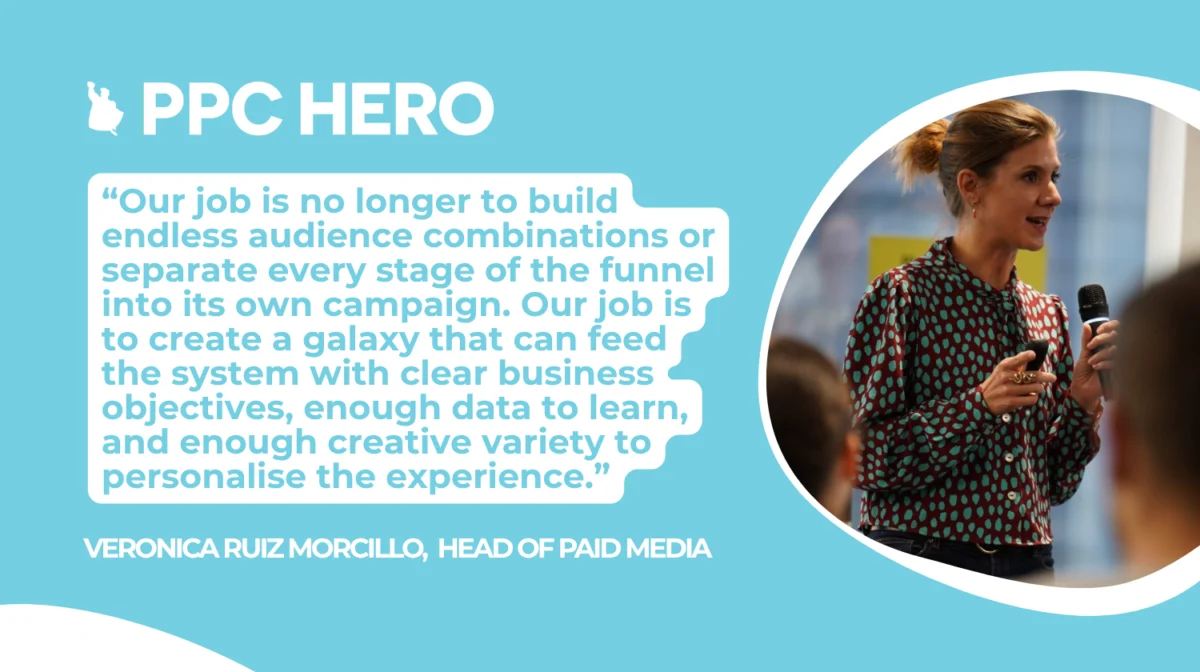
This evolution reflects a fundamental shift in the role of the advertiser. Instead of meticulously building “micro-planets” of audience segments, the focus is now on constructing “galaxies” of clear business objectives, rich data, and diverse creative content. Meta’s AI is now demonstrably more adept at identifying the right users than humanly possible through intricate segmentation. The advertiser’s primary responsibility has transitioned from audience management to the creation of a robust and dynamic system that empowers the AI to perform optimally.
The Future of Paid Social: Understanding People, Not Just Segments
The irony of this transformation is that while campaign structures are becoming simpler, the creative strategy is becoming infinitely more sophisticated. The time previously spent organizing audiences is now being redirected towards a deeper understanding of human behavior, motivations, and preferences. This shift represents a more engaging and ultimately more impactful approach to digital advertising. By focusing on the “why” behind consumer behavior and translating that into diverse and compelling creative narratives, advertisers can harness the full power of AI systems like Andromeda, fostering more meaningful connections with their audiences and driving more effective business outcomes. The era of Andromeda is not just about technological advancement; it’s about a more human-centric and strategically nuanced approach to digital engagement.