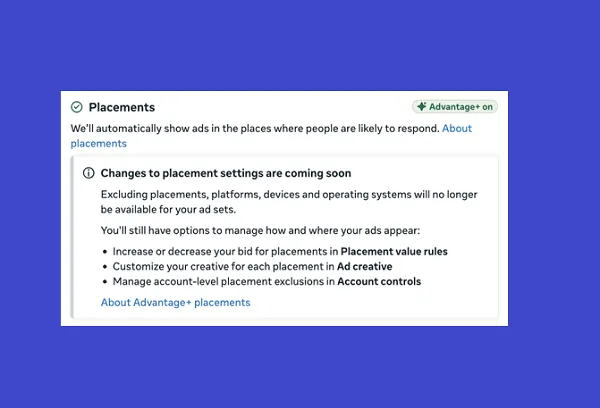
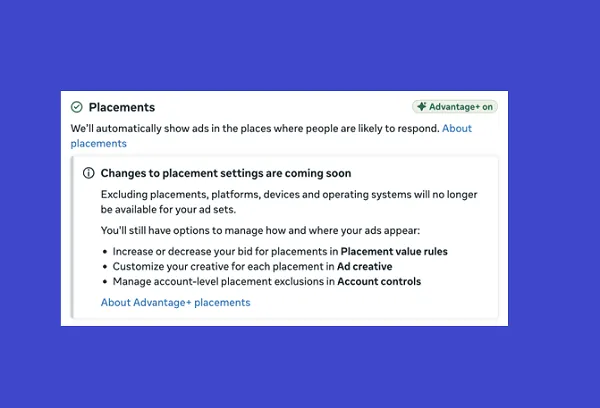
Meta is poised to fundamentally alter how advertisers manage their campaigns, announcing the imminent removal of manual placement and platform exclusion options from ad sets. This strategic shift, initially flagged by Meta ads expert Jon Loomer, signals a significant acceleration towards the company’s long-term vision of fully automated, AI-driven advertising. While a definitive timeline for these changes remains unannounced, the move represents a critical step in Meta’s efforts to simplify campaign management and maximize performance through its sophisticated artificial intelligence systems, compelling advertisers to increasingly cede control to the platform’s algorithms.
The core of this impending change involves the removal of the "Placements" option, which currently allows advertisers to meticulously select or deselect specific locations where their ads appear across Meta’s extensive network. This includes granular choices such as excluding ads from Facebook search results, in-stream ads within Reels, or even specific articles in the Audience Network. For years, this feature has been a cornerstone for marketers seeking precise control over brand safety, contextual relevance, and budget allocation tailored to specific ad formats or user experiences. However, Meta’s new directive aims to eliminate this manual override, instead pushing advertisers towards broader, system-optimized placements.
Further underscoring this trajectory, Jon Loomer also highlighted that the ability to exclude entire platforms (e.g., Facebook, Instagram, Messenger, Audience Network) will similarly be deprecated. This means that Meta’s AI will gain complete autonomy to distribute campaigns across any of its properties, based purely on its algorithmic assessment of where an ad is most likely to achieve the advertiser’s stated objective. This comprehensive removal of manual controls signifies a profound reorientation, shifting the onus of optimization entirely onto Meta’s automated systems.
The Evolution of Meta’s Automated Advertising Vision
This latest development is not an isolated incident but rather a natural progression within Meta’s overarching strategy, openly articulated by CEO Mark Zuckerberg. In a pivotal 2023 interview with Ben Thompson of Stratechery, Zuckerberg laid out a bold vision for the future of advertising on Meta’s platforms. He envisioned a future where businesses could launch campaigns with minimal human input: "We’re going to get to a point where you’re a business, you come to us, you tell us what your objective is, you connect to your bank account, you don’t need any creative, you don’t need any targeting demographic, you don’t need any measurement, except to be able to read the results that we spit out. I think that’s going to be huge, I think it is a redefinition of the category of advertising." This statement encapsulates the "lights-out advertising" ideal – a system so intelligent and self-sufficient that it handles everything from creative generation to targeting, placement, and performance optimization, requiring only a business objective and a budget from the advertiser.
The roots of this automation drive extend back several years, significantly accelerated by external pressures and internal strategic shifts. The introduction of Apple’s App Tracking Transparency (ATT) framework with iOS 14.5 in 2021 proved to be a watershed moment. By limiting Meta’s ability to track user behavior across apps and websites, ATT severely hampered the precision of traditional, granular targeting methods. In response, Meta pivoted aggressively towards aggregated data and machine learning, emphasizing solutions that could deliver performance without relying on individual-level tracking. This environment made automation not just a convenience, but a necessity for maintaining ad effectiveness.
A Chronology of Meta’s Automation Milestones
Meta’s journey towards a fully automated ad ecosystem can be traced through several key initiatives:
- 2019-2020: The "Power5" Framework: Meta introduced the "Power5," a set of five best practices designed to leverage its automated systems. These included Account Simplification, Advantage+ (formerly Automatic) Placements, Dynamic Ads, Campaign Budget Optimization (CBO), and Simplified Account Structure. These recommendations encouraged advertisers to give Meta’s algorithms more leeway in campaign management.
- 2021: iOS 14.5 and the Shift: Following Apple’s privacy changes, Meta doubled down on its machine learning capabilities. The platform emphasized broad targeting and "signal loss mitigation" techniques, pushing advertisers away from highly specific audience segments towards allowing the algorithm to find optimal audiences.
- 2022: Advantage+ Shopping Campaigns (ASC): This was a major leap forward. ASC streamlined the creation of performance-focused shopping campaigns, requiring minimal input from advertisers beyond a budget and creative assets. Meta’s AI then dynamically tested and optimized across audiences, placements, and creative variations to drive conversions. This proved highly successful for many e-commerce businesses, demonstrating the power of automation.
- 2023: Expansion of Advantage+ Suite: Meta continued to expand its Advantage+ offerings, introducing Advantage+ Creative, Advantage+ Audience, and Advantage+ Placements. These tools further automated various aspects of campaign setup, from generating creative variations to identifying optimal audience segments and, crucially, selecting the best ad placements. The current announcement about removing manual placement controls directly builds on the existing Advantage+ Placements framework, making it the default and only option.
- Ongoing: AI Integration Across the Board: Beyond specific ad products, Meta has been consistently integrating AI into every facet of its ad infrastructure – from bid optimization and delivery to ad ranking and measurement. The goal is to create a seamless, self-optimizing system that learns and adapts in real-time.
Supporting Data and Industry Context
Meta’s pivot towards automation is not unique; it mirrors a broader trend across the digital advertising landscape. Competitors like Google have heavily invested in similar "black box" solutions, with Performance Max campaigns serving as Google’s answer to fully automated ad management across its vast network. TikTok also employs highly sophisticated AI for its Smart Performance Campaigns, leveraging its powerful recommendation engine to drive ad effectiveness.
Industry data consistently highlights the potential benefits of AI-driven optimization:
- Increased Efficiency: AI can analyze vast datasets and make real-time adjustments far faster and more accurately than human marketers, leading to more efficient budget allocation. A study by BCG and Google found that AI-powered marketing can improve ROI by 15-20%.
- Improved Performance: By continuously learning from user interactions and performance metrics, AI algorithms can identify optimal combinations of audience, creative, and placement to drive better results, often leading to higher conversion rates and lower cost per acquisition. Meta itself has frequently cited internal studies demonstrating that Advantage+ products consistently outperform traditional manual campaigns for many advertisers.
- Scalability: Automation allows advertisers to manage larger, more complex campaigns with fewer resources, making advanced advertising accessible to a wider range of businesses, from small enterprises to large corporations.
Implications for Advertisers: Benefits and Challenges
The removal of manual placement controls presents a double-edged sword for advertisers.
Potential Benefits:
- Simplified Campaign Management: For businesses with limited resources or expertise, the streamlined process could significantly reduce the time and effort required to launch and manage campaigns. This democratizes access to sophisticated ad optimization.
- Enhanced Performance: Meta’s AI, with its expansive processing capacity and real-time data analysis, is theoretically better equipped to identify the most responsive display options across its diverse platforms. This could lead to more effective ad delivery and improved ROI for many.
- Access to New Audiences: By removing manual exclusions, ads may be exposed to placements or platforms that advertisers might have overlooked, potentially uncovering new high-performing audience segments.
- Adaptation to Privacy Changes: In a privacy-first world where granular targeting is increasingly challenging, relying on aggregated data and AI for optimization becomes a pragmatic approach to maintain ad effectiveness.
Significant Challenges and Concerns:
- Loss of Granular Control: This is the most immediate concern. Advertisers will lose the ability to exclude specific placements for brand safety, contextual relevance, or performance reasons. For instance, a luxury brand might not want its ads appearing in certain low-quality mobile apps within the Audience Network, or a sensitive ad might be inappropriate for in-stream video placements.
- Brand Safety and Suitability: Without direct control, advertisers must place absolute trust in Meta’s automated systems to ensure their ads appear in suitable environments. While Meta employs brand safety tools, the complete removal of advertiser-side exclusions raises questions about the platform’s ability to cater to nuanced brand guidelines.
- Reduced Transparency: The "black box" nature of AI-driven optimization means advertisers may have less insight into why their ads are performing well or poorly in specific contexts. This can complicate performance analysis and strategic planning.
- Creative Fatigue and Homogenization: The original article touches on a crucial concern: if AI generates and optimizes all ads, will there be a risk of ads becoming too similar or predictable over time, leading to creative fatigue and diminishing returns? While Meta undoubtedly has mechanisms to promote diversity, over-reliance on algorithms could inadvertently limit human creativity and experimentation.
- Budget Allocation Discrepancies: Advertisers often have preferences for certain platforms or ad formats based on their specific business goals (e.g., driving app installs vs. brand awareness). The AI might prioritize conversions over other objectives if not explicitly instructed, potentially leading to suboptimal budget distribution from the advertiser’s perspective.
- Learning Curve for Optimization: While setup might be simpler, optimizing performance will now require a different skillset – understanding how to "coach" the AI through objectives, creative inputs, and budget adjustments, rather than direct manual configuration.
Inferred Statements and Reactions
Meta’s Official Stance (Inferred): Meta will likely frame these changes as an inevitable evolution towards a more efficient and effective advertising ecosystem. Their messaging will emphasize the superior capabilities of AI in optimizing campaigns for better ROI, simplifying complex processes for advertisers, and adapting to the evolving digital landscape, particularly in light of privacy changes. They would highlight internal data showing the superior performance of Advantage+ campaigns when fully leveraged. The argument would be that by removing manual overrides, the AI can operate at its peak efficiency, unconstrained by potentially suboptimal human choices.
Advertiser Reactions (Inferred): Reactions from the advertising community are expected to be mixed.
- Experienced Marketers and Agencies: Many highly skilled media buyers and agencies, who have built their expertise on granular control and strategic placement choices, may express frustration. They value the ability to fine-tune campaigns for specific objectives, manage brand perception, and conduct detailed A/B testing across placements. For them, this feels like a loss of strategic leverage.
- Small Businesses and Novice Advertisers: Smaller businesses or those new to digital advertising might welcome the simplification. The prospect of an AI handling complex optimization could reduce barriers to entry and make advertising more accessible, allowing them to focus on their core business.
- Performance Marketers: Those primarily focused on direct response and measurable ROI might be more open to the change, provided the AI consistently delivers superior performance. Their primary concern would be results, and if Meta’s AI can reliably improve their metrics, the loss of control might be a worthwhile trade-off.
Industry Analyst Perspective (Inferred): Industry analysts would likely view this as a continuation of the "walled garden" strategy adopted by major platforms. By centralizing control and pushing advertisers towards automation, Meta reinforces its ecosystem, potentially increasing its share of ad spend while making it harder for advertisers to compare performance across platforms with identical strategies. It’s a move that consolidates power and data within Meta’s infrastructure, positioning them as the ultimate arbiters of ad effectiveness on their platforms.
Broader Impact and Future Outlook
The removal of placement controls is more than just a feature update; it’s a philosophical shift that redefines the relationship between advertisers and the platform. It signals a future where the human role in advertising becomes increasingly strategic and less tactical. Ad managers may transition from configuring campaigns to focusing on higher-level objectives, creative innovation, and interpreting AI-generated insights, rather than manually adjusting bids or placements.
The long-term vision of "lights-out advertising" raises profound questions about the future of marketing roles, the nature of creativity in an AI-driven world, and the potential for market concentration. As Meta’s AI becomes more sophisticated, its ability to generate compelling creative, identify niche audiences, and optimize across an ever-expanding array of placements will only grow. This could lead to an unprecedented level of efficiency for businesses, but also to a greater reliance on a single platform’s algorithms.
Furthermore, the ethical implications of fully automated advertising will undoubtedly come under increased scrutiny. Questions about algorithmic bias, the potential for manipulation, and the transparency of ad delivery will become even more pressing as human oversight diminishes. Regulators and privacy advocates will likely keep a close watch on how platforms like Meta balance their pursuit of automation with advertiser needs for control, brand safety, and ethical ad practices.
Ultimately, Meta’s move to remove manual placement controls is a decisive step towards its envisioned future of AI-first advertising. While it promises enhanced efficiency and performance through sophisticated automation, it also ushers in an era of reduced advertiser autonomy, demanding a new level of trust in algorithmic decision-making and a re-evaluation of traditional advertising strategies. The success of this transition will hinge on Meta’s ability to consistently deliver superior results while addressing the legitimate concerns of advertisers regarding control, transparency, and brand suitability in an increasingly automated landscape.