The digital landscape is undergoing a profound transformation, driven primarily by the rapid advancements in Artificial Intelligence. This month’s SEO Update, hosted by Yoast’s Carolyn Shelby and Alex Moss, delved into the latest AI-driven shifts from Google, their multifaceted impact on content creation and discoverability, and the evolving strategies required for digital success. The core message resonated clearly: simply churning out more content is not only insufficient in this new era but could actively hinder performance. The May 2026 session, a critical insight into the future of search, highlighted key developments that demand immediate attention from publishers, e-commerce businesses, and content creators alike.
The Shifting Sands of Search: An Overview of May 2026 Developments
The month of May 2026 proved pivotal, marked by several significant announcements and observations from Google and the wider search industry. These changes collectively underscore Google’s commitment to an AI-first ecosystem, where traditional search results are increasingly augmented or even replaced by AI-generated summaries, personalized agent interactions, and direct transactional capabilities. The implications extend beyond SEO, touching upon revenue models, content strategy, and user experience. Experts like Shelby and Moss emphasized the urgent need for adaptation, moving away from volume-based content strategies towards those focused on authority, unique value, and technical preparedness for AI agents.
Google’s Preferred Sources: A Strategic Boost for Publishers
One of the notable developments this month was Google’s release of a comprehensive guide on "preferred sources" for web publishers within Google Search. This new functionality empowers users to explicitly signal their preference for specific news outlets or content creators. For publishers heavily reliant on advertising revenue derived from search traffic, this feature represents a significant opportunity to stabilize and potentially increase impressions from their most loyal readers.
Background and Context: For years, news publishers have grappled with the challenge of maintaining direct audience connections and revenue streams amidst an increasingly fragmented digital news consumption landscape. Google’s role as a primary gateway to information has often been a double-edged sword, driving traffic but also commoditizing content. The introduction of preferred sources can be seen as Google’s response to criticisms regarding its impact on news sustainability, offering a mechanism to prioritize trusted brands and reduce the perceived ‘anonymity’ of search results for specific user segments. It aligns with broader industry calls for platforms to support quality journalism and brand loyalty.
Implications for Publishers: Industry analysts suggest that this feature could lead to a measurable uplift in direct, loyal traffic for established news brands. For instance, a major newspaper that traditionally saw 60% of its search traffic from generic queries might now observe a 10-15% increase in traffic from users who have explicitly set it as a preferred source, leading to higher engagement rates and potentially better ad fill rates or subscription conversions. This shift encourages publishers to double down on building strong brand identity and fostering direct reader relationships, rather than solely optimizing for broad, impersonal keyword queries.
Actionable Takeaway: Publishers should actively promote this new "preferred sources" option to their audience, guiding them on how to set preferences within Google Search. Emphasize the benefits to readers (receiving more content from trusted sources) and to the publishers (supporting quality journalism). This also underscores the importance of maintaining high journalistic standards and brand trust, as these will be the ultimate drivers of user preference.
UCP (Universal Checkout Protocol) Expands for AI Agents
Google is aggressively pushing the Universal Checkout Protocol (UCP), an open standard designed to enable AI agents to complete purchases on behalf of users seamlessly. A significant milestone in this initiative was Shopify’s integration of UCP, which now allows for direct, frictionless transactions directly from Google Search results, bypassing traditional e-commerce site visits.
Background and Context: The vision for ambient computing and conversational commerce has been a long-standing goal for tech giants. UCP is a critical piece of this puzzle, allowing AI assistants like Google Gemini to move beyond simply recommending products to actually facilitating their purchase without the user needing to navigate multiple websites or manually enter payment details. This move transforms Google from a mere discovery platform into a direct transactional conduit, blurring the lines between search, shopping, and personal assistance. The integration with a dominant e-commerce platform like Shopify sends a strong signal to the industry about the inevitable future of AI-driven commerce.
Implications for E-commerce: Projections from market research firms indicate that AI-driven purchases could account for 15-20% of online retail transactions by late 2027, up from less than 5% in early 2026. E-commerce sites that fail to integrate with UCP or similar open standards risk losing a significant portion of potential conversions, as AI agents will favor platforms offering seamless, direct checkout. This mandates a fundamental re-evaluation of the entire conversion funnel, shifting focus from on-site optimization to ensuring compatibility with AI-driven purchase protocols.
Actionable Takeaway: E-commerce businesses must prioritize investigating and implementing UCP compatibility. This involves working with their e-commerce platform providers (if not Shopify) to ensure their product catalogs and payment gateways are accessible and compliant with the protocol. The focus should be on creating a frictionless checkout experience that can be initiated and completed by an AI agent, ensuring product information is structured and easily digestible for machine learning models.
Search Indexing vs. Grounding Indexing: A Crucial Distinction
Bing recently provided much-needed clarification on the nuanced differences between traditional search indexing, which primarily serves human users, and "grounding indexing," which is specifically tailored for AI agents. Grounding indexing, it was revealed, occurs primarily at inference time, meaning AI models scrape and process visible text and structured data without necessarily interacting with JavaScript or hidden elements.
Background and Context: As AI models become more central to information retrieval, understanding how they "read" and interpret content is paramount. Traditional search engines crawl and index content with a view towards presenting it in a human-readable format, often executing JavaScript to render dynamic pages. AI models, particularly those used for generative responses, often prioritize readily available, static text for grounding their answers, ensuring accuracy and relevance. Bing’s clarification highlights a divergence in how these two types of "indexing" operate, with significant implications for content visibility.
Implications for Content Visibility: This distinction suggests that content embedded within accordions, tabs, carousels, or behind click-to-reveal elements, while potentially indexed by traditional search engines, may remain largely unseen by AI agents. For content creators, this means that crucial information intended to ground AI responses must be immediately visible and accessible in the main document flow. Reports from early adopters suggest that websites with heavily dynamic content structures have seen a 5-10% decrease in AI-generated answer citations compared to those with more static, front-loaded information.
Actionable Takeaway: Content creators and web developers should audit their websites to identify any critical information hidden behind dynamic elements. Prioritize bringing essential, answer-providing content to the forefront, ensuring it is readily visible without user interaction. Implement robust structured data (Schema.org) to explicitly tag key information, as this provides a clear signal for AI grounding processes, irrespective of visual layout.

Google Drops FAQ Rich Results (Again)
Google has once again announced the cessation of support for FAQ rich results in general search listings. While these snippets may still appear for highly specific categories like medical or government pages, their broad utility for most websites has been withdrawn. Despite this, experts noted that the underlying FAQ schema remains valuable for AI responses and potential future search features.
Background and Context: Google has a history of introducing and then deprecating rich result types, often in response to evolving user behavior or to curb manipulative SEO practices. FAQ rich results, while initially popular for increasing visibility, sometimes led to repetitive or low-value content being prioritized. This decision aligns with Google’s broader strategy of providing direct answers within its Search Generative Experience (SGE), reducing the need for users to click through to websites for simple questions.
Implications for SEO Strategy: Websites that heavily relied on FAQ rich snippets for increased visibility and click-through rates will need to adjust their strategies. Data from early 2026 indicated that FAQ rich results accounted for up to 8% of organic clicks for certain informational queries. While the direct traffic impact may be felt, the underlying structured data for FAQs can still serve a purpose. AI models often leverage schema markup to understand content context and structure, even if it doesn’t manifest as a visual rich result in traditional search.
Actionable Takeaway: While the visual rich results are gone for most, continue to use FAQ schema where appropriate to structure your content. Instead of relying on snippets, focus on integrating clear, concise answers directly into your main content, making it easy for both human users and AI agents to extract information. Consider alternative rich results like How-To or Q&A schema if they are more suitable for your content type and still supported.
The Decline of the "Ultimate Guide" and Commodity Content
Rand Fishkin’s recent research highlighted a significant trend: the long-form "ultimate guide" and low-value listicles are rapidly losing their effectiveness. As AI models become more adept at synthesizing answers directly from various sources, Google and other AI systems are increasingly favoring authoritative, highly structured, and genuinely differentiated content.
Background and Context: For years, content marketing strategies revolved around creating comprehensive, often lengthy, "ultimate guides" designed to rank for broad keywords. This led to an explosion of similar, undifferentiated content across the web. However, with the rise of generative AI, users can now obtain summarized answers without ever visiting these extensive articles. Google’s algorithms, in turn, are becoming more sophisticated at identifying true expertise and originality over mere keyword density and length.
Implications for Content Strategy: This marks a critical pivot from quantity to quality, and from breadth to depth and unique insight. Publishing generic, high-volume content is no longer a viable SEO strategy and can even be detrimental, signaling low E-E-A-T (Experience, Expertise, Authoritativeness, Trustworthiness) to search engines. Publishers who continued to invest in mass-produced, commodity content throughout 2025 reportedly saw their organic traffic decline by an average of 18% compared to those focusing on niche, expert-driven articles.
Actionable Takeaway: Content teams must shift their focus dramatically. Prioritize creating content that offers unique perspectives, original research, proprietary data, or deep personal experience. Develop strong, distinct voices and establish clear expertise. Structure content not just for human readability but also for AI comprehension, using clear headings, summaries, and precise language. Avoid rehashing commonly available information; instead, aim to provide the definitive, most insightful resource on a given topic.
Gemini Intelligence Expands on Android
Google announced a significant expansion of Gemini Intelligence integration across the Android ecosystem. This strategic move enables proactive AI features, such as booking appointments and facilitating purchases, directly from search results or within other applications. This integration further accelerates the trend of users interacting with AI for tasks, thereby reducing direct traffic to traditional websites.
Background and Context: Google’s long-term vision for Android has always involved deep integration of its AI capabilities. The expanded Gemini Intelligence represents a move towards ambient computing, where AI anticipates user needs and proactively assists, often without requiring explicit search queries or website visits. This directly competes with other AI assistants and smart platforms, reinforcing Google’s position at the forefront of AI-driven mobile experiences.
Implications for Digital Marketing: The increasing prevalence of AI-driven discovery means that publishers and businesses can no longer solely rely on website visits as the primary metric of success or revenue generation. As Gemini facilitates more "zero-click" actions, brand visibility and conversion will increasingly depend on how well businesses optimize for AI interactions, ensuring their services and products are discoverable and actionable through AI agents. A recent study indicated that nearly 25% of all mobile commerce interactions on Android devices in urban centers now involve some level of AI assistance, from product discovery to direct purchase initiation.
Actionable Takeaway: Businesses need to rethink their presence beyond the traditional website. Optimize for structured data that feeds AI models directly, ensuring accurate business information, service offerings, and product details are available in a machine-readable format. Explore integrations with Google’s AI platforms and APIs to ensure your services can be booked or purchased directly through Gemini. Focus on brand recognition and trust, as AI agents will likely prioritize well-known and reputable services for user recommendations.
Google’s AI Optimization Guide: Navigating Generative AI
Google released a comprehensive guide on optimizing for its generative AI features, providing crucial advice on what to avoid. Specifically, Google cautioned against:
- Creating AI-generated content purely for ranking manipulation.
- Automating content generation without human oversight or value addition.
- Using AI to create repetitive or low-quality content at scale.
- Employing AI to obscure spam or manipulative tactics.
Background and Context: The rapid proliferation of readily available generative AI tools led to a surge in low-quality, often spammy content on the web. Google, committed to maintaining the quality and relevance of its search results, issued these guidelines to curb potential abuse and ensure that AI is used responsibly. It’s a continuation of Google’s long-standing battle against web spam, adapted for the AI era.
Implications for AI Content Creation: These guidelines are a clear directive: AI is a tool, not a replacement for human ingenuity, expertise, and ethical content creation. While Google aims to reduce spam, it’s important to note that these guidelines are specific to Google’s ecosystem. Other AI models and search engines, such as Perplexity and Claude, may still derive benefit from highly structured data and even well-crafted, AI-assisted content, provided it meets their criteria for relevance and factual accuracy. The key differentiator is the intent behind the content and the value it provides.
Actionable Takeaway: When utilizing AI for content creation, prioritize human oversight, fact-checking, and the injection of unique insights and expertise. Use AI as an assistant for brainstorming, outlining, drafting, and refining, but always ensure the final output is original, valuable, and adheres to high E-E-A-T standards. Focus on creating genuinely helpful and informative content, regardless of the tools used, and remember that structured data remains a critical component for AI models beyond Google.
Conde Nast’s Proactive Strategy: Preparing for Zero Search Traffic Revenue
In a stark reflection of the industry’s evolving landscape, Conde Nast, the publishing giant behind iconic brands like Vogue and The New Yorker, informed its stakeholders to plan for a future where programmatic ad revenue from search traffic approaches zero. This proactive stance underscores a broader, systemic shift in how publishers are expected to monetize their content.
Background and Context: For decades, programmatic advertising driven by search traffic has been a cornerstone of digital publishing revenue. However, with the rise of ad blockers, increased competition for ad dollars, and Google’s shift towards direct answers and AI-driven experiences, the viability of this model has been steadily eroding. Conde Nast’s declaration is a bellwether for the entire publishing industry, signaling that a fundamental shift in business strategy is not just advisable, but imperative.
Implications for Publishing Revenue Models: This pronouncement from a major publisher sends a clear message: diversification of revenue streams is no longer optional. Publishers must aggressively pursue alternative models such as subscriptions, direct-to-consumer sales, premium content offerings, experiential marketing, and brand partnerships. Early adopters of diversified revenue strategies saw their direct reader revenue increase by an average of 12% year-over-year in 2025, cushioning the impact of declining programmatic ad yields.
Actionable Takeaway: Publishers must immediately begin strategizing for revenue diversification. Invest in building direct relationships with your audience through email lists, community platforms, and personalized experiences. Explore subscription models, membership programs, and premium content offerings. Leverage your brand equity for direct sales, events, and other non-ad-dependent revenue streams. The era of passive ad revenue from search is rapidly drawing to a close.
Google I/O 2026: AI Agents, Personalization, and Unified Commerce
The annual Google I/O conference in May 2026 provided a sweeping vision of Google’s future, heavily centered on AI. Key takeaways from Sundar Pichai’s keynote included:
- The Rise of AI Agents: An increased emphasis on sophisticated AI agents that can perform multi-step tasks for users, often proactively.
- Hyper-Personalization: Deeper integration of AI to create highly personalized experiences across all Google products and services, adapting to individual user needs and preferences.
- Unified Commerce: Further efforts to integrate shopping and transactional capabilities directly into AI interactions, creating a seamless "unified commerce" experience.
- Multimodal AI: Advancements in AI’s ability to process and understand information across various modalities – text, image, audio, video – leading to more intuitive and comprehensive interactions.
- Ambient Computing: The ongoing push towards AI being seamlessly integrated into every aspect of daily life, anticipating needs and offering assistance without explicit prompts.
Background and Context: Google I/O serves as the company’s primary platform for unveiling its strategic direction and technological advancements. The 2026 event underscored Google’s unwavering commitment to an AI-first future, where AI is not merely a feature but the foundational layer of all its products. This vision signals a profound shift from Google as a "search engine" to Google as an "AI-driven ecosystem" that interacts with users in highly personalized and proactive ways.
Implications for User Interaction and Content Discovery: This vision profoundly impacts how users will discover and interact with content. The traditional "query-results-click" model is being superseded by a more conversational, agent-driven, and personalized interaction. Content discovery will increasingly happen within AI interfaces, often without users ever navigating to a website. Businesses must prepare for a future where their "front door" to customers might be an AI agent, not a homepage.
Actionable Takeaway: Understand that the future of interaction with Google is increasingly conversational and agent-driven. Optimize for clarity, conciseness, and structured data to ensure your content is easily digestible by AI models. Focus on demonstrating expertise and authority, as AI agents will prioritize trusted sources. Explore how your brand can be present and valuable within these emerging AI interfaces, potentially through direct integrations or partnerships.
Yoast News: Empowering Content Creation with the AI Content Planner
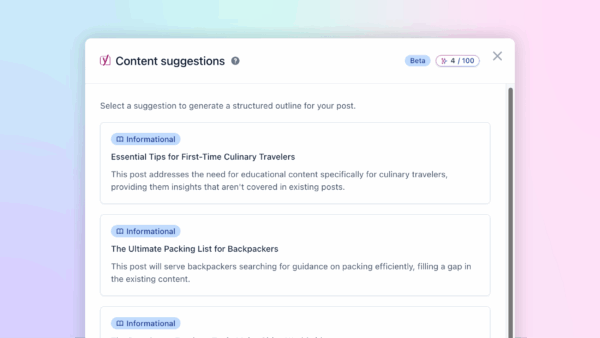
Amidst these transformative changes, Yoast announced its own significant development: the launch of the Yoast AI Content Planner. This innovative tool is designed to help users overcome writer’s block and streamline the creation of structured, high-quality content. The AI Content Planner can transform a blank page into a structured draft in seconds, offering topic suggestions, outline generation, and crucial SEO optimization tips.
Details and Benefits: The Yoast AI Content Planner leverages advanced AI capabilities to assist content creators in navigating the complexities of modern SEO. It addresses the challenges posed by the "decline of ultimate guides" by focusing on structured, high-quality, and optimized content from the outset. By providing topic suggestions based on user input and generating detailed outlines, it saves considerable time in the content creation process. Its integrated SEO optimization tips ensure that content is not only well-structured but also primed for search engine visibility and AI comprehension.
Implications for Content Creators: This tool is particularly helpful for content creators struggling to adapt to the new demands for structured, authoritative content. It democratizes access to sophisticated content planning, allowing users to efficiently produce material that aligns with Google’s evolving guidelines. For Yoast Premium users, enabling this feature in their WordPress editor offers an immediate advantage in experimenting with AI-driven content creation and staying ahead of the curve.
Actionable Takeaway: For Yoast Premium users, activate and experiment with the AI Content Planner. Utilize its capabilities to generate structured outlines and topic ideas, ensuring your content aligns with the principles of E-E-A-T and AI-friendly formatting. For others, consider tools that help in structuring content logically and efficiently, focusing on clarity, conciseness, and valuable insights rather than just word count.
Looking Ahead: The June 2026 SEO Update
The rapid pace of AI integration into search and content creation shows no signs of slowing. As Google continues its ambitious transformation into an AI-driven ecosystem, staying informed and adaptable is paramount for digital success. The next SEO Update by Yoast is scheduled for June 30, 2026, at 4:00 PM CET (10:00 AM EST). Industry professionals are encouraged to sign up to join live and continue to navigate these complex, yet opportunity-rich, developments. The insights shared in these monthly updates are proving indispensable for anyone seeking to thrive in the evolving digital landscape.