The landscape of large language models is frequently punctuated by the release of "frontier" models, yet few introduce the level of granular operational control found in Moonshot AI’s latest release, Kimi K3. While many developers have grown accustomed to the "black box" nature of API interactions—where a prompt is sent and a response is received with little transparency regarding the internal computation—Kimi K3 shifts this paradigm by introducing a suite of API-level settings that fundamentally alter the economic and functional utility of the model. By exposing parameters such as reasoning effort and implementing sophisticated prefix caching, Moonshot AI is positioning K3 not just as a competitor to OpenAI’s o1 or Anthropic’s Claude 3.5, but as a specialized tool for high-density information processing and complex software engineering tasks.
The Technical Architecture of a 2.8 Trillion Parameter Giant
At its core, Kimi K3 is a Mixture-of-Experts (MoE) model, a design philosophy that allows a model to possess a massive total parameter count while maintaining relatively low inference costs. K3 boasts a staggering 2.8 trillion total parameters, yet the architecture is designed such that only a fraction of these are active for any given token. Out of approximately 896 routed experts, only 16 are engaged per input. This "sparse activation" allows the model to maintain the intelligence of a multi-trillion parameter system without the prohibitive latency or cost typically associated with such scale.
To achieve this, Moonshot AI has implemented several proprietary technical innovations. One of the most significant is Kimi Delta Attention (KDA). In traditional transformer architectures, the key-value (KV) cache grows linearly with the context length, often leading to memory bottlenecks when processing long documents. KDA utilizes a form of linear attention that stabilizes memory usage, allowing the model to handle massive context windows without a proportional increase in hardware overhead. Furthermore, the model utilizes LatentMoE for more efficient routing and has entirely replaced traditional rotary position embeddings with a system known as NoPE (No Positional Embeddings), which enhances the model’s ability to handle sequence lengths that exceed training distributions.
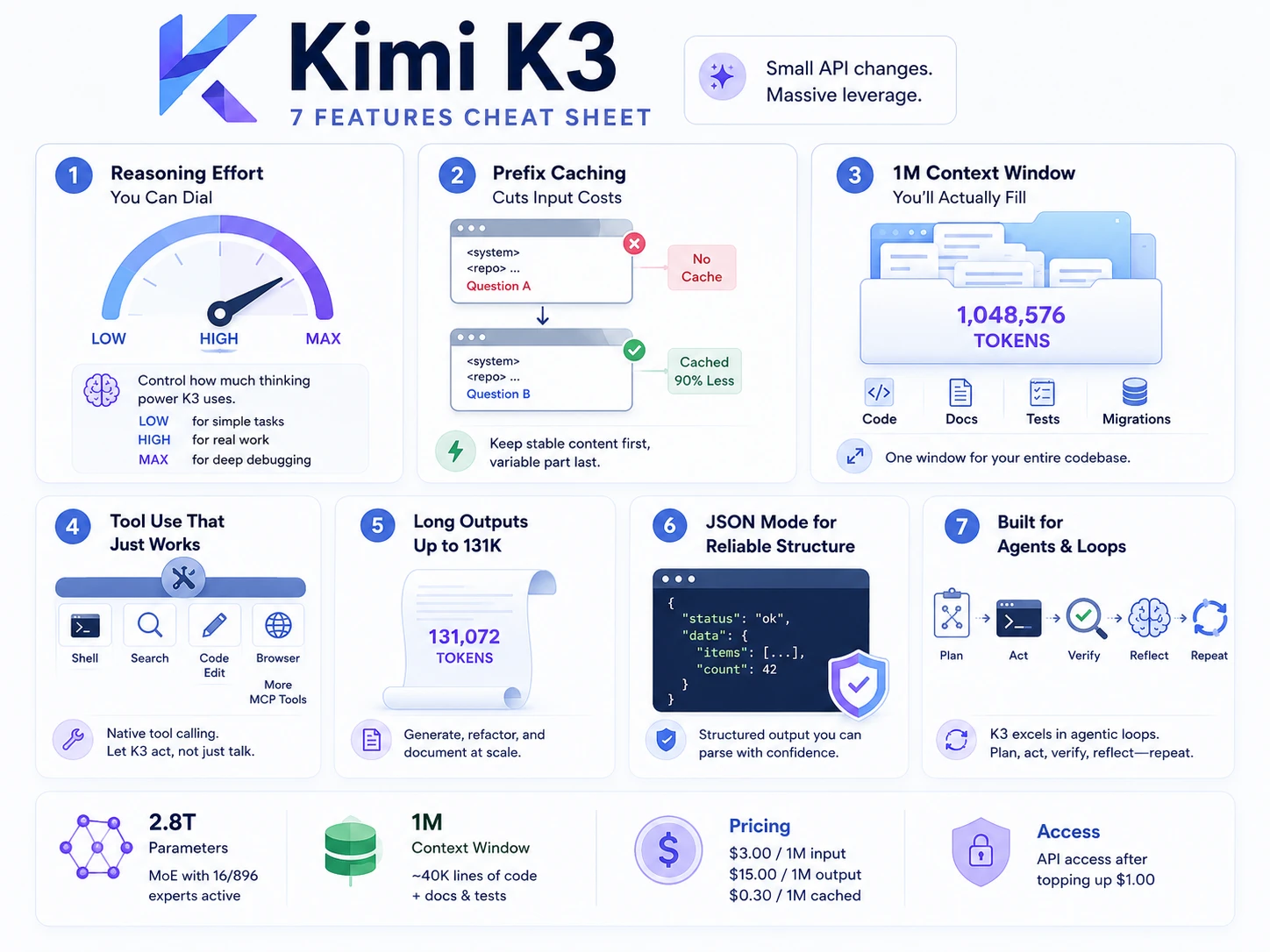
The weights themselves are distributed using quantized MXFP4 (Microscaling Formats), a 4-bit floating-point representation that preserves high precision while significantly reducing the storage and memory footprint. This technical sophistication is reflected in the model’s context window, which supports up to 1,048,576 tokens, placing it in the same tier as Google’s Gemini 1.5 Pro for long-context capabilities.
The Reasoning Economy: Understanding the reasoning_effort Parameter
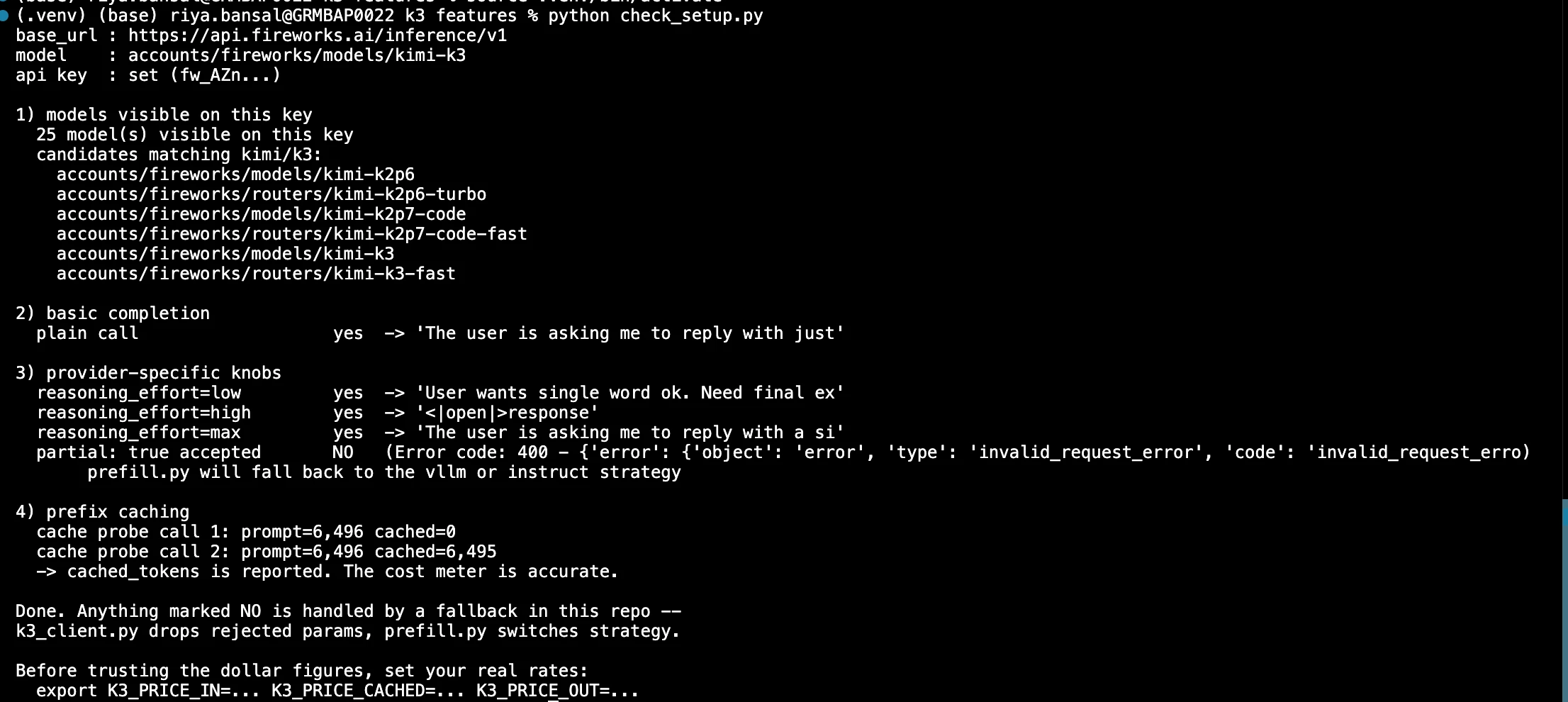
The most significant departure from standard API design in Kimi K3 is the introduction of the reasoning_effort parameter. Unlike traditional models where "thinking" is an invisible part of the inference process, K3 makes the model’s internal deliberation a tunable variable. The API provides three distinct tiers: low, high, and max.
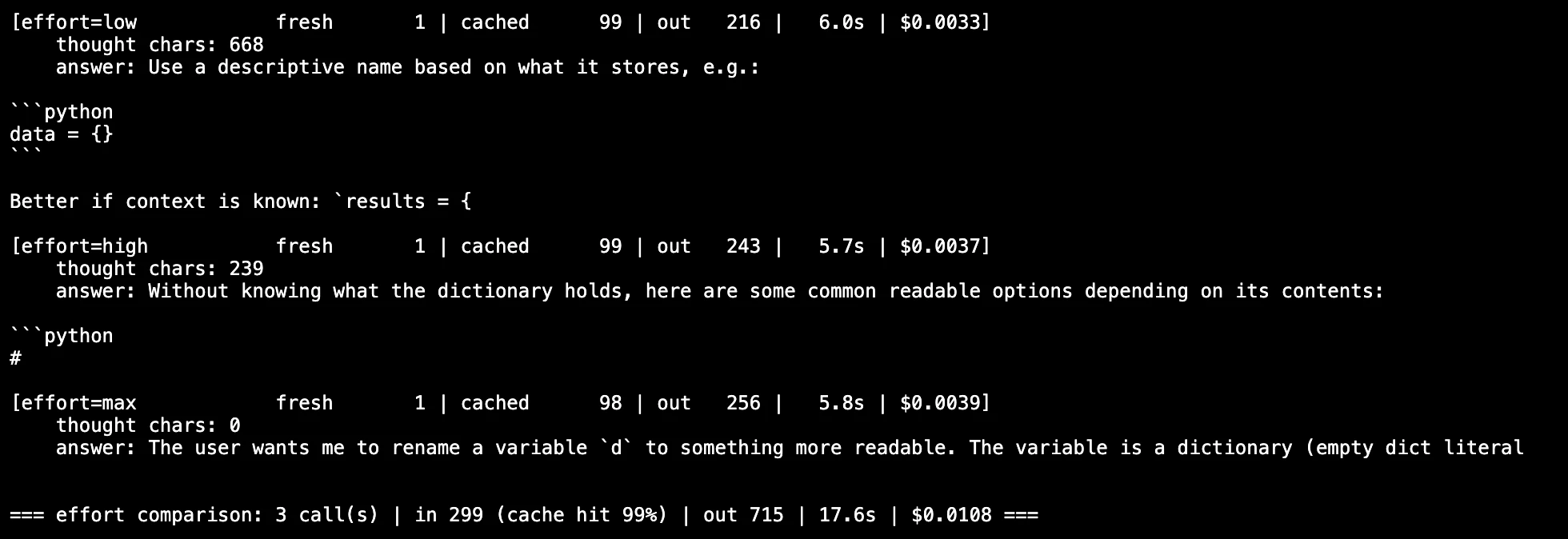
This is not merely a cosmetic setting; it dictates the depth of the model’s Chain-of-Thought (CoT) processing. When set to max, K3 will engage in exhaustive reasoning, often identifying edge cases, race conditions, or subtle logical fallacies that a standard pass would miss. For example, asking the model to perform a simple task like variable renaming under the max setting might result in the model analyzing the entire scope of the codebase to ensure no naming collisions occur across asynchronous functions.
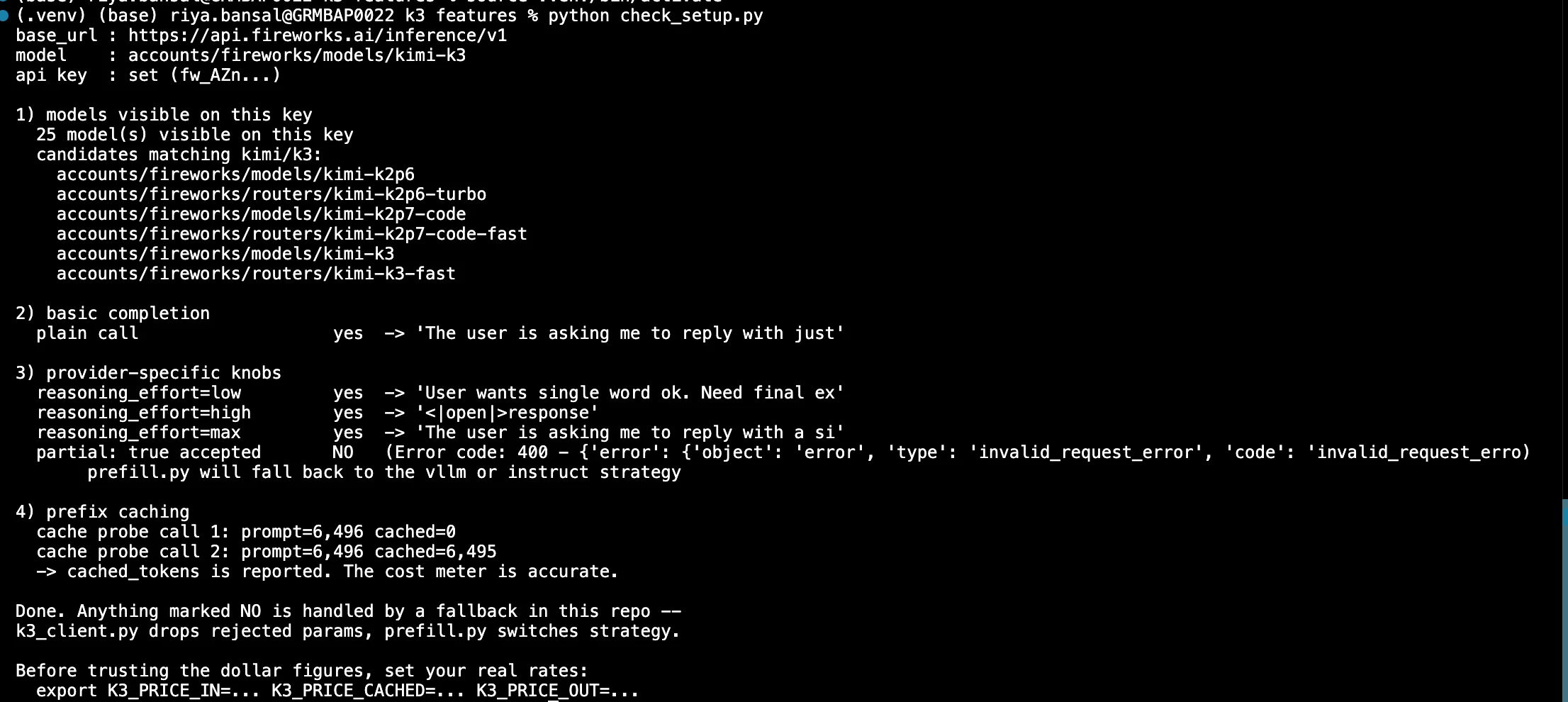
However, this increased intelligence comes at a cost. The max setting defaults to a max_completion_tokens value of 131,072. Without careful management, a developer could inadvertently trigger a massive reasoning chain for a trivial task, leading to unnecessary expenses. The strategic implementation of K3 involves matching the effort level to the task complexity: low for mechanical edits and boilerplate, high for standard logic, and max for deep architectural debugging and security audits.
Economic Efficiency Through Advanced Prefix Caching
Pricing remains a critical barrier for the adoption of long-context models. Kimi K3 is priced at $3.00 per million input tokens and $15.00 per million output tokens. While these rates are competitive for a model of this scale, the true economic advantage lies in its native prefix caching.
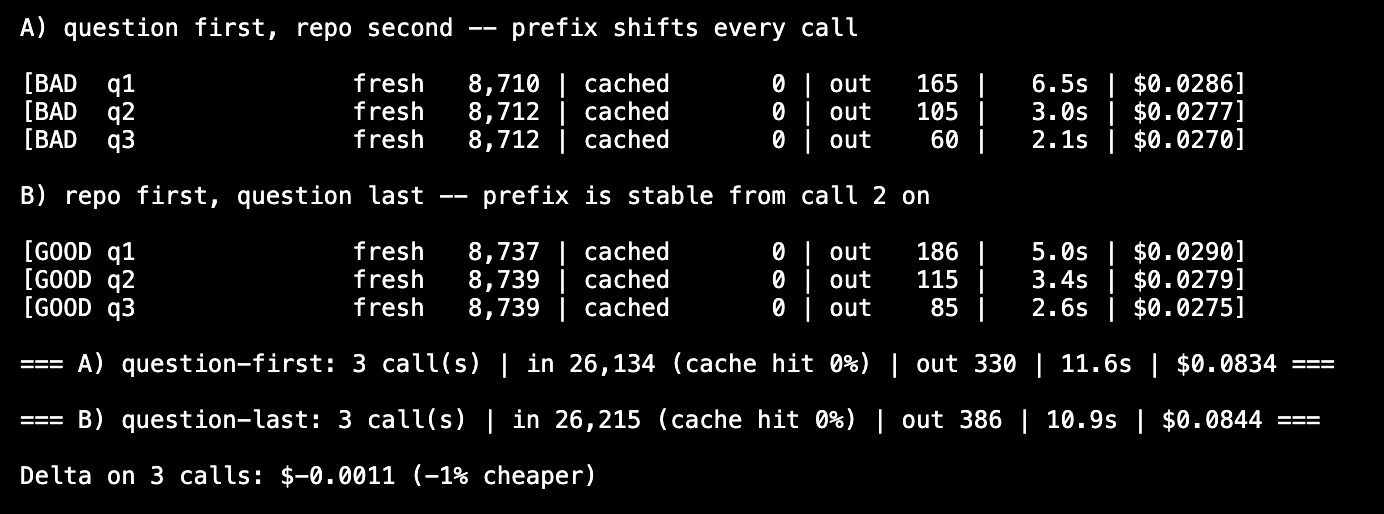
K3’s caching system is "transparent," meaning it does not require explicit cache IDs or Time-to-Live (TTL) configurations. The system automatically identifies and caches prompt prefixes that exceed 256 tokens. When a cache hit occurs, the cost for those input tokens drops by 90%, from $3.00 to $0.30 per million tokens.
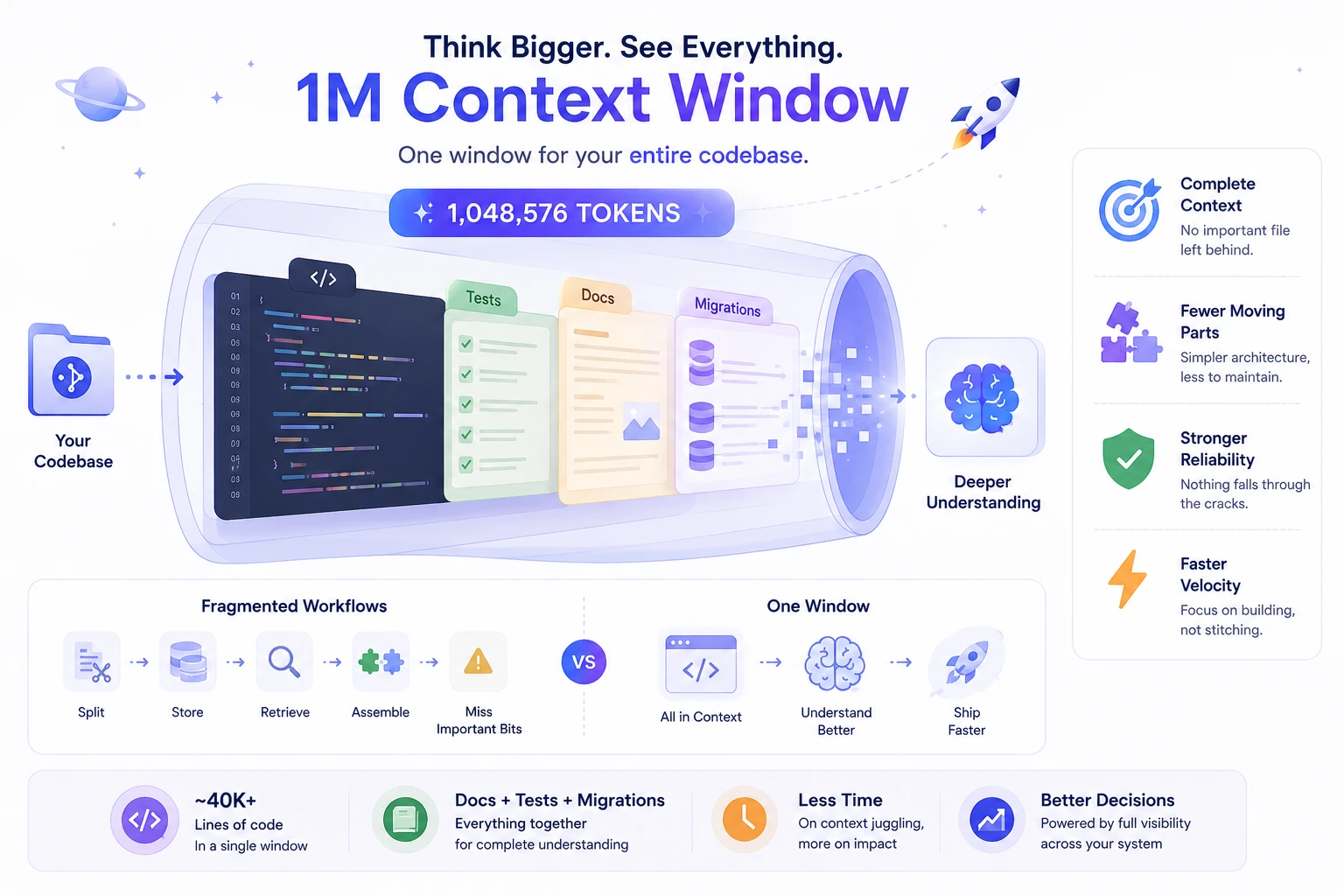
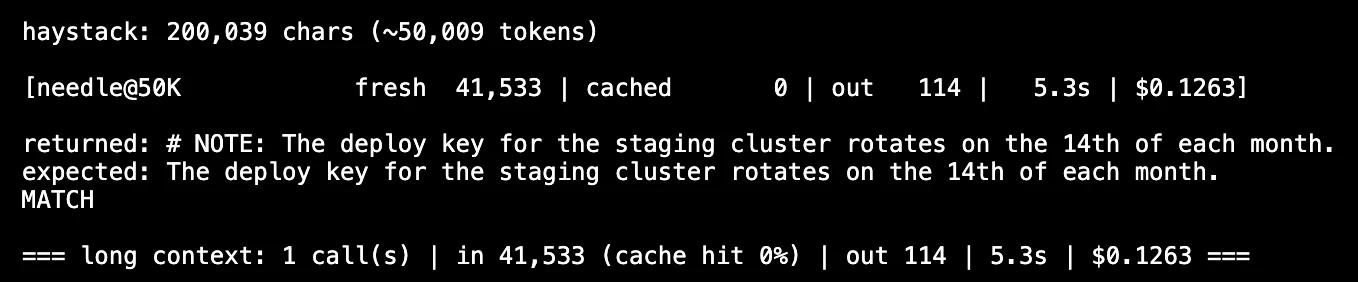
This creates a new imperative for prompt engineering: structural stability. In traditional workflows, developers often place dynamic content, such as a user’s specific question, at the beginning of a prompt. This practice breaks the prefix cache for every subsequent request. By reordering the prompt to place stable content—such as a 500,000-token repository blob or a massive legal document—at the beginning and the dynamic query at the end, developers can process multiple queries against the same data at a fraction of the original cost. This makes K3 a viable alternative to Retrieval-Augmented Generation (RAG) for many use cases, as it is often cheaper and more accurate to feed an entire codebase into the 1M context window than to maintain a complex vector database infrastructure.
Advanced Functional Features: Partial Mode and Enforced Tool Calling
Kimi K3 introduces "Partial Mode," a feature that allows developers to provide a pre-filled response for the assistant. By setting the partial flag to true in the last message of the assistant role, developers can force the model to continue from a specific string. This is particularly useful for steering the model toward structured outputs like JSON without the "preamble" often generated by LLMs (e.g., "Certainly! Here is the JSON you requested…").
Furthermore, K3’s tool-calling capabilities include a required mode, which forces the model to select a tool before providing a textual response. This is a critical feature for autonomous agents, ensuring that the model does not attempt to "hallucinate" an answer when it has been instructed to use a specific external function or API. Moonshot AI emphasizes that for complex agentic workflows, it is vital to feed the model’s internal reasoning back into the conversation history. Without this reasoning context, the model may lose the "thread" of its plan during multi-turn interactions, leading to degraded performance in long-running tasks.
The Reality of Open Weights and Hardware Requirements
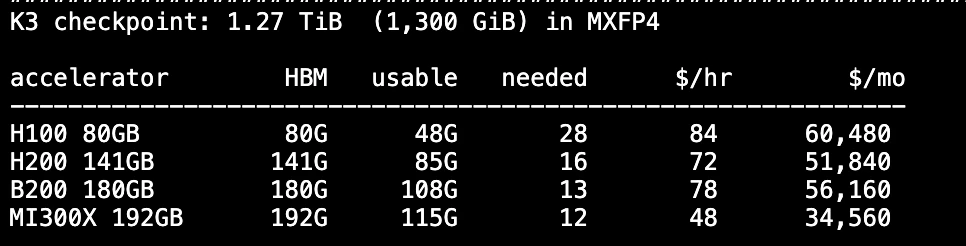
In a move toward transparency, Moonshot AI has released the weights for Kimi K3, allowing enterprises to host the model on their own infrastructure. However, the sheer scale of the model introduces significant hardware challenges. The total size of the weights is approximately 1.27 TiB.
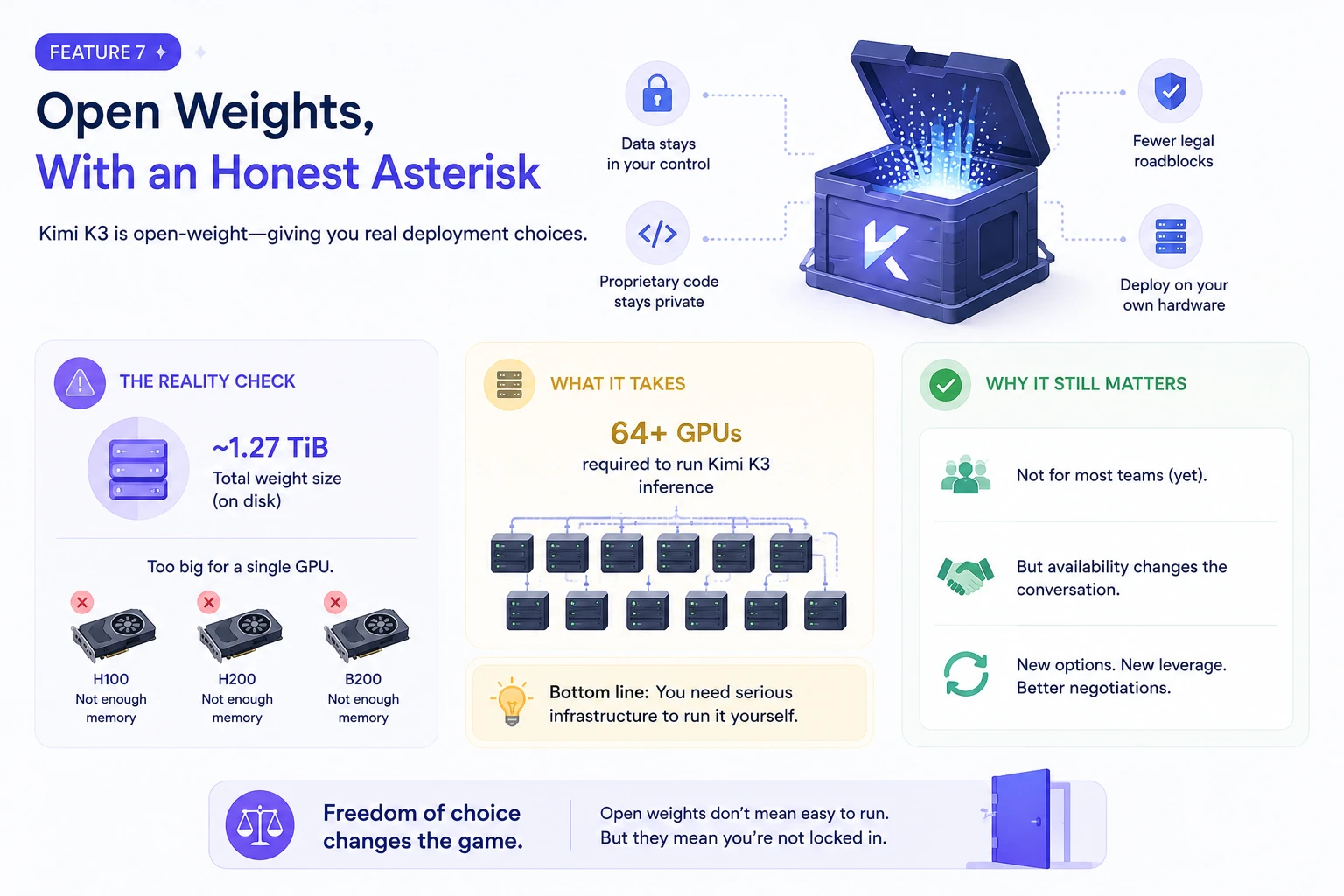
To run K3 at full capacity, a massive hardware cluster is required. A single NVIDIA H100 or H200 GPU, which typically offers 80GB to 141GB of VRAM, is insufficient. In practice, deploying K3 requires a minimum of 64 high-end GPUs networked together to handle the parameter count and the memory overhead of the 1M token context window. For most small-to-medium enterprises, the cost of local hosting remains prohibitive, making the Moonshot API the primary gateway for utilizing K3. Nevertheless, the availability of open weights provides a crucial "exit strategy" for large corporations concerned about data sovereignty and long-term vendor lock-in.
Chronology of Development and Market Impact
The release of Kimi K3 marks a significant milestone in the evolution of Moonshot AI, a company founded by Yang Zhilin, a prominent figure in the AI world previously known for his work at Google and Meta. Since its inception in 2023, Moonshot AI has focused on the "long context" niche, a strategy that has allowed it to carve out a significant market share in China’s competitive AI landscape, rivaling offerings from Alibaba (Qwen) and DeepSeek.
K3 represents the culmination of a year of intensive research into MoE architectures and reasoning-optimized training. Its release follows a trend of "reasoning-first" models that prioritize logical consistency over pure conversational fluency. Industry analysts suggest that K3’s approach to exposing reasoning tiers may soon become a standard feature across the industry, as it allows for better alignment between computational expenditure and task value.
Broader Implications for the AI Industry
Kimi K3’s introduction of a "cost-aware" API suggests a shift in how AI products will be developed in the future. As models become more powerful and expensive to run, the ability to "dial down" a model’s intelligence for simpler tasks becomes a vital feature for sustainable scaling.
The move away from RAG in favor of massive context windows also signals a potential consolidation in the AI infrastructure stack. If a model can reliably and affordably process a million tokens, the need for complex chunking, embedding, and retrieval pipelines diminishes for many applications. This "brute force" approach to context, supported by innovations like Kimi Delta Attention, simplifies the developer experience while increasing the accuracy of the model’s responses, as it can "see" the entire dataset at once rather than relying on potentially incomplete snippets retrieved by a search algorithm.
In conclusion, Kimi K3 is more than a benchmark-chasing LLM. It is a sophisticated development platform that demands a new set of skills from its users: cost management, structural prompt optimization, and a deep understanding of reasoning hierarchies. For those willing to master its settings, K3 offers a level of power and efficiency that was previously unattainable in the realm of high-scale automated reasoning.