Neng Nana

The perennial challenge of accountability within marketing teams, particularly in complex cross-functional projects, is being addressed through a nuanced application of two distinct, yet complementary, project management frameworks: RACI and DACI. Senior Engagement Manager at Heinz Marketing, Tom Swanson, advocates for a dual-model approach, asserting that while RACI excels within individual functional teams, DACI proves more effective for overarching, interdepartmental workflows. This strategic integration aims to mitigate common pitfalls such as diluted ownership, bottlenecked decision-making, and the "tyranny of the approver," ultimately fostering a more efficient and accountable marketing operation.
The evolving landscape of B2B marketing necessitates sophisticated strategies for project execution and accountability. As campaigns become more integrated, involving diverse teams from content creation and design to demand generation and web development, the traditional linear approach to assigning responsibility often falters. Swanson’s recent insights build upon his prior discussions on accountability, where he initially favored the widely understood RACI (Responsible, Accountable, Consulted, Informed) matrix. However, through extensive experience with B2B marketing teams, his perspective has matured, leading to the recognition that a blended strategy, incorporating the DACI (Driver, Approver, Contributor, Informed) model, offers a more robust solution.
The Limitations of a Singular RACI Approach in Cross-Functional Marketing
Swanson highlights a critical flaw in solely relying on RACI for cross-functional marketing initiatives: the inherent dilution of accountability. In a RACI model, the "Accountable" role typically designates a single individual responsible for the successful completion of a task or project. However, in marketing, where projects often traverse multiple departments, each with its own set of specialized contributors and approval processes, this single point of accountability can become a significant bottleneck.
"Accountability has some real baggage as a term," Swanson observes, referencing Scott Galloway’s provocative question about increasing compensation while reducing accountability. He posits that while most professionals desire accountability that aligns with their scope, the reality of collaborative marketing projects makes a singular "ass on the line" scenario often untenable and unfair. When numerous individuals contribute to a project, assigning ultimate blame or credit to one person becomes problematic.

This issue is exacerbated by the subjective nature of many marketing deliverables, particularly creative assets. In a RACI framework, the "Accountable" individual often also holds the final sign-off authority. This concentration of power, especially over subjective calls like the aesthetic quality of an advertisement or the tone of a campaign, can lead to what Swanson terms the "tyranny of the approver." This scenario can stifle creativity, delay progress, and foster resentment as one person’s subjective preference dictates the fate of extensive team efforts. The inherent subjectivity and the multi-stage handoffs in marketing workflows are identified as two primary reasons why a pure RACI model often struggles to maintain effectiveness at an organizational level.
DACI: A Framework for Decision-Driven Workflows
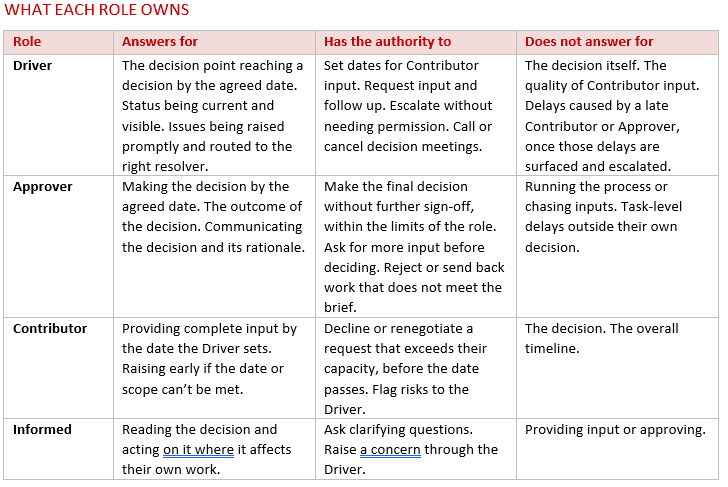
In contrast to RACI, the DACI model is presented as a more suitable framework for managing the overall workflow of marketing initiatives, particularly those that are cross-functional and decision-centric. DACI assigns roles as follows:
- Driver: Responsible for getting the work done, managing the project timeline, and escalating issues when they arise. This role is akin to a project manager, ensuring progress and proactive problem-solving.
- Approver: Owns the ultimate results and makes the go/no-go decisions. This individual has the final say on whether a project meets objectives and is ready for implementation.
- Contributor: Provides input and expertise to the project, contributing to the decision-making process. These are the subject matter experts who offer valuable insights.
- Informed: Kept in the loop about the project’s progress and decisions. Their role is to be aware, often through updates and communications.
Swanson emphasizes that DACI’s strength lies in its recognition that decisions are the primary drivers of project momentum. By clearly delineating the "Approver" who is accountable for outcomes and the "Driver" who is accountable for execution and escalation, the model effectively distributes responsibility. The "Driver," in particular, is crucial for managing escalation pathways, ensuring that subjective decisions by the "Approver" are challenged and resolved through a structured process. This mechanism helps to mitigate the "tyranny of the approver" by providing a formal route to address stalled or contentious decisions.
The DACI framework acknowledges that accountability is not necessarily a singular burden but can be effectively shared between distinct leadership roles. The Approver bears accountability for the strategic success and final output, while the Driver is accountable for the operational execution and timely progression of the project. This division allows for a more balanced and realistic assignment of responsibility, especially in dynamic marketing environments.
The Strategic Integration: RACI Within Functions, DACI Across Them
The core of Swanson’s evolved thinking lies in the strategic pairing of these two models. He posits that the most effective approach for modern B2B marketing teams is to implement RACI within individual, specialized teams and DACI for the overarching, cross-functional workflows that connect these teams.
Within a specific marketing function, such as the content team or the social media team, work often proceeds in a more linear, assembly-line fashion. In these scenarios, where tasks are sequential and roles are clearly defined within that single discipline, RACI can operate effectively. For instance, within the content team, a writer may be Responsible, an editor Accountable, a subject matter expert Consulted, and the broader marketing team Informed about the published piece. The criteria for successful application of RACI within a team are:
- Is the work primarily within a single function? If the answer is yes, RACI is a strong contender.
- Does the work flow like an assembly line? If yes, RACI is likely suitable.
- Is there a clear, single point of ownership for the output of that specific function? If yes, RACI is a good fit.
However, when projects require collaboration between multiple marketing functions – for example, a new product launch campaign involving product marketing, demand generation, creative services, and web development – the DACI model becomes paramount. In these cross-functional initiatives, the focus shifts from granular task assignment within a single team to the strategic orchestration of work across departments. The DACI model provides the necessary structure for navigating subjective decisions, managing dependencies, and ensuring clear lines of authority and escalation.
The "Approver" in a DACI model for a campaign might be the Marketing Director or VP of Marketing, who is ultimately accountable for the campaign’s success against key performance indicators (KPIs). The "Driver" could be a dedicated campaign manager or project manager responsible for coordinating efforts across the various functional teams, ensuring timelines are met, and escalating any roadblocks to the Approver or relevant stakeholders. The "Contributors" would be representatives from each involved department, providing their specialized input, while the "Informed" individuals would be kept abreast of progress and key decisions.
This dual-model strategy addresses the inherent challenges of modern marketing by leveraging the strengths of each framework. RACI provides clarity and efficiency for internal team operations, while DACI offers a robust mechanism for strategic decision-making and accountability in the complex, interconnected world of cross-functional marketing.
Implications for Team Structure and Performance
The adoption of a combined RACI and DACI approach has significant implications for how marketing teams are structured and how their performance is measured. By clearly defining roles and responsibilities at both the intra-team and inter-team levels, organizations can foster a culture of greater clarity and reduce the ambiguity that often leads to inefficiency and frustration.
For B2B marketing leaders, this means a strategic evaluation of existing workflows. Teams must identify which processes are best managed by RACI and which require the broader oversight of DACI. This assessment can lead to a more deliberate design of team responsibilities and reporting structures. The emphasis on clear escalation paths within the DACI model, managed by the "Driver," is particularly crucial. This ensures that subjective disputes or progress impediments are not left to fester but are systematically addressed, involving higher levels of management if necessary.
The benefit extends beyond mere operational efficiency; it impacts team morale and individual job satisfaction. When accountability is perceived as fair and aligned with scope, and when decision-making processes are transparent and structured, team members are more likely to feel empowered and valued. The elimination of bottlenecks and the reduction of "tyranny of the approver" scenarios can lead to a more collaborative and less conflict-ridden work environment.
Furthermore, the data generated from these structured workflows can provide valuable insights for continuous improvement. By tracking how projects progress under both RACI and DACI frameworks, marketing leaders can identify areas where specific teams or cross-functional processes might be underperforming and implement targeted interventions. This data-driven approach to process optimization is critical in the fast-paced B2B marketing landscape.
As businesses continue to navigate increasingly complex markets and customer journeys, the ability to execute campaigns effectively and hold individuals and teams accountable for results is paramount. Tom Swanson’s articulation of the dual-model strategy offers a practical and strategic solution, providing a roadmap for marketing organizations to enhance their operational agility, decision-making prowess, and ultimately, their overall effectiveness. The integration of RACI for internal team efficiency and DACI for strategic cross-functional orchestration represents a significant step forward in refining accountability within the modern marketing enterprise.


 Asro
 Lina Hope