rifanmuazin
HubSpot, a leading customer relationship management (CRM) platform, has announced a profound, three-phase transformation driven by artificial intelligence, fundamentally reshaping its product development lifecycle and engineering capabilities. This strategic pivot, detailed in a recent company release, underscores a commitment to leveraging generative AI not merely as a productivity enhancer but as a core infrastructural pillar to accelerate innovation and deliver unparalleled customer value. The initiative has culminated in 100% AI adoption among its engineering teams, a remarkable 73% increase in lines of code written per engineer, and a 90% reduction in time-to-first-feedback on pull requests, signaling a new era of efficiency and accelerated product delivery.
The journey began with a clear vision: to integrate AI at every level of product development, ensuring that every advancement compounds, making the entire system more robust and beneficial for customers. This holistic approach contrasts sharply with the common industry trend of deploying disparate AI tools, setting HubSpot apart in its long-term strategy for scalable AI integration. The company’s leadership identified generative AI as a critical opportunity to not only build better products but also to bring enhanced value into customers’ hands at an unprecedented pace. When off-the-shelf AI solutions proved inadequate for HubSpot’s ambitious goals, the decision was made to build a proprietary AI platform from the ground up, a move that has rapidly yielded significant dividends.
The Strategic Imperative: Adapting to the AI Revolution
The emergence of generative AI marked a pivotal moment for the software industry. Companies across sectors faced the imperative to integrate these powerful new capabilities or risk falling behind. For HubSpot, a company deeply rooted in empowering businesses to grow, this was not just a technological challenge but a strategic opportunity to redefine its product offerings and internal operational efficiency. The market demand for intelligent, predictive, and automated tools within CRM and marketing automation platforms was surging, driven by businesses seeking to optimize customer engagement, streamline operations, and enhance personalization at scale.
HubSpot’s leadership recognized that incremental adoption would not suffice. A foundational shift was required to harness AI’s full potential. This meant not just adopting existing tools but investing heavily in infrastructure, cultivating an AI-first engineering culture, and developing proprietary solutions where commercial offerings fell short. The goal was to create a unified AI ecosystem that would ensure consistency across all customer touchpoints and leverage shared learning to amplify the impact of every new feature. This long-term vision laid the groundwork for the methodical, phased rollout of AI capabilities across its engineering division.
Phase 1: Cultivating Productivity with AI Co-pilots (2023-2024)
The initial phase, spanning from 2023 into 2024, focused on cautious yet impactful integration of AI co-pilots. At this juncture, large language models (LLMs) had just crossed a critical threshold, demonstrating genuine utility in coding contexts. HubSpot’s engineering team began with proven applications, primarily code completion tools, where AI co-pilots assisted human engineers by suggesting code snippets and accelerating routine tasks. This approach allowed engineers to familiarize themselves with AI assistance without fully relinquishing control.
The rollout commenced with a deliberate, measured strategy. Initial adoption reached approximately 30% among engineers. Crucially, HubSpot implemented rigorous internal monitoring, comparing incident data between teams utilizing co-pilots and those that were not. This data-driven validation was paramount. "Our primary concern was maintaining product reliability and stability," stated Clara Jenkins, HubSpot’s Head of Engineering. "Before scaling, we needed irrefutable evidence that AI tools would not compromise the quality our customers expect." The analysis conclusively demonstrated that AI adoption did not negatively impact product reliability.
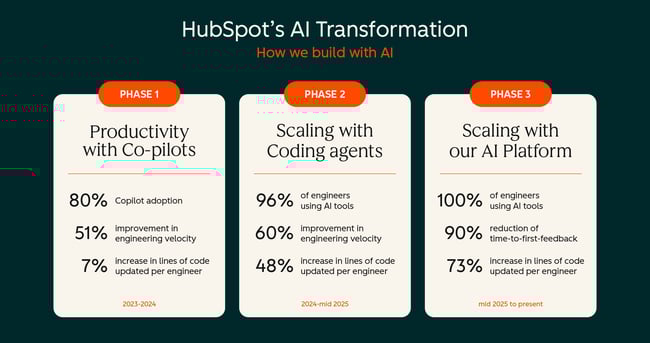
Armed with this critical data, HubSpot removed the initial guardrails, granting widespread access to its coding co-pilots. Adoption subsequently surged past 50% overnight. This experience solidified a key operational philosophy within the company: "Measure, prove, then scale." By the end of Phase 1, an impressive 80% of HubSpot engineers were actively using AI tools. This translated into a significant 51% improvement in engineering velocity, indicating a substantial acceleration in shipping functional code to production. Furthermore, engineers saw a 7% increase in lines of code updated per engineer, proving that AI could enhance individual productivity without sacrificing product integrity. This foundational success not only boosted internal confidence but also provided valuable insights into effective AI deployment strategies.
Phase 2: Scaling Autonomy with Coding Agents (2024-Mid 2025)
Building on the success of co-pilots, Phase 2 marked a significant leap towards autonomous coding with AI agents, spanning from 2024 to mid-2025. This phase envisioned tools capable of handling end-to-end development tasks, from understanding context and writing code to running tests and self-correcting errors, all under the review and guidance of an engineer. HubSpot leadership strongly believed this represented the future of software engineering and committed fully to its implementation.
The transition, however, presented immediate technical constraints. Off-the-shelf coding agents lacked the ability to access HubSpot’s intricate internal build systems, proprietary code libraries, or verify code functionality within the company’s unique development environment. To overcome this, HubSpot embarked on developing its own agent integrations. This involved leveraging the MCP (Managed Code Platform) standard, an internal framework designed to allow AI agents to securely connect with external tools and internal systems. These custom integrations were rapidly deployed to every engineer, providing agents with the necessary access and contextual understanding.
To drive rapid adoption, HubSpot launched targeted internal events, offering engineers dedicated time and resources to learn, experiment, and build confidence with these new, more autonomous tools. The strategy proved highly effective, propelling agent usage from zero to an astonishing 80% adoption within a single month.
The next critical challenge was scalability. Engineers desired the ability to run multiple agents in parallel, often overnight and without constant supervision, to tackle larger, more complex tasks. In response, HubSpot developed a sophisticated agent execution platform built atop its existing Kubernetes infrastructure. This platform allowed each agent to run within an isolated container, meticulously replicating a real HubSpot developer environment. These agents could autonomously compile code, execute automated tests, interpret error outputs, and iterate on their solutions until the code functioned correctly, largely without human intervention.
By the conclusion of Phase 2, AI tool adoption among engineers had climbed to 96%. Engineering velocity saw a further increase to 60%, and lines of code updated per engineer surged by 48%. This demonstrated that HubSpot was not only shipping products faster but also beginning to deliver qualitatively better solutions through the enhanced capabilities of AI agents.
Phase 3: The Unified AI Platform and Compounding Value (Mid 2025-Present)
The current phase, initiated in mid-2025, represents the culmination of HubSpot’s AI strategy: the establishment of a unified AI platform. This mirrors HubSpot’s longstanding platform approach to product development, where foundational capabilities (like reporting or automation) are built once at the platform level and then extended across all hubs simultaneously, creating compounding value.
Instead of developing individual agents in isolation, HubSpot focused on constructing a shared foundation for all AI operations. This platform dictates how agents access data, the range of actions they can perform, and how they seamlessly integrate with the broader HubSpot ecosystem. Everything, from simple co-pilots to complex autonomous agents, now operates on top of this single, cohesive infrastructure.
"This is where the magic truly happens," remarked Mark Evans, HubSpot’s Chief Technology Officer. "By building a unified AI platform, we ensure all our agents are inherently interoperable. They speak the same language, share common toolsets, and draw from a consistent, enriched context. This eliminates silos and provides our customers with a remarkably consistent experience, regardless of the specific AI-powered feature they are using."
The interconnectivity means that every new capability or piece of context added to the platform instantly enhances the value and effectiveness of the entire system. This contrasts sharply with a collection of disparate point solutions, which often struggle with integration and consistency. The platform approach guarantees that innovation is amplified across all product lines.
The success of this phase is evident in the latest metrics: 100% of HubSpot engineers now leverage AI in their daily work. Lines of code updated per engineer have dramatically increased by 73% overall since the start of the transformation. Perhaps even more impactful for rapid development cycles, the time-to-first-feedback on pull requests has plummeted by an astounding 90%. This drastic reduction in wait times means engineers can iterate faster, address issues more swiftly, and ultimately ship higher-quality, customer-ready products at an accelerated pace.
Broader Impact and Strategic Implications
HubSpot’s comprehensive AI transformation carries significant implications, both for the company and the broader software industry. For HubSpot, the unified AI platform acts as a powerful accelerator for innovation, solidifying its competitive edge in the fiercely contested CRM and marketing automation markets. The ability to rapidly develop, test, and deploy new features, driven by highly productive engineers and intelligent agents, means HubSpot can respond to market demands with unprecedented agility. New capabilities that once required months of development are now achievable in weeks, directly translating into tangible benefits for marketers, sales professionals, and customer success managers who rely on HubSpot’s tools.
"Our customers are at the heart of everything we do," stated Yamini Rangan, CEO of HubSpot. "This AI platform allows us to deliver more powerful, intuitive, and connected experiences faster than ever before. Whether it’s helping a marketer craft compelling content, empowering a sales rep to close a deal more efficiently, or assisting a customer success manager in retaining a valuable client, our AI-driven enhancements are designed to simplify their work and amplify their growth."
The transformation also redefines the role of the engineer within HubSpot. Instead of being bogged down by repetitive coding or debugging, engineers are increasingly empowered to focus on higher-level problem-solving, architectural design, and strategic innovation. The AI tools handle the mundane, allowing human creativity and expertise to flourish. This shift not only improves job satisfaction but also optimizes the allocation of intellectual capital.
For the wider software industry, HubSpot’s journey serves as a compelling case study in successful enterprise-wide AI adoption. It demonstrates the necessity of strategic investment in proprietary infrastructure when off-the-shelf solutions fall short. The "measure, prove, scale" philosophy offers a practical roadmap for managing the risks associated with new technology adoption. Moreover, the emphasis on a unified platform over fragmented point solutions highlights a path towards truly integrated and compounding AI value. As other companies grapple with their own AI strategies, HubSpot’s phased, data-driven, and platform-centric approach provides a blueprint for achieving significant, sustainable improvements in productivity and product delivery. The era of AI-first development has arrived, and HubSpot is demonstrating its profound capabilities.