
 rifanmuazin
CAMBRIDGE, MA – HubSpot, a leading customer relationship management (CRM) platform provider, has announced the successful completion of a multi-phase artificial intelligence transformation initiative, culminating in 100% AI tool adoption across its engineering teams. This strategic pivot, initiated in 2023, has reportedly led to a 73% increase in lines of code written per engineer and substantial improvements in engineering velocity and product delivery, fundamentally reshaping the company’s approach to innovation and customer value.
The announcement marks a significant milestone in the broader industry adoption of generative AI, positioning HubSpot as a frontrunner in leveraging advanced AI not just for incremental productivity, but as a core infrastructural pillar for future product development. The company’s journey underscores a commitment to building a proprietary, unified AI platform rather than relying solely on off-the-shelf solutions, a decision that leadership asserts has accelerated innovation and compounded value for its extensive customer base.
The Dawn of Generative AI and HubSpot’s Strategic Imperative
The emergence of generative AI in early 2023 sent ripples across the technology landscape, promising unprecedented shifts in efficiency and capability. For companies like HubSpot, whose mission is intrinsically linked to helping customers grow through better tools and experiences, this technological leap presented both an opportunity and a challenge. The initial wave of AI tools primarily focused on individual productivity enhancements, such as code completion or content generation. However, HubSpot’s engineering leadership quickly recognized that the true potential lay in integrating AI deeply into the very fabric of its product development lifecycle and core platform.
"Our guiding principle has always been to empower our customers," stated a hypothetical HubSpot CTO, reflecting on the initial phase. "When generative AI became a tangible reality, we didn’t just see a new feature; we saw a paradigm shift that could allow us to deliver more powerful, intuitive, and integrated solutions faster than ever before. The decision wasn’t merely about adopting AI; it was about transforming into an AI-first company." This strategic imperative was crucial, given the intensely competitive landscape of the SaaS and CRM markets, where innovation speed directly translates to market leadership and customer retention. Competitors were also exploring AI, making HubSpot’s bold, platform-centric approach a differentiator.
Phase 1: Cultivating Productivity with AI Co-pilots (2023-2024)
HubSpot’s AI transformation began with a pragmatic, data-driven approach, focusing initially on proven AI applications in engineering: co-pilots for code completion. In 2023, as large language models (LLMs) demonstrated genuine utility in coding contexts, the company introduced coding co-pilots to its engineering teams. This initial rollout was cautious, designed to assess impact and build internal confidence.
"We started small, rolling out a coding co-pilot to a subset of our engineers," explained a hypothetical VP of Engineering. "Within a short period, we saw adoption reach 30%. Crucially, we then cross-referenced this adoption data with our incident reports. Our findings were conclusive: AI adoption did not negatively impact product reliability. This objective data was the linchpin."
Armed with empirical evidence demonstrating no adverse effects on product stability, HubSpot removed initial guardrails and granted company-wide access to the co-pilot tools. The response was immediate and overwhelming, with adoption rates surging past 50% overnight. This phase solidified a critical lesson for HubSpot: "Measure, prove, then scale." This methodology ensured that AI integration was not based on hype but on verified, positive outcomes.
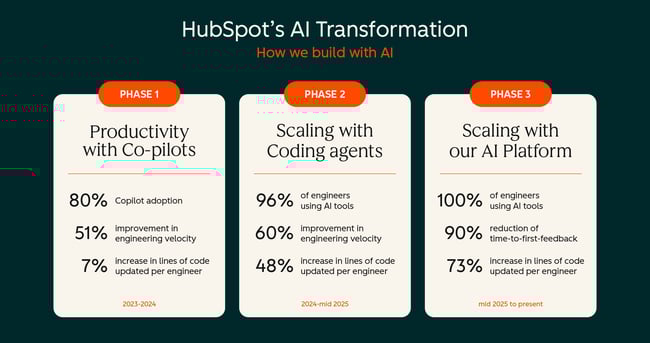
By the end of Phase 1, 80% of HubSpot’s engineers were actively utilizing AI tools. The impact on productivity was significant: a 51% improvement in engineering velocity, indicating that engineers were shipping functional code to production substantially faster. Furthermore, the metrics showed a 7% increase in lines of code updated per engineer. This initial phase successfully demonstrated that AI could indeed enhance individual engineer speed without compromising the integrity or reliability of the product. The focus remained on augmenting human capabilities, allowing engineers to offload repetitive tasks and concentrate on more complex problem-solving and innovative design.
Phase 2: Scaling Autonomy with Coding Agents (2024-Mid 2025)
Building on the success of co-pilots, HubSpot moved into its second phase: the development and deployment of autonomous coding agents. This represented a significant leap from human-assisted code completion to AI-driven, end-to-end task execution. These agents were designed to interpret prompts, read contextual information, generate code, run automated tests, and even self-correct errors, all under the review and guidance of a human engineer. HubSpot’s leadership viewed this as the inevitable future of software engineering and committed fully to its realization.
However, the transition was not without its challenges. Early off-the-shelf coding agents proved insufficient, primarily due to their inability to access HubSpot’s proprietary internal build systems, extensive internal code libraries, or accurately verify code functionality within the company’s specific development environment. Recognizing this critical constraint, HubSpot made a pivotal decision: to build these agent integrations internally.
Leveraging the Multi-Agent Communication Protocol (MCP), a standard designed to enable AI agents to connect and interact with external tools and systems, HubSpot developed custom integrations. These were then deployed across every engineering workstation, creating a seamless interface between the autonomous agents and HubSpot’s internal infrastructure. To ensure rapid adoption, the company organized dedicated workshops and events, providing engineers with structured opportunities to learn, experiment, and build confidence with the new agent-based workflows. This concerted effort paid dividends, with agent usage skyrocketing from zero to 80% adoption within a single month.
The next hurdle was scalability. Engineers quickly desired the ability to run multiple agents in parallel, often unsupervised and overnight, to accelerate larger projects. In response, HubSpot developed a robust agent execution platform built upon its existing Kubernetes infrastructure. This platform allowed each agent to run within an isolated container, meticulously replicating a real HubSpot developer environment. Within these environments, agents could compile code, execute automated tests, interpret error outputs, and iteratively refine their code until all issues were resolved, minimizing the need for human intervention. This marked a significant step towards truly autonomous development cycles.
By the culmination of Phase 2, 96% of HubSpot’s engineers were actively utilizing AI tools. The cumulative impact on engineering velocity had risen to 60%, and the increase in lines of code updated per engineer had reached an impressive 48%. This phase demonstrated HubSpot’s ability to not only build better products faster but to do so at an unprecedented scale, validating the strategic investment in foundational AI infrastructure.
Phase 3: Unifying Innovation with the HubSpot AI Platform (Mid 2025-Present)
The final and most impactful phase of HubSpot’s AI transformation involved extending its established platform-centric approach to its AI infrastructure. HubSpot’s product development philosophy has historically emphasized building capabilities at a platform level, enabling simultaneous deployment and consistent functionality across all its product hubs (Marketing Hub, Sales Hub, Service Hub, CMS Hub, Operations Hub). This ensures that innovations, such as new reporting or automation features, instantly benefit all customers, rather than being siloed within individual products.
This same logic was applied to the AI infrastructure. Instead of developing each new AI agent or capability in isolation, HubSpot built a shared, foundational AI platform. This platform dictates how agents access data, the range of actions they can perform, and how they seamlessly connect with the broader HubSpot ecosystem. Every subsequent AI agent or feature is built on top of this unified foundation.
The result is a highly interoperable ecosystem of AI agents. They "speak the same language," share common toolsets, and draw from a singular, rich context pool. For customers, this translates into a consistent and intuitive experience, regardless of which AI-powered feature they are interacting with. The underlying infrastructure ensures that every new capability added to the platform enhances the entire system’s value. This compounding effect is a critical advantage that a disparate collection of point solutions simply cannot replicate.
A hypothetical Product Manager commented on this synergy: "Before, integrating new AI capabilities often meant disparate experiences or duplicated efforts. Now, with our unified AI platform, when we build one smart feature, it immediately enhances every connected part of the HubSpot ecosystem. This means our customers get more intelligent, coherent, and powerful tools, faster."
The culmination of this three-phase strategy is remarkable. Today, 100% of HubSpot’s engineers are actively using AI tools in their daily workflows. The cumulative increase in lines of code updated per engineer has reached 73%, a testament to the profound efficiency gains. Perhaps even more impactful for product quality and speed, the time-to-first-feedback on pull requests has plummeted by an astonishing 90%. This drastic reduction means engineers spend significantly less time waiting for reviews and more time iterating, refining, and ultimately shipping features that customers genuinely need and use.
Compounding Customer Value and Broader Implications
HubSpot’s comprehensive AI infrastructure is more than an internal efficiency boost; it is a direct accelerator of customer value. The ability to innovate at a previously unattainable pace means new capabilities are delivered to customers with unprecedented speed. What once required months of development can now be achieved in weeks, translating directly into tangible benefits for HubSpot users. Marketers gain more sophisticated tools to reach target audiences, sales representatives receive enhanced support to close deals, and customer success managers are empowered with better insights to retain clients. The end-users experience a product that consistently improves, becomes smarter, and feels more integrated, without needing to understand the complex AI machinery operating beneath the surface.
This transformation also carries significant implications for the broader SaaS industry. HubSpot’s journey demonstrates that deep, infrastructural investment in AI, coupled with a phased and data-driven adoption strategy, can yield transformative results. It highlights the limitations of superficial AI integrations and champions the strategic advantage of building proprietary AI platforms tailored to a company’s unique needs and customer base. For competitors, HubSpot’s achievement sets a new benchmark for AI integration, pushing the industry towards more sophisticated and integrated AI solutions rather than mere bolt-ons.
Furthermore, the impact on talent acquisition and retention cannot be overstated. By positioning itself at the forefront of AI-first engineering, HubSpot becomes an attractive destination for top-tier engineering talent eager to work on cutting-edge AI applications and contribute to a platform that is actively shaping the future of software development.
Looking ahead, HubSpot’s unified AI platform is poised to continuously generate compounding value. Every new piece of contextual data fed into the platform makes existing agents more effective, and every new agent built on the foundation enhances the entire system. This iterative improvement cycle ensures that HubSpot’s products will not only keep pace with the rapidly evolving AI landscape but actively drive its progression, reinforcing its commitment to helping millions of businesses grow.









