
 rifanmuazin
The rapid evolution of the Model Context Protocol (MCP) has introduced a transformative standard for connecting Large Language Models (LLMs) to external data sources and tools. However, as organizations move toward agentic workflows, the security risks associated with granting LLMs unfettered access to local environments have become a primary concern for IT departments and software engineers. To address these vulnerabilities, a new architectural approach utilizing n8n automation and the Model Context Protocol OpenAPI (MCPO) wrapper is emerging as a preferred method for creating secure, scalable, and team-oriented AI systems. By converting powerful but potentially hazardous MCP servers into structured API endpoints, developers can maintain the “least privilege” security model while leveraging the advanced capabilities of modern AI agents.

The Rise of MCP and the Security Challenge
The Model Context Protocol, introduced by Anthropic in late 2024, was designed to solve the fragmentation of AI tool-use. Before MCP, every integration between an LLM and a database, API, or local file system required custom, bespoke code. MCP standardized this interaction, allowing a single server to provide tools and resources to any compatible AI client. While this standardization has accelerated the development of “agentic” AI—AI that can take actions rather than just generate text—it has also introduced significant security vectors.
When a user grants an LLM access to an MCP server, they are often providing the model with the ability to execute commands, read sensitive files, or modify system configurations. If the model experiences a “hallucination” or is manipulated via prompt injection, the potential for unintended system damage is high. Furthermore, managing MCP configurations across a large team is notoriously difficult, as each individual developer must maintain their own local configuration files and API keys, leading to “Shadow AI” practices that bypass corporate security protocols.

MCPO: Bridging the Gap Between Flexibility and Control
The introduction of MCPO (Model Context Protocol OpenAPI) represents a critical shift in how these tools are deployed within an enterprise. MCPO acts as a middleware layer that wraps MCP services into well-documented OpenAPI-compliant endpoints. By doing so, it transforms a raw, high-privilege connection into a standard REST API.
This transformation provides three immediate benefits to technical teams:
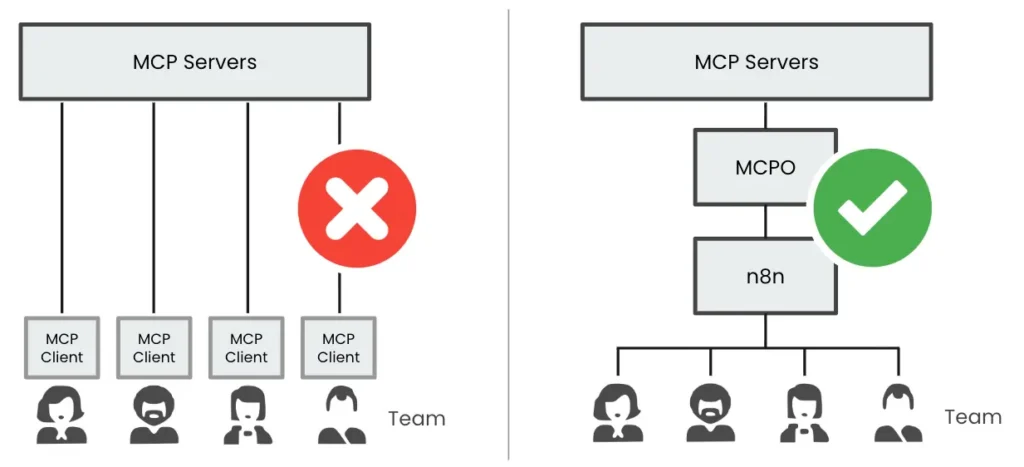
- Centralization: Instead of every team member running their own MCP instance, a single MCPO server can be hosted centrally, providing a unified interface for the entire organization.
- Security Granularity: Administrators can choose exactly which tools and endpoints to expose to the LLM, rather than granting blanket access to the entire MCP server.
- Tool Compatibility: Because MCPO outputs a standard API, it can be integrated into traditional automation platforms like n8n, Zapier, or Make.com, which may not yet have native, robust support for the burgeoning MCP standard.
Chronology of a Secure Workflow Implementation
The process of building a secure n8n workflow using MCP begins with the containerization of the environment. Using Docker Compose, developers can deploy MCPO alongside their existing automation stack. The configuration involves defining a config.json file that specifies which MCP servers the wrapper should manage. For example, integrating an A/B testing platform like Convert.com requires defining the specific command-line arguments and environment variables—such as API keys and secrets—within the MCPO configuration.
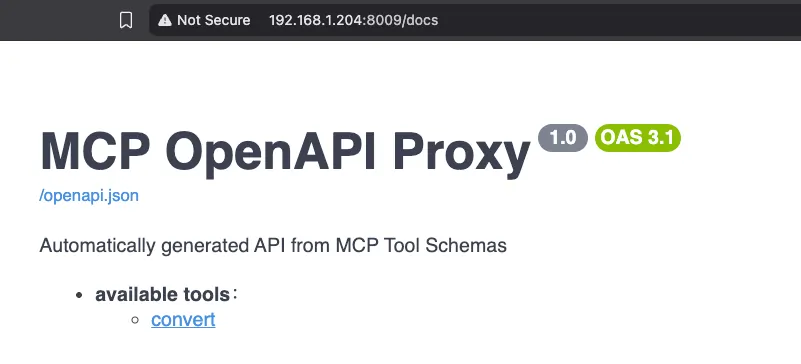
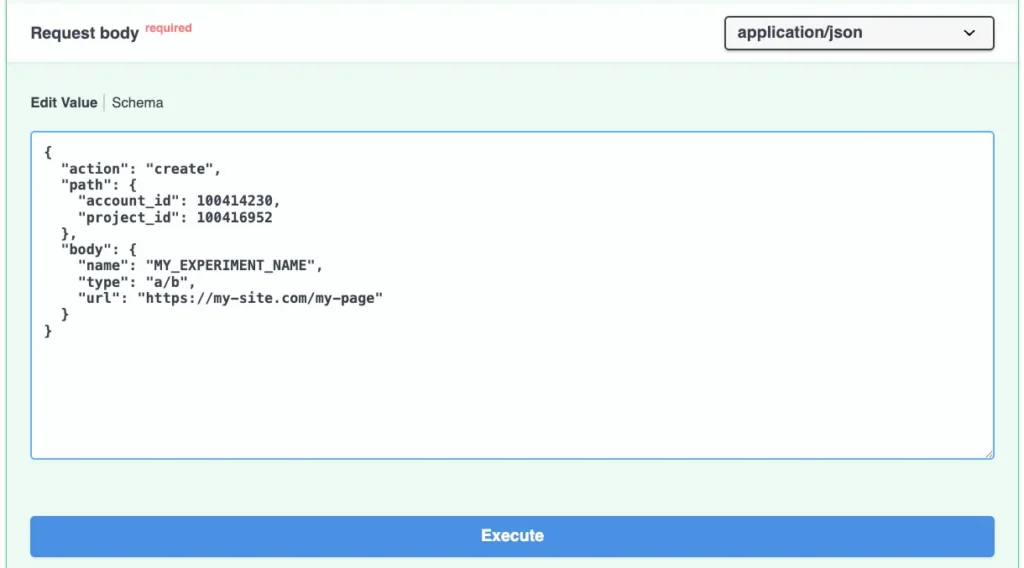
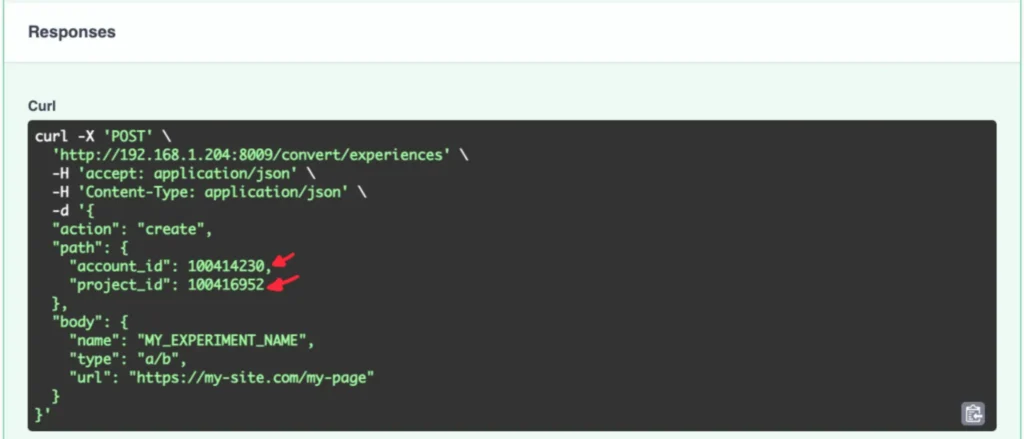
Once the MCPO service is active, it generates a Swagger UI (User Interface), which serves as a sandbox for testing API calls. This allows developers to verify that the LLM can interact with the external service through a controlled gateway before any automation logic is written.
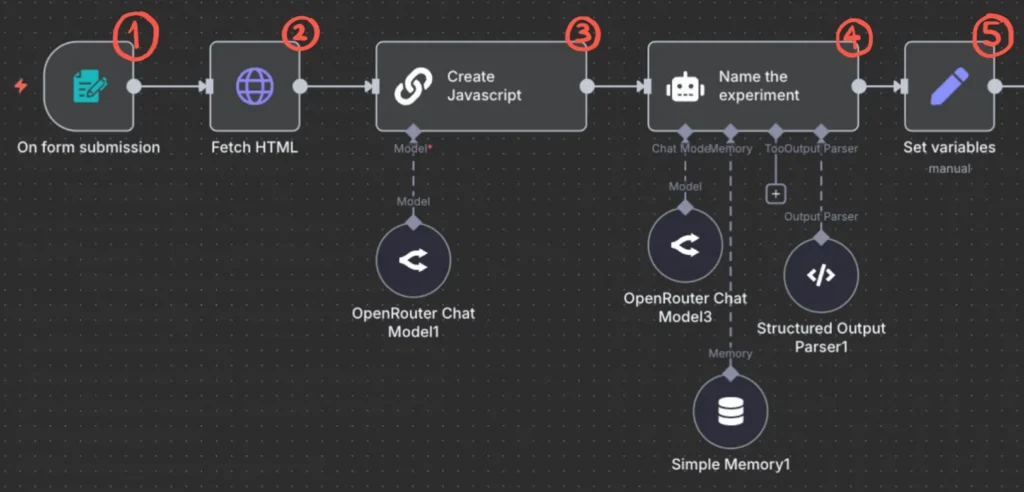
Following the setup of the gateway, the n8n workflow is constructed in a modular fashion. A typical high-efficiency workflow for technical tasks, such as generating and deploying code for experimental variations, follows a specific five-step chronology:
1. Standardized Input Capture
The workflow initiates via a structured trigger, such as a webhook or a web form. This ensures that the AI receives specific, validated data rather than ambiguous instructions. In the context of A/B testing, this includes the target URL and the specific UI changes requested by the marketing or product team.
2. Environmental Context Retrieval
The system programmatically fetches the HTML or CSS of the target page. By providing the LLM with the actual code environment it will be modifying, the workflow significantly reduces the likelihood of syntax errors or non-functional code generation.
3. Generative Logic via Small Language Models (SLMs)
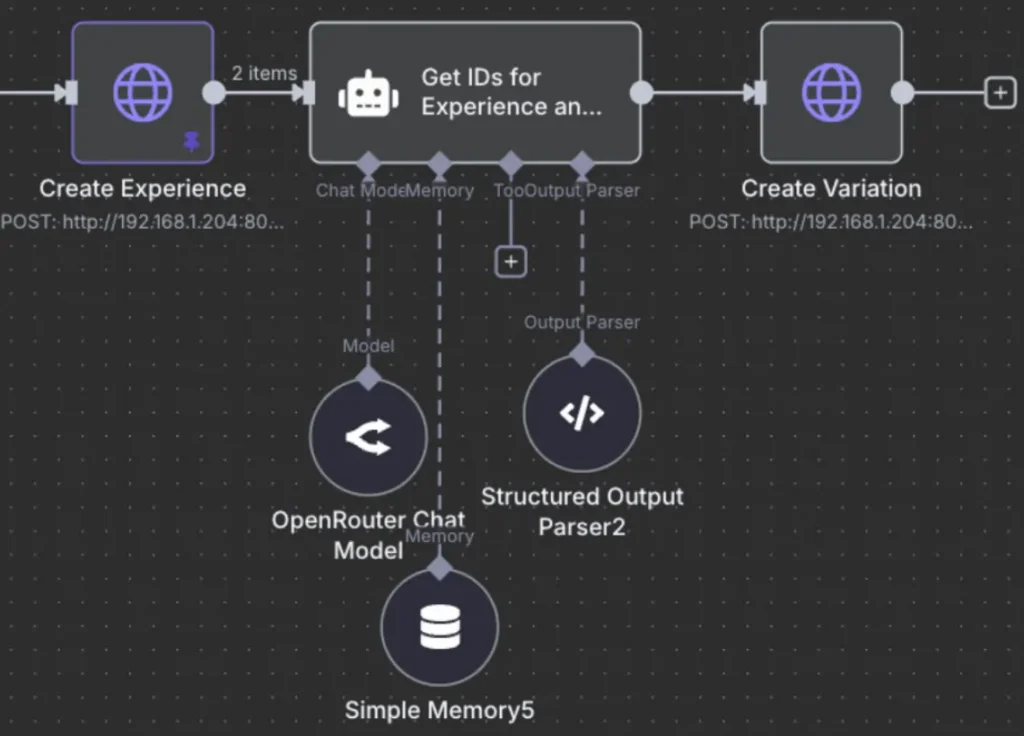
Rather than using expensive, high-latency models for every task, the workflow employs specific AI agents—often powered by smaller, cost-efficient models like Llama 3 or Phi-3—to perform discrete tasks. One agent is tasked solely with writing the JavaScript required for the change, while another enforces naming conventions for the experiment.
4. Variable Consolidation and Logic Mapping
A “Set Variables” node in n8n bundles all disparate data points—the generated code, the experiment name, and the account IDs—into a single JSON object. This step is crucial for maintaining state across the workflow and ensuring that subsequent API calls have access to the correct metadata.
5. Controlled API Execution
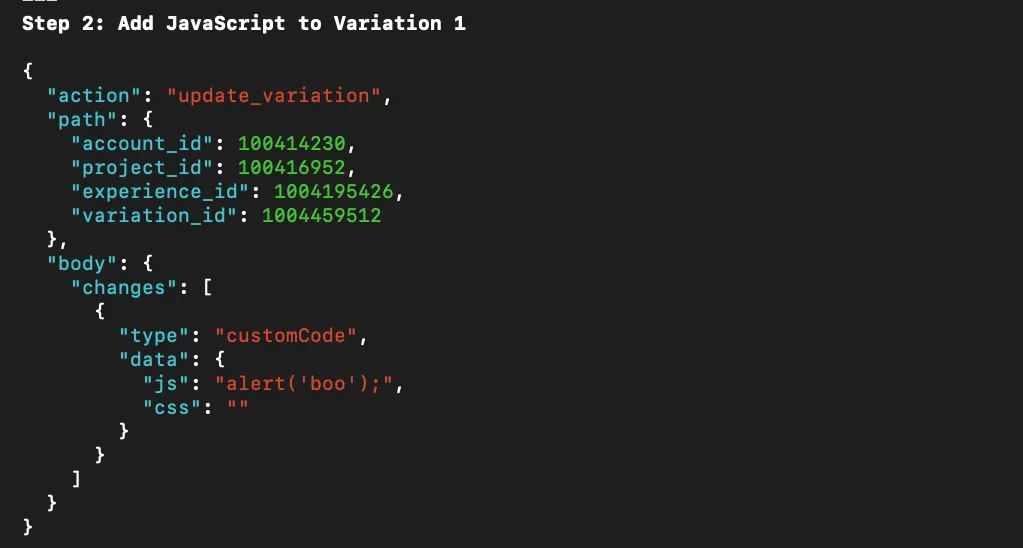
The final step uses n8n’s HTTP Request nodes to send the data to the MCPO endpoints. These endpoints then communicate with the Convert.com MCP server to create the experiment and upload the variation code. By using HTTP nodes instead of direct terminal access, the organization creates an immutable log of every action taken by the AI.
Supporting Data and Efficiency Metrics
Industry data suggests that the transition from manual experimentation setups to automated AI workflows can reduce “time-to-live” for A/B tests by as much as 85%. In traditional environments, a developer may spend two to four hours writing, testing, and deploying a single UI variation. With a structured n8n and MCP workflow, this process is reduced to under five minutes, with the majority of that time spent on human review rather than manual labor.
Furthermore, the shift toward using Small Language Models (SLMs) for specific nodes within these workflows has profound cost implications. While a large model like Claude 3.5 Sonnet is ideal for complex reasoning, using it for simple tasks like “extracting an ID from a string” is economically inefficient. By routing these simpler tasks to SLMs through an n8n workflow, enterprises can lower their API consumption costs by 40% to 60% without sacrificing the quality of the final output.
Official Responses and Industry Implications
The move toward “API-fying” AI protocols has been met with approval from security-conscious sectors. Chief Information Security Officers (CISOs) have frequently expressed concern over the “black box” nature of agentic AI. The use of middleware like MCPO provides the transparency and auditability required for compliance with frameworks such as SOC2 and GDPR.
From a developer experience (DX) perspective, the ability to use Claude Code or other CLI-based AI tools to “discover” the necessary API calls—and then immediately codify those calls into a permanent n8n workflow—represents a new paradigm in software engineering. This “co-working” phase allows for rapid prototyping, while the n8n implementation ensures that the prototype is turned into a reliable, repeatable business process.
Broader Impact on the AI Ecosystem
The integration of MCP, MCPO, and n8n signifies a maturation of the AI automation market. We are moving away from a period of “experimental prompts” and toward a period of “engineered systems.” This architecture proves that the power of agentic AI does not have to come at the expense of corporate security or operational stability.
As more platforms like Convert.com release dedicated MCP servers, the library of available tools will grow exponentially. Organizations that master the ability to wrap these tools in secure, automated workflows will possess a significant competitive advantage in agility and operational efficiency. The ultimate goal is the creation of a “Self-Service Experimentation” environment where non-technical team members can safely trigger complex technical workflows, confident that the underlying architecture is governed by strict security protocols and optimized for performance.








