
 rifanmuazin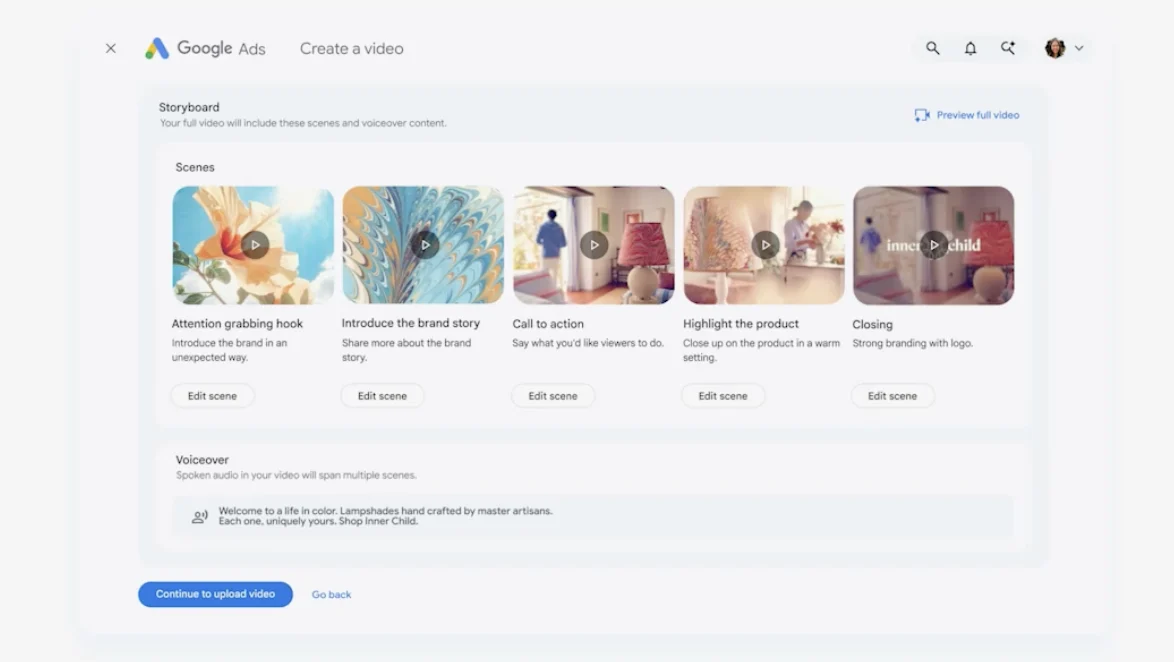
Google Marketing Live 2026, held with a festive atmosphere and a nod to iconic electronic music duos, served as a pivotal moment for the advertising industry, unveiling Google’s ambitious vision for the future of marketing. Following closely on the heels of the transformative announcements at Google I/O, the event underscored a clear strategic direction: the pervasive integration of artificial intelligence across the entire marketing ecosystem. For professionals immersed in performance marketing, the key themes were both predictable and profoundly impactful, signaling a significant evolution in how brands will connect with consumers.
At the core of Google’s strategy is the declaration, “Google Search is AI Search,” a sentiment that permeated every product innovation and strategic announcement. This fundamental shift positions AI not merely as an enhancement but as the driving force behind search functionality and, by extension, the entire advertising landscape. The conference highlighted a transition towards more sophisticated AI applications, aiming to empower marketers to become more strategic, align business priorities with advertising efforts, and prepare for an era of “infinite creative.”
The overarching themes articulated at Google Marketing Live 2026 painted a picture of an integrated and intelligent advertising future:
- The Evolving Role of Search: Search is no longer confined to the initial discovery phase of the purchase journey but is now a dynamic touchpoint across all stages.
- Elevating AI in Performance Campaigns: Artificial intelligence is being deeply embedded into performance marketing strategies, moving beyond basic automation.
- Powering Agentic Commerce: The move towards “agentic commerce,” where AI agents facilitate transactions and interactions, was a central narrative.
- From Conversation to Action: Empowering marketers to leverage AI agents to translate consumer interactions into tangible business outcomes.
- YouTube’s Dual Role: Leveraging YouTube for both upper-funnel brand building and lower-funnel conversion objectives.
- Enhanced Media Measurement: Advancements in measurement solutions to provide clearer insights in an increasingly complex digital environment.
Becoming More Strategic with AI: The Rise of Agentic Interfaces
The contemporary marketing professional operates in an environment where AI is an indispensable tool. The shift from solely relying on platform-native interfaces to incorporating external AI assistants like Claude and ChatGPT for briefing, messaging, creative ideation, and audience strategy was acknowledged by Google. The product announcements under this theme are designed to meet marketers where they are, integrating AI capabilities directly into the tools they already use.
Ask Advisor: A Holistic Conversational Interface
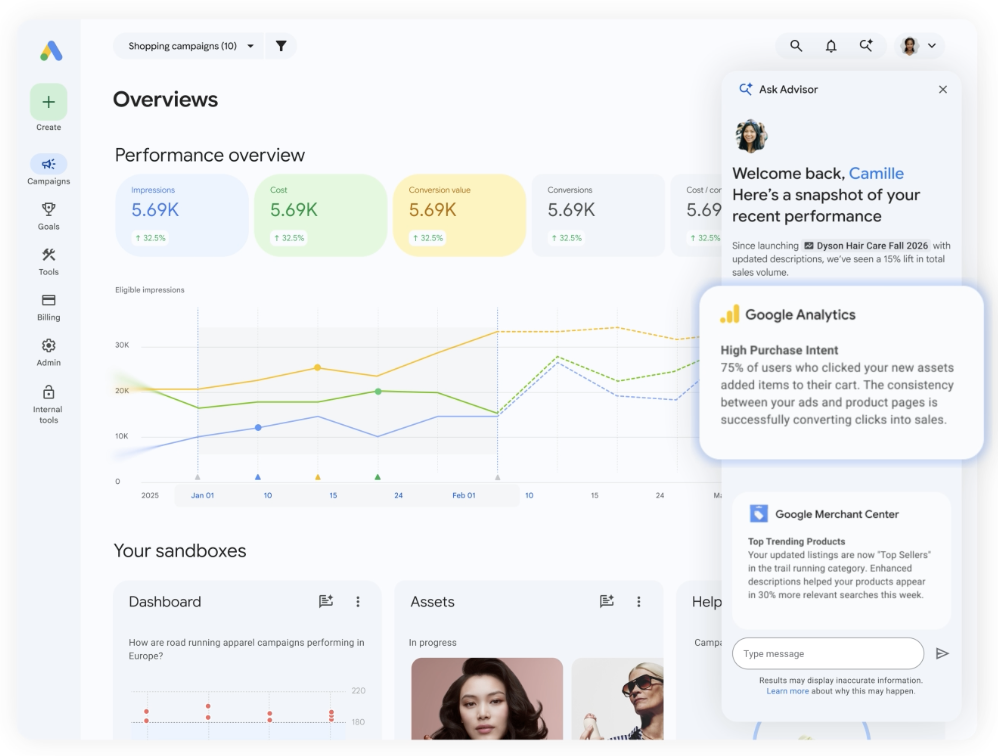
A standout innovation is Ask Advisor, an agentic conversational interface that aims to unify Google Ads, Google Analytics, Google Marketing Platform, and Merchant Center. By connecting specialized AI agents embedded within these critical components of the Google advertising and measurement ecosystem, Ask Advisor offers advertisers a novel way to analyze their marketing strategies and uncover opportunities from a holistic viewpoint. This development represents a significant leap forward from the previously siloed conversational functionalities within each platform. Historically, integrating insights across these Google products required complex backend workarounds. Ask Advisor promises to streamline this process, allowing advertisers to diagnose issues, surface insights, and identify opportunities through natural language interactions. This mirrors the growing trend of users interacting with technology through chat-based interfaces, powered by sophisticated AI.
AI Brief: Directing AI with Natural Language
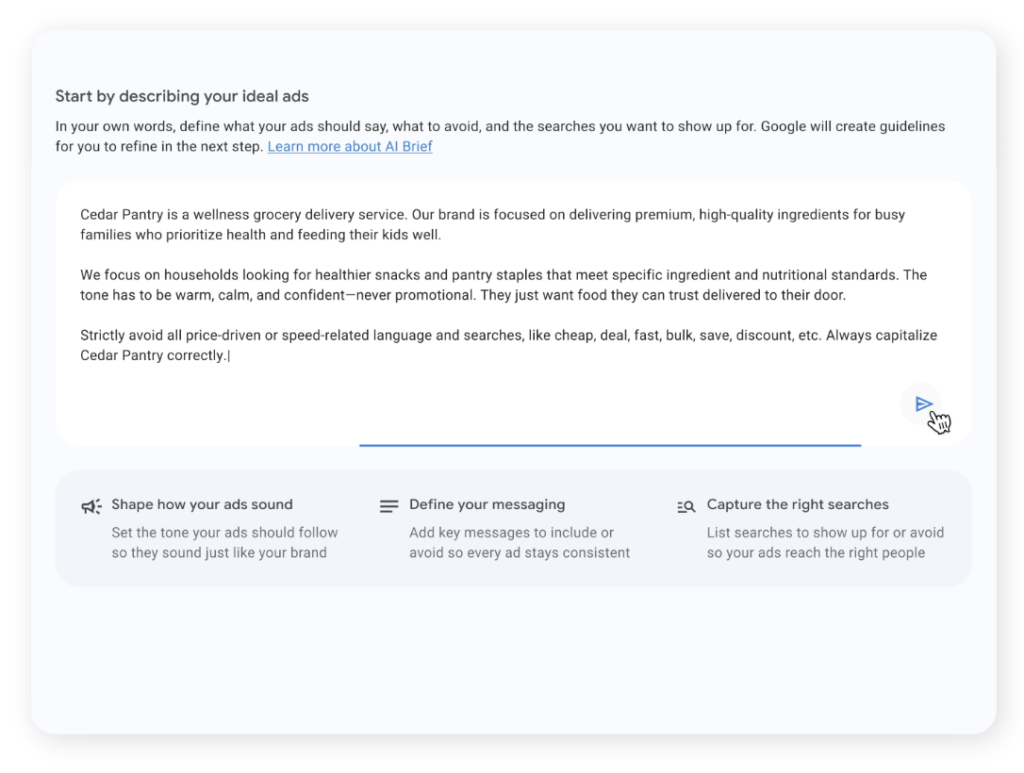
In line with Google’s “Gemini Agentic Era,” AI Brief introduces a new paradigm for managing AI Max and, eventually, Performance Max campaigns. Instead of navigating complex settings and toggles, advertisers can now provide instructions in natural language. This involves describing their brand, specifying messaging directives, outlining audience priorities, and defining the desired tone. Google’s AI then uses this comprehensive brief as context to generate ad copy. This functionality is akin to providing a detailed brief to a human copywriter or media planner, directly informing the AI’s output.
This feature is poised to fundamentally alter the strategic role of paid search practitioners. For years, Google has emphasized AI’s capacity to accelerate performance and create efficiencies, freeing up marketers for more strategic tasks. AI Brief directly addresses this by establishing a clear causal link between an advertiser’s ability to articulate customer needs and brand proposition, and the resulting campaign performance. The act of writing a compelling brief will evolve into a critical new skill.
Furthermore, if AI Brief is implemented as a campaign-level setting, it opens the door for A/B testing not just ad copy variations but also fundamental brand propositions. This capability has the potential to answer a crucial strategic question for businesses: which brand proposition resonates most effectively with the market? The long-term implications could extend beyond creative generation, potentially influencing bidding and targeting strategies as well. Imagine a future where a brief includes insights about high-value customer traits, enabling Google AI to optimize campaigns without the need for extensive technical setup of customer match lists or value-based bidding.
AI Max for Shopping Campaigns: Expanding Reach and Intelligence
AI Max for Shopping offers a one-click activation to bring AI Max capabilities to existing Shopping campaigns. Traditionally, Shopping campaigns rely on product feed attributes to match ads to queries. AI Max liberates campaigns from this constraint, enabling them to respond to natural language and conversational queries that might not directly align with feed data. Google positions this as a method to capture long-tail demand that standard Shopping campaigns are structurally unable to address.
This announcement presents two key considerations. Firstly, the adoption of AI Max for existing Shopping campaigns is a logical step given the increasing prevalence of conversational search queries. For advertisers whose current Shopping campaigns are missing out on potential demand due to feed limitations, AI Max offers a direct solution. Secondly, the integration of AI Max into Shopping campaigns raises questions about the future positioning of Performance Max (PMax). As both products aim to capture missed opportunities, including conversational queries, a clear framework for choosing between them will be essential. Google has yet to provide this, suggesting a period of testing and evaluation for advertisers to determine optimal deployment strategies.
Communicating Business Goals with Enhanced Data Solutions
In an increasingly privacy-conscious digital landscape, where third-party tracking is becoming more challenging, first-party data has emerged as the primary mechanism for communicating business objectives to Google. Consumers’ seamless transitions across channels and devices have always posed tracking challenges. The introduction of Google’s Universal Cart, a persistent shopping cart spanning Search, YouTube, Gmail, and Gemini, announced at Google I/O, is a significant development. Beyond enhancing the consumer shopping experience, Universal Cart presents a substantial opportunity for advertisers by improving the quality of incoming signals and ensuring that a greater portion of the purchase journey occurs within environments where data is captured cleanly.
The core problem addressed by the new tools in this category is the often incomplete or misaligned data signals feeding into Google’s automated systems. These new solutions aim to rectify this by providing more robust and accurate data inputs.
Google Tag Gateway: Fortifying Conversion Tracking
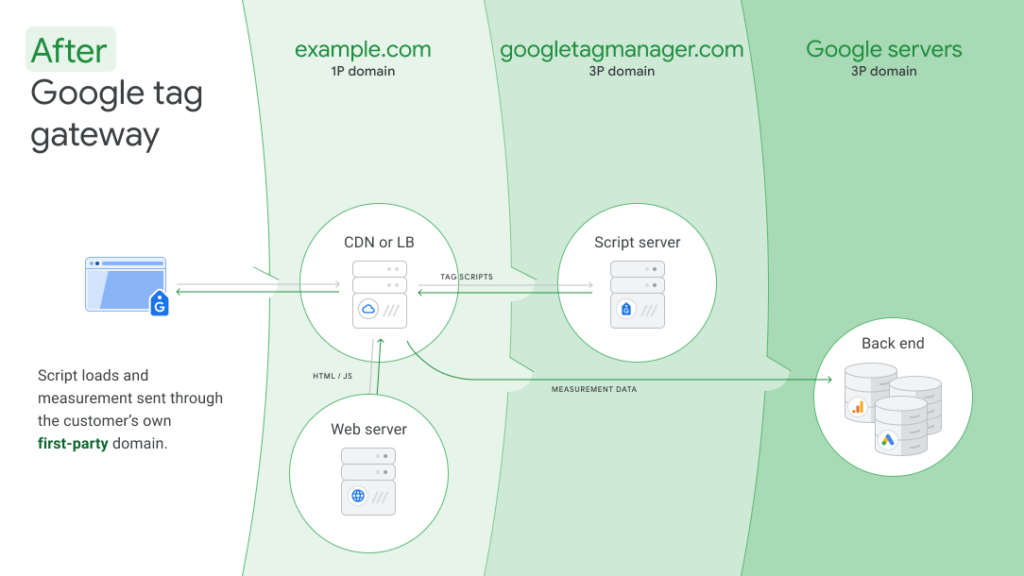
Google Tag Gateway (GTG) aims to improve conversion tracking by routing tag signals through a client’s own domain server, rather than directly through Google’s infrastructure. This approach is designed to mitigate data loss challenges, similar to the functionality offered by server-side APIs in other platforms, but with a distinct methodology. The practical benefits include enhanced data accuracy, higher match rates, and first-party data that is more resilient to browser-level tracking restrictions. A key advantage highlighted by Google is that GTG requires no modifications to existing tag code, allowing for infrastructure upgrades without altering website code.
While GTG is not entirely new, its re-framing at GML 2026 as a more accessible solution for agencies, with one-click implementation, is significant. Historically, the technical friction on the client side has been a barrier to adoption. Google’s efforts to lower this barrier could lead to a substantial widening of the data quality gap between early adopters and those who delay implementation. Furthermore, GTG’s integration with Confidential Matching, introduced at GML 2025, has demonstrated an ability to provide up to 11% more signals, offering a direct performance advantage for strategies reliant on customer matching.
Product Value Adjustments: Granular Control Over Conversion Values
Product Value Adjustments (PVAs) empower e-commerce advertisers to apply multipliers to the conversion values of specific products within their catalog. This enables more aggressive bidding on chosen SKUs within Shopping and Performance Max campaigns without altering campaign structures. While sophisticated advertisers may have existing mechanisms for influencing conversion value data, the primary value of PVAs lies in their ease of application. Advertisers can now modify conversion values directly within Merchant Center or Google Ads, a process expected to be significantly more straightforward than server-side modifications.
PVAs offer a more generalized application compared to Profit Optimization bidding, allowing for a wider range of strategic uses beyond simply optimizing for high-margin products. Potential applications include prioritizing products with higher lifetime value, boosting items with excess inventory, or promoting products with strategic importance beyond immediate profit margins.
Welcome to the World of Infinite Creative: Generative AI for Assets
The creative announcements at GML 2026 are underpinned by Gemini Omni Flash, Google’s advanced multimodal model, set to be integrated into Google Ads this summer. This model is designed to process “any input” and produce “any output,” enabling text-to-video, image-to-copy, and brief-to-campaign generation. This technology forms the foundation for “infinite creative” capabilities.
Asset Studio: The Unified Creative Workspace
Asset Studio serves as Google’s centralized creative workspace within Google Ads, leveraging powerful AI models for generating, testing, and managing creative assets. The key 2026 update introduces multimodal capabilities, allowing advertisers to generate both images and video content through natural language descriptions. Existing brand materials and marketing briefs can be incorporated to ensure brand consistency. A built-in one-click A/B testing flow is integrated directly into the creation process.
While Asset Studio has been available previously, its initial launch may not have fully met advertiser expectations. The 2026 iteration promises greater consistency in asset quality and, crucially, video generation capabilities at scale. The one-click testing flow is particularly noteworthy, addressing a persistent gap where creative testing is often overlooked or conducted informally. If Asset Studio makes structured creative experiments accessible, it could fundamentally alter how creative strategy is approached. The critical question remains whether Google’s definition of “brand safe” aligns with client expectations of “brand right,” as high-volume, guideline-compliant creative does not always equate to brand voice authenticity or market resonance.
Supporting Announcements: Expanding the Ecosystem
Beyond the headline features, GML 2026 also introduced several supporting announcements designed to further enhance the advertising ecosystem:
- Business Agents for Leads: A new ad type in AI Mode for automotive, education, and real estate verticals, enabling consumers to ask questions about a company or ad, directly linked to a lead form. Eligibility requires leveraging AI Max or Performance Max.
- Data Manager API: Google’s centralized hub for connecting first-party data sources to Google Ads, GA4, and GMP. The 2026 update includes direct connectors to platforms like Mailchimp, ActiveCampaign, and Klaviyo, simplifying programmatic data flow setup. This addresses a key barrier to adoption for CRM data integration.
- Affiliate Partnerships Boost: A limited US pilot allowing merchants to discover and amplify organic YouTube Shopping affiliate videos within Demand Gen campaigns, effectively converting influencer content into paid ad inventory.
- Commerce Media Suite: A unified suite for retail data, Google AI, and ad inventory. Key features include SKU-level measurement in DV360 and cross-retailer reporting in SA360, offering significant benefits for large retail and CPG accounts.
- View Through Conversion Optimization: An opt-in feature for Demand Gen campaigns on YouTube that allows bidding based on view-through conversion signals, offering a new approach to optimizing for users who saw an ad but didn’t click.
- Demand Gen Uplift Experiments: An A/B experiment framework to measure the performance uplift of adding Demand Gen to existing campaign mixes, providing a structured method to prove its value against other channels.
- Campaign Type Attribution: A measurement approach that isolates conversions from Demand Gen campaigns for clearer performance comparisons against paid social channels, addressing a long-standing reporting ambiguity.
- Merchant Center for Agencies: A formally launched MCC-equivalent for Google Merchant Center, enabling agencies to manage multiple merchant clients at scale.
- Missed Opportunity Reporting: A reporting feature visualizing lost conversion volume and value due to budget or bid constraints, intended to support investment justifications.
- Qualified Future Conversions (QFC): A predictive measurement tool applying AI to future engagements, showing the unrealized potential of campaigns by using early user actions as intent signals, with eventual integration into MMM solutions.
What Comes Next: Navigating the AI-Powered Future
Over the past five years, Google has prioritized AI-driven automation, sometimes at the expense of advertiser visibility and strategic control. While AI-powered targeting, bidding, creative, and budgeting are powerful, many marketers have struggled to strategically guide these systems. The traditional Google Ads UI, in some instances, may have hindered the full embrace of AI’s potential.
The way marketers work has fundamentally shifted. The transition from spreadsheet-based analysis and manual uploads to conversing with LLMs and building AI agents for workflow automation signifies a new entry point for engagement. Google’s embrace of these evolving work patterns across its advertising solutions is a welcome development.
The provision of agentic, AI-powered solutions for campaign management, coupled with enhanced data and conversion tracking capabilities, offers advertisers unprecedented tools. The next phase involves experimentation and discovery to identify the optimal applications of these new features for specific business challenges. The future of marketing, as envisioned by Google Marketing Live 2026, is one where AI is not just a tool but an intelligent partner, fundamentally reshaping how brands connect with consumers and drive measurable results.










