rifanmuazin
For years, the efficacy of B2B thought leadership was often perceived through a lens of mystique. The launch of a well-researched report, the dissemination of executive insights, and a subsequent uptick in brand visibility were frequently observed, with the direct correlation to pipeline growth often felt rather than definitively proven. This opaque process, while seemingly effective, left marketers grappling with the precise mechanics of how these initiatives translated into tangible business outcomes. However, the advent of sophisticated modern analytics has begun to demystify this process, offering B2B marketing leaders unprecedented visibility into how thought leadership influences engagement and propels pipeline progression. The persistent challenge, however, lies in the fragmentation of this data, where brand engagement metrics reside in one system, campaign performance in another, and crucial revenue data is locked within CRM platforms. The critical missing piece has been a cohesive view that links these disparate signals into a coherent narrative of influence and return on investment. Unified analytics is emerging as the key to bridging this gap.
The Evolution of B2B Thought Leadership Measurement
The landscape of B2B marketing has undergone a significant transformation. In earlier eras, the impact of thought leadership was often gauged by more qualitative metrics. Increased media mentions, website traffic spikes following content releases, and anecdotal feedback from sales teams were primary indicators of success. The "magic" was in the perception of increased authority and market presence, with the direct attribution to revenue often being a secondary or assumed outcome. This was particularly true in the pre-digital age and the nascent years of the internet, where tracking customer journeys was considerably more challenging.
The rise of digital marketing and analytics platforms in the early 2000s began to peel back the layers of this mystery. Marketers gained the ability to track website interactions, download rates, and form submissions with greater precision. This allowed for the correlation of specific content pieces with lead generation. However, even with these advancements, the journey from initial awareness and engagement with thought leadership content to closed deals remained complex and often siloed within different marketing and sales technology stacks.

Thought Leadership as the Core of "Best Answer Marketing"
Within frameworks like TopRank Marketing’s "Best Answer Marketing," thought leadership is fundamentally rooted in generating valuable insights. This can manifest as original research, proprietary data analysis, or a clearly articulated point of view substantiated by demonstrable expertise and evidence. The strategic imperative is that this insight does not remain confined to a single asset. Instead, it serves as the foundational element that informs a multitude of marketing activities.
This core insight can be leveraged to craft compelling executive perspectives, foster collaborations with industry influencers, shape demand generation programs, equip sales teams with valuable enablement materials, and fuel ongoing brand publishing efforts. The objective is to ensure that this consistent, authoritative narrative permeates across various customer touchpoints. This includes its appearance in organic search results, social media conversations, educational webinars, industry events, and direct sales outreach. When influence is strategically deployed across such a diverse array of channels, a single, isolated dashboard becomes woefully inadequate for capturing its comprehensive impact.
The Measurement Gap Hindering Thought Leadership’s Potential
The inherent fragmentation of data across multichannel thought leadership programs presents a significant impediment to achieving comprehensive visibility. Jane Bartel, Director of Search & Content Marketing at TopRank Marketing, elaborates on this challenge: "Measuring the influence of thought leadership on marketing outcomes means understanding how it advances buyers through the journey and impacts the KPIs that track their progression. Each format and channel produces data points framed around metrics that each tell part of the larger story. To prove the value of thought leadership and to surface insights for optimizations, two things are crucial: unified analytics and a measurement model that translates multiple signals into a cohesive view."
When engagement metrics, opportunity data, and revenue outcomes are compartmentalized, the quantifiable influence of thought leadership becomes elusive. This often leads to investment decisions being driven by what is most readily measurable, inadvertently prioritizing channel outputs over the subtler, cross-channel influence. The ability to bridge brand-level engagement, demand generation activities, and sales pipeline data within a single analytical framework is essential to making this cross-functional influence visible and actionable.

High-Performing Teams Understand the Value of Integrated Visibility
Empirical data underscores the significance of this integrated approach. According to "The State of B2B Thought Leadership in 2026" report, a substantial portion of marketers – approximately one-third – identify limited visibility into funnel performance as a primary challenge. Compounding this issue, another third of marketers report an over-reliance on a limited number of channels, potentially missing opportunities to engage audiences across their preferred platforms. Furthermore, 41% of B2B marketers cite difficulties in measuring content performance as the top reason for their content underperforming.
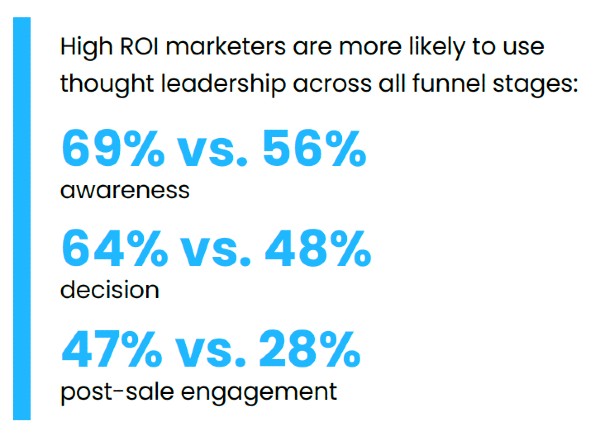
Conversely, high-performing B2B organizations demonstrate a clear understanding of this dynamic. These teams are more adept at distributing thought leadership content across multiple stages of the buyer’s journey. Crucially, they exhibit a greater propensity to connect brand-building activities directly with revenue outcomes. This suggests that underperformance in B2B marketing is not necessarily a deficit in effort or content quality, but rather a lack of integrated visibility that prevents a holistic understanding of impact.
Redefining Success: From Impressions to Influence
Multichannel thought leadership initiatives inherently generate a diverse spectrum of engagement signals. These can range from content downloads and webinar registrations to social media shares, website visits, and direct inquiries. While each of these interactions signifies activity, their collective power lies in reflecting forward momentum through the buyer’s journey.
Consider a typical scenario: A company releases groundbreaking original industry research. Potential customers download the report, indicating initial interest. Some of these individuals then attend a follow-up webinar to delve deeper into the findings, while others engage with executive commentary and social media discussions surrounding the research. Simultaneously, sales teams leverage the insights from this research to inform conversations with existing accounts and prospects. Over time, accounts and stakeholders who have been exposed to these multiple touchpoints are observed to enter the sales pipeline at higher rates and progress through the various stages with increased efficiency.

These observable behaviors can then be directly mapped to critical metrics such as opportunity creation, pipeline velocity, and overall revenue contribution. This shifts the definition of success from isolated impressions to demonstrable buyer progression and tangible business impact.
Unifying Data Across the Entire Buyer Journey: The Infrastructure of Insight
Unified analytics, when implemented to encompass the entire customer journey, acts as essential infrastructure for modern B2B marketing. It facilitates the integration of data from awareness, engagement, conversion, and even post-sale phases into a singular analytical environment. This consolidated view is instrumental in revealing both milestone achievements and the cumulative impact of thought leadership efforts.
Connecting Cross-Channel Activity: Effective measurement necessitates the seamless integration of signals across a multitude of platforms and touchpoints. This includes:
- Website Analytics: Tracking user behavior, content consumption, and on-site engagement.
- CRM Data: Capturing lead information, sales stage progression, and closed-won opportunities.
- Marketing Automation Platforms: Monitoring email engagement, lead nurturing activities, and campaign performance.
- Social Media Analytics: Gauging reach, engagement, sentiment, and influencer interactions.
- Advertising Platforms: Measuring campaign impressions, clicks, conversions, and return on ad spend (ROAS).
- Customer Data Platforms (CDPs): Consolidating customer profiles and interactions from various sources.
When these disparate datasets are integrated, underlying patterns and causal relationships become not only visible but also measurable.
Attribution and Modeling at Scale: Understanding the nuanced influence of multichannel thought leadership often requires sophisticated attribution models and analytical frameworks.
- Multi-Touch Attribution (MTA): This methodology assigns credit to various touchpoints along the customer journey, providing a more accurate picture of which marketing activities contributed to a conversion.
- Marketing Mix Modeling (MMM): MMM analyzes historical data to determine the impact of different marketing channels and strategies on overall business outcomes, allowing for optimized budget allocation.
- Data Aggregation and Normalization: The process of collecting data from various sources and standardizing it into a consistent format is fundamental for reliable analysis.
Manual data aggregation is a significant bottleneck, hindering strategic analysis. Daniel Kravtsov, CEO of Improvado, highlights this critical issue: "Measuring the impact of multi-channel thought leadership programs requires sophisticated analytics. At times, it takes a combination of Marketing Mix Modeling and Multi-Touch Attribution to understand how content influences the pipeline across channels. The problem is that marketing orgs spend 20–40% of their time manually aggregating data from Google Analytics, social platforms, CRMs, and media monitoring tools, rather than running these analyses. Without a unified analytics infrastructure, you can’t build reliable attribution models or MMM frameworks. Complex programs demand complex measurement." This intensive manual effort detracts from the time marketing teams could otherwise dedicate to strategic interpretation and optimization.
Building Executive Confidence Through Evidence-Based Insights
The implementation of unified analytics fundamentally alters how marketing leadership engages in revenue-focused conversations. It provides Chief Marketing Officers (CMOs) and other senior executives with a shared, holistic view that integrates engagement, opportunity, and revenue data across previously siloed systems. This allows for the evaluation of research interaction, repeated exposure to thought leadership content, and account-level activity in conjunction with pipeline performance and closed revenue. Thought leadership, therefore, can be assessed within the same analytical framework as other significant growth investments.
With this enhanced visibility, marketing leaders are empowered to:

- Quantify the ROI of Thought Leadership: Demonstrating a clear return on investment becomes achievable, justifying continued or increased investment.
- Identify High-Impact Narratives: Pinpointing which messages and themes resonate most effectively with target audiences allows for strategic reinforcement.
- Optimize Program Performance: Underperforming initiatives can be identified and adjusted based on data-driven insights, leading to more efficient resource allocation.
- Inform Strategic Decision-Making: Investment decisions are grounded in concrete evidence, fostering greater confidence and alignment across the organization.
Unified Analytics: Transforming Thought Leadership into a Sustainable Growth Engine
When thought leadership is measured holistically across the entire customer journey, it transforms from a perceived intangible benefit into a sustained, measurable driver of revenue growth. Unified analytics provides the essential structure to manage these critical customer relationships deliberately and strategically.
By measuring engagement, opportunity progression, and revenue contribution in concert, thought leadership becomes a manageable and potent growth lever. High-impact narratives can be systematically reinforced, while underperforming efforts can be identified and refined. This data-driven approach enables more informed investment decisions, backed by clear evidence of impact. Ultimately, with comprehensive visibility across the buyer’s journey, thought leadership evolves into a consistent, measurable engine for sustained business growth.
To gain deeper insights into how leading B2B marketers are successfully connecting brand, demand, and revenue, and building robust measurement systems that foster growth, explore the research: "The State of B2B Thought Leadership in 2026." This report offers a comprehensive look at current strategies and challenges within the B2B thought leadership landscape. Further insights can also be found in related articles exploring the "Best Answer Marketing" approach, including content on B2B thought leadership, B2B marketing strategies, and the utilization of B2B influencer marketing.