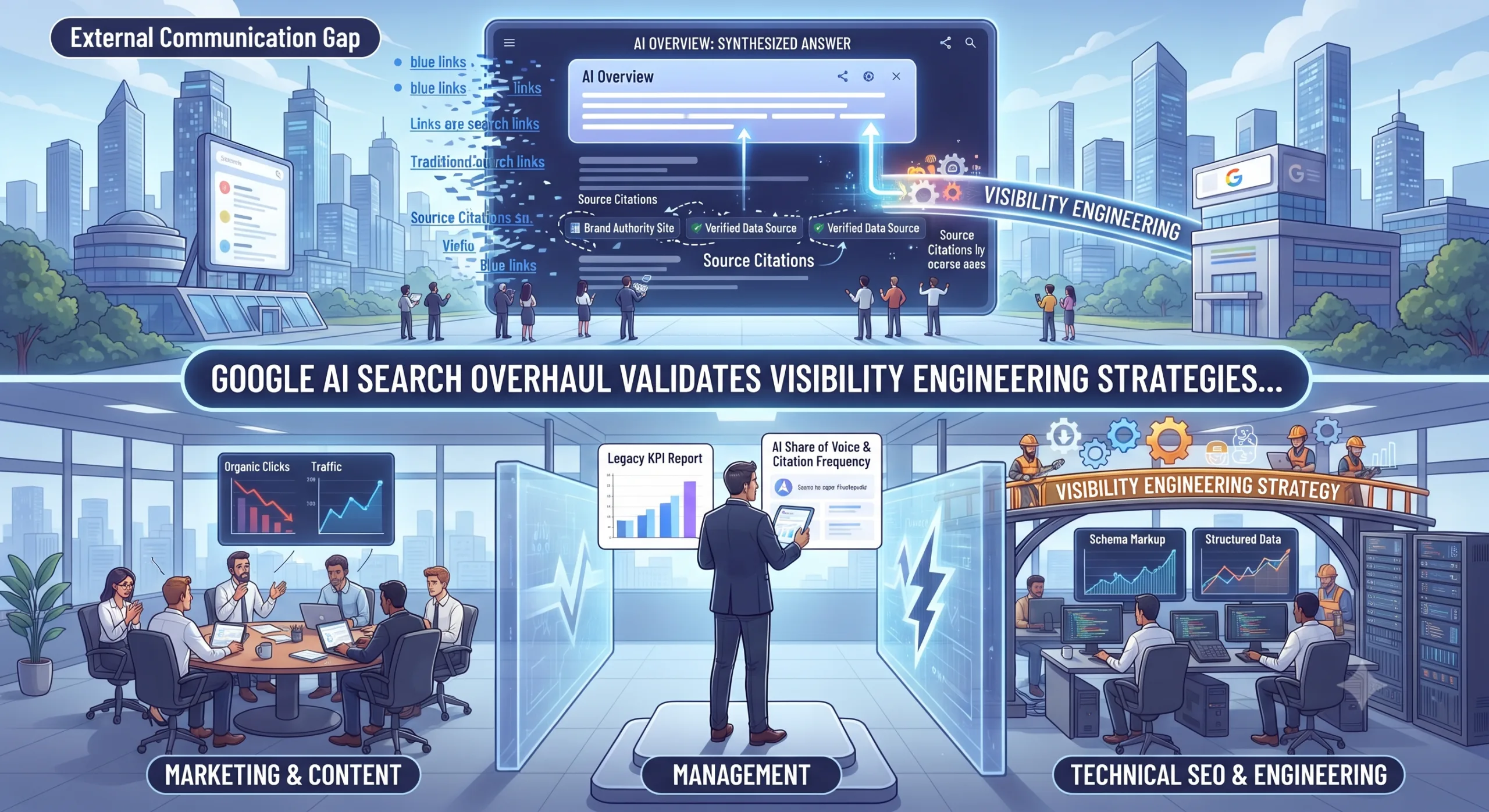
Google AI Search Overhaul Validates Visibility Engineering Strategies Amid Growing External and Internal Communication Gaps

Google’s recent announcement regarding the comprehensive integration of generative artificial intelligence into its core search functionality marks the most significant transformation of the platform in more than a quarter-century. This shift, which introduces sophisticated AI Overviews and a conversational "AI Mode," effectively validates a strategic framework known as visibility engineering—a concept industry experts have been advocating for as traditional search engine optimization (SEO) evolves into a broader model of digital authority. As the digital landscape moves toward a "zero-click" environment, organizations are facing two distinct visibility challenges: an external gap involving how AI systems perceive brands, and an internal gap regarding how communication teams demonstrate the value of this work to executive leadership.

The Evolution of Search: From Keywords to Conversational Briefs

The redesign of the Google search interface represents a fundamental departure from the keyword-based indexing that has defined the internet since the late 1990s. Liz Reid, Google’s Vice President of Search, has characterized this transition as the most substantial change to the search box in the company’s history. The introduction of AI Overviews, which now reach an estimated 2.5 billion monthly users, signifies a move toward "information agents"—autonomous systems that run 24/7 to synthesize data on behalf of the user.

In this new paradigm, the traditional metric of the "click-through rate" is being superseded by "visibility and citation." Consumers are increasingly bypassing simple keyword queries in favor of highly specific, conversational "briefs." For example, rather than searching for "running shoes," a modern user might ask an AI assistant for the best footwear for a runner with a high arch and narrow foot planning to run multiple half-marathons on pavement. This level of specificity requires AI systems to pull from a diverse array of data points across the web, making traditional SEO tactics insufficient on their own.

Chronology of the AI Search Transformation

The path to the current search landscape has been defined by several key milestones over the past few years:

  • Late 2022: The public launch of ChatGPT introduced the mass market to large language models (LLMs), beginning the shift in user behavior away from traditional search engines for complex queries.
  • Summer 2023: Early research indicated a measurable decline in standard Google queries as users migrated toward conversational AI platforms for research and discovery.
  • May 2024: Google launched a major core update alongside the I/O AI redesign, introducing the first widespread implementation of AI-generated summaries at the top of search results.
  • 2025-2026: AI Mode surpassed one billion monthly users, with query volume doubling each quarter. Concurrently, ChatGPT reached approximately 900 million weekly active users, translating to roughly 3.6 billion monthly interactions.
  • Present Day: Google’s rollout of generative UI modules and custom widgets marks the transition to a search environment where visibility is determined by an organization’s ability to be cited by AI, rather than just ranking for a specific link.

The External Visibility Gap: The Rise of GEO and AEO

The "external visibility gap" refers to the risk that a brand becomes invisible to the AI systems that now mediate the relationship between companies and consumers. If an organization’s content is not structured to be "read" and "cited" by an LLM, it effectively ceases to exist in the modern discovery process.

Industry analysts have categorized the necessary response into several overlapping disciplines:

  1. Generative Engine Optimization (GEO): Focusing on how generative models synthesize and prioritize brand information.
  2. Answer Engine Optimization (AEO): Tailoring content to provide direct, authoritative answers to specific user questions.
  3. LLM Optimization: Ensuring that technical files, such as "llms.txt," are accessible to crawlers to provide clear guidance to AI models.

Data suggests that the impact of this gap is profound. With Google Search as it was once known reaching an end, brands that fail to earn their way into AI Mode citations or generative UI modules risk losing access to billions of monthly active users. The goal is no longer just to drive traffic to a website, but to ensure that when an AI agent synthesizes an answer for a user, the brand is included as a primary authority.

The Internal Visibility Gap: A Crisis of Nomenclature

While the external gap is a technical and strategic challenge, the "internal visibility gap" is a communication crisis within organizations. Many marketing and public relations teams are already performing the work required for the AI era—refactoring earned media for citations, auditing owned media for AI readability, and rebuilding paid plans around discovery. However, they are often failing to receive credit or budget for these efforts because they are not using the same vocabulary as their executive leadership.

This gap is frequently exposed during board meetings or C-suite briefings. An executive may present a news article from a major publication like The Wall Street Journal or TechCrunch regarding Google’s AI overhaul and ask if the company is prepared. If the communication team describes their work in technical silos (like AEO or SEO) while the executive is looking for a holistic response to "AI Search," a disconnect occurs. This lack of alignment results in lost credibility, reduced budgets, and a loss of strategic influence at the executive level.

The problem is exacerbated by the fact that even technical teams at Google often disagree on terminology. While some departments emphasize the continued importance of search fundamentals, others are flagging websites for lacking AI-specific documentation. This inconsistency makes it imperative for internal teams to establish a clear, consistent name for their work—such as "visibility engineering"—to ensure it is legible to those who sign the checks.

Supporting Data: The Scale of the Shift

To understand the necessity of closing these visibility gaps, one must look at the current scale of AI interaction:

  • Google AI Overviews: 2.5 billion monthly users.
  • ChatGPT: 3.6 billion monthly users (based on 900 million weekly actives).
  • Query Growth: AI-driven search queries are currently doubling every quarter, far outpacing the growth of traditional keyword searches.
  • Zero-Click Reality: Estimates suggest that a significant majority of AI-driven searches result in the user receiving the information they need without ever clicking through to a third-party website.

These figures illustrate that the "asteroid" hitting the marketing industry is not just a change in algorithm, but a total reimagining of the digital interface.

The PESO Operating System and Visibility Engineering

The solution to both visibility gaps lies in the integration of the PESO Model (Paid, Earned, Shared, and Owned media). Visibility engineering is the practice of making a brand legible to both AI systems and the humans they serve by re-engineering how these four channels work together.

In a visibility engineering framework, the channels are used as follows:

  • Earned Media: Shifted from a focus on high-volume "hits" to high-authority "citations" that LLMs use to verify facts.
  • Owned Media: Audited for technical AI-readability and structured data that allows "information agents" to easily parse brand claims.
  • Shared Media: Focused on community signals and social proof, which AI models use to gauge the sentiment and relevance of a brand.
  • Paid Media: Rebuilt around discovery and reinforcing the brand’s presence in generative UI modules.

When these channels are integrated into a single system, the "operating system" of the brand becomes recognizable to models like Gemini, Claude, and Perplexity.

Strategic Recommendations for Organizations

To address the immediate challenges posed by Google’s AI overhaul, organizations are advised to take four specific actions within a condensed timeframe:

1. Standardize Internal Nomenclature
Organizations must choose a single term—whether it be visibility engineering, AI-discovery readiness, or GEO—and use it consistently across all internal reporting. The goal is to ensure that when leadership reads about industry changes, the internal roadmap uses the same language, thereby closing the internal visibility gap.

2. Develop Executive Proof-of-Work Briefs
Communication teams should produce concise, non-technical briefs for executive leadership. These documents should map the team’s current activities to the latest announcements from Google and other AI providers. By naming the specific surfaces (such as AI Overviews) and the actions taken to address them, teams can secure the necessary investment for future cycles.

3. Conduct AI Brand Audits
Brands should move beyond keyword tracking and begin auditing how they appear in conversational AI results. This involves prompting various LLMs with the complex "briefs" that customers are actually using. Identifying what the AI gets right, what it misses, and where it provides incorrect information is essential for directing future content strategy.

4. Resource Reallocation
The shift to visibility engineering requires the retirement of legacy tasks. Teams must identify activities that focus on dying surfaces or low-value impressions and "stop doing" them to free up capacity for AI-readability work. Without this uncomfortable reallocation of resources, organizations will remain stuck in a reactive posture.

Broader Impact and Future Implications

The validation of visibility engineering marks a turning point for the communications profession. For years, the industry has struggled to move beyond the "clippings" and "impressions" era of measurement. The AI-driven search environment demands a more sophisticated approach that prioritizes authority, legibility, and systemic integration.

As we move deeper into 2026, the distinction between "marketing" and "engineering" will continue to blur. Senior buyers and internal stakeholders will increasingly require evidence of "enterprise readiness"—the assurance that a brand’s digital presence is robust enough to withstand the scrutiny of autonomous AI agents. Those who successfully close both the external and internal visibility gaps will not only survive the "end of search as we know it" but will emerge as the new authorities in an AI-mediated world. The transition from a click-based economy to a citation-based economy is no longer a theoretical projection; it is the current operational reality for every global brand.

Related Posts

Mastering the Modern Business Pitch: Insights from Business Insider’s Editorial Leadership on Ambition, Influence, and the Evolving Media Landscape

In the rapidly shifting landscape of digital journalism, the criteria for capturing the attention of major newsrooms have moved beyond the traditional press release. During a recent high-level editorial session…

Evolution of the PESO Model as Spin Sucks Unveils Outcome-Based Framework and New Licensing Standards for 2026

The communications industry is witnessing a significant shift in its foundational frameworks as Gini Dietrich, the creator of the PESO Model® and founder of Spin Sucks, announced a comprehensive update…

Leave a Reply

Your email address will not be published. Required fields are marked *

You Missed

Optimizing Popup Forms for Enhanced Email List Growth: A Strategic Approach to Conversion

  • By
  • June 4, 2026
  • 7 views
Optimizing Popup Forms for Enhanced Email List Growth: A Strategic Approach to Conversion

Mastering the Modern Business Pitch: Insights from Business Insider’s Editorial Leadership on Ambition, Influence, and the Evolving Media Landscape

  • By
  • June 4, 2026
  • 5 views
Mastering the Modern Business Pitch: Insights from Business Insider’s Editorial Leadership on Ambition, Influence, and the Evolving Media Landscape

The AI Revolution Reshapes the Competitive Landscape: Businesses Must Adapt to Broader Market Forces

  • By
  • June 4, 2026
  • 5 views
The AI Revolution Reshapes the Competitive Landscape: Businesses Must Adapt to Broader Market Forces

Generative AI: Transforming Content Marketing with Speed and Efficiency, But at What Cost?

  • By
  • June 4, 2026
  • 6 views
Generative AI: Transforming Content Marketing with Speed and Efficiency, But at What Cost?

Hootsuite Unveils Major Platform Enhancements in April 2026 Update, Bolstering Social Media Management Capabilities for Enterprises and Marketers

  • By
  • June 4, 2026
  • 5 views
Hootsuite Unveils Major Platform Enhancements in April 2026 Update, Bolstering Social Media Management Capabilities for Enterprises and Marketers

Shopify vs. Basecamp: Understanding Your Ecommerce Stack in 2026

  • By
  • June 4, 2026
  • 7 views
Shopify vs. Basecamp: Understanding Your Ecommerce Stack in 2026