Google Ads, the ubiquitous advertising platform from the tech giant, has announced a series of pivotal updates designed to refine campaign performance, enhance predictability, and offer advertisers more robust tools for navigating market fluctuations. These changes encompass a significant overhaul in bidding target optimization, an expanded rollout of Smart Bidding Exploration, and the official beta launch of Promotion Mode. The most immediate concern for many advertisers stems from the adjustments to bidding target optimization, which Google states will lead to more predictable campaign performance, particularly for those operating under fixed spending limits.
A New Paradigm for Bidding Target Optimization
Commencing its phased rollout on August 17 and expected to fully propagate over several weeks, Google Ads is recalibrating how bidding target optimization functions. The overarching objective, as articulated by Google, is to “deliver more predictable performance in line with your bidding targets, especially as you scale your campaign.” This strategic shift underscores Google’s ongoing commitment to automation and efficiency, aiming to provide advertisers with a more consistent return on their investment.
The core of this alteration lies in how the system interprets and adheres to an advertiser’s stated cost-per-acquisition (CPA) or return-on-ad-spend (ROAS) targets. Historically, some campaigns, particularly those constrained by budget, might have “overachieved” their set targets, delivering conversions or revenue at a more efficient rate than specified. For instance, a campaign with a Target CPA of $10 might have consistently achieved an actual CPA of $5. Under the new regime, Google explicitly warns that such campaigns may experience a shift in performance, trending closer to the stated target rather than maintaining the historically more efficient actual performance. Using the previous example, a campaign with a $10 Target CPA, currently performing at $5 actual CPA, could see its actual CPA gravitate towards $10 starting August 17.
This change carries significant implications for advertisers. Google’s official documentation highlights that if a campaign is currently performing more efficiently than its set targets, its performance may trend towards the set target. This necessitates proactive intervention from advertisers. To maintain recent performance levels or align with new business objectives, advertisers will be required to adjust their CPA or ROAS targets accordingly. Google has indicated that notifications will appear in Google Ad dashboards as early as July 6, prompting advertisers to make these crucial adjustments before the full rollout of the new optimization logic.
The impact extends beyond single-channel campaigns. Multi-channel campaign types, such as Performance Max and Demand Gen, may also observe shifts in how traffic is distributed across various channels, requiring a comprehensive review of target settings and overall campaign strategy. This move reflects Google’s continuous drive to streamline and automate campaign management, seeking to reduce variability and provide a more deterministic outcome aligned with advertiser inputs. While the intent is predictability, the immediate challenge for advertisers will be adapting to a potentially less efficient performance if targets are not recalibrated. This requires a deeper understanding of campaign data and a proactive approach to target management. The rationale behind this change likely stems from Google’s efforts to ensure that its automated bidding systems are consistently optimizing towards explicit advertiser goals, preventing situations where implicit over-performance might obscure the true target. This also aligns with the broader trend in digital advertising towards greater transparency in how automated systems operate.
Smart Bidding Exploration: Expanding the Horizon of Data-Driven Testing
In tandem with the bidding target optimization changes, Google is significantly expanding access to its Smart Bidding Exploration feature. This expansion marks a pivotal step in empowering advertisers to experiment with different bidding strategies with reduced risk, fostering a more data-driven approach to campaign optimization.
Smart Bidding Exploration, at its core, provides advertisers with a controlled environment to conduct A/B tests on various Smart Bidding strategies. Prior to this expansion, its availability was more limited. Now, all Performance Max campaigns that do not include a product feed will gain access to this invaluable tool. This is particularly relevant for lead generation, service-based businesses, and other non-e-commerce advertisers utilizing Performance Max to drive conversions across Google’s vast network.
Furthermore, the beta for Smart Bidding Exploration is now being extended to Shopping ads, encompassing both Performance Max campaigns that incorporate a product feed and traditional Shopping campaigns. This broader availability is a boon for e-commerce businesses, allowing them to test the efficacy of different automated bidding strategies – such as Maximize Conversion Value, Target ROAS, or Enhanced CPC – without having to fully commit or risk their primary campaign performance.
The ability to explore and compare bidding strategies is crucial in today’s complex digital advertising landscape. As Google Ads increasingly leverages artificial intelligence and machine learning to optimize campaigns, understanding the nuances of how different Smart Bidding strategies interact with specific campaign goals and audiences becomes paramount. By offering a structured testing framework, Google is enabling advertisers to make informed decisions based on empirical data rather than relying solely on assumptions or broad best practices. This iterative testing approach can lead to significant improvements in campaign efficiency and effectiveness, ultimately contributing to better ROI for businesses. The expansion signals Google’s recognition of the demand for greater control and insight within its automated systems, allowing advertisers to validate automation’s impact before full deployment.

Promotion Mode Beta: Capitalizing on Demand Spikes with Agility
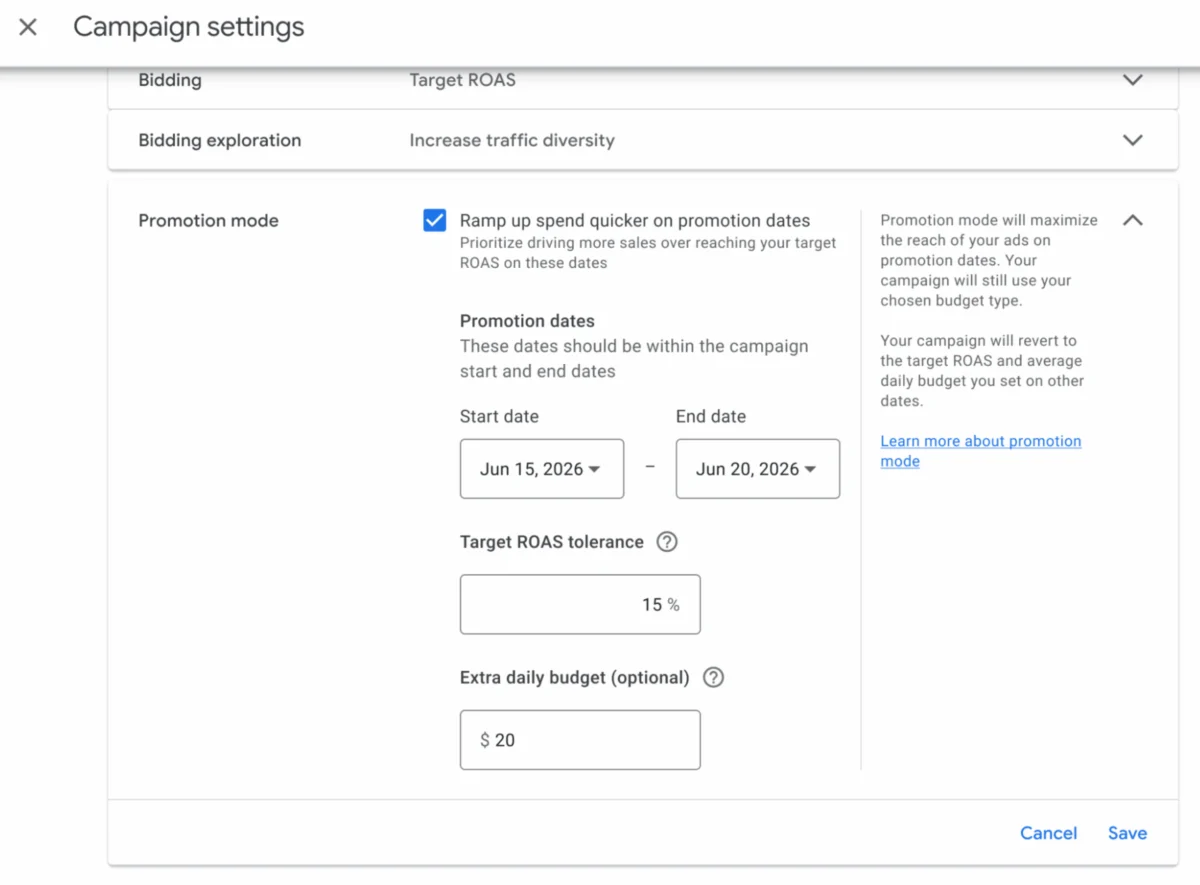
Addressing a long-standing challenge for advertisers during peak demand periods, Google is officially launching Promotion Mode in beta to a wider pool of advertisers. This feature, which was initially spotted by some advertisers as early as last September, is designed to help businesses effectively capture more queries and conversions during predictable or sudden demand spikes.
The impetus behind Promotion Mode is clear: to provide advertisers with the agility needed to respond to seasonal events, flash sales, product launches, and other periods of heightened consumer interest. Manually adjusting bids and budgets during such critical windows can be cumbersome, time-consuming, and often reactive, potentially leading to missed opportunities.
Promotion Mode streamlines this process by allowing advertisers to schedule temporary changes to their ROAS tolerance and allocate extra daily budget for specific peaking periods. For instance, a retailer preparing for Black Friday, a service provider anticipating increased demand during tax season, or a company launching a new product can pre-set their campaigns to temporarily relax their ROAS targets (to secure more impressions and conversions) and simultaneously inject additional budget to ensure they don’t hit spending limits prematurely.
This feature is currently available in beta for both Search and Performance Max campaigns, covering a significant portion of Google’s advertising ecosystem. The strategic implications are profound. Businesses can now plan their peak season advertising with greater precision and confidence, knowing that their campaigns will automatically adjust to capitalize on increased demand. This proactive approach can lead to a substantial increase in conversions and revenue during critical sales periods, offering a competitive edge in fast-moving markets. It also reduces the operational burden on marketing teams, allowing them to focus on broader strategic planning rather than manual campaign tweaks. The introduction of Promotion Mode is a direct response to advertiser feedback and market trends, where the ability to quickly scale and adapt to fluctuating demand is a key differentiator for success.
Broader Implications for the Digital Advertising Ecosystem
These three updates collectively paint a clear picture of Google’s ongoing strategic direction for its advertising platform: a continued push towards intelligent automation, coupled with enhanced tools that provide advertisers with both predictability and agile control within those automated frameworks.
The bidding target optimization changes emphasize a move towards more deterministic performance. While some advertisers might initially perceive a loss of “over-performance,” the long-term benefit for many will be greater clarity and consistency in campaign outcomes. It compels advertisers to be more precise with their target settings, ensuring that Google’s powerful machine learning algorithms are optimizing towards accurately defined business goals. This shift likely aims to reduce instances where advertisers might implicitly expect performance beyond their stated targets, aligning expectations with the platform’s automated capabilities.
The expansion of Smart Bidding Exploration underscores Google’s commitment to empowering advertisers with data-driven decision-making, even within a highly automated environment. It acknowledges that while automation offers efficiency, advertisers still require the ability to test, learn, and validate strategies before full-scale deployment. This feature bridges the gap between full automation and granular control, fostering confidence in the underlying AI. It also reflects the increasing sophistication required from digital marketers, who must now become adept at interpreting automated insights and designing effective A/B tests.
Finally, the Promotion Mode beta is a direct response to the real-world challenges faced by businesses operating in dynamic markets. It provides a crucial mechanism for advertisers to proactively capitalize on time-sensitive opportunities, ensuring they can scale their efforts to meet surging demand without the logistical complexities of manual adjustments. This feature is particularly pertinent in an e-commerce landscape heavily influenced by seasonal sales, product launches, and cultural events. It represents an evolution in how businesses can integrate their marketing efforts with broader commercial strategies, ensuring that advertising spend is maximized during critical periods.
In essence, Google Ads is evolving into a platform that demands more strategic input from advertisers while offering more sophisticated automated execution. The role of the advertiser is shifting from day-to-day manual optimization to one of strategic oversight, target setting, and interpreting the output of advanced machine learning systems. Agencies and in-house marketing teams will need to adapt by focusing on precise goal definition, robust testing methodologies, and proactive planning for market fluctuations. These updates are not merely incremental changes; they represent a significant refinement in how businesses will manage and derive value from their Google Ads investments in the years to come, further solidifying Google’s position at the forefront of the digital advertising industry. The ongoing dialogue between Google’s engineering teams and the global advertising community will undoubtedly shape further iterations of these powerful tools.