The digital advertising landscape is on the cusp of a significant transformation as Google Ads prepares to implement a fundamental change to its Smart Bidding strategies on August 17, 2026. This pivotal update, detailed in official Google Ads documentation, will permanently alter how budget limitations interact with target-based bidding strategies like Target CPA (Cost Per Acquisition) and Target ROAS (Return on Ad Spend). The long-standing practice of campaigns artificially achieving hyper-efficient results due to budget constraints will cease, ushering in an era of more predictable and scalable campaign performance. While some in the PPC (Pay-Per-Click) community have expressed concern over the potential loss of "cheap conversions," the broader implication is a strategic decoupling of budget management from efficiency metrics, a move poised to benefit advertisers seeking sustainable growth.
The Historical Anomaly: Budget Constraints as an Unintended Efficiency Throttle
For years, PPC managers have grappled with a well-documented phenomenon: when a campaign employing Smart Bidding strategies such as Target CPA or Target ROAS is "Limited by budget," its performance often appears exceptionally efficient. The underlying mechanism, as articulated by industry experts, is that in such scenarios, Smart Bidding aggressively conserves spend. It focuses on securing only the most readily available, lowest-cost conversions that fall within the daily budget cap. This often results in a significantly lower CPA than the stated target, leading to a perception of campaign overperformance.
For instance, a campaign with a target CPA of $50 might consistently deliver conversions at $35 when capped at a $100 daily budget. While this scenario typically pleases clients and internal stakeholders, it creates a misleading baseline. The $35 CPA is not necessarily a testament to superior campaign optimization; rather, it reflects the algorithm’s constrained approach, cherry-picking the most accessible conversion opportunities within a limited spend.
The critical issue arises when the decision is made to scale the campaign by increasing the budget. As the daily limit is raised, for example, to $500, the algorithm is suddenly exposed to a much wider spectrum of auction opportunities. This expansion forces a rapid and often disruptive re-evaluation of bidding parameters. Without prior learning on this broader inventory, the algorithm’s performance can destabilize, leading to a dramatic spike in the actual CPA, often soaring past the original $50 target. This instability not only erodes efficiency but also significantly extends the campaign’s learning period, creating a frustrating cycle for advertisers.
This behavior has been a persistent challenge for PPC professionals tasked with scaling successful campaigns. The act of increasing the budget, a natural progression for growth, paradoxically often led to a decline in performance efficiency, necessitating careful, incremental budget adjustments to avoid triggering this instability. The perceived "cheap conversions" were, in essence, a byproduct of a system designed to operate within artificial limits, not a true reflection of its broader optimization potential.
The August 17th Revelation: Decoupling Budget and Efficiency
The forthcoming update on August 17, 2026, marks a fundamental shift in this long-standing behavior. Google’s intention is to compel Smart Bidding algorithms to optimize strictly towards the designated target CPA or ROAS, irrespective of the campaign’s budget status. This means that if a campaign has a Target CPA of $10, the algorithm will strive to deliver conversions at or around $10, even if recent performance has been significantly lower due to budget limitations.
While this might initially be perceived as a reduction in efficiency, it is, in fact, a critical stabilization fix. The core change is the separation of the budget lever from the efficiency lever. Previously, a constrained budget artificially boosted efficiency. Post-August 17, the budget will primarily dictate the volume of conversions acquired at the target efficiency level.
Consider the previous example: a campaign with a $50 target CPA delivering at $35 due to budget constraints. After August 17, if the budget is increased, the algorithm will aim to acquire more conversions at the $50 target, rather than artificially suppressing spend to achieve a lower CPA. This predictable behavior is a significant win for advertisers focused on sustainable, scalable growth. Instead of experiencing a performance freefall when budgets increase, advertisers can anticipate a more linear expansion of their reach and conversions, all while adhering to their defined efficiency goals.
This decoupling addresses a core flaw in the previous system, where budget limitations masked the algorithm’s true bidding potential and created a false sense of efficiency. By forcing optimization towards the stated target, Google is enabling advertisers to have a clearer understanding of their campaign’s true performance ceiling and a more reliable method for scaling.
Campaigns in Focus: Understanding the Scope of the Change
The impact of this update is not universal across all campaign types and bidding strategies within Google Ads. Understanding these distinctions is crucial for advertisers to accurately audit their accounts and prioritize preparation efforts.

Campaign Types and Bidding Strategies Affected:
- Search, Shopping, Performance Max, Demand Gen, Travel Campaigns: These campaign types, when utilizing Target CPA and Target ROAS bidding strategies, will be directly impacted. The post-August 17 behavior will strictly adhere to the stated targets, eliminating the artificial efficiency gains previously seen under budget constraints. For Demand Gen campaigns, Target CPC (Cost Per Click) will also fall under this new rule.
- Display and Hotel Campaigns: These specific campaign categories, when employing Target CPA and Target ROAS, are not expected to see a change in behavior. They have historically operated under a stricter adherence to target efficiency, making them less susceptible to the budget-induced anomaly.
- App Campaigns, Video Reach, Video View (VVC) Campaigns: These campaign types, using their respective CPA or Cost-Per-View targets, will retain their historical bidding behavior. The changes are not anticipated to affect their operational dynamics.
- Manual Bidding Strategies: Campaigns utilizing manual bidding approaches, such as Manual CPC or Target Impression Share, will remain unaffected by this update, as their optimization logic is not directly tied to automated target-based strategies.
This detailed breakdown highlights that the most significant adjustments will be observed in campaigns where automated bidding aims for specific conversion cost or revenue goals, particularly within the high-volume Search and Shopping environments.
Preparing for the Shift: Unlocking Scalability and Strategic Growth
While the immediate reaction in the PPC community may focus on the potential loss of "cheap conversions," the August 17 update presents a significant strategic upside: predictable scalability. However, this upside requires proactive preparation. Doing nothing is an active choice that will allow existing CPAs to trend upwards towards the legacy, potentially inefficient, targets set in campaign settings.
Google has provided advertisers with tools to navigate this transition smoothly. The Bid Target Adjustment Tool, rolled out on July 6, 2026, is central to this preparation. This tool automatically identifies campaigns that have historically experienced "Limited by budget" status over the past 12 months, removing the need for manual data mining.
The recommended four-step transition framework is as follows:
-
Access the Bid Target Adjustment Tool: Navigate to the notification within your Google Ads account to launch the tool. The system will pre-populate it with relevant campaigns. For manual verification, advertisers can filter their campaign table by "Search Lost IS (budget) > 0%" over a 12-month period. It is also advisable to cross-reference this with the last 30 days of performance to ensure the existing target is realistic in the current market.
-
Evaluate and Adjust CPA/ROAS Bids: This is the critical juncture for advertisers. The tool allows for two primary actions:
- Maintain Current CPA/ROAS Bids: If the actual performance of a campaign has been consistently at or near the target CPA/ROAS (despite previous budget limitations), advertisers can choose to maintain these targets. This aligns the stated target with the actual achieved efficiency.
- Increase CPA/ROAS Bids: For campaigns that have been artificially suppressed by budget limits, the tool enables advertisers to increase their target CPA or ROAS to a more realistic, aspirational level. This should be informed by the campaign’s actual performance data and business objectives. The key is to set a target that reflects the desired efficiency for scaled spend.
-
Respect the Conversion Cycle Window: Smart Bidding algorithms require time to learn and stabilize after significant bid adjustments. Google recommends allowing for 1-2 conversion cycles for re-stabilization. Advertisers operating with longer sales cycles (e.g., one week) must account for this and make bid adjustments in advance to ensure performance is stable by the August 17 deadline.
-
Incrementally Reality Check: The update provides an opportunity to re-evaluate the true incremental value of campaigns that previously delivered exceptionally low CPAs. These campaigns may have been heavily reliant on low-hanging fruit, such as branded searches. This transition is an opportune moment to assess whether these campaigns are generating genuine, incremental business value and to make any necessary adjustments to campaign structure or targeting.
Broader Implications: A More Predictable Future for PPC
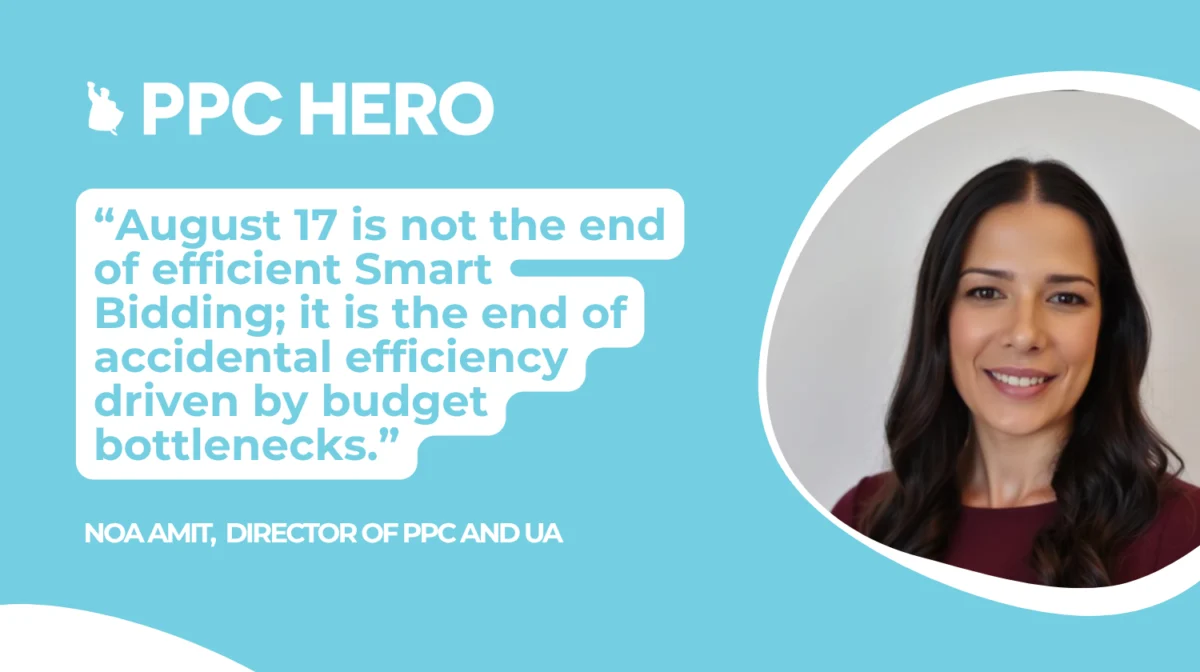
The August 17, 2026, update signifies the end of efficiency gains derived from artificial budget bottlenecks. Instead, it ushers in an era where budget increases directly translate into scaled results at predictable efficiency levels. This is not the demise of efficient Smart Bidding but rather its evolution towards a more transparent and reliable system.
By proactively recalibrating stale targets to align with current actual performance, PPC managers can mitigate the risk of unwanted CPA drift. More importantly, they are setting their accounts up for a future where scaling campaigns is a predictable and strategic endeavor. The ability to increase budgets and expect a proportional increase in conversions at a defined cost is a fundamental improvement that will empower advertisers to drive more sustainable and profitable growth. This shift represents a significant step forward in the maturity of automated bidding, moving it closer to a truly predictable engine for business expansion. The long-term implications point towards a more stable and data-driven approach to digital advertising, where efficiency is a direct outcome of optimization, not a side effect of constraint.


 Laily UPN
 Siti Muinah