

The intricate world of SMS marketing has emerged as a powerful tool for businesses to connect directly with consumers, offering unparalleled immediacy and engagement. However, the efficacy of text message campaigns is inextricably linked to stringent regulatory compliance, a critical aspect often underestimated by marketers. Failing to adhere to the diverse and evolving legal frameworks across different jurisdictions can result in substantial financial penalties, reputational damage, and a complete breakdown of consumer trust. With fines ranging from $500 to $1,500 per non-compliant message in the U.S. alone, and penalties reaching up to €20 million or 4% of global turnover under GDPR, the stakes for businesses are exceptionally high. This comprehensive guide outlines the essential compliance standards, regional variations, and best practices required to launch or scale compliant SMS sending operations effectively.
The Imperative of SMS Compliance in a Digitally Connected World
The proliferation of mobile devices has made SMS a direct and intimate channel for communication. Businesses leverage it for everything from promotional offers and product updates to order confirmations and customer service alerts. However, this direct access comes with a significant responsibility: respecting consumer privacy and preferences. Governments and regulatory bodies worldwide have responded to the rise of unsolicited commercial messages by enacting robust laws designed to protect consumers from spam and misuse of personal data. These regulations ensure that consent is freely given, easily revoked, and that messages are transparent about their purpose and sender.
The primary distinction in compliance often lies between marketing texts and transactional SMS. Marketing messages, by their nature, require prior explicit opt-in, meaning consumers must unequivocally agree to receive promotional content. Transactional messages, such as order confirmations or shipping updates, typically do not require explicit opt-in, provided they are strictly non-promotional and directly related to an existing commercial relationship. However, even transactional messages must respect fundamental principles like clear sender identification and the provision of opt-out mechanisms. Regardless of message type, the capability for recipients to easily opt-out is a universal and non-negotiable requirement.
Key Regulatory Frameworks: A Global Overview
SMS compliance is not a monolithic concept; it is a mosaic of regional and national laws, each with its own nuances and requirements. Businesses operating across borders must understand that the recipient’s location, not the sender’s, dictates which regulations apply. This necessitates a granular approach to audience segmentation and message delivery.
![SMS Compliance Checklist for Ecommerce [2026 ]](https://www.omnisend.com/blog/wp-content/uploads/2023/08/11-14-SMS-compliance-checklist.png)
United States: The TCPA and A2P 10DLC Mandate
The Telephone Consumer Protection Act (TCPA) is the cornerstone of U.S. SMS regulations. Enacted in 1991 and regularly updated, the TCPA aims to protect consumers from unwanted telemarketing calls and text messages. For SMS marketing, it mandates "prior express written consent," which means consent must be unambiguous, documented, and not a condition of purchase. This typically translates to a separate, unchecked box for SMS opt-in on a form. Penalties for TCPA violations are severe, ranging from $500 to $1,500 per non-compliant message, making robust consent management paramount.
A significant recent development in the U.S. is the A2P (Application-to-Person) 10DLC (10-Digit Long Code) registration requirement. Implemented by major U.S. carriers, this system requires businesses sending commercial SMS via standard local phone numbers (long codes) to register their brand and campaign type with The Campaign Registry. Failure to register results in messages being filtered, blocked, or heavily throttled, effectively rendering SMS campaigns useless. This mandate, aimed at increasing transparency and reducing spam, represents a critical operational step for any business targeting U.S. consumers.
Canada: CASL’s Strict Consent Rules
Canada’s Anti-Spam Legislation (CASL) is one of the most comprehensive anti-spam laws globally. It applies to all "commercial electronic messages" (CEMs), including SMS, sent to or from Canada. CASL emphasizes "express consent," which must be obtained through a clear, affirmative action, and pre-checked boxes are strictly prohibited. While "implied consent" can exist (e.g., from an existing business relationship), it has strict expiry periods, after which express consent becomes necessary for continued communication. CASL violations carry hefty fines, up to CAD $10 million per violation, underscoring the need for meticulous consent management.
A notable upcoming change for Canadian operations, effective March 2025, requires A2P registration for new long codes used for Canada-to-Canada sending, mirroring the U.S. trend towards greater sender transparency. Toll-free numbers, however, remain exempt from this specific A2P registration.
European Union: GDPR’s Broad Data Protection Scope
The General Data Protection Regulation (GDPR) is arguably the most far-reaching data privacy law in the world, affecting any business that processes personal data of individuals within the EU, regardless of the business’s location. While not solely an SMS regulation, GDPR’s principles of lawful processing, consent, data minimization, and individual rights directly impact SMS marketing. Consent under GDPR must be "freely given, specific, informed, and unambiguous," requiring a clear affirmative action. This means blanket consent for multiple purposes is generally not acceptable, and consent for email does not automatically extend to SMS.
GDPR also imposes strict requirements for data handling, storage, and security, making it crucial for businesses to protect phone numbers and associated personal data. The potential penalties for GDPR non-compliance are severe: up to €20 million or 4% of the company’s annual global turnover, whichever is higher.
United Kingdom: PECR and the "Soft Opt-in" Exception
Following its departure from the EU, the UK maintains its own data privacy framework, primarily through the UK GDPR and the Privacy and Electronic Communications Regulations (PECR). PECR specifically governs electronic marketing communications, including SMS. Like GDPR, it demands consent for marketing messages. However, PECR includes a "soft opt-in" exception for existing customers. This allows businesses to send marketing messages about "similar products and services" to customers whose contact details were obtained during a sale or negotiations for a sale, provided an opportunity to opt-out was given at the point of collection and in every subsequent communication. This "soft opt-in" is a distinct feature compared to the stricter requirements in other regions. Penalties for PECR breaches can reach up to £500,000, enforced by the Information Commissioner’s Office (ICO).
![SMS Compliance Checklist for Ecommerce [2026 ]](https://www.omnisend.com/blog/wp-content/uploads/2026/07/1.-SMS-form-builder-in-Omnisend.png)
Pillars of SMS Compliance: A Detailed Checklist
Beyond understanding the regional laws, operationalizing compliance involves several critical steps:
1. Explicit, Documented Consent is Non-Negotiable:
The foundation of compliant SMS marketing is legitimate consent. A phone number alone does not grant permission to send marketing texts.
- Marketing vs. Transactional: Marketing messages always require explicit consent. Transactional messages generally do not, provided they are strictly non-promotional.
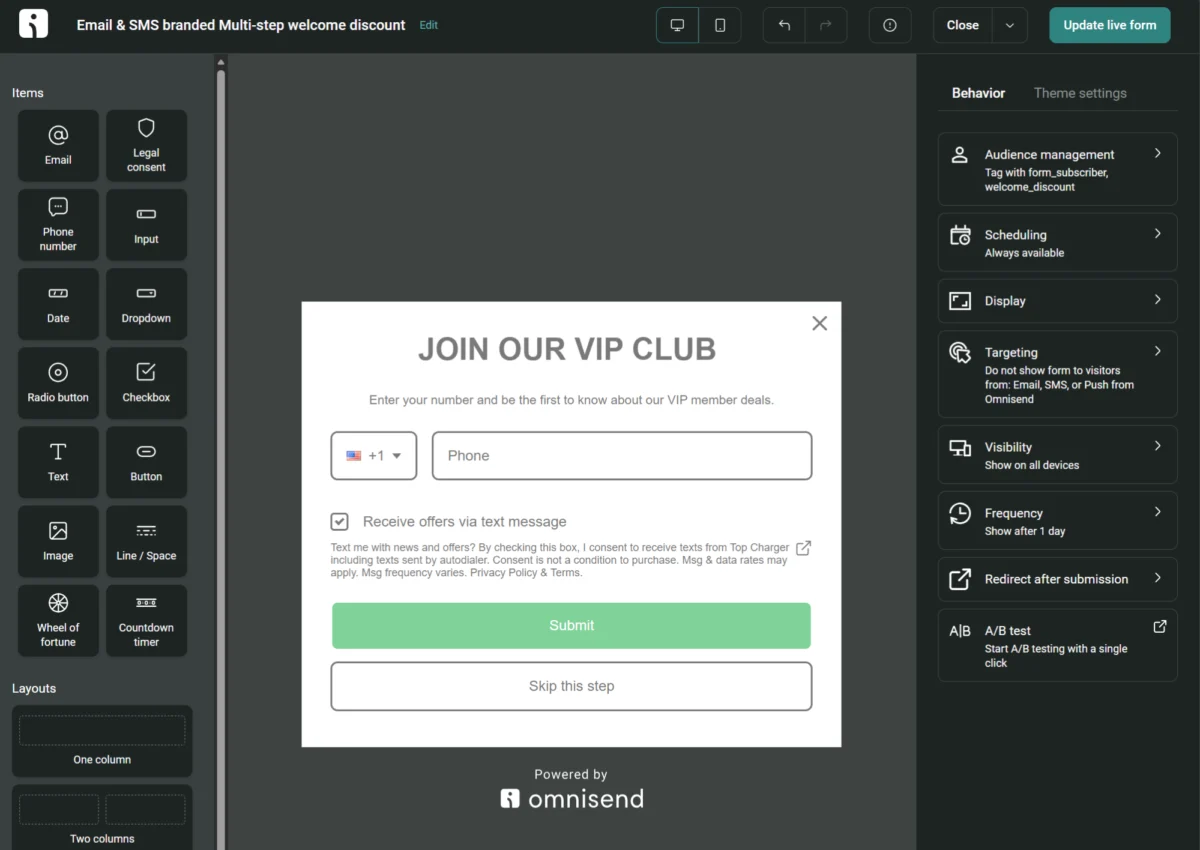
- Methods of Capture: Consent must be captured via a clear affirmative action, such as an unchecked checkbox on a web form, a text-to-join keyword, or at checkout. Pre-checked boxes are universally non-compliant for marketing.
- Documentation: Every opt-in must be meticulously documented, including the date, time, method of consent, and the specific language used at the point of opt-in. This record is your primary defense in case of a regulatory inquiry.
- Separation of Consent: Consent for SMS must be separate from consent for email or other communication channels. A customer agreeing to email marketing does not automatically agree to SMS.
2. Transparent Disclosure at Opt-in:
Consumers must be fully informed about what they are signing up for. This transparency builds trust and is a legal requirement.
- Sender Identity: Clearly state your brand or store name.
- Message Content & Frequency: Inform subscribers about the type of messages they will receive (e.g., "offers and order updates") and the approximate frequency (e.g., "~4 messages/month").
- Cost Implications: Include a disclaimer like "Message & data rates may apply."
- No Purchase Condition: Explicitly state that "Consent is not a condition of purchase."
- Opt-out Instructions: Provide clear instructions on how to opt-out (e.g., "Reply STOP to cancel").
- Links to Terms & Privacy: Include links to your SMS terms and conditions and your privacy policy.
These disclosures should be prominently displayed near the SMS opt-in field on forms and reiterated in the initial welcome message.
3. Meticulous Record-Keeping and Data Protection:
Compliance is an ongoing process that demands robust record-keeping.
- Consent Logs: Maintain timestamped records of every opt-in, including the source, consent language, and date.
- Opt-out Logs: Similarly, log every opt-out, noting the date and method.
- Data Security: Since phone numbers are personal data, they must be stored securely. This includes encryption, restricted access, and adherence to data protection principles (e.g., GDPR’s data minimization). Your SMS provider’s security practices are paramount.
- Retention: Keep records for an appropriate duration, often tied to the statute of limitations for relevant regulations.
4. Effortless Opt-out Mechanisms:
Facilitating easy and immediate opt-outs is a cornerstone of consumer protection and compliance.
![SMS Compliance Checklist for Ecommerce [2026 ]](https://www.omnisend.com/blog/wp-content/uploads/2026/07/2.-Example-of-a-compliant-SMS-form.png)
- STOP Keyword: Every marketing SMS must include clear instructions to reply "STOP" to opt-out. This should trigger an immediate unsubscribe.
- Multiple Opt-out Methods: While "STOP" is standard, consumers must be able to opt-out via any reasonable method (e.g., email, phone call, web form). Businesses must honor these requests promptly.
- Timely Action: In the U.S., the TCPA allows up to 10 business days to process an opt-out, but faster action is always recommended. A confirmation text acknowledging the unsubscribe is good practice.
- Automated vs. Manual: Ideally, your SMS platform should automate opt-outs for keyword replies. For other methods, manual processing is required to ensure compliance.
5. Mindful Content and Timing:
The content and delivery time of your messages are subject to regulatory scrutiny and carrier policies.
- Prohibited Content (SHAFT): Avoid sending messages related to Sex, Hate, Alcohol, Firearms, or Tobacco (SHAFT content). These categories are often filtered by carriers and can lead to account suspension.
- Quiet Hours: Respect local quiet hours for your recipients. Generally, this means no sending outside 8 AM to 9 PM in their local time zone. SMS platforms often have features to automatically adjust send times based on recipient location.
- Sender Identification: For U.S. and Canadian recipients, explicitly include your brand name in the message content, as alphanumeric sender IDs (custom sender names) are typically not supported for commercial traffic in these regions.
6. Sender Registration (A2P 10DLC, Toll-Free Verification):
Before sending any commercial SMS, your sender identity must be registered and verified.
- A2P 10DLC (U.S.): As mentioned, businesses using U.S. local 10-digit numbers for commercial traffic must register their brand and campaign with The Campaign Registry.
- Canadian Long Codes (March 2025): New long codes for Canada-to-Canada sends will also require A2P registration.
- Toll-Free Number Verification: Toll-free numbers used for commercial SMS typically require a verification process to confirm ownership and legitimate use.
- Short Codes: Dedicated short codes (5-6 digit numbers) undergo a more rigorous carrier vetting process to ensure compliance.
Skipping these registration and verification steps will invariably lead to messages being blocked or flagged as spam, severely impacting deliverability.
Recent Developments and Future Outlook
The landscape of SMS compliance is dynamic, continuously evolving in response to technological advancements and consumer demands. The upcoming changes in the U.S. regarding the 10-business-day window for opt-out processing, and the A2P registration for Canadian long codes, highlight a global trend towards greater sender accountability and consumer protection. Regulators and carriers are increasingly collaborating to combat spam and fraud, pushing for more transparent and legitimate SMS practices.
Industry experts anticipate further tightening of regulations, especially concerning data privacy and the definition of consent. The integration of AI in marketing also raises new compliance questions, particularly around personalized content generation and data usage. Businesses must remain agile, regularly reviewing their compliance practices and staying informed about legislative updates.
Leveraging Technology for Compliance
![SMS Compliance Checklist for Ecommerce [2026 ]](https://www.omnisend.com/blog/wp-content/uploads/2026/07/2.-Compliant-SMS-example.png)
Given the complexity, relying on purpose-built SMS marketing platforms is crucial. These platforms are designed with compliance in mind, offering features such as:
- Built-in Opt-in Forms: Customizable forms that include all necessary disclosures and capture consent in a compliant manner.
- Automated Consent Tracking: Timestamped records of opt-ins and opt-outs, essential for audit trails.
- Automated Opt-out Processing: Handling "STOP" replies and other common opt-out phrases automatically.
- Quiet Hours Management: Automatically scheduling messages to respect recipients’ local time zones.
- A2P 10DLC Support: Guiding businesses through the registration process or managing it on their behalf.
- Data Security: Ensuring stored customer data is encrypted and protected.
While such platforms significantly streamline compliance efforts, they do not absolve businesses of their ultimate legal responsibility. It is imperative to understand the underlying regulations and to consult with qualified legal professionals to confirm requirements specific to one’s business operations and target markets.
Conclusion: Building Trust Through Compliance
SMS marketing offers unparalleled opportunities for direct engagement, but its power comes with significant regulatory obligations. Navigating the complex web of TCPA, CASL, GDPR, PECR, and carrier-specific mandates is not merely a legal chore; it is a fundamental aspect of building and maintaining consumer trust. By prioritizing explicit consent, transparent disclosure, meticulous record-keeping, effortless opt-outs, and adherence to content and timing rules, businesses can ensure their SMS campaigns are both effective and compliant. The penalties for non-compliance are severe, but the rewards of a legally sound, trust-centric SMS strategy—including enhanced brand reputation, stronger customer relationships, and sustained marketing effectiveness—are immeasurable. In an era where consumer privacy is paramount, compliance is not just a safeguard against fines; it is a strategic imperative for long-term success.
Legal Disclaimer: This SMS compliance guide isn’t legal advice. It is general information. Confirm requirements for your business with a qualified professional.








