
 rifanmuazin
Email verification is increasingly recognized as a foundational pillar for effective digital marketing, transcending its traditional perception as a mere maintenance task. In an era dominated by data-driven strategies, hyper-personalization, and artificial intelligence (AI), the integrity of an email list directly dictates the return on investment (ROI) of marketing campaigns. Without this crucial first step, even the most meticulously crafted messaging and sophisticated technological deployments risk falling into a void of invalid addresses, leading to significant financial waste and reputational damage. This article explores why proactive email verification is not just a best practice, but an essential prerequisite for all marketing activities, offering a deep dive into its importance, mechanics, costs of neglect, and strategic implementation within the contemporary marketing landscape.
The Evolving Landscape of Email Marketing: A Chronology of Deliverability Challenges
The journey of email marketing has been marked by continuous evolution, from rudimentary broadcast tools to highly sophisticated engagement platforms. In the early days, the primary challenge was simply reaching an inbox. As email volume surged and spam became a pervasive issue, mailbox providers (ISPs) like Gmail, Outlook, and Yahoo introduced increasingly stringent filtering mechanisms. Understanding this evolution helps contextualize the critical role email verification plays today.
- Early 2000s: The Dawn of Spam Filters. The widespread proliferation of unsolicited commercial email led to the rapid development and deployment of spam filters. Marketers began to grasp the necessity of building opt-in lists and avoiding common spam triggers. However, email verification was often rudimentary, focusing primarily on basic syntax checks rather than deep validation. Bounce rates were a concern, but the sophisticated impact on sender reputation was less understood.
- Mid-2000s: The Rise of Sender Reputation. ISPs began to track a wider array of metrics, including bounce rates, spam complaints, and user engagement, to assess a sender’s trustworthiness. A high volume of hard bounces, indicating permanent delivery failures to invalid addresses, started to significantly degrade sender reputation, resulting in legitimate emails being shunted to spam folders or blocked entirely. This period marked a shift towards understanding the long-term consequences of poor list hygiene.
- 2010s: Personalization and the "Downstream Fallacy." With advancements in analytics and automation, marketers increasingly focused on personalization and segmentation. Data quality became more important for tailoring messages, yet many organizations fell into the "downstream fallacy." Resources were heavily invested in creative content, automation platforms, and A/B testing, often at the expense of fundamental data quality. The natural phenomenon of data decay—email lists degrading by an estimated 20-30% annually due to job changes, domain expirations, and user abandonment—became a recognized challenge that was frequently overlooked.
- Late 2010s – Present: Regulatory Scrutiny and AI Integration. The latter half of the decade saw the enactment of stringent data privacy regulations such as the General Data Protection Regulation (GDPR) in Europe (2018), the California Consumer Privacy Act (CCPA) in the US (2020), and Canada’s Anti-Spam Legislation (CASL). These regulations made valid, consented data not just a marketing best practice, but a legal imperative. Sending to unverified or improperly acquired addresses could lead to substantial fines and severe reputational damage. Concurrently, the burgeoning integration of AI and hyper-personalization in marketing strategies has made precise audience targeting paramount. Invalid data now represents an insurmountable barrier to leveraging these advanced technologies effectively, making verification an indispensable strategic component.
This chronological shift underscores a critical lesson: the stakes for email deliverability and data quality have never been higher. What was once a technical footnote has become a strategic imperative for brand communication, regulatory adherence, and maximizing digital marketing ROI.

The Invisible Ceiling on ROI: Why Email Verification is Non-Negotiable
Many organizations mistakenly view email verification as a peripheral maintenance task, a chore to be performed sporadically rather than a fundamental prerequisite. This perspective creates an "invisible ceiling" on campaign ROI, as resources are continually wasted on reaching non-existent recipients.
The core issue lies in the direct correlation between invalid email addresses and elevated bounce rates. A "hard bounce" – indicating a permanent delivery failure due to an invalid or non-existent address – sends a clear, negative signal to mailbox providers. Consistently high hard bounce rates can severely degrade a sender’s reputation, causing future legitimate emails to be routed directly to spam folders or, in severe cases, blocked entirely. According to industry benchmarks, a bounce rate exceeding 2% can begin to negatively impact sender reputation, with rates above 5% often signaling serious data quality issues that can lead to significant deliverability problems. For example, a major email service provider recently reported that senders with consistent bounce rates above 3% experienced a 15% reduction in overall inbox placement across their network.
"The integrity of your email list is the bedrock of your entire digital communication strategy," states Sarah Jenkins, a leading marketing analytics expert at Data Insights Group. "Investing in sophisticated content or cutting-edge AI without verifying your audience is akin to building a skyscraper on sand. The foundation must be sound, or the entire structure is compromised."
Proactive verification mitigates this risk by ensuring that marketing efforts are directed towards genuinely reachable leads. This foundational step protects deliverability, allowing brands to scale their campaigns confidently without fear of suspension or diminished inbox placement. By cleaning email databases, businesses establish a sound data foundation, ensuring that creative assets, personalized messaging, and A/B testing efforts are maximized, reaching as many relevant leads as possible. This also optimizes the use of email service provider (ESP) resources, as most charge based on subscriber count or email volume. Purging invalid contacts directly translates to reduced direct costs and a more efficient allocation of marketing budget, potentially allowing businesses to move down to a more cost-effective pricing tier.
The Downstream Fallacy: A Misplaced Focus in Marketing
A prevalent pitfall in modern marketing strategy is the "downstream fallacy," where teams disproportionately allocate resources to the latter stages of the marketing workflow – such as crafting compelling AI-generated copy, designing visually stunning emails, and implementing complex automation sequences – while neglecting the critical upstream task of ensuring data quality. This inversion of priorities often stems from the pressure to demonstrate visible "output" and creative prowess, making it difficult to accurately measure the true impact of these efforts if the underlying audience data is flawed.
The 2025 Gartner CMO Spend Survey highlighted that marketing budgets have flatlined at 7.7 percent of overall company revenue, underscoring a tighter fiscal environment where every dollar must be maximized. In such an environment, sending emails to "ghosts" or invalid domains is an expensive oversight. Marketing teams, eager to leverage trending technologies like AI and hyper-personalization, often find their innovations stifled by poor data. "Even the most intelligent AI cannot converse with a non-existent email address," noted Dr. Alex Chen, a prominent AI in marketing researcher at the Institute for Digital Transformation. "The power of personalization is entirely dependent on knowing your audience, and that starts with validating their contact information."
Beyond wasted ad spend and diminished campaign performance, the downstream fallacy fosters significant internal friction, particularly between marketing and sales departments. Marketing’s primary role is to generate qualified leads; when these leads are passed to sales with invalid contact information, sales teams waste valuable time and effort, leading to frustration and a breakdown of trust. John Davis, a veteran Sales Director for a B2B SaaS company, expressed his team’s frustration: "When we get a list from marketing and half the emails bounce, it’s not just wasted time; it erodes our confidence in the lead generation process. We need valid contacts to hit our targets." Verification acts as a crucial bridge, ensuring the quality of leads handed off, thereby fostering greater collaboration and efficiency between these interdependent teams. Correcting this fallacy requires a cultural shift, emphasizing audience validity as the primary launchpad for all subsequent marketing activities.
The Hierarchy of Email Success: Building from a Solid Foundation
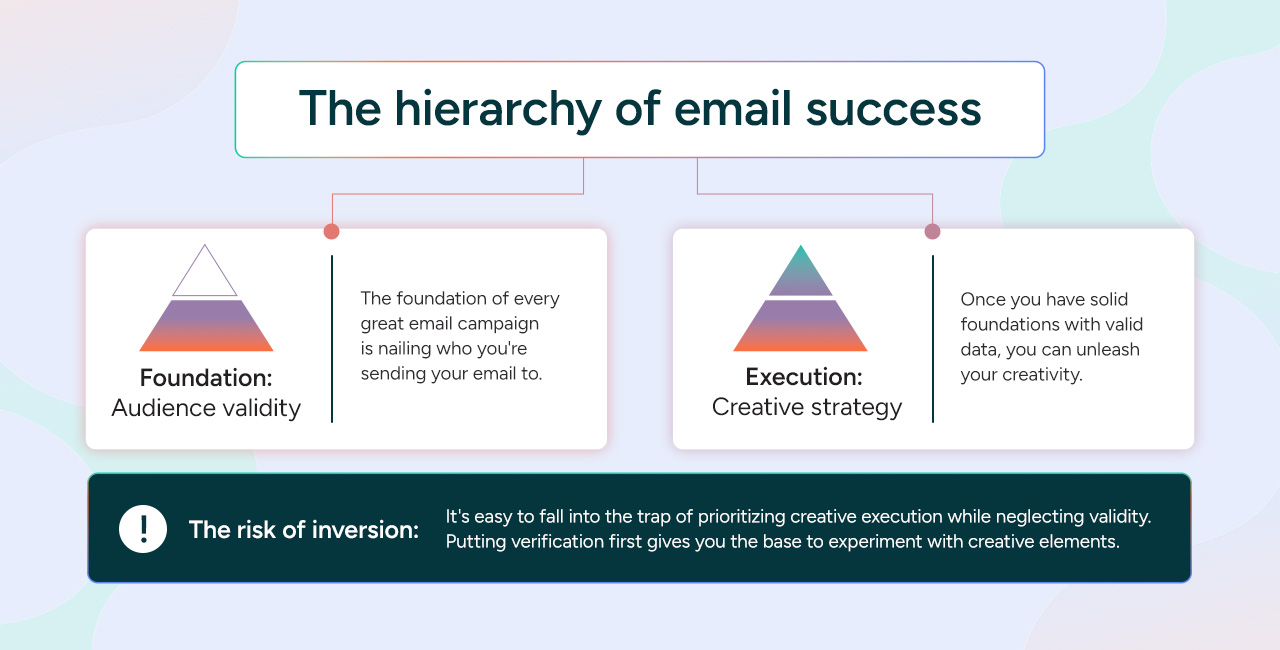
Achieving truly impactful email campaigns demands adherence to a clear hierarchy of priorities, where foundational elements precede creative execution. This structure ensures that efforts are strategically aligned for maximum effect.
1. Foundation: Audience Validity
The absolute bedrock of any successful email campaign is ensuring the validity and relevance of the target audience. This initial step dictates not only who receives the email but also profoundly influences the creative direction and messaging. By verifying email addresses at the outset, marketers avoid the costly exercise of "shouting into the void," ensuring that resources are allocated efficiently to genuinely reachable prospects. This foundational work is critical for both short-term campaign success and long-term scalability, preventing spiraling bounce rates as lists grow. Without a healthy list, growth becomes synonymous with increased risk and diminished deliverability, ultimately hindering overall marketing effectiveness.
2. Execution: Creative Strategy
Once a robust foundation of valid data is established, the creative team can unleash its full potential. This layer encompasses all aspects of engaging content: compelling copywriting, intuitive design, strategic calls to action, and advanced personalization tactics. While creative elements are responsible for capturing attention and driving engagement, their effectiveness is entirely contingent upon the deliverability secured by the preceding verification step. A brilliant email that never reaches the inbox is, by definition, a wasted effort. This stage builds upon the solid base provided by verified data, allowing innovation to flourish meaningfully.
3. The Risk of Inversion
A common and detrimental mistake is the inversion of this hierarchy, where creative execution is prioritized over audience validity. This can create a false sense of security, as teams might perceive a high volume of sent emails as a sign of productivity, even if a significant portion never reaches their intended destination. For instance, a campaign reporting a 20% open rate on a list with 30% invalid addresses is actually achieving a much higher effective open rate on its valid audience, but the true picture is obscured. Correcting this inversion requires a profound cultural shift within marketing organizations. Metrics such as list hygiene, bounce rate reduction, and valid contact percentage must be championed with the same vigor as click-through rates and conversion metrics. This ensures a holistic understanding of campaign performance and encourages a proactive approach to data quality, fostering a data-driven culture that values accuracy from the ground up.
Beyond the "@" Symbol: The Mechanics of Advanced Email Verification
Modern email verification is far more sophisticated than a simple check for the "@" symbol. It involves a multi-layered technical process designed to meticulously evaluate the authenticity and deliverability of an email address, providing a nuanced understanding of its status.

Comprehensive Technical Validation
Basic syntax checks are a preliminary step, confirming that an address adheres to the standard format (e.g., [email protected]). However, this only scratches the surface. Advanced verification processes delve deeper:
- Domain Validation (DNS Check): Verifies if the domain name (e.g., "example.com") actually exists and has valid DNS records, including Mail Exchange (MX) records, which indicate that the domain is configured to receive emails. An invalid domain immediately flags the email address as undeliverable.
- SMTP Connection & Response: The verification system attempts to establish a connection with the recipient’s mail server via SMTP (Simple Mail Transfer Protocol), simulating an email send without actually sending one. The server’s response provides crucial information. A "250 OK" response typically indicates a valid and active address, while specific error codes (e.g., "550 User unknown") definitively signal a non-existent user. Other responses can indicate temporary issues like a full mailbox or a temporary server outage.
- Greylisting Detection: Some mail servers employ greylisting, temporarily rejecting emails from unknown senders to deter spam. Verification tools are designed to detect this behavior and can re-attempt checks after a short delay to ensure an accurate status without falsely flagging the address as invalid.
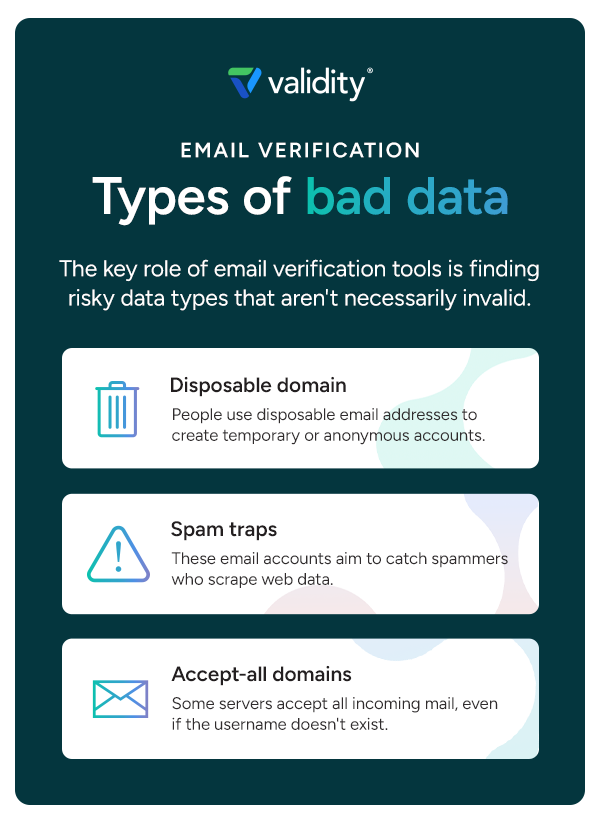
- Spam Trap Identification: These are email addresses specifically designed to catch spammers, often created from old, unused, or deliberately deceptive addresses. Hitting a spam trap is highly detrimental to sender reputation and can lead to immediate blacklisting. Advanced verification algorithms can identify known spam traps.
- Role-Based Email Detection: Identifies generic addresses like "info@," "sales@," or "admin@." While not always invalid, these often have lower engagement rates, higher complaint rates, and may not reach a specific individual, making them less valuable for personalized marketing.
- Disposable Email Address (DEA) Detection: Flags temporary email addresses (e.g., from services like Mailinator) used to sign up for services without revealing a primary email. These are often indicators of low-quality leads who may not be genuinely interested in long-term engagement.
By distinguishing between temporary delivery issues (e.g., a full mailbox, which might resolve itself) and permanent failures (e.g., a non-existent user), marketers can make informed decisions about pruning their lists and protecting their Sender Score from hard bounces, ensuring sustained deliverability.
Compliance and Risk Mitigation
The role of email verification extends significantly into regulatory compliance. By identifying and removing risky data types – such as spam traps, high-risk domains associated with purchased lists, or addresses with poor data hygiene – businesses can









