


April 17, 2026 – Email, the venerable cornerstone of digital communication, continues to assert its indispensability in the marketing landscape, yet a critical divide is rapidly emerging. According to Sinch Mailgun’s comprehensive 2026 Email Impact Report, while the channel’s fundamental importance remains undisputed, the chasm between email programs committed to rigorous measurement, meticulous deliverability, and continuous optimization, and those operating on outdated assumptions, is broadening with each passing year. This bifurcation signals a pivotal moment for businesses, urging a strategic re-evaluation of their email marketing investments and practices.
The meticulously compiled report draws from an extensive global survey of over 1,200 email senders and an unprecedented analysis of more than 400 billion real emails dispatched through Sinch Mailgun’s robust infrastructure in 2025. Spanning five critical chapters—ROI, industry benchmarks, deliverability, AI adoption, and investment trends—the study provides an unparalleled, data-backed snapshot of the email ecosystem. Its findings are poised to shape strategic decisions for email senders navigating the complexities of the second half of 2026 and beyond.
Email’s Enduring Relevance: A Foundational Channel
The report unequivocally confirms email’s unwavering significance. A staggering 78% of senders characterize email as either “very” or “extremely” important to their organization’s objectives. This level of organizational buy-in is a rare feat for any marketing channel, underscoring email’s unique position as a direct, personal, and cost-effective communication tool. From fostering customer relationships and driving conversions to delivering critical transactional updates, email permeates nearly every facet of the modern customer journey. Its inherent ability to segment audiences, personalize content, and provide measurable results has ensured its longevity amidst the rise and fall of numerous digital platforms. However, this widespread conviction in email’s value often masks a critical underlying deficiency: a lack of robust, empirical evidence to support that belief.
The ROI Imperative: Bridging Conviction and Evidence
Despite the high regard for email, a significant disconnect persists between organizational belief and organizational evidence, particularly concerning Return on Investment (ROI). The report highlights a startling reality: fewer than half of senders actively measure the ROI of their email programs. Specifically, only 46% track the ROI of promotional emails, and a mere 43% do so for transactional emails. This indicates that a substantial majority of teams are operating on faith rather than quantifiable data, potentially leaving significant budget justifications and optimization opportunities on the table.
For those who do measure, the figures are compelling. A remarkable 60% of senders tracking promotional email ROI report returns exceeding $10 for every $1 spent. Even more impressively, 13% of these senders achieve an ROI greater than $40 for every dollar invested. Similarly, 62% of senders measuring transactional email ROI cross the $10:1 threshold, with 13% reporting returns above $40:1. While these high returns underscore email’s immense profitability, Sinch Mailgun’s research intriguingly suggests that such exceptionally high figures might, paradoxically, signal underinvestment rather than peak efficiency. In essence, if the ROI is extraordinarily high, it could mean that businesses are not allocating enough resources to scale their successful email initiatives, missing out on even greater potential gains.
The primary obstacle to increasing email investment, cited by 43% of senders, is budget constraints. Yet, the report shrewdly observes that securing a larger budget is inherently challenging without compelling data to build a strong business case. Most teams, trapped in a cycle, are not gathering the very data needed to advocate for increased resources. To break this cycle, the report advocates for an intermediate, more accessible step: tracking revenue per campaign. Even with an imperfect attribution model initially, this metric can provide tangible evidence of email’s financial impact, paving the way for more sophisticated, full ROI tracking down the line. A Sinch Mailgun spokesperson, commenting on this finding, stated, “The era of operating on gut feeling is over. To truly unlock email’s potential, organizations must prioritize data collection and analysis, starting with achievable metrics that demonstrate value.”
400 Billion Emails Reveal Industry Benchmarks: A Data-Driven Reality Check
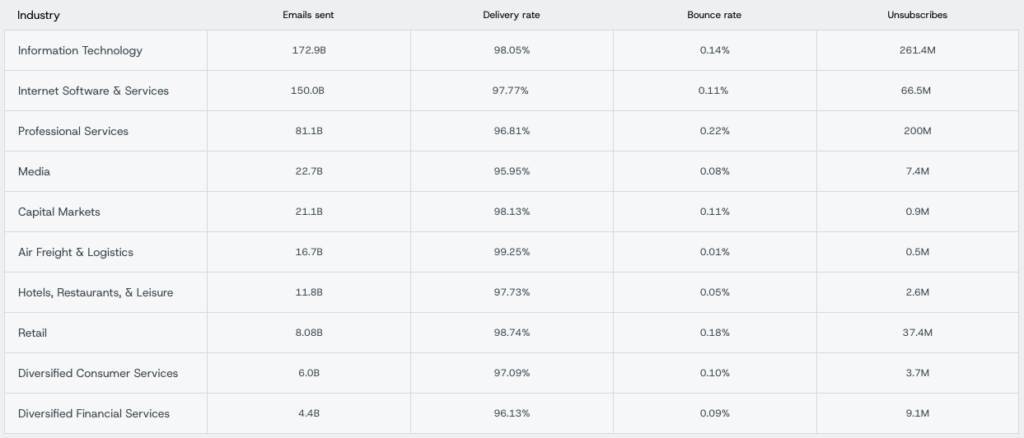
Chapter 2 of the 2026 Email Impact Report offers a groundbreaking departure from conventional benchmark data, which often relies on self-reported estimates from surveys. Instead, Sinch Mailgun leveraged its vast infrastructure to analyze real sending data from 400 billion emails across the top 10 industries by volume in 2025. This unprecedented scale provides an authentic, granular view of email performance metrics, including delivery, bounce, and unsubscribe rates, offering businesses a more accurate yardstick against which to measure their own programs.

The variations across industries are stark and illustrative. The Air Freight & Logistics sector leads with an impressive 99.25% delivery rate and an exceptionally low 0.01% bounce rate. These stellar figures are largely attributable to the nature of their communications: predominantly transactional sends such as shipping confirmations and tracking updates, which are highly anticipated and desired by recipients. In stark contrast, the Media industry sits at the lower end of the spectrum among the top 10, with a 95.95% delivery rate. This is often driven by high volumes of promotional content aimed at broad audiences, which naturally exert downward pressure on deliverability metrics due to varied engagement levels and higher spam complaint rates.
However, the report issues a critical caution: delivery rate alone can be a misleading metric. An email technically “delivered” to a recipient’s spam or junk folder still counts as delivered, yet fails to achieve its primary objective of reaching the inbox. The report makes a compelling case for senders to consistently pair delivery rate tracking with dedicated inbox placement testing. This dual approach provides a far more accurate understanding of where emails actually land, rather than simply whether they were accepted by the receiving server. Without inbox placement data, businesses risk misinterpreting their email program’s true effectiveness.
Further analysis of the raw data reveals crucial nuances. Information Technology, for instance, logged the highest raw number of unsubscribes at 261 million. However, when contextualized against its monumental send volume of 172.9 billion emails, this translates to a relatively low unsubscribe rate of approximately 0.15%. Conversely, the Retail sector generated 37.4 million unsubscribes from a significantly smaller volume of 8.08 billion sends, resulting in a far higher unsubscribe rate per email. This comparison unequivocally demonstrates that raw unsubscribe volume, divorced from the context of send volume, is an utterly meaningless metric. Understanding these rates in proportion is essential for identifying potential issues like list fatigue, irrelevant content, or aggressive sending patterns. Industry analysts suggest that comparing performance metrics against these real-world benchmarks, rather than generalized averages, allows businesses to set more realistic goals and identify areas for targeted improvement.
Deliverability Is Improving, But Knowledge Gaps Persist
The foundational importance of deliverability is well-recognized, with 89% of senders acknowledging its significance to their organization. Encouragingly, 43% report an improvement in their inbox placement over the past 12 months, signaling genuine progress in the underlying infrastructure of email sending. A significant driver of this improvement has been the widespread adoption of DMARC (Domain-based Message Authentication, Reporting & Conformance) – an email authentication protocol designed to protect domains from unauthorized use, such as phishing.
DMARC adoption has seen substantial growth, propelled by increasingly stringent requirements from major email service providers like Gmail, Yahoo, and Microsoft. For the first time in Sinch Mailgun’s research history, the report notes that DMARC enforcement is outpacing passive monitoring, with over half of DMARC adopters now implementing “quarantine” or “reject” policies. This signifies a proactive shift from merely monitoring email authentication issues to actively preventing unauthorized emails from reaching inboxes or even being delivered at all, thereby bolstering security and brand reputation. The timeline of DMARC adoption shows a steady increase: 43% in 2023, 54% in 2024, and a solid 61% in 2025, reflecting a growing industry commitment to email security and integrity.
Despite this progress in infrastructure and adoption, a critical “knowledge gap” continues to plague the industry. A significant 36% of senders erroneously claim to monitor their “email deliverability rate”—a metric that, in precise terms, does not exist. This confusion highlights a fundamental misunderstanding of core email performance indicators. As the report clarifies, “delivery rate” merely indicates that an email was accepted by the receiving server, regardless of whether it landed in the inbox or the spam folder. “Inbox placement,” conversely, measures precisely what percentage of emails actually reached the intended recipient’s primary inbox. The startling statistic that only 25% of senders actively run inbox placement tests underscores this knowledge deficit. Furthermore, 27% of DMARC users are unaware of the specific policy (none, quarantine, or reject) they have in place, indicating a lack of understanding regarding the implications of their own security measures. The report concludes that while the tools and infrastructure for better deliverability are evolving rapidly, the general literacy and understanding surrounding their effective use have yet to catch up. This gap poses a significant risk, as even the most sophisticated systems cannot compensate for a lack of informed operational oversight.
AI Adoption: Wide Reach, Uneven Impact
Artificial Intelligence (AI) has emerged as a transformative force across industries, and email marketing is no exception. The 2026 Email Impact Report reveals widespread interest and adoption, with 79% of senders either currently using or planning to integrate AI into their email programs. However, the reality of its implementation paints a more nuanced picture. Regular, systematic use of AI currently stands at a modest 27%, suggesting that a substantial portion of adopters are still in the experimental phase rather than fully embedding AI into their routine workflows.
The most common applications of AI in email marketing include copy generation (41%), content personalization (36%), dynamic content (29%), send time optimization (27%), and data analysis (27%). This pattern illuminates a key insight: AI delivers the most profound value when strategically integrated into decision-making processes, extending beyond mere content production. Teams leveraging AI for sophisticated tasks like personalization, optimal timing, and A/B testing report compounding returns, witnessing a synergistic effect that amplifies their marketing efforts. Conversely, teams whose AI usage is limited to more superficial tasks, such as drafting subject lines, observe a significantly limited impact.
The report presents compelling evidence of AI’s burgeoning influence: 54% of senders who have implemented AI report a moderate or significant improvement in their email programs year-over-year. This stands in stark contrast to the 37% of senders not using AI who saw similar improvements within the same timeframe. This 17-point performance gap is a powerful indicator that AI is beginning to stratify email programs, creating distinct tiers of performance. While the report carefully notes that this does not definitively prove causation, the consistent direction of the data strongly suggests a significant correlation between AI integration and enhanced email program efficacy.
Crucially, the report also acknowledges that 23% of AI users report no discernible benefit from the technology. This finding underscores that the effectiveness of AI is not solely dependent on the tool itself, but rather on the depth and sophistication of its integration. Simply adopting an AI tool without a clear strategy for embedding it into critical decision-making processes and workflows is unlikely to yield significant returns. An inferred statement from a technology analyst might emphasize that “AI is a powerful accelerant, but its true potential is unlocked only when it moves beyond novelty and becomes an intrinsic part of a strategic marketing framework.”
Where Email Investment is Heading: Strategic Priorities for 2026
Looking ahead to 2026, the strategic priorities for email senders are clear and closely aligned with the report’s findings. “Taking advantage of AI” and “increasing email engagement” are tied as the top priorities, each cited by 40% of senders. This indicates a recognition of AI’s potential to drive deeper, more effective interactions with audiences.
Regarding financial commitments, the investment landscape for email marketing shows cautious optimism. A solid 31% of senders plan to increase their email investment, reflecting confidence in the channel’s ROI potential when managed effectively. The largest contingent, 48%, intends to maintain their current spending levels, suggesting a stable, if not aggressively expanding, commitment. A smaller but notable 7% plan to decrease their email investment, which might be attributed to the lack of measured ROI or a misunderstanding of email’s full capabilities.
The Sinch Mailgun report culminates with a straightforward, yet profound, conclusion: email undeniably works. The overwhelming data across ROI, industry benchmarks, and deliverability trends consistently supports this assertion. However, the future success of email programs will hinge not merely on its inherent effectiveness, but on a triple-pronged investment strategy. The programs that will truly distinguish themselves and pull ahead are those that simultaneously invest in:
- Measurement: Proving ROI with real, attributable data, moving beyond assumptions to concrete evidence. This involves implementing robust analytics, attribution models, and continuous performance tracking.
- Deliverability: Consistently ensuring emails reach the inbox through diligent authentication protocols (like DMARC), meticulous list hygiene, and proactive monitoring of inbox placement, rather than just delivery rates. This also requires a deep understanding of ISP requirements and best practices.
- Optimization: Leveraging advanced tools and techniques, including AI and systematic A/B testing, to continuously improve performance at scale. This encompasses dynamic content, personalization, send time optimization, and intelligent segmentation.
The report offers a reassuring note: none of these critical areas necessitate a massive budget to initiate. Rather, they represent strategic shifts that, when implemented consistently, compound over time, yielding increasingly significant returns.
Broader Implications and The Path Forward
The 2026 Email Impact Report serves as a clarion call for businesses to elevate their email marketing strategies from a tactical execution to a data-driven, strategic imperative. The widening gap between sophisticated and unsophisticated programs suggests that businesses failing to adopt these recommended practices risk falling significantly behind competitors who embrace data, robust deliverability, and AI-powered optimization.
The implications are far-reaching. For marketers, it underscores the critical need for continuous skill development in data analytics, AI integration, and advanced deliverability management. For organizations, it highlights the importance of fostering a culture of evidence-based decision-making and allocating resources to tools and training that empower their email teams. As digital communication continues to evolve, email’s role as a direct, powerful, and personal channel remains secure. However, its efficacy will increasingly be defined by the intelligence, precision, and strategic foresight with which it is managed. The future of email marketing belongs to those who are willing to invest in understanding and optimizing its true impact.








