
The landscape of digital communication continues to evolve rapidly, yet email steadfastly remains a cornerstone of organizational outreach. However, a significant and widening chasm is emerging between email programs that proactively invest in robust measurement, stringent deliverability practices, and advanced optimization techniques, and those that rely on outdated assumptions. This critical divergence is the central theme of Sinch Mailgun’s comprehensive 2026 Email Impact Report, a seminal study released on April 17, 2026, offering an unparalleled look into the current state and future trajectory of email marketing.
The report, drawing from a global survey encompassing more than 1,200 email senders and an exhaustive analysis of over 400 billion real emails transmitted through Sinch Mailgun’s infrastructure during 2025, provides a data-rich narrative across five crucial chapters. These sections meticulously explore the return on investment (ROI) of email programs, establish industry benchmarks based on actual send data, dissect the intricacies of email deliverability, evaluate the burgeoning adoption of artificial intelligence (AI) in email, and forecast investment trends for the remainder of 2026 and beyond. The findings present a clear mandate for email senders aiming to thrive in an increasingly competitive and data-driven digital ecosystem.
The Enduring Power of Email and the ROI Imperative
Email’s strategic importance within organizations is undeniable, with a striking 78% of senders categorizing it as “very” or “extremely” important to their operations. This level of internal buy-in is a rare commodity for any marketing channel, often reflecting its pervasive use in customer acquisition, retention, and communication. Despite this widespread organizational conviction, the report uncovers a significant blind spot: a widespread failure to translate belief into measurable evidence. Fewer than half of senders actively measure the ROI of their email programs, whether for promotional campaigns (46%) or transactional communications (43%). This substantial measurement gap indicates that a majority of teams are operating on faith rather than concrete financial justification.
For those organizations that do undertake the crucial step of measuring email ROI, the results are compelling. A remarkable 60% of senders who track promotional email ROI report returns exceeding $10 for every $1 spent. Even more impressively, 13% of these senders claim an ROI greater than $40 for every dollar invested. Similarly, 62% of senders measuring transactional email ROI achieve the $10:1 threshold, with 13% also reporting returns above $40:1. However, Sinch Mailgun’s research cautiously suggests that such exceptionally high returns might paradoxically signal underinvestment in the email channel, implying that more resources could potentially yield even greater, albeit slightly less disproportionate, returns.
The primary impediment to increasing email investment, as cited by 43% of senders, is budget constraints. This creates a challenging paradox: securing a larger budget often requires robust data to demonstrate value, yet most teams are not collecting the fundamental data needed to build such a case. Industry analysts suggest that this cycle can be broken by adopting incremental measurement strategies. “While a perfect attribution model can be complex and costly to implement from day one, starting with simpler metrics like revenue per campaign provides an actionable intermediate step,” commented an email marketing strategist familiar with the report. “Even imperfect data is better than no data, as it allows teams to begin demonstrating tangible value and incrementally building the case for further investment and more sophisticated measurement tools.” This foundational step enables organizations to quantify the direct impact of their email efforts, thereby bolstering their position in budget allocation discussions.
Unveiling True Performance: Benchmarks from Billions of Emails
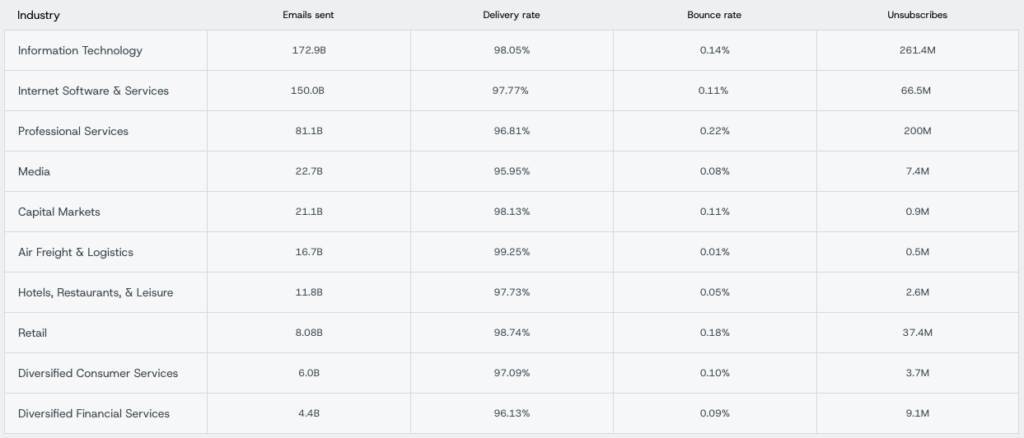
A distinguishing feature of the 2026 Email Impact Report is its departure from conventional benchmark data, which often relies on self-reported estimates and surveys. Chapter 2 of the report leverages an unprecedented dataset: real sending data from Sinch Mailgun’s infrastructure, encompassing the top 10 industries by volume in 2025. This granular, real-world data offers a more accurate reflection of email performance metrics, including delivery rates, bounce rates, and unsubscribe rates, across diverse sectors.

The industry-specific performance metrics reveal significant disparities. Air Freight & Logistics, for example, leads with an impressive 99.25% delivery rate and an exceptionally low 0.01% bounce rate. This superior performance is largely attributable to the transactional nature of their emails, such as shipping confirmations and tracking updates, which are highly anticipated and valued by recipients. In stark contrast, the Media industry recorded the lowest delivery rate among the top 10, at 95.95%. This can be attributed to the high volume of promotional emails, broader audience targeting, and the inherent challenges of maintaining engagement in a content-saturated environment.
However, the report makes a crucial distinction: delivery rate alone can be misleading. An email successfully “delivered” to a recipient’s spam folder still counts as delivered by many basic metrics. To gain a true understanding of email efficacy, senders are strongly advised to pair delivery rate tracking with consistent inbox placement testing. “Understanding where your emails actually land – in the primary inbox, promotions tab, or spam folder – is far more indicative of success than merely knowing they were accepted by the server,” noted a deliverability expert. “Without inbox placement testing, marketers are essentially flying blind, potentially celebrating a high delivery rate while their messages languish unseen in spam filters.” This emphasis on genuine inbox reach underscores the evolving sophistication required in email program management.
Further analysis of unsubscribe rates highlights the critical need for context. The Information Technology sector, for instance, generated the highest raw number of unsubscribes at 261 million. Yet, when contextualized against its colossal send volume of 172.9 billion emails, this translates to a relatively low unsubscribe rate of approximately 0.15%. Conversely, the Retail industry, with 37.4 million unsubscribes on a much smaller volume of 8.08 billion sends, exhibits a significantly higher unsubscribe rate per email. This comparison unequivocally demonstrates that raw unsubscribe volume, without the crucial context of send volume, is an unreliable and potentially misleading metric for assessing audience engagement and list health.
Deliverability’s Paradox: Progress in Infrastructure, Stagnation in Understanding
Deliverability, the ability of an email to reach its intended recipient’s inbox, is acknowledged as vital by 89% of senders. Encouragingly, 43% of senders reported an improvement in their inbox placement over the preceding 12 months. This positive trend is largely underpinned by significant progress in email infrastructure, particularly the widespread adoption of DMARC (Domain-based Message Authentication, Reporting, and Conformance). This protocol, alongside SPF (Sender Policy Framework) and DKIM (DomainKeys Identified Mail), helps protect email senders and recipients from spam, spoofing, and phishing.
The report details a clear chronology of DMARC adoption growth: 43% in 2023, rising to 54% in 2024, and reaching 61% in 2025. This accelerated adoption has been significantly driven by increasingly stringent requirements from major email service providers (ESPs) such as Gmail, Yahoo, and Microsoft, which have mandated DMARC for bulk senders to enhance security and combat spam. For the first time in Sinch Mailgun’s research, DMARC enforcement—where organizations actively use quarantine or reject policies to block unauthorized emails—is outpacing passive monitoring, with over half of DMARC adopters now implementing these stronger policies. This shift represents a maturity in email security practices, moving beyond mere observation to active defense.
Despite these advancements in infrastructure and security protocols, a critical knowledge gap persists among many email senders. A notable 36% of senders incorrectly claim to monitor their “email deliverability rate,” a metric that, as defined by industry standards, does not exist in the way they perceive it. This confusion often conflates the delivery rate (emails accepted by the server) with actual inbox placement (emails reaching the primary inbox). Only a quarter (25%) of senders routinely conduct inbox placement tests to ascertain where their emails are truly landing. Furthermore, a concerning 27% of DMARC users are unaware of the specific policy (none, quarantine, or reject) they have implemented. This indicates a significant disconnect between the availability of sophisticated tools and the fundamental understanding required to leverage them effectively. “The technology is improving at a rapid pace, offering robust solutions for authentication and inbox reach,” observed a spokesperson for Sinch Mailgun. “However, the literacy and practical application of these tools by many email professionals have not kept pace, leading to suboptimal performance despite enhanced infrastructure.”
The AI Divide: Uneven Impact and Strategic Integration
Artificial intelligence (AI) has rapidly permeated the email marketing domain, with 79% of senders either currently using or planning to integrate AI into their email programs. Yet, the report highlights a significant disparity between widespread interest and actual, impactful implementation. Regular use of AI in email workflows stands at a mere 27%, suggesting that a considerable portion of adopters are still in experimental phases rather than systematically integrating AI into their operations.
The most common application of AI is in copy generation, cited by 41% of senders, followed by content personalization (36%), dynamic content creation (29%), send time optimization (27%), and data analysis (27%). The report’s analysis reveals a clear pattern: AI delivers the most substantial value when it is deeply embedded in strategic decision-making processes rather than solely in superficial content production. Teams leveraging AI for advanced personalization, optimizing send times, and facilitating A/B testing report compounding returns on their investment. In contrast, teams using AI primarily for basic tasks like drafting subject lines or simple content prompts see limited, if any, discernible impact on their program performance.
A compelling data point underscores this “AI divide”: 54% of senders who have actively implemented AI report that their email programs improved moderately or significantly year-over-year. This contrasts sharply with just 37% of senders who are not using AI reporting similar improvements during the same period. This 17-point performance gap, while not definitively proving causation, consistently points towards AI as a burgeoning differentiator, separating email programs into distinct performance tiers. The report notes that 23% of AI users claim it has not helped them at all, reinforcing the idea that the tool itself is less critical than the depth and strategy of its integration. The true value of AI lies in its ability to augment human decision-making, automate complex optimizations, and unlock deeper insights, rather than merely serving as a content-generation utility.
Future Trajectories: Investment Priorities and Strategic Imperatives
Looking ahead to 2026, the report identifies “taking advantage of AI” and “increasing email engagement” as the top priorities for email senders, with each cited by 40% of respondents. These twin priorities reflect a growing recognition of AI’s potential to drive more effective and personalized engagement, which remains the ultimate goal of email marketing.
Regarding investment plans, 31% of organizations intend to increase their email marketing budget, while 48% plan to maintain current spending levels. Only a small fraction, 7%, anticipate decreasing their investment. This indicates a general sentiment of sustained or growing confidence in email as a vital channel, even amidst broader economic uncertainties. The slight majority opting to maintain current spending may also reflect the lingering challenge of demonstrating tangible ROI for budget increases, as highlighted earlier in the report.
The Sinch Mailgun 2026 Email Impact Report concludes with a clear, unequivocal message: email is not merely surviving but thriving, consistently demonstrating its efficacy across various metrics. The underlying data unequivocally supports its continued importance in ROI generation, benchmark performance, and evolving deliverability trends. However, the report’s most significant takeaway is that future success in email marketing will not be evenly distributed. The programs poised to outperform their peers are those that commit to simultaneous, strategic investment in three interconnected areas: robust measurement to prove ROI with real data, sophisticated deliverability practices to consistently reach the inbox through advanced authentication, list hygiene, and continuous monitoring, and proactive optimization strategies that leverage AI and rigorous testing to enhance performance at scale.
Crucially, none of these critical areas necessitate a massive upfront budget to initiate. The report emphasizes that even small, consistent investments in measurement, deliverability, and optimization can yield compounding returns over time, progressively widening the performance gap between proactive email programs and those content to operate on outdated assumptions. As the digital landscape continues its rapid evolution, the insights from the Sinch Mailgun 2026 Email Impact Report serve as a vital guide for organizations seeking to solidify email as a powerful, measurable, and indispensable driver of business growth.