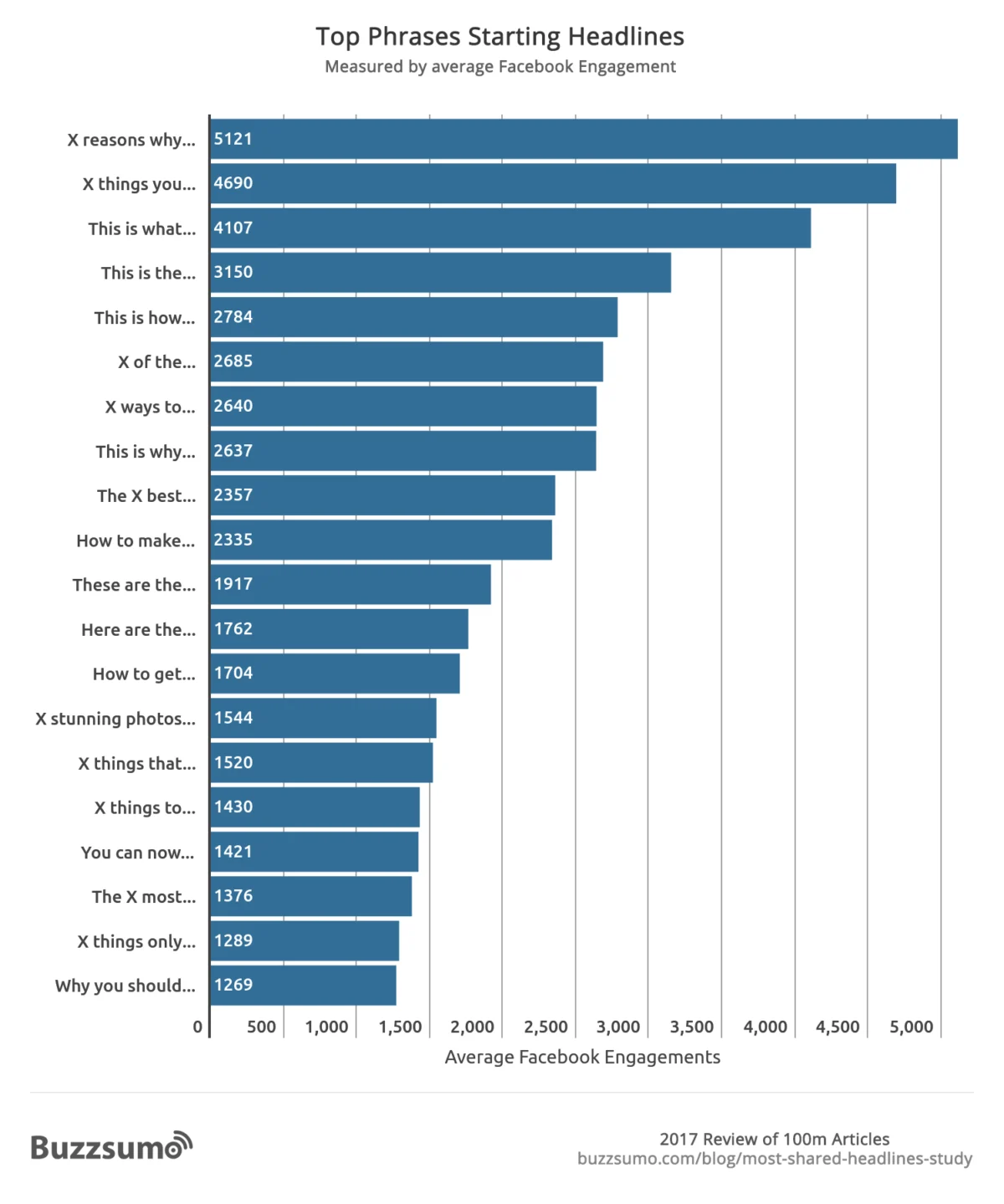
The dynamic landscape of digital content consumption has undergone a significant transformation in recent years, demanding a fresh understanding of what makes a headline truly effective. A comprehensive analysis by BuzzSumo, examining over 100 million article headlines published between 2019 and 2020, reveals a stark departure from the strategies that dominated social media as recently as 2017. This updated research, building upon BuzzSumo co-founder Steve Rayson’s seminal 2017 study, highlights critical shifts in audience preferences, algorithmic priorities, and the overall digital publishing ecosystem, offering invaluable insights for content creators and marketers navigating today’s crowded online spaces.
The Evolving Digital Content Landscape: A Chronology of Change
The period between BuzzSumo’s 2017 and 2019-2020 headline studies was marked by profound changes in how social media platforms, particularly Facebook, managed content. This evolution significantly shaped user engagement patterns and, consequently, the efficacy of different headline styles.
- May 2017: Facebook initiated efforts to demote "clickbait" content, specifically targeting headlines that withheld crucial information (e.g., "what happened next") or exaggerated story details with sensational language. This marked the beginning of a move away from purely curiosity-driven, often misleading, tactics.
- January 2018: Further algorithmic refinements saw Facebook prioritize news content from "trustworthy sources." This change aimed to foster a more reliable information environment, indirectly favoring established news publishers.
- June 2020: Facebook announced another update, focusing on boosting original and authoritative news reporting. These continuous adjustments underscore a platform-wide push for quality and credibility over pure virality.
Concurrently, the sheer volume of online content exploded, with a separate BuzzSumo study revealing a 64% increase in all content published online since 2016. This "content overload" has contributed to an audience with increasingly high standards and a preference for concise, informative headlines that deliver immediate value.
Key Shifts in Headline Effectiveness: 2017 vs. 2019-2020
The most striking finding from the comparative analysis is the almost complete overhaul of effective headline phrases. On Facebook, there is a 100% difference between the top 20 headline phrases from 2017 and 2019-2020. Twitter also saw significant changes, with only two of its most popular headline phrases remaining consistent.
The Demise of Emotional and Tribal Headlines
The emotional and tribal headlines that once thrived on Facebook are now largely a relic of the past. In 2017, phrases like "will make you," "tears of joy," "melt your heart," and "shocked to see" consistently drove high engagement. Similarly, quizzes ("can we guess," "only X in") and tribal identifiers ("things only X will understand") were highly successful.
However, the latest analysis shows a dramatic decline in these types of headlines. The top phrase "will make you," which garnered 1.7 million shares for its leading headline in 2017, achieved only 143,000 shares for its top counterpart in 2019-2020. Explicitly emotional or sensational language is rarely found in today’s top-performing headlines, with the exception of exaggerated phrases referencing exceptional content, such as "one of the most beautiful." This shift is a direct consequence of algorithmic maturity and audience fatigue with overly emotive or identity-based content.
Shorter, More Direct Headlines Prioritized
The ideal headline length has also contracted significantly. In 2017, the optimal formula was 15 words and 95 characters. The updated study reveals a preference for snappier headlines, with the ideal length now identified as 11 words and 65 characters. This reduction by approximately four words and 30 characters reflects the audience’s demand for information that is quickly digestible and to the point, a natural response to the overwhelming volume of content available.
The Enduring Power of Numbers, with a Twist
While numbers continue to be a powerful element in headlines, the preferred digits have seen some subtle changes. In both 2017 and 2019-2020, the "magic number" 10 reigned supreme, followed by single-digit numbers. The latest research indicates that numbers three through to 10 drive the most engagement, securing the top seven positions for most shared headlines on Facebook and Twitter. However, larger double-digit numbers like 15 and 20, which were popular in 2017, appear to have fallen out of favor, further emphasizing the audience’s desire for "speed to insight" and a rejection of longer, more exhaustive lists.
Publisher Landscape Transformation
The types of publishers dominating social media engagement have also undergone a radical shift, particularly on Facebook. In 2017, a mix of news, entertainment, and viral content sites characterized the top domains. By 2019-2020, Facebook’s algorithm changes had solidified the prominence of established news organizations. Domains like cnn.com, dailymail.co.uk, nbcnews.com, washingtonpost.com, cbsnews.com, and time.com now feature prominently, reflecting Facebook’s deliberate move to prioritize content from trustworthy and authoritative sources. This provides a stronger foundation for the reliability of the current headline findings.
Platform Divergence: Engagement Trends
A notable divergence in engagement trends between Facebook and Twitter was observed. The most engaging Facebook trigram in 2019-2020 ("of the year") garnered 26,702 average shares, a three-fold increase compared to Facebook’s top phrase in 2017 ("will make you," 8,691 average shares). Conversely, Twitter shares decreased by nearly 4x when comparing the most shared phrases from 2017 to 2019-2020. Despite Twitter’s monthly active users remaining largely stable over this period, total Twitter shares dropped by 14% between 2017 and 2020, suggesting a dilution of engagement across common headline phrases or a shift in how users interact with content on the platform.
Deep Dive: Facebook Headline Dynamics (2019-2020)
Facebook audiences now respond best to headlines that are instructional, hyperbolic, or focused on rankings and newness.
-
Top Trigrams and Themes: Analyzing three-word phrases ("trigrams") revealed several dominant categories:
- Ranking: Phrases like "of the year" (e.g., "TIME’s Person of the Year 2020") resonate, often sparking discussion between "fans" and "haters" of the featured subject.
- Newness: "in X years," "for the first," and "the first time" convey a sense of unique or rare events (e.g., "For the first time in history, U.S. billionaires paid a lower tax rate"). These build intrigue and encourage clicks.
- Hyperbole: Exaggerated statements using superlatives are highly effective. Phrases like "one of the," "of the most," and "of the best" tap into this (e.g., "Why Your Older Sister Is One of the Most Important People in Your Life").
- Instructional: This category emerged as particularly successful. Phrases such as "you need to," "need to know," "you should," and "everything you need" directly address the reader, implying urgency and the necessity of the information (e.g., "Everything you need to know about washing your hands to protect against coronavirus"). This taps into FOMO (Fear Of Missing Out) and the desire for essential information.
- Surprise: Headlines designed to shock or challenge existing views (e.g., "There Are At Least 36 Intelligent Alien Civilizations In Our Galaxy").
- Curiosity: Phrases hinting at revelations or explanations (e.g., "Here Are The Results," "X reasons why").
- Guidance: "How to" or tutorial-based headlines.
- Story: Headlines centered around a person or topic, similar to a case study.
-
Starting and Ending Phrases:
- Starting: Listicles (headlines beginning with a number) remain popular, promising actionable takeaways and specificity. Instructional and curiosity-driven phrases also dominate the beginning of successful Facebook headlines. When looking at single words, "The," "new," and "how" were top performers, indicating a desire for new information and guidance.
- Ending: Time-centric phrases were most prevalent, especially those related to "2020" or "2021," reflecting the impact of the pandemic. Numbers were often used to induce surprise or highlight speed to insight (e.g., "in just 5 minutes"). Social media trends also fueled content headlines ending with phrases like "social media."
Deep Dive: Twitter Headline Dynamics (2019-2020)
Twitter’s audience exhibits a distinct preference for curiosity, research, and current affairs.
- Top Trigrams: The phrase "future of" was the most shared trigram, indicating a strong interest in forward-looking analysis (e.g., "The future of work in a post-COVID world").
- Starting Words: The words "study" and "report" frequently started top-performing headlines, suggesting that Twitter is an ideal platform for sharing research-backed content and expert analysis.
- Ending Phrases: Immediacy and reactivity are key on Twitter. The top eight ending phrases were "2020"-based, and at least 13 of the top 20 ending phrases conveyed urgency or current developments, reflecting the platform’s role in real-time information dissemination.
Crafting Cross-Platform Headlines
Despite the platform-specific nuances, some headline characteristics demonstrate cross-platform efficacy. Eight of the top 20 headline phrases were identical across Facebook and Twitter, and 10 of the top starting phrases also crossed over. Instructional headlines (e.g., "need to know," "what to do") proved successful on both networks. However, content creators should acknowledge the vast difference in potential reach: Facebook’s most shared headline phrase had 590 times more average shares than Twitter’s, emphasizing the need for tailored strategies and testing.
Expert Perspectives on the Findings
Industry leaders have weighed in on these transformative trends:
- Heidi Cohen (Actionable Marketing Guide) emphasizes that the study reflects three key customer behavior changes due to the pandemic: increased content consumption, a desire for trusted information, and a focus on practical solutions. She advises marketers to return to core marketing basics and adapt to evolving customer needs.
- Rand Fishkin (SparkToro) highlights the value for content creators, strategists, and marketers in contrasting past and present headline effectiveness. He notes the "mythbusting" of some clickbait and emotional triggers, while illuminating the nuances of what truly works today.
- Ross Simmonds (Foundation) finds the widespread adoption of "instructional copy" fascinating, suggesting it reflects the human desire not to miss out on important information.
- Brian Dean (Backlinko) points out the "huge shift" on Facebook from BuzzFeed-style clickbait to instructional content, indicating that users now seek content that teaches them something new.
- Amanda Milligan (Fractl) connects the "instructional" trend to a growing desire to learn from experts, noting that such language inherently demonstrates authority. She encourages brands to leverage their expertise to benefit readers through this content.
These experts collectively underscore the importance of understanding human psychology, adapting to algorithmic changes, and delivering tangible value and trustworthiness through headlines.
Methodology and Actionable Takeaways
The 2019-2020 study meticulously analyzed 100 million headlines from BuzzSumo’s index, focusing on three-word phrases (trigrams) and their average median shares on Facebook and Twitter. To prevent popular sites from skewing results, only one headline trigram example per domain was included in the trigram analysis. The research was conducted by Louise Linehan, BuzzSumo’s Content Manager, with data collection by Henley Wing Chiu, Co-Founder and CTO of BuzzSumo.
For content creators, the implications are clear:
- Be Specific and Detailed: Longer headlines (11 words, 65 characters) that provide sufficient detail outperform overly snappy ones.
- Embrace Instruction and Utility: Phrases like "you need to know," "how to," and "everything you need" resonate strongly, particularly on Facebook.
- Leverage Hyperbole Responsibly: Use phrases like "one of the most" to highlight exceptional content, but steer clear of overtly emotional or sensational language.
- Strategic Use of Numbers: Stick to the "magic number" 10 and single digits (3-10) for listicles, focusing on "speed to insight" rather than exhaustive lists.
- Understand Platform Nuances: While some phrases cross over, tailor headlines for Facebook’s instructional/hyperbolic leanings and Twitter’s preference for curiosity, research, and current affairs.
- Prioritize Trust and Authority: Align with social media platforms’ emphasis on credible sources and original reporting.
- Test and Adapt: Continuously analyze what resonates with your specific audience, topics, and social networks using tools like the BuzzSumo Content Analyzer.
Ultimately, a compelling headline is no longer just about catching attention; it’s about making a clear promise of value, demonstrating authority, and meeting the evolving demands of an informed and time-constrained audience in a digitally saturated world. The days of generic clickbait are over; the era of insightful, instructional, and credible headlines has arrived.