Iffa Jayyana
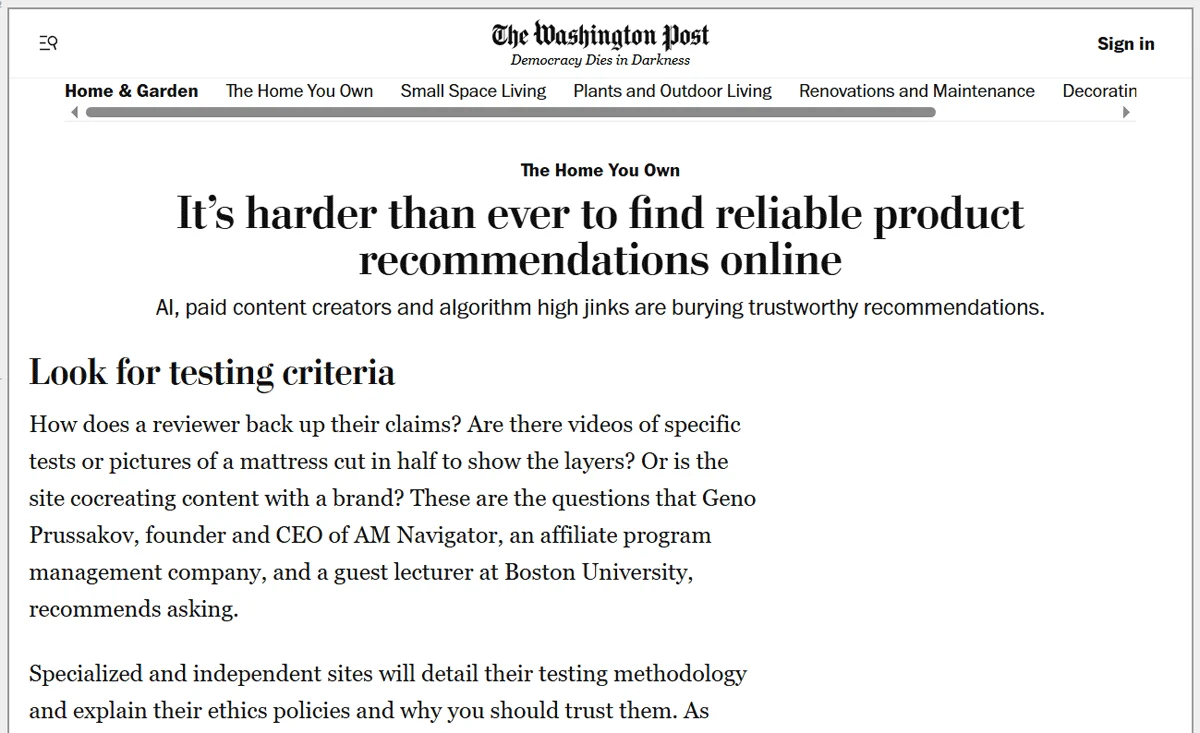
The landscape of digital journalism has undergone a profound transformation over the last decade, shifting from a reliance on traditional display advertising to a more integrated model known as "commerce content." This shift was highlighted in early 2025 when major national publications, including The Washington Post, began a rigorous internal and external examination of how online product recommendation lists—often titled as "The Best" or "Top Rated" items—are curated and presented to the public. As media conglomerates increasingly leverage their established brand authority to generate revenue through affiliate marketing, the line between objective editorial review and sponsored content has become a focal point of consumer advocacy and regulatory scrutiny.
Industry experts, including veteran affiliate marketing consultant Geno Prussakov of AM Navigator, have noted that while many large-scale media outlets maintain rigorous testing standards, the financial underpinnings of these recommendations cannot be ignored. The monetization of search engine authority has become a cornerstone of modern publishing, leading to a complex ecosystem where a product’s ranking may be influenced by a combination of genuine performance metrics and financial arrangements, such as placement fees or inflated commission rates.
The Evolution of Commerce Content: A Chronology of Monetization
The integration of product recommendations into news outlets is not a new phenomenon, but its scale has reached unprecedented levels. To understand the current state of media-driven shopping guides, one must look at the chronological progression of the industry:
- The Early 2010s: The Rise of Niche Review Sites: Before major newspapers entered the fray, independent review sites like The Wirecutter and Gear Patrol began perfecting the "deep-dive" review format, using affiliate links to fund exhaustive testing.
- 2016: The New York Times Acquisition: A pivotal moment occurred in 2016 when The New York Times Company acquired The Wirecutter for approximately $30 million. This signaled to the broader media industry that product recommendations were a viable and prestigious revenue stream.
- 2018–2021: The Mass Expansion: During this period, legacy brands including CNN (CNN Underscored), Forbes (Forbes Advisor), and Rolling Stone launched dedicated commerce divisions. These outlets began utilizing their high domain authority to dominate Google Search results for "best of" keywords.
- 2023–2024: The AI and SEO Crisis: The influx of AI-generated content and shifting search engine algorithms forced big media to double down on "human-tested" branding to maintain consumer trust and search rankings.
- January 2025: Heightened Transparency Efforts: Major outlets began publishing more transparent disclosures and methodology statements in response to growing consumer skepticism regarding the influence of affiliate commissions on product rankings.
The Mechanics of Media Endorsements and Testing Protocols
Contrary to the perception that all "Best of" lists are merely paid advertisements, many major media organizations invest significantly in the integrity of their recommendations. When an outlet like The Washington Post or New York Magazine reviews a product, they typically follow a multi-tiered verification process designed to protect their brand reputation.
Rigorous Testing Environments
Most reputable media houses have established dedicated testing labs. These facilities are staffed by experts who subject products to standardized stress tests, comparative performance metrics, and long-term durability assessments. For example, a kitchen appliance might be tested for hundreds of hours to ensure its longevity matches its marketing claims.
Expert Consultations
Beyond internal testing, publishers often hire subject matter experts (SMEs). For instance, medical equipment reviews frequently involve consultations with board-certified physicians, while tech reviews are handled by engineers or long-term industry analysts. This adds a layer of professional accountability to the content.
Hands-On Consumer Experience
Unlike "aggregator" sites that simply summarize Amazon reviews, big media outlets generally insist on hands-on usage. This involves journalists using the products in real-world scenarios—such as wearing hiking boots on actual trails or using a laptop as a primary work device for several weeks—to identify nuances that a spec sheet might miss.
Editorial Independence Protocols
In many legacy organizations, a "firewall" exists between the editorial team and the business development team. The writers and testers are often unaware of the specific commission rates offered by various merchants, theoretically ensuring that the "Best" pick is chosen based on merit rather than the highest payout.

The Financial Reality: Commissions and Placement Fees
Despite the presence of editorial firewalls, the financial incentives of affiliate marketing remain a powerful force. Affiliate marketing operates on a performance-based model where the publisher receives a percentage of a sale made through their link. However, the commercial arrangements have become increasingly sophisticated.
Data from the Performance Marketing Association indicates that affiliate marketing spending in the United States alone has grown to exceed $9 billion annually. Within this budget, "placement fees" or "tenancy payments" have become common. In these scenarios, a brand pays a flat fee to be included in a "Top 10" list, regardless of the eventual sales volume. Furthermore, "EPC (Earnings Per Click) Guarantees" ensure that a publisher receives a minimum level of income for the traffic they send to a merchant, which can subtly influence which products receive the most prominent "above-the-fold" positioning on a webpage.
Regulatory Response and Industry Standards
The Federal Trade Commission (FTC) in the United States has intensified its oversight of these practices. According to the FTC’s updated "Guides Concerning the Use of Endorsements and Testimonials in Advertising," any material connection between an endorser and a seller must be clearly and conspicuously disclosed.
In response to these regulations, the industry has seen a standardizing of disclosure language. However, critics argue that these disclosures are often buried in fine print or phrased in a way that minimizes the perceived impact of the financial relationship. Industry analysts suggest that the next phase of regulation may require more explicit labeling of "sponsored rankings" versus "organic rankings" to prevent consumer confusion.
Consumer Protection: Strategies for Navigating Online Reviews
As the sophistication of commerce content grows, consumers must adopt a more analytical approach to online shopping. Experts suggest four primary strategies for verifying the authenticity of a media recommendation:
- Cross-Referencing Multiple Sources: Consumers should compare "Best of" lists from at least three different major publications. If a specific product appears at the top of every list despite mediocre user reviews on third-party sites, it may indicate a dominant affiliate campaign rather than product superiority.
- Investigating the Reviewer’s Credentials: High-quality reviews will feature a detailed "About the Author" section or a methodology page explaining exactly how the testing was conducted. If a list lacks a named author with relevant expertise, it should be treated with caution.
- Analyzing Third-Party Review Aggregators: Tools and websites that aggregate verified purchaser reviews can provide a necessary counter-perspective to professional editorial reviews. Discrepancies between professional "lab tests" and everyday consumer experiences often highlight flaws in the testing methodology.
- Scrutinizing the Disclosure Policy: A transparent publication will clearly state how they make money and whether their editorial team is insulated from the sales department. The more specific the disclosure, the more likely the outlet is to value its long-term credibility over short-term commission gains.
Broader Implications for Journalism and E-commerce
The reliance of big media on product recommendations represents a double-edged sword for the future of journalism. On one hand, the revenue generated from affiliate marketing provides essential funding for investigative reporting and high-quality news coverage at a time when traditional ad revenue is cratering. On the other hand, the commodification of trust poses a long-term risk to the brand equity of legacy institutions.
If consumers begin to perceive "The Best" lists as mere extensions of a brand’s marketing department, the authority that makes these lists valuable will inevitably erode. The challenge for media outlets in 2025 and beyond will be maintaining a balance between the necessity of monetization and the preservation of the editorial integrity that earned them their audience in the first place.
As search engines like Google continue to prioritize "helpful content" and "first-hand experience," the pressure on big media to deliver genuinely objective reviews will only increase. The survival of the commerce content model depends on the ability of these organizations to prove to both search algorithms and human readers that their recommendations are based on more than just the highest bidder.

 Suro Senen

 Lina Hope