rifanmuazin
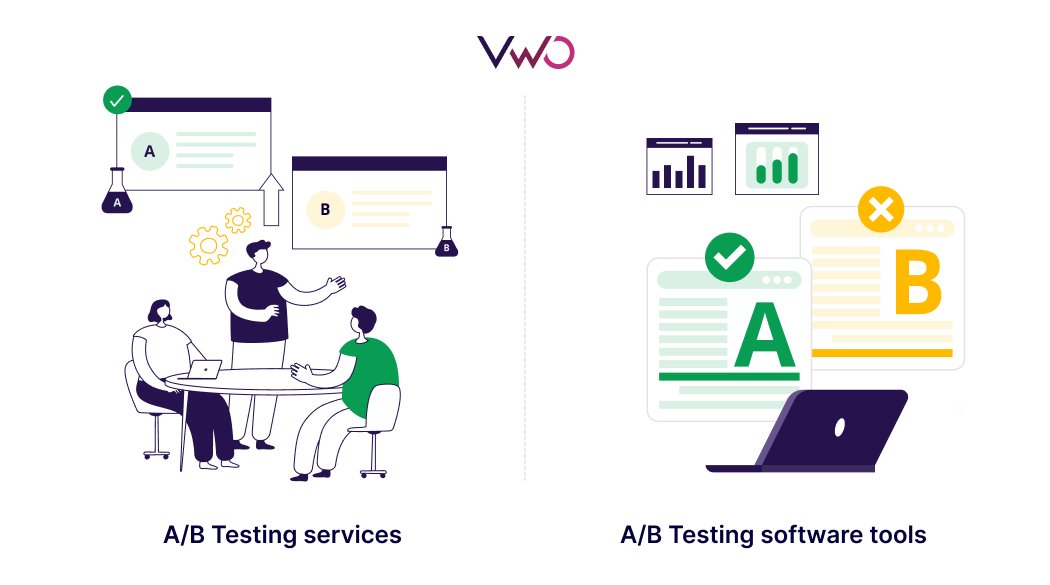
As digital landscapes become increasingly competitive, the distinction between A/B testing services and software tools has become a pivotal strategic decision for growth-oriented organizations. The primary divergence lies in the ownership and execution of experimentation: services offer expert-led, outsourced management designed for immediate impact, while software tools provide the infrastructure for internal teams to build, scale, and manage their own testing ecosystems. This choice is no longer merely a budgetary consideration but a fundamental decision regarding how an organization intends to cultivate institutional knowledge and manage its long-term digital evolution.
The Evolution of Digital Experimentation
The rise of A/B testing—the process of comparing two versions of a webpage or app against each other to determine which performs better—has mirrored the broader digital transformation of the global economy. In the early 2000s, experimentation was the domain of a few tech giants like Google and Amazon. Today, it is a standard requirement for any company with a digital footprint. However, as the complexity of the “digital stack” has increased, so too has the difficulty of running effective experiments.
Initially, simple split-testing tools allowed marketers to change button colors or headlines. Modern experimentation now encompasses server-side testing, feature flag management, and AI-driven personalization. This technical maturation has created a fork in the road for many enterprises: do they hire external experts to navigate this complexity (Services), or do they invest in the internal capabilities to master it themselves (Software)?
Strategic Framework: Ownership vs. Externalization
The decision-making process typically hinges on several key strategic factors, ranging from data governance to experimentation velocity. For organizations with high volumes of monthly tracked users (MTU) across web, mobile, and server environments, the question is rarely whether to experiment, but rather who owns the engine of that innovation.
1. Ownership and Institutional Knowledge
When an organization adopts an A/B testing software tool, such as VWO or similar enterprise-grade platforms, it is investing in its own long-term capability. The expertise remains within the company, allowing marketing, product, and engineering teams to build a library of insights over years. Conversely, when hiring an agency service, the expertise often resides with the vendor. While the company receives the “wins” from successful tests, it may fail to develop the internal “muscle memory” required to innovate independently.
2. Scalability and Cross-Platform Integration
Software tools are built for scalability. Once integrated into the company’s infrastructure, they allow for testing across the entire product stack. This includes not just landing pages, but also backend algorithms and mobile app configurations. Services, however, are often limited by the scope of a contract or the specific bandwidth of the agency’s team. While an agency can provide a “turnkey” solution, scaling that solution across every department of a global enterprise can become prohibitively expensive compared to a software subscription.
3. Experimentation Velocity
Velocity refers to the speed and frequency of testing. In the initial stages, agencies often provide higher velocity because they arrive with pre-established workflows. However, as internal teams mature in their use of software tools, their velocity tends to surpass that of external partners. Internal teams do not face the “back-and-forth” friction of agency communication and can iterate in real-time based on immediate business needs.
The Software Model: Building an Internal Innovation Hub
For mature product teams, an experimentation platform is more than a utility; it is a feature management system that de-risks every release. Modern platforms offer a suite of capabilities that go far beyond simple URL redirects.
Infrastructure for Controlled Innovation
Leading software platforms provide visual editors for non-technical staff and code editors for developers. More importantly, they offer feature flags and remote configuration. This allows engineering teams to roll out new features to a small percentage of users first, monitoring for bugs or performance issues before a full launch. This “kill switch” capability is essential for modern software development.

Deep Behavioral Context
One of the most significant advantages of modern software is the integration of behavioral analytics. Tools now combine A/B testing with heatmaps, session recordings, and form analytics. This means a team doesn’t just see that “Version B” won; they see why it won by observing how users interacted with the specific changes. This unified data ecosystem allows for the measurement of long-term metrics like Customer Lifetime Value (CLV) rather than just session-level conversions.
AI and Automation
The integration of Artificial Intelligence, such as VWO Copilot, has significantly lowered the barrier to entry for internal teams. AI can now generate hypothesis ideas, summarize hours of session recordings into actionable insights, and even suggest code variations. This allows smaller internal teams to perform at the level of much larger departments.
The Service Model: Accelerating Results Through Expertise
Hiring an A/B testing or Conversion Rate Optimization (CRO) agency is often the fastest route to high-impact results for organizations that have the budget but lack the technical headcount.
Immediate Access to Specialized Talent
A professional testing agency brings a full roster of specialists: strategists, data analysts, UX designers, and specialized developers. For a company that cannot afford to spend six months recruiting and training an internal team, an agency provides an immediate “plug-and-play” solution.
Organizational Enablement
Agencies are often used as a “proof of concept.” By delivering early, measurable ROI, an agency can help a CMO or Head of Product secure the budget needed for a larger, permanent internal program. They demonstrate the value of data-driven decision-making to stakeholders who may still be relying on “HIPPO” (Highest Paid Person’s Opinion) methodology.
Objective Perspectives
Internal teams can sometimes suffer from “tunnel vision” or corporate bias. An external agency provides an objective view of the user experience, often identifying friction points that internal employees have become blind to.
Comparative Data and Financial Implications
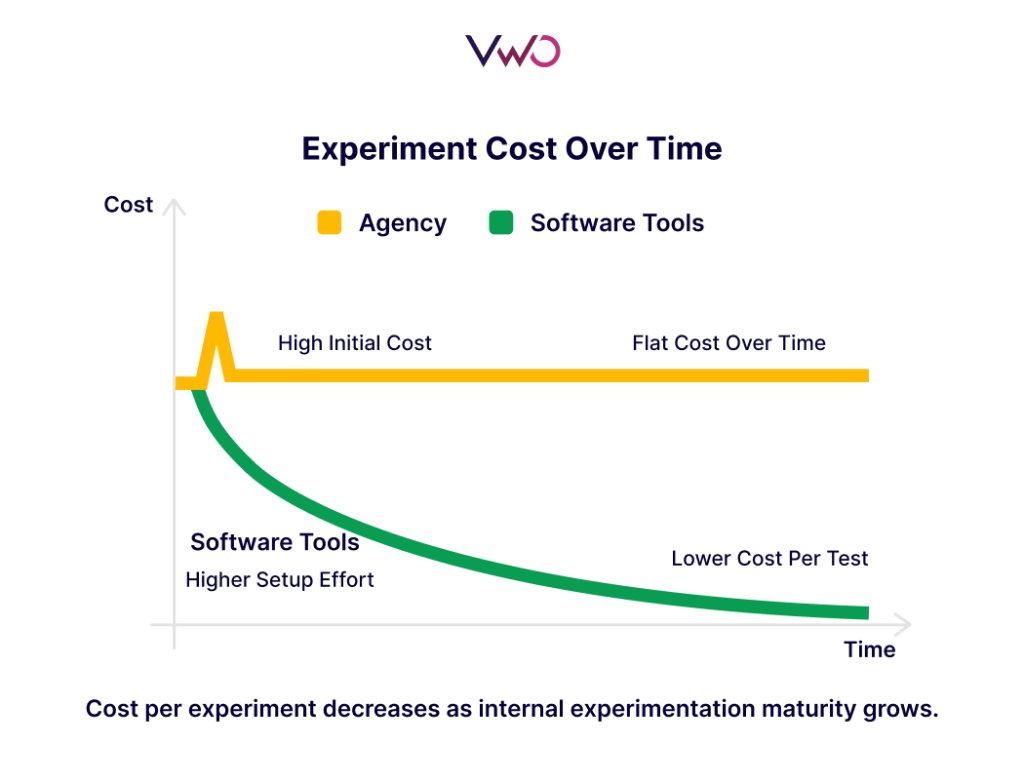
The cost structure of these two models differs significantly. Software tools typically operate on a subscription basis, often tied to the number of users tracked or features accessed. As the team becomes more efficient, the “cost per test” decreases, leading to a compounding ROI.
Agencies generally operate on retainers or project-based fees. While the initial investment may be higher, the cost is tied directly to professional hours. According to industry benchmarks, organizations that transition from agency-led to tool-led models often see a 30% to 50% reduction in the cost of individual experiments over a three-year period, provided they successfully build the internal expertise.
Case Study: Vandebron’s Data-Driven Success
The impact of choosing the right infrastructure is best illustrated by the experience of Vandebron, a Dutch green energy provider. Vandebron integrated a unified experimentation platform to combine user behavior analytics with A/B testing.
By analyzing behavioral data, the team identified a specific usability issue in the date-of-birth field on their registration form. They hypothesized that a simplified input method would reduce friction. Using their internal software tool, they quickly launched an experiment to validate this. The result was a 16.3% increase in sign-up conversions. This case highlights how having the right tools in-house allows a company to move from an observation (friction in a form) to a validated solution (16% uplift) with minimal lag time.

Navigating Compliance and Security
In an era of tightening data privacy regulations, such as GDPR in Europe and CCPA in California, the “where” and “how” of data processing are critical.
The Software Advantage: Organizations in highly regulated sectors like FinTech or Healthcare often prefer software tools because they allow for complete control over data governance. Data can be processed within the company’s own cloud environment, ensuring that sensitive user information never leaves their controlled perimeter.
The Agency Role: While agencies use these same tools, the organization must ensure that the agency’s access levels and data-handling practices comply with internal security policies. The agency becomes a processor of data, adding a layer of complexity to legal and compliance audits.
The Hybrid Approach: The Modern Middle Ground
The choice between a service and a tool is increasingly not a binary one. Many high-growth organizations adopt a hybrid model. In this scenario, the company purchases the software (ensuring data ownership and infrastructure) but hires an agency to run the experiments for the first 12 to 18 months.
This approach allows the company to see immediate results while the agency simultaneously trains the internal staff. Gradually, the agency’s role shifts from “execution” to “consultancy,” eventually allowing the internal team to take full control of the platform.
Conclusion and Future Outlook
The trajectory of the experimentation industry is moving toward democratization. As AI continues to simplify the technical hurdles of coding and analysis, the value of A/B testing will shift from the “ability to run a test” to the “ability to ask the right questions.”
For organizations looking to lead their industries, the long-term goal should be the cultivation of an internal culture of experimentation. While agencies provide an excellent springboard for results and expertise, the compounding value of institutional knowledge, unified data, and cross-platform scalability makes a robust software platform the foundation of modern digital strategy. Whether through a solo software implementation or a hybrid partnership, the objective remains the same: transforming every digital touchpoint into a data-driven opportunity for growth.