In the pursuit of entrepreneurial success, a critical yet often overlooked element is the concurrent cultivation of a robust personal financial foundation. While the allure of a lucrative business exit can be a powerful motivator, relying solely on this future event introduces significant risk. This article delves into the strategic imperative for entrepreneurs to build their personal balance sheets alongside their businesses, exploring a framework that prioritizes financial optionality, security, and informed decision-making. This approach is presented as one of the eight foundational pillars within a comprehensive financial mastery framework designed for store owners.
The Strategic Imperative: Diversification Beyond the Business
The fundamental premise is that an entrepreneur’s net worth should not be inextricably tied to the performance and ultimate sale of their business. A future exit, while a potential windfall, is inherently uncertain. Market conditions can shift, valuations can fluctuate, and unforeseen challenges can derail even the most promising divestment plans. By actively developing a personal investment portfolio, entrepreneurs gain a crucial layer of security and flexibility. This diversification allows for greater strategic freedom, enabling them to make critical business decisions from a position of strength rather than desperation. The ability to weather short-term business downturns or to walk away from unfavorable deals without jeopardizing their entire financial future is a testament to the power of a well-managed personal balance sheet.
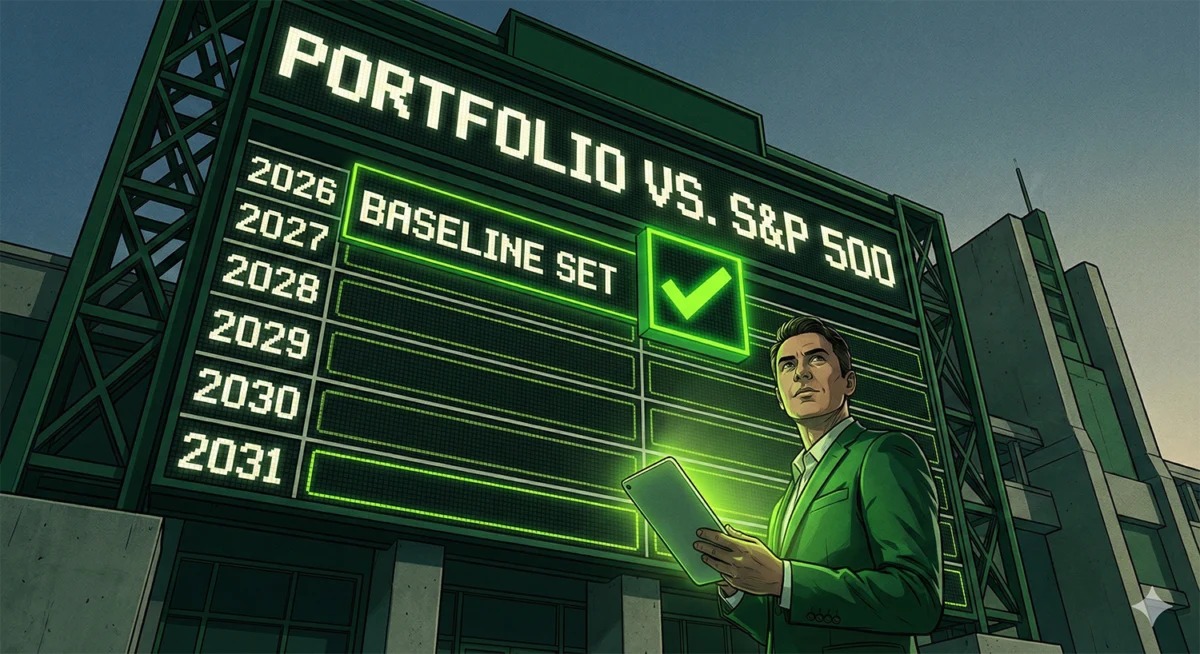
To illustrate this philosophy in practice, this report will provide a detailed breakdown of a personal investment portfolio’s baseline, as established at the beginning of 2026. This annual tracking against a benchmark like the S&P 500 index aims to offer transparency and a tangible example of how entrepreneurial capital can be strategically deployed beyond the confines of their primary venture.
Defining the Personal Balance Sheet: Exclusions for Clarity
Before delving into the asset allocation, it is essential to clarify what constitutes this personal balance sheet. For the purpose of this analysis and the broader financial mastery framework, the following are explicitly excluded:
- Primary Residence: While a significant asset for many, a primary residence is categorized as a consumption good rather than a direct investment. Its value is tied to personal use and housing market fluctuations, not necessarily to income generation or capital appreciation in the same vein as investable assets.
- Physical Possessions: Tangible assets such as vehicles, furniture, and personal collections, while valuable, are generally illiquid and do not contribute to a dynamic investment portfolio. They represent personal utility and lifestyle choices rather than financial instruments.
- The Business Itself: Until an actual sale is consummated, a business is an illiquid and volatile asset. Including its estimated value in a personal balance sheet can create a misleading sense of security. The goal is to track assets that can be readily converted to cash or generate passive income, separate from the operational and market risks of the entrepreneurial venture.
By maintaining this clear distinction, the focus remains on liquid, investable assets, providing a more accurate and actionable snapshot of an entrepreneur’s financial health and diversification strategy.
Portfolio Allocation: A Balanced Approach to Investment
The personal investment portfolio for the baseline year of 2026 is strategically allocated across several asset classes, reflecting a philosophy of balancing conservative, long-term growth with calculated, high-conviction plays. The allocation can be summarized as follows:
3.5% Individual Stocks: The "Bold" Component
This segment represents the more speculative, high-conviction portion of the portfolio, guided by the principle that investing should be largely "boring" with a small, impactful "bold" element. The aim is to identify a select few opportunities where there is deep conviction in outperformance, ensuring that the position size is significant enough for any gains to materially impact the overall portfolio.
- Shopify (SHOP): Positioned as a near-monopoly in the e-commerce software-as-a-service (SaaS) space, outside of Amazon’s direct marketplace. Shopify’s entrenched position and continued expansion in the hosted software sector make it a compelling long-term holding. Its ability to consistently attract and retain merchants, coupled with ongoing platform enhancements, solidifies its competitive advantage.
- Cloudflare (NET): While internal operations may be less familiar, market sentiment and user experience with Cloudflare are overwhelmingly positive. The company’s robust infrastructure, comprehensive suite of services for web performance and security, and strong company culture suggest sustained growth potential. Its role in securing and accelerating internet traffic positions it at the forefront of digital infrastructure development.
63% Index Funds: The Core of Stability
The vast majority of the portfolio is anchored in low-cost index funds, embodying the "boring but intentional" approach to wealth building.
- U.S. Total Market Index Funds: Form the core, providing broad exposure to the U.S. equity market.
- International Index Funds (approx. 15%): A deliberate allocation to international markets offers diversification benefits and captures growth opportunities beyond domestic borders. Recent performance in international equities has been strong, and valuations may still present opportunities for further gains. This component is crucial for mitigating country-specific risk.
- Zero Bonds: The current allocation eschews bonds, reflecting a higher risk tolerance and a focus on growth during this phase of wealth accumulation. However, this is a dynamic decision that can be adjusted based on market conditions and individual risk profiles.
The strategy here is simple: broad market exposure, minimal fees, and a long-term, buy-and-hold philosophy. This approach aims to capture market returns consistently over time without the need for active stock picking or market timing.
12% Cryptocurrency: A Hedge and Diversifier
This segment is allocated to digital assets, primarily Bitcoin and Ethereum. The underlying thesis remains focused on their potential as a non-institutional store of value and a hedge against potential monetary policy missteps by governments.

However, recent market behavior has introduced a note of caution. The correlation of cryptocurrencies with risk assets, rather than traditional safe havens like gold, has been observed. Gold’s significant appreciation (over 70% in the preceding 12 months) contrasts with Bitcoin’s performance, prompting reflection on its "digital gold" narrative. Despite this, the long-term fundamentals, the desire to defer capital gains tax on existing holdings, and its role as an anti-institutional hedge continue to support its inclusion. The increasing institutional adoption, while potentially increasing stability, also carries the risk of moderating future upside potential. Nevertheless, the conviction remains strong enough for continued holding.
11% Real Estate: A Lifestyle-Driven Investment
This allocation represents a single rental property, which is acknowledged as not being a purely optimal investment from a pure financial return perspective. Instead, it reflects a personal situation where a beloved home is being rented out pending future decisions.
The experience of setting up and managing a short-term rental (like an Airbnb) over the past four months has provided invaluable insight into the operational complexities involved, even with third-party management. This hands-on experience has also fostered a greater appreciation for the value proposition of platforms like Airbnb for travelers, offering convenience without the managerial burdens. While not a core growth engine for the portfolio, it contributes to diversification and offers potential income.
9% Cash: The Cushion and Opportunity Fund
A significant cash reserve is maintained, particularly given the current market environment of all-time highs. This liquidity serves a dual purpose:
- Emergency Fund/Cushion: Provides financial security against unexpected events.
- "Big Bets" Fund (approx. half): A portion of the cash is earmarked for future high-conviction investment opportunities. The goal for 2026 is to identify one or two specific ventures where a substantial investment can be made with high confidence.
This strategic reserve allows for proactive capital deployment when compelling opportunities arise, rather than being forced to liquidate existing assets at unfavorable times.
Less Than 1% Private Investments: Nurturing Early-Stage Ventures
A small allocation is dedicated to private investments, comprising three early-stage companies where the entrepreneur has strong conviction in the founders and their business models: IntelliGems, Postpilot, and Kanpai Foods. These investments are made based on personal domain expertise and trusted relationships with the founders. While not a significant portion of the overall portfolio, these ventures represent an opportunity to support promising startups and potentially benefit from their future growth. The focus here is on strategic partnerships and intellectual alignment rather than purely financial returns.
Portfolio Adjustments: Lessons Learned from Two Key Exits
The year 2026 also saw two significant divestments from the portfolio, each carrying valuable lessons:
-
Tesla (TSLA) Sale: After a four-year holding period, Tesla was sold. The original investment thesis was centered on the superior product and customer satisfaction with the vehicles. However, the company’s strategic pivot towards robotics, self-driving technology, and automated taxis shifted the investment landscape. While these future ventures hold promise, the entrepreneur lacked the deep homework required to confidently evaluate them at a trillion-dollar valuation. Furthermore, the increasing "key man risk" associated with Elon Musk, given his age, intense workload, and multifaceted corporate responsibilities, added another layer of concern. At a valuation exceeding a trillion dollars and with the original thesis significantly altered, the exit was deemed prudent.
-
Airbnb (ABNB) Sale: This divestment is characterized as one of the year’s less successful decisions. The initial investment was a "knee-jerk" reaction to a recommendation, a classic pitfall of investing without thorough conviction. The shares were held for approximately six to twelve months, resulting in a break-even outcome. The personal experience of managing an Airbnb property provided a different perspective, leading to a realization that the entrepreneurial conviction in the company was not as strong as initially assumed. While not viewed as a poor operator, Airbnb’s sustained lackluster growth and the absence of a clear catalyst for significant change prompted the sale. The key takeaway from this experience is the imperative to avoid making investments with only a 5-out-of-10 conviction level. If conviction is not high, the capital is better allocated to diversified index funds.
Looking Ahead: The Baseline and Future Reporting
This detailed breakdown establishes the financial baseline for 2026. The intention is to provide regular updates on the performance of this portfolio relative to the S&P 500 index, offering ongoing insights into the effectiveness of this strategic approach.
For entrepreneurs seeking to cultivate financial mastery and gain deeper insights from a community of successful 7- and 8-figure owners, staying connected through regular tips and community discussions is highly encouraged. The journey of financial resilience and strategic wealth building is an ongoing process, demanding both disciplined execution and continuous learning.

 Raul Delapena Setiawan
 Ammar Sabilarrohman