Jia Lissa

Creative testing has long been a cornerstone of modern advertising, providing marketers with invaluable data on which campaigns resonate most effectively with their target audiences. However, a critical gap often exists between identifying a "winning ad" and truly understanding why it succeeded. This disconnect limits the potential for iterative improvement, leaving brands with a wealth of performance data but insufficient actionable intelligence to inform future creative endeavors. As artificial intelligence accelerates the pace of creative production and testing, bridging this gap becomes not just beneficial, but essential for brands aiming to maximize their advertising investments and build a truly impactful creative portfolio.
The current paradigm of creative testing frequently stops at the asset level, declaring a victor based on metrics like engagement rates, click-throughs, or conversion numbers. While this provides a clear direction for immediate budget allocation, it often fails to dissect the multifaceted components that contribute to an ad’s success. Was it the compelling opening hook, the persuasive messaging, the specific creator’s delivery, or a combination of these elements? Furthermore, even a proven performer in one context may falter when exposed to a different audience or platform. This lack of granular understanding hinders the strategic evolution of creative output, turning a powerful learning opportunity into a cyclical process of trial and error.
The increasing accessibility of AI-powered creative tools amplifies this challenge. Brands can now generate and test a multitude of creative variations at an unprecedented scale. This surge in available data and creative assets presents a profound opportunity, but only if the intelligence derived from these tests is systematically leveraged to shape subsequent production. The true value lies not in simply producing more ads, but in using the insights gleaned from performance data to make more informed, strategic decisions about what to create next. This necessitates a shift towards viewing creative testing as a continuous feedback loop, where each iteration of testing directly informs and refines the subsequent creative brief and execution.
The Pitfall of Treating the Winning Ad as the Sole Insight
An advertisement is not a monolithic entity; it is a carefully constructed assembly of individual creative decisions. These decisions encompass the initial hook designed to capture attention, the core message intended to convey value, the visual aesthetic, the choice of creator or spokesperson, the chosen format (video, image, carousel, etc.), and the explicit call to action. The synergistic interplay of these elements dictates an ad’s performance, making it difficult to pinpoint the precise drivers of success when analysis is confined to comparing entire assets.
This is precisely the challenge that advanced analytics and specialized platforms aim to address. By breaking down performance metrics to the level of individual creative elements, brands can begin to identify which specific creative choices are consistently contributing to desired outcomes and which are ripe for further experimentation. Consider a scenario where a product close-up featured within the initial seconds of a video consistently outperforms a more lifestyle-oriented introduction in terms of audience attention. This granular insight is far more valuable than simply knowing which of the two ads performed better overall. It empowers the creative team to retain the effective opening structure while exploring variations in messaging, creator persona, or format, thereby building upon a proven success factor.
The critical distinction lies in moving beyond simply replicating the aesthetic of a winning ad. Producing a series of new assets that superficially resemble the successful one, without understanding the underlying reasons for its efficacy, does not guarantee future success. If every new creative execution simultaneously alters the hook, message, format, and visual treatment, it becomes nearly impossible to isolate the specific elements that are truly driving performance. By systematically isolating and testing variables, creative teams can build upon established learnings while simultaneously venturing into new creative territories. The ultimate objective is to gain a clear understanding of which creative decisions are worth repeating, which can be adapted for different contexts, and which warrant outright challenging or discarding. This iterative process of isolating variables allows for more strategic and less guesswork-driven creative development.

Context is King: The Nuances of a Winning Creative Element
Identifying a high-performing creative element is a significant step, but it represents only a partial victory. The effectiveness of a particular hook, message, or visual approach is rarely universal; it is profoundly influenced by a confluence of factors including the audience’s demographic and psychographic profile, the platform on which the ad is displayed, and the specific objective it is designed to achieve.
This underscores the imperative for a deep understanding of the target audience to inform both the initial creative brief and subsequent performance analysis. Prior to any production commencing, creative teams must possess a clear definition of their target audience, their existing knowledge base, and the specific communication barriers that the creative endeavor needs to overcome. Once the campaign is live, rigorous testing can then validate whether the creative is resonating with the intended audience and whether the initial assumptions about their needs and perceptions were accurate.
Often, the most insightful discoveries are those that were entirely unexpected. Creative content developed with one audience segment in mind may consistently over-index with another, thereby revealing an unforeseen audience opportunity that the marketing team had not initially considered. Conversely, a creative approach that has proven successful in other contexts might struggle with a new audience because the message, despite its strong execution, fails to address what is most important to that specific group.
Therefore, the most valuable learning becomes highly specific: which creative elements are effective, for whom, within what contextual parameters, and against which defined objective. This contextual understanding is paramount when deciding whether a successful creative approach should be extended to other audience segments or if the subsequent brief necessitates a fundamentally different strategic direction. Without this nuanced perspective, brands risk misapplying successful tactics and missing opportunities for genuine creative innovation.
Transforming Creative Intelligence into Strategic Production Decisions
Brands possess a significant, yet often underutilized, opportunity to derive greater value from their creative testing initiatives. Even when valuable performance insights are generated, these findings frequently fail to translate into tangible changes in the next round of production. A common scenario involves reviewing creative performance at the conclusion of a campaign, at which point the subsequent creative brief may already be in development, or the production plan for the next cycle has been firmly established. By the time a comprehensive understanding of what worked and why is achieved, the window of opportunity to apply these learnings may have already closed.
The core challenge lies in integrating this crucial intelligence into the creative process early enough to meaningfully influence what gets made. This necessitates fostering closer collaboration between creative and media teams, establishing a shared understanding of the learning objectives, and ensuring that the findings from one testing cycle are readily accessible and actively considered when planning the subsequent one. This proactive approach fundamentally alters the nature of decisions that teams can make, shifting from reactive adjustments to strategic foresight.
For this integrated approach to function consistently, a robust system for capturing and reusing learned insights is indispensable. Creative elements, such as hooks, messages, formats, and creators, need to be systematically tagged to facilitate comparative analysis across diverse executions. Crucially, these findings must extend beyond the confines of individual campaigns, enabling teams to identify recurring patterns and trends across different channels, markets, and time periods.
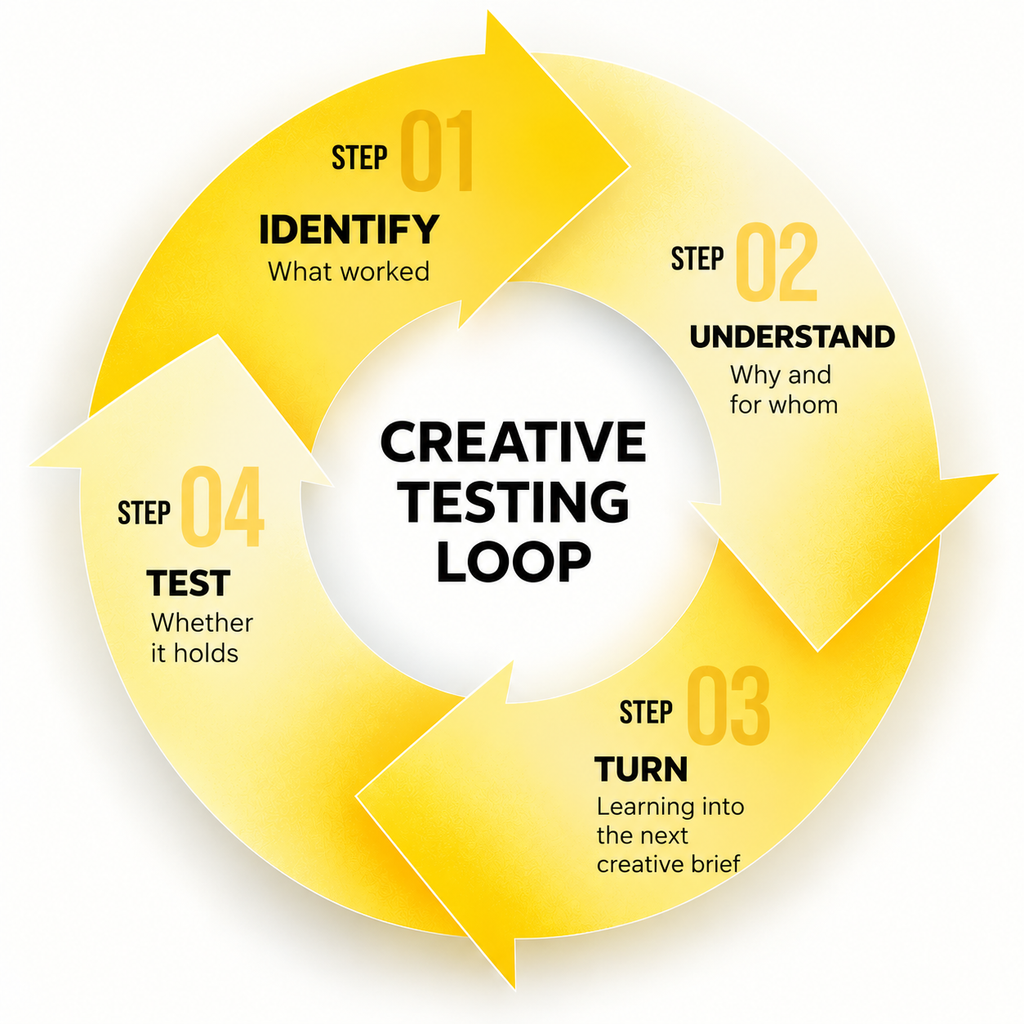
The next creative brief should then be able to draw directly from this accumulated knowledge base. Key questions to address would include: What fundamental creative principles have already been established? Which assumptions still require validation? Where are the existing gaps within the current creative portfolio? And what specific knowledge should the next round of creative development aim to uncover? This strategic integration ensures that creative testing actively influences the production process before creative assets are finalized, rather than merely serving as a post-hoc explanation of their performance.
AI: Accelerating the Creative Feedback Loop
The advent of artificial intelligence injects a new level of dynamism into this feedback loop. AI technologies empower brands to produce and test creative variations with a speed and agility that were previously unattainable. A single core concept can be rapidly adapted across a multitude of formats, target audiences, and product offerings, thereby multiplying the opportunities for testing specific elements and building upon accumulated learnings.
However, the mere increase in creative output does not automatically equate to enhanced learning. A brand could potentially deploy 100 AI-generated assets and, at the campaign’s conclusion, identify the top five that yielded the highest return on ad spend without gaining a deeper understanding of the underlying factors that enabled their success. The true opportunity lies in leveraging this expanded production capacity with greater intentionality. This involves retaining a successful hook while rigorously testing alternative messages, exploring the efficacy of a proven concept with a different audience segment, or adapting a high-performing execution across various placements without compromising the elements that contributed to its initial success.
While AI can significantly accelerate the production and analysis phases, the responsibility for defining the critical questions to be investigated, interpreting the nuanced audience and cultural context, and determining how these findings should shape the next creative brief still rests with human teams. The more rapid the production cycle becomes, the more crucial it is to possess a clear and focused understanding of the specific learning objectives that guide the entire process. This strategic clarity ensures that AI serves as a powerful tool for insight generation, not simply a generator of more data points.
Building the Optimal Creative Portfolio for Future Success
As brands continue to expand their creative output, the primary challenge shifts towards strategically directing these efforts. A robust and intelligent testing program should provide clear guidance on which opening hooks consistently capture audience attention, which messages resonate most effectively with distinct demographic and psychographic groups, which creators demonstrably build credibility, and which creative elements can be adapted across channels without diminishing their impact.
More significantly, these findings should directly inform the subsequent production pipeline. If testing reveals a need for more audience-specific messaging within the creative portfolio, a shift towards different creative formats, or the introduction of an entirely new conceptual approach, these insights must be reflected in the next creative brief. Similarly, if a particular creative element consistently drives superior results, teams should possess a clear methodology for extending its value and impact without resorting to a simple, uninspired replication of the same execution.
Creative teams retain their essential role in interpreting cultural shifts, conceptualizing innovative ideas, and defining the brand’s unique presence. However, the integration of creative intelligence provides them with more robust evidence to support their decision-making processes, enabling them to allocate their time and creative resources more effectively. Ultimately, this is the true promise of sophisticated creative testing. While the ability to identify a winning ad is now widely achievable, the greater opportunity lies in leveraging the lessons learned from those successes to strategically shape the future needs and direction of the brand’s creative portfolio. This transition from post-campaign analysis to pre-production strategy is the key to unlocking sustained creative effectiveness and maximizing marketing impact.

 Ali Ikhwan
 Layla Zulfa