Muslim

Creative testing has become an indispensable tool for marketers, adept at identifying which advertisements resonate most effectively with target audiences. However, a critical oversight often plagues this process: the effective utilization of the insights gleaned from these tests. While identifying a winning creative asset is a significant achievement, the deeper question of why it succeeded and how to systematically apply that knowledge to future campaigns remains largely unaddressed. This disconnect is amplified in the current era, where Artificial Intelligence (AI) facilitates the rapid production and testing of creative at an unprecedented scale, generating vast amounts of data that demand more sophisticated interpretation.
The current paradigm often sees brands celebrate a winning ad without truly dissecting its constituent elements. Was it the captivating hook that seized attention, the compelling message that resonated, or perhaps the influence of the creator themselves? Furthermore, would these successful components translate equally well to a different demographic or platform? These are the nuanced inquiries that should be actively shaping brand creative strategies. Yet, a tangible gap frequently exists between the performance data generated by creative testing and its actual influence on subsequent creative briefs.
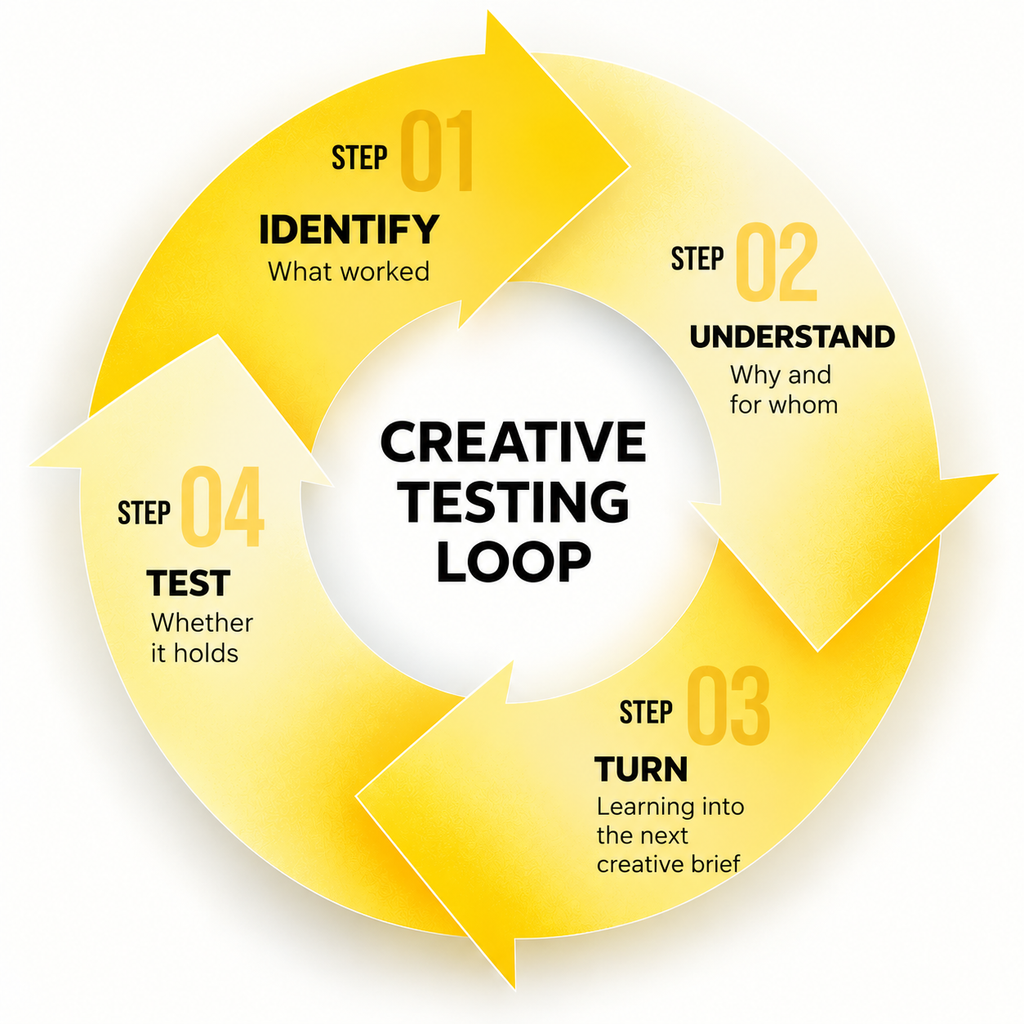
The advent of AI has dramatically lowered the barrier to entry for creative production and iterative testing. This technological leap offers brands access to a greater volume and variety of creative assets and performance metrics than ever before. However, the true strategic advantage lies not merely in the abundance of data, but in the intelligent application of this intelligence to inform and elevate future creative endeavors. The ultimate goal of creative testing, therefore, must evolve from a post-campaign evaluation to a continuous feedback loop, where each testing cycle actively informs and refines the subsequent creative output.
Deconstructing Success: Moving Beyond Asset-Level Analysis
A single advertisement is a complex amalgamation of numerous creative decisions. From the initial hook designed to capture attention, to the core message, the visual aesthetics, the choice of creator or talent, the chosen format, and the final call to action, each component plays a role in the ad’s overall performance. When campaigns rely solely on comparing entire ad assets, it becomes exceedingly difficult to pinpoint the precise factors that contributed to a winning result. This limitation hinders the ability to replicate success or to strategically iterate on proven elements.
This is precisely the challenge that advanced analytics platforms, often referred to as "Creative Intelligence" tools, are designed to address. By dissecting performance data down to the individual creative element level, brands can begin to identify which specific creative choices are demonstrably driving results and which warrant further exploration and testing.
Consider a hypothetical scenario: A product-focused close-up in the initial seconds of a video ad consistently outperforms a lifestyle-oriented introduction in terms of viewer attention. This granular insight is far more actionable than simply knowing which of the two video variations garnered more views. Armed with this understanding, the creative team can retain the effective opening structure while strategically experimenting with different messaging, creators, or formats within that proven framework.
The distinction here is crucial: simply producing more assets that resemble the winning ad does not guarantee an understanding of why it succeeded. If every new creative iteration simultaneously alters the hook, message, format, and visual treatment, it becomes an almost impossible task to isolate the actual drivers of performance. Conversely, by systematically isolating and testing individual variables, creative teams can build upon established knowledge while concurrently exploring novel creative approaches. The objective shifts towards a clear understanding of which creative decisions are worth repeating, adapting, or challenging in the next production cycle.
Context is King: The Interplay of Elements and Audience
Identifying a high-performing creative element is a significant step, but it represents only one facet of a comprehensive understanding. The efficacy of a particular hook, message, or visual style can fluctuate dramatically depending on the audience encountering it, the platform where it is displayed, and the desired action it aims to elicit.

This underscores the indispensable role of audience understanding in both the initial creative brief and subsequent performance analysis. Prior to any creative production, marketing teams must possess a clear definition of their target audience: their existing perceptions, their media consumption habits, and the specific barriers the creative needs to overcome to achieve its objectives. Once the creative is live, testing can validate whether it is resonating with the intended audience and confirm or refute the initial assumptions made about their receptivity.
Often, the most illuminating insights emerge from unexpected findings. Creative developed with one audience segment in mind may consistently over-index with another, thereby revealing unforeseen audience opportunities. Conversely, a previously successful creative approach might falter with a new demographic because the message fails to address their specific priorities, even if the execution itself remains technically strong.
The truly valuable learning becomes highly specific: which creative elements perform well, for which audiences, under what contextual conditions, and in pursuit of which objectives? This contextual understanding is paramount when deciding whether a successful approach should be extended to other audiences or if the next creative brief requires a fundamentally different direction.
Bridging the Gap: Transforming Intelligence into Actionable Production
The industry faces a significant opportunity to extract greater value from creative testing by bridging the gap between performance insights and actual creative production. It is a common scenario for creative performance data to be reviewed retrospectively, often at the conclusion of a campaign when the subsequent creative brief is already in development or production plans have been finalized. By the time a comprehensive understanding of what worked is achieved, opportunities to apply those learnings may be severely limited.
The key challenge lies in integrating this crucial intelligence into the creative process at an early enough stage to genuinely influence what is produced. This necessitates fostering closer collaboration between creative and media teams, establishing a shared understanding of learning objectives, and ensuring that findings from one testing phase are readily accessible and actionable when planning the next.
This integrated approach fundamentally alters the nature of the decisions teams can make. It allows for proactive, data-informed creative development rather than reactive adjustments.
To ensure this process functions effectively and consistently, robust mechanisms for capturing and reusing accumulated knowledge are essential. Creative elements must be meticulously tagged, enabling detailed comparison of hooks, messages, formats, creators, and audience responses across various executions. These findings must then be accessible beyond the confines of individual campaigns, allowing teams to identify overarching patterns across different channels, markets, and time periods.
The subsequent creative brief should be empowered by this consolidated knowledge base. It should prompt critical questions such as: What have we definitively established about our audience and creative effectiveness? Which assumptions still require validation? Where are the existing gaps in our creative portfolio? And what specific knowledge should the next round of creative assets aim to uncover?
This proactive integration transforms creative testing from a post-hoc explanation of performance into a powerful driver of creative output, shaping the work before it even begins.
AI as an Accelerator: Enhancing the Feedback Loop
The integration of AI into creative workflows presents a particularly compelling opportunity for this iterative, intelligence-driven approach. Brands can now produce and test a multitude of creative variations with a speed and efficiency previously unattainable. A single creative concept can be rapidly adapted across diverse formats, target audiences, and product variations, providing teams with significantly more opportunities to test specific elements and build upon accumulated learnings.
However, an increased volume of creative assets does not automatically equate to enhanced learning. A brand might deploy 100 AI-generated assets and, upon campaign completion, identify the top five performers based on Return on Ad Spend (ROAS) without gaining a deeper understanding of how to consistently achieve such results. The true opportunity lies in utilizing this enhanced production capacity with greater strategic intent: maintaining a successful hook while experimenting with alternative messaging, exploring the applicability of a proven concept to a new audience, or adapting an effective execution across various placements without compromising its core strengths.
While AI can undoubtedly accelerate the production and analysis phases, the critical thinking and strategic decision-making remain human-centric. Creative teams must still define the most pertinent questions to investigate, interpret the nuances of audience and cultural context, and determine how these findings should inform the next creative brief. The faster production becomes, the more imperative it is to possess a clear, well-defined understanding of what the brand aims to learn.
Cultivating a Strategic Creative Portfolio
As brands increasingly leverage AI for scaled creative production, the paramount challenge shifts towards strategically directing these efforts. A robust testing program should empower teams to understand which hooks consistently capture attention, which messages resonate with specific audience segments, which creators build credibility, and which elements can be effectively adapted across channels without diminishing their impact.
Crucially, these findings must actively influence the direction of future creative production. If testing reveals a need for more audience-specific messaging, a different creative format, or an entirely novel concept, these insights should be directly reflected in the subsequent creative brief. Similarly, if a particular creative element consistently drives superior results, teams should possess a clear strategy for extending its value without resorting to mere replication of the same execution.
While AI offers powerful tools for production and analysis, creative teams retain the essential role of interpreting culture, conceptualizing groundbreaking ideas, and defining the brand’s unique voice and presence. Creative intelligence, however, equips them with more robust evidence, enabling more informed and strategic decisions regarding where to invest their valuable time and creative resources.
Ultimately, this represents the evolutionary leap we should be demanding from creative testing. The ability to identify winning ads is now a well-established capability. The more significant and impactful opportunity lies in leveraging the lessons learned from these successes to strategically shape the future of a brand’s creative portfolio.

 Sagoh

 Dwi Wanna