
The integration of Artificial Intelligence (AI) into Business-to-Business (B2B) marketing workflows presents a landscape of immense opportunity, but also necessitates a structured approach to identify and prioritize the most impactful applications. Tom Swanson, Senior Engagement Manager at Heinz Marketing, proposes a three-part framework—Leverage, Risk, and Chainability—as a robust methodology for B2B marketing teams to evaluate potential AI use cases. This framework aims to move beyond the initial identification of opportunities, offering a practical system for assessing their viability and strategic fit within an organization’s operational ecosystem.
Swanson’s previous work has focused on the initial discovery phase, such as employing SWOT analyses to pinpoint areas where AI could offer significant benefits. This latest contribution shifts the focus to the critical next step: rigorous evaluation and prioritization. His experience with numerous marketing teams grappling with AI integration over the past 1.5 years highlights a common challenge: moving from theoretical possibilities to concrete, actionable implementations. "Obviously the first step is how do you identify use cases that would be meaningful, and then have to prioritize them," Swanson notes, underscoring the importance of a systematic approach. The proposed framework is designed to enable teams to concentrate their efforts on a select few initiatives, executing them with a high degree of proficiency.
The Three Pillars of AI Use Case Evaluation
The core of Swanson’s methodology rests on three distinct, yet interconnected, criteria: Leverage, Risk, and Chainability. Each element is designed to provide a specific lens through which to scrutinize potential AI applications, ensuring a comprehensive assessment.
1. Leverage: Quantifying the Impact of Automation
Leverage, in this context, directly addresses the frequency with which a particular task is repeated. The higher the repetition, the greater the potential for AI to deliver significant time savings and efficiency gains. Swanson defines leverage as "how often is the task repeated?" This metric is crucial for identifying low-hanging fruit – tasks that are not only candidates for automation but also offer a clear return on investment through reduced manual effort.

When evaluating leverage, several factors come into play. These include the specific situation or use case being considered, the sheer frequency of the task’s execution, and the associated cost, predominantly measured in terms of human time and resources. Furthermore, the uniformity of the workflow and the consistency of its output are critical. A task that follows a consistent workflow and produces predictable outputs is generally a stronger candidate for AI automation than one that is highly variable or prone to significant deviation.
Consider a hypothetical scenario for a B2B software company. A task like generating initial sales outreach email drafts based on prospect firmographic data and recent industry news might be performed hundreds of times a month. If this process currently takes a sales development representative (SDR) 15 minutes per prospect, automating it could free up substantial SDR capacity for more strategic selling activities. The workflow is likely consistent – pull data, analyze, draft email – and the output, while requiring human refinement, can be standardized to a degree that makes AI a valuable assistant.
Swanson provides a concrete example from his client work: a "Local Data Miner" solution. In this instance, regional sales representatives needed to identify new local businesses as potential prospects. The task was performed weekly, consuming approximately half a day for each representative. Crucially, the workflow and output were uniform each time. This scenario exemplifies a high-leverage use case. The regular, time-consuming, and consistent nature of the task made it an ideal candidate for AI automation, directly impacting sales productivity by freeing up valuable selling time. The potential for AI to automate this process meant a significant reduction in manual effort and a more efficient prospecting pipeline.
2. Risk: Understanding the Potential Downsides
The second pillar, Risk, addresses the consequences of an AI system failing or producing erroneous outputs. "What happens if things go wrong?" is the central question here. Risks are inherently task-specific and can vary dramatically across different organizations and industries. A misstep in generating a product description might have minimal repercussions, whereas an error in financial forecasting or customer data analysis could be catastrophic.
Swanson categorizes risks to provide a more granular assessment, often using a low/mid/high scale. These categories can include:

- Financial Risk: The direct monetary cost of errors, such as overspending on ad campaigns due to faulty targeting or losing revenue from incorrect pricing.
- Rework Risk: The time and effort required to correct AI-generated outputs that are inaccurate, nonsensical, or require significant human intervention to fix.
- Total Cost of Ownership (TCO) Risk: Beyond initial implementation, this includes the ongoing costs of maintenance, data updates, and potential system downtime.
- Brand Risk: The potential damage to a company’s reputation if AI outputs are offensive, factually incorrect, or inconsistent with brand messaging.
- Adoption Risk: The challenge of getting internal teams to trust and effectively utilize AI tools, which can lead to underperformance or resistance.
- Accountability Risk: Determining who is responsible when an AI system makes a mistake, especially in regulated industries.
Swanson illustrates this with an example of an "Automated Campaign Strategy with Human Review" use case. The client aimed to automate the drafting of campaign strategies by pulling CRM data, web research, and customer insights. While the financial risk was deemed low (primarily token costs), the rework risk was high, with a strong likelihood of "strategic drift" – the AI deviating from strategic objectives. The TCO risk was mid-level, dependent on maintaining up-to-date documentation. Brand risk was low, mitigated by a mandatory leadership review, as was accountability risk. Adoption risk was identified as mid-level, anticipating the need to encourage team buy-in. This nuanced breakdown of risks is critical; what might seem like a low-risk task on the surface can have significant underlying challenges when dissected.
The B2B technology sector, for instance, often deals with complex technical products. An AI generating marketing copy that misrepresents a product’s capabilities could lead to customer dissatisfaction, increased support calls, and significant reputational damage, thus carrying a high brand and rework risk. Conversely, automating the generation of basic social media posts about company news might have a lower risk profile.
3. Chainability: Integrating AI into Workflows
Chainability, the third pillar, focuses on how well an AI task integrates into existing workflows and whether its output can serve as direct input for subsequent tasks. Swanson describes it as "how does this fit into a workflow?" This is particularly important for B2B marketing, where campaigns and customer journeys are often multi-stage processes involving various tools and human touchpoints.
A highly chainable task means that the output of the AI can be seamlessly passed to the next stage in the workflow, ideally without human intervention. This creates an automated "chain" of operations, significantly accelerating processes and reducing manual handoffs. The critical question here is the desired level of human oversight. Some organizations might require human review at every step, while others are comfortable with a higher degree of automation.
Swanson elaborates that chainability is often a Boolean (yes/no) consideration, or at least a significant factor. If an AI’s output requires substantial human review or modification before it can be used in the next step, its chainability is reduced. This is a nuanced point, as the definition of "chainable" can differ based on team culture and operational protocols. For instance, if a marketing team mandates that a human strategist must approve any campaign plan before tactical execution begins, then an AI generating that plan is not fully chainable in that specific workflow.
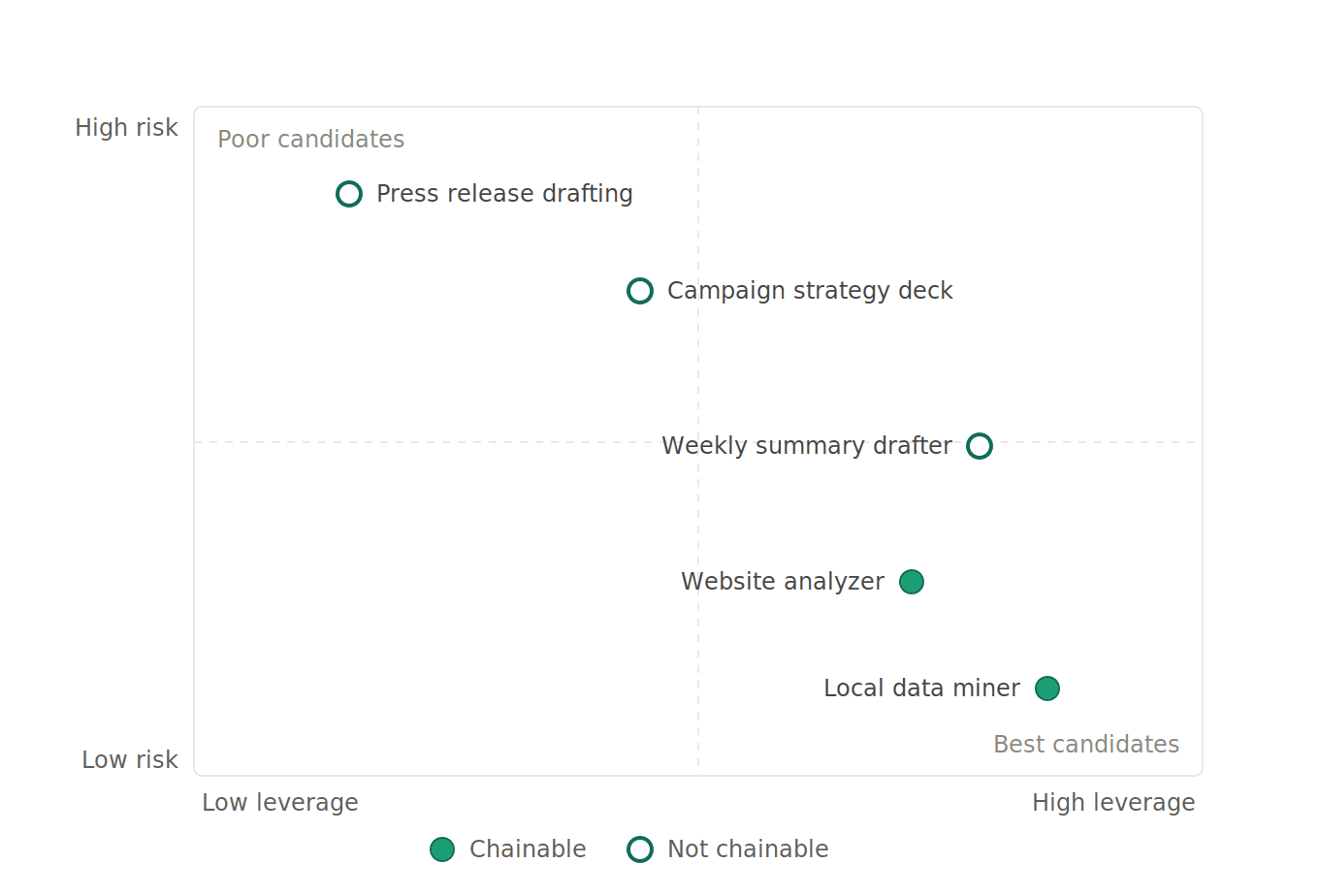
He offers an example from Heinz Marketing’s own AI bot development: a "Website Analyzer Agent." This agent takes a client’s website URL as input and performs an analysis. The key here is that its output serves as input for multiple subsequent agents, including a "Content Analyzer," "Messaging Developer," and "Campaign Strategist." While the "Campaign Strategist" might only trigger once other inputs are received, the Website Analyzer’s output is a vital link in a larger chain. This high degree of connectivity makes it a valuable component of a broader AI-driven workflow, demonstrating the power of well-integrated AI agents.
The implications of chainability are profound. In B2B lead generation, an AI that can analyze incoming leads, enrich them with data, score them, and then automatically assign them to the appropriate sales rep represents a highly chainable and efficient process. Conversely, if each of those steps requires manual review, the process becomes fragmented and less efficient, diminishing the overall benefit of AI.
Visualizing the Framework and Prioritization
Swanson suggests visualizing these three components on a Cartesian plane, with leverage and risk as axes. Chainability can then act as a Boolean gate or a significant modifier. This visual approach helps to objectively place use cases within a spectrum, aiding in prioritization.
- High Leverage, Low Risk, High Chainability: These are the "golden opportunities" – ideal candidates for immediate AI implementation. They promise significant efficiency gains with minimal downside and seamless integration into existing workflows. The "Local Data Miner" example fits this category.
- High Leverage, High Risk, High Chainability: These use cases offer substantial benefits but come with significant potential pitfalls. They require careful risk mitigation strategies and robust testing before deployment.
- Low Leverage, Low Risk, Low Chainability: These might be minor enhancements or tasks that are already efficient. While not high priority, they could be considered for future optimization.
- High Leverage, Low Risk, Low Chainability: These tasks offer efficiency gains but don’t integrate well into broader workflows. They might be pursued as standalone automations.
The framework acknowledges that "everything is a spectrum" and that subjective judgment plays a role, particularly regarding risk tolerance, which can be influenced by company culture and leadership’s stance on AI adoption.
Background Context and Broader Implications
The push for AI integration in B2B marketing is not new, but it has accelerated significantly in recent years due to advancements in natural language processing, machine learning, and the increasing availability of data. The COVID-19 pandemic, in particular, highlighted the need for digital transformation and remote operational capabilities, further fueling the adoption of AI-powered tools.
Many B2B organizations are facing pressure to demonstrate a clear return on investment from their marketing efforts. AI offers a compelling pathway to achieve this by enhancing personalization, optimizing campaign performance, improving customer segmentation, and automating repetitive tasks. However, the success of these initiatives hinges on a strategic and methodical approach. Without a clear framework for evaluating use cases, companies risk investing in solutions that fail to deliver on their promise, leading to wasted resources and disillusionment with AI technology.

Swanson’s framework addresses a critical gap in the AI adoption journey. While many articles focus on what AI can do, fewer provide a practical guide on how to decide which AI applications are most suitable for a given organization. By emphasizing Leverage, Risk, and Chainability, he provides a structured methodology that can be applied by teams of all sizes, from startups to large enterprises.
The analysis of implications is clear: a well-defined AI strategy, guided by a robust evaluation framework, can lead to significant competitive advantages. B2B companies that effectively leverage AI can achieve greater marketing agility, deeper customer insights, and ultimately, improved sales performance. The inverse is also true: organizations that adopt AI haphazardly or without proper due diligence may find themselves struggling to realize its benefits, potentially falling behind more forward-thinking competitors.
The Path Forward: Embracing a Roadmap
Swanson concludes by emphasizing that the ultimate prioritization is subjective and depends on individual team contexts. However, the framework provides a guide to maximize objectivity. As teams gain more experience with AI, their perception of risk might evolve, and their ability to integrate complex systems will improve.
He reiterates the importance of understanding one’s own team, referencing his prior discussion on SWOT analyses. This foundational understanding is essential for building a practical roadmap. Marketing, perhaps more than other fields, stands to gain significantly from AI applications that can generate tangible ROI. This requires a deliberate and informed approach to AI implementation.
A key takeaway is the practical reality that teams can typically only build one AI initiative at a time, especially when inputs and outputs need to be chained together. This necessitates a phased approach: building one chain at a time, adding parallelism modularly, and maintaining a visual workflow to understand how different components fit together. This methodical progression ensures that AI initiatives are built on a solid foundation and are integrated effectively into the overall marketing technology stack.
For organizations seeking to navigate this complex landscape, engaging with experts and utilizing diagnostic tools can be invaluable. The article implicitly suggests that by following such a structured evaluation process, B2B marketing teams can unlock the transformative potential of AI, driving efficiency, innovation, and ultimately, business growth.