
The integration of Artificial Intelligence (AI) into B2B marketing workflows presents a landscape ripe with potential, yet fraught with complexities. To navigate this terrain effectively and ensure successful adoption, B2B marketing professionals require a structured approach to identify and prioritize AI use cases. Tom Swanson, Senior Engagement Manager at Heinz Marketing, has articulated a pragmatic three-part framework designed to provide clarity and objectivity in this process. This framework, focusing on Leverage, Risk, and Chainability, offers a systematic method for evaluating the viability and impact of AI applications within marketing operations.
The genesis of this framework stems from extensive work with numerous teams aiming to optimize their marketing orchestration. For the past eighteen months, a significant portion of this effort has been dedicated to understanding and implementing AI solutions. As Swanson notes, the initial hurdle involves not only identifying meaningful use cases but also establishing a clear order of priority. "The first step is how do you identify use cases that would be meaningful, and then have to prioritize them," he stated in a recent publication. This need for a discerning evaluation process is paramount as businesses increasingly seek to harness AI’s capabilities to enhance efficiency, personalize customer interactions, and ultimately drive revenue growth.
Understanding the Three Pillars of AI Use Case Evaluation
Swanson’s framework is built upon three core components, each designed to assess a different facet of a potential AI application:
- Leverage: This metric quantifies how frequently a particular task is repeated. Tasks that are highly repetitive and consume significant human hours represent prime candidates for AI automation, offering substantial gains in efficiency and resource allocation. The greater the frequency of a task, the higher its leverage and the more compelling the case for AI intervention.
- Risk: This component assesses the potential negative consequences should an AI application falter or produce erroneous results. The severity of these consequences can vary dramatically, ranging from minor inconveniences to significant financial losses, brand damage, or strategic missteps. Understanding the risk profile is crucial for determining the appropriate level of oversight and the acceptable tolerance for error.
- Chainability: This factor evaluates how well a particular AI task integrates into existing or future workflows. A highly chainable task produces an output that can be seamlessly passed as input to another task, whether human-driven or AI-powered. This ability to create automated sequences or "chains" of operations amplifies the overall impact of AI by fostering greater operational fluidity and reducing manual handoffs.
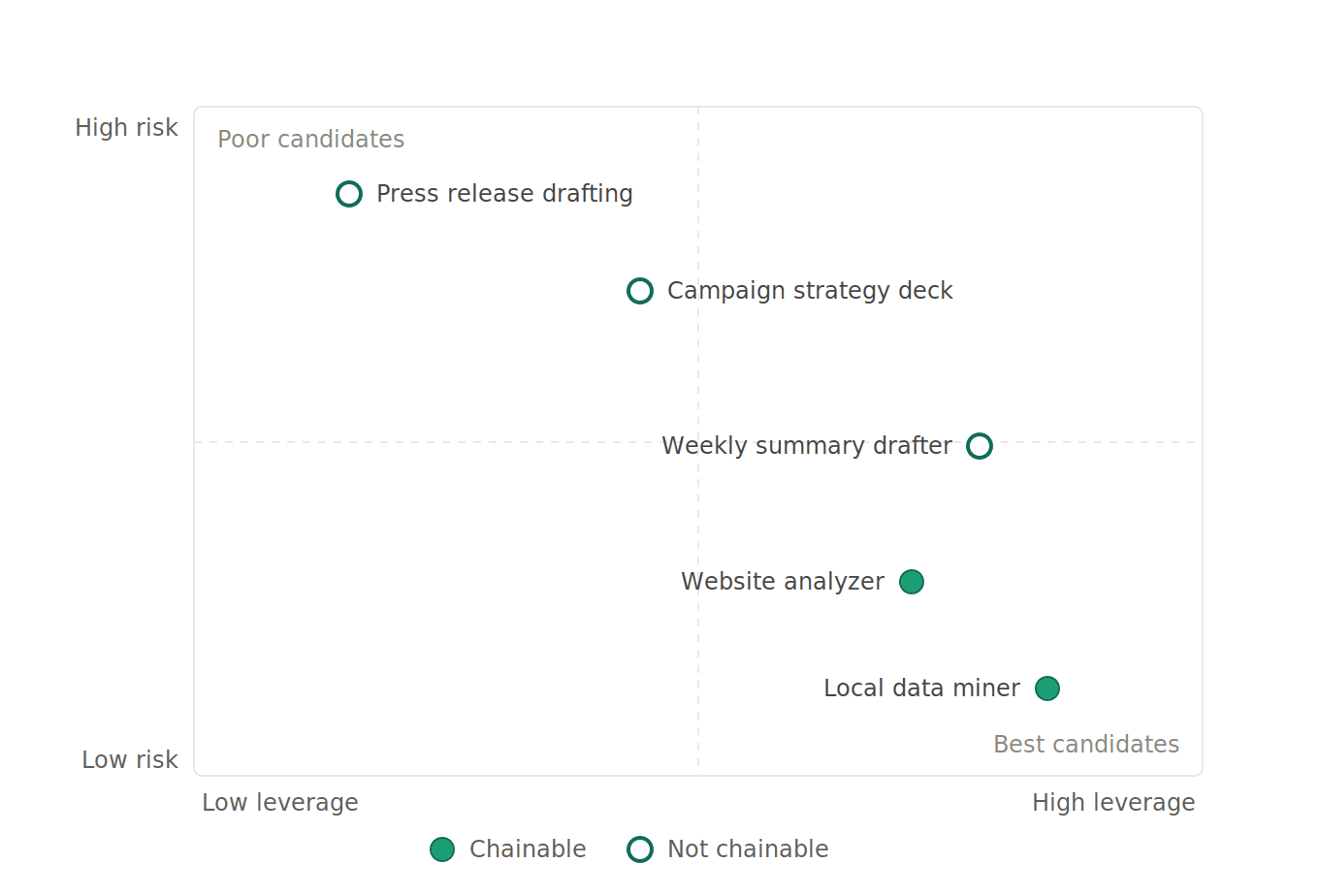
These three elements, when considered in concert, provide a comprehensive lens through which to view and prioritize AI opportunities. The ideal AI use case would exhibit high leverage, low risk, and strong chainability, representing a low-effort, high-reward implementation. Conversely, tasks with low leverage, high risk, and poor chainability would likely be deferred or re-evaluated.

Quantifying Leverage: The Power of Repetition
The concept of leverage hinges on the principle that AI excels at automating tasks that are performed repeatedly. For B2B marketing teams, these can range from generating initial drafts of campaign copy to segmenting customer lists, identifying leads, or even conducting preliminary market research. Swanson emphasizes that "rote, repeated tasks are the best fit for AI, particularly early on while you are still learning to build." This focus on foundational, high-frequency tasks allows teams to build confidence and understanding of AI capabilities before tackling more complex, nuanced applications.
When evaluating leverage, several sub-factors come into play. These include the inherent situation or the specific use case, the frequency with which the task occurs (daily, weekly, monthly), the cost associated with performing the task (primarily in terms of human time and resources), the degree of uniformity in the workflow from one execution to the next, and the consistency of the output generated.
Consider a practical example: a regional sales team’s need to stay abreast of new local businesses emerging as potential prospects. If this task involves manually sifting through local business directories, news feeds, and online listings on a weekly basis, consuming half a day per representative, the leverage for AI automation is significant. The workflow is generally uniform – the objective is always to identify new businesses – and the desired output (a list of new prospects with contact information) is also consistent. In such a scenario, an AI-powered "Local Data Miner" could automate this process, freeing up valuable selling time for the reps. The cost savings, measured in hours of sales activity regained, would be substantial. Furthermore, if the output of this tool is a structured list that can be directly imported into a CRM or passed to a sales development representative for initial outreach, its chainability would also be high.
Navigating the Risk Landscape: Identifying Potential Pitfalls
The introduction of AI into any operational process inherently carries risk. In B2B marketing, these risks can manifest in various forms, and their perceived severity is often subjective, influenced by organizational culture, industry regulations, and leadership attitudes towards AI adoption. Swanson categorizes risks to help teams assess their impact:
- Financial Risk: This pertains to the direct monetary cost associated with the AI tool, including subscription fees, development costs, and potential losses due to errors.
- Rework Risk: This involves the potential need for significant human intervention to correct or revise the AI’s output. High rework risk indicates that the AI is not reliably producing accurate or usable results.
- Total Cost of Ownership (TCO) Risk: Beyond the initial financial outlay, this encompasses ongoing maintenance, updates, data integration, and training costs.
- Brand Risk: This relates to the potential for AI errors to negatively impact the company’s brand reputation, for instance, through the dissemination of incorrect or inappropriate content.
- Adoption Risk: This refers to the challenge of getting internal teams to embrace and effectively utilize the AI tool. Resistance to change or a lack of proper training can hinder adoption.
- Accountability Risk: This addresses the question of who is responsible when an AI system makes a mistake. Clearly defined lines of accountability are essential.
For instance, a client seeking to automate the drafting of campaign strategies using AI agents that pull CRM data, web research, and customer insights presents a complex risk profile. While the direct financial risk might be low (primarily token costs for AI processing), the rework risk could be high if the AI generates strategically unsound recommendations. The TCO risk might be moderate, requiring ongoing updates to data sources and algorithms. Brand risk could be low if the AI-generated strategies are subject to thorough human review by leadership before implementation. Adoption risk might be moderate, as sales and marketing teams may need persuasion and training to trust and integrate AI-driven insights into their planning process. Accountability risk could be low if leadership review serves as a final approval layer.

The nuanced evaluation of these risks is critical. A high-risk application might still be pursued if its potential rewards are sufficiently high and if robust mitigation strategies are in place. Conversely, a seemingly low-risk application might be deemed unsuitable if it offers minimal strategic benefit. The context of the organization—its risk tolerance, industry, and regulatory environment—plays a pivotal role in this assessment.
Charting the Workflow: The Importance of Chainability
Chainability, in Swanson’s framework, speaks to the seamless integration of AI tasks within broader operational workflows. It addresses the question of whether the output of one AI process can serve as the direct input for another, or for a human task, without requiring manual intervention or significant reformatting. This aspect is particularly compelling for professionals who appreciate the efficiency and automation potential of well-defined workflows.
A highly chainable AI application operates as a cog in a larger machine, receiving information, processing it, and passing the results along to the next stage. This creates a ripple effect, automating multiple steps in a process and significantly reducing the time and effort required to complete complex tasks. The ultimate goal is often to create end-to-end automated processes where data flows smoothly from one stage to the next, driven by AI.
However, the degree of chainability often hinges on the acceptable level of human oversight. For some organizations, a "hands-off" approach where AI executes tasks autonomously is desirable. For others, a critical human review step is non-negotiable, especially for strategic decisions or customer-facing communications. In such cases, the AI’s output is chainable to the point of generating a draft or recommendation, but not to the point of autonomous execution.
A compelling example of chainability can be observed in AI agents designed for website analysis. An initial agent might be tasked with ingesting a client’s website URL and key pages. This URL is provided by a preceding "Client Information Analyzer" agent, which might have processed a larger data dump from clients. Upon receiving the URL, the website analyzer agent performs its task, generating a comprehensive website analysis. This analysis then serves as a crucial input for subsequent agents, such as a "Content Analyzer," a "Messaging Developer," or a "Campaign Strategist." While the campaign strategist agent might not trigger immediately—perhaps requiring inputs from other discovery process agents—the website analysis remains an integral part of the overall chain, enabling a more data-driven and efficient strategic planning process. This illustrates how a single agent’s output can feed into multiple downstream processes, highlighting its strong chainability.
Prioritizing AI Investments: A Strategic Roadmap
The ultimate objective of this framework is to provide B2B marketing leaders with a structured methodology for prioritizing AI investments. By systematically evaluating potential use cases against Leverage, Risk, and Chainability, organizations can move beyond anecdotal evidence and make data-informed decisions.
Swanson suggests that while the framework provides a guide for objectivity, the ultimate prioritization is a strategic decision influenced by the organization’s specific context. "At the end of the day, what you prioritize is up to you," he states. "This framework is a guide for how we try to maximize objectivity and figure out the right places to start." As teams gain more experience with AI, their risk tolerance may evolve, and their understanding of these tools will deepen, potentially making previously daunting risks more manageable. Similarly, an organization’s specific workflow requirements might place a greater emphasis on human intervention, thereby reducing the weight of pure chainability.
The foundational step, as highlighted in previous discussions, is a thorough understanding of the internal team and its current operational landscape. This often involves conducting a SWOT analysis (Strengths, Weaknesses, Opportunities, and Threats) of existing marketing processes to identify areas ripe for improvement. Once this internal assessment is complete, the leverage, risk, and chainability framework can be applied to develop a tangible roadmap for AI implementation.
Marketing, in particular, is identified as a field with immense potential for AI-driven ROI, provided the implementation is strategic and well-executed. Swanson emphasizes the importance of a focused approach, advocating for teams to concentrate on developing and implementing one AI initiative at a time. This iterative process allows for learning, refinement, and successful integration. As new AI capabilities are introduced, maintaining a visual representation of workflows can help identify how new AI components fit into the broader operational ecosystem.
The journey of AI integration in B2B marketing is not a one-time event but an ongoing process of evaluation, adaptation, and optimization. By employing a structured framework like the one proposed by Tom Swanson, organizations can navigate this complex landscape with greater clarity, ensuring that their AI investments yield meaningful returns and contribute to sustainable marketing success.

For organizations looking to assess their current state and identify potential AI opportunities, Heinz Marketing offers resources such as an Orchestration Self-Audit. This proactive approach, combined with a strategic framework for evaluating AI use cases, positions B2B marketing teams to effectively harness the transformative power of Artificial Intelligence.