
 rifanmuazin
The digital economy has reached a point of saturation where marginal gains in user experience can translate into millions of dollars in incremental revenue. As organizations seek to optimize their digital touchpoints, a fundamental strategic dilemma emerges: whether to invest in A/B testing software tools to build an internal experimentation engine or to hire A/B testing services to manage the process externally. The main difference lies in the locus of control and expertise; software tools prioritize scalability and long-term institutional knowledge, while services prioritize immediate speed and expert-led execution. For global enterprises, this choice is not merely a budgetary line item but a decision that shapes the organization’s data governance, innovation velocity, and competitive positioning.
The Evolution of the Experimentation Landscape
The practice of A/B testing—comparing two versions of a webpage or app against each other to determine which performs better—has evolved from a niche marketing tactic into a core product development methodology. In the early 2010s, experimentation was largely restricted to "client-side" changes, such as altering button colors or headlines. Today, the field encompasses "server-side" testing, feature flag management, and AI-driven personalization.
This technological advancement has created a maturity curve for organizations. Typically, a company begins its journey by identifying a need for higher conversion rates. Depending on their internal resource availability, they either purchase a license for a platform like VWO or Optimizely or sign a retainer with a Conversion Rate Optimization (CRO) agency. Industry data suggests that the global CRO software market is expanding at a compound annual growth rate (CAGR) of approximately 10-12%, reflecting a broader corporate shift toward data-driven decision-making.
Strategic Framework: Comparing Software Tools and Managed Services
To understand the impact of this choice, it is necessary to examine the core pillars of experimentation through the lens of both models.
1. Ownership and Institutional Knowledge
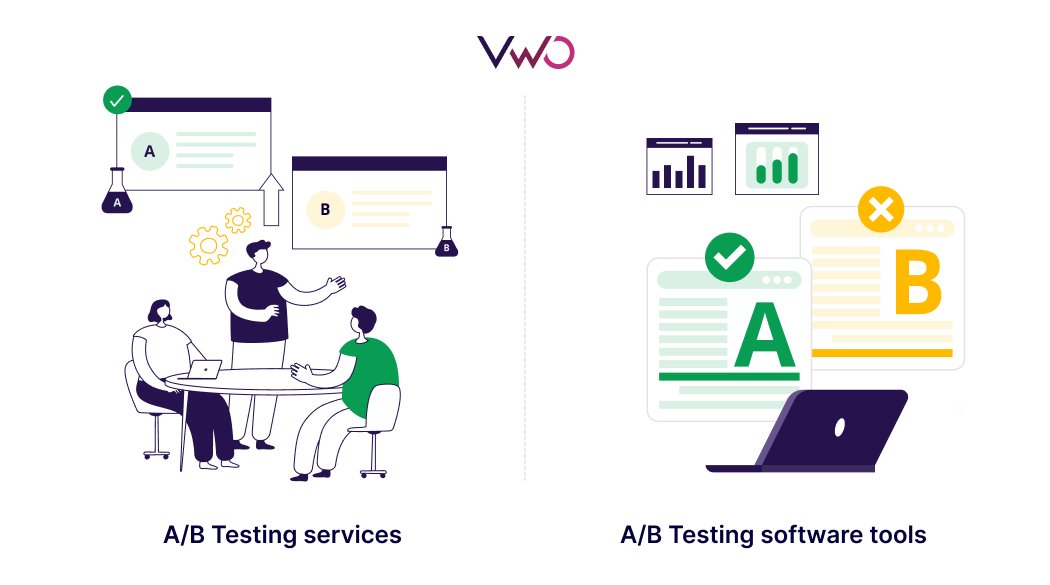
When an organization utilizes A/B testing software, it retains full ownership of the experimentation lifecycle. Internal teams—spanning marketing, product, and engineering—design the hypotheses and interpret the results. This builds "institutional memory," where the lessons learned from failed and successful tests alike are stored within the company.
Conversely, A/B testing services externalize this expertise. While an agency provides a turnkey solution, the deep insights into user behavior often reside with the agency’s consultants. If the contract ends, the organization may find itself with a "knowledge gap," lacking the internal talent to continue the momentum of the testing program.
2. Scalability and Cross-Platform Execution
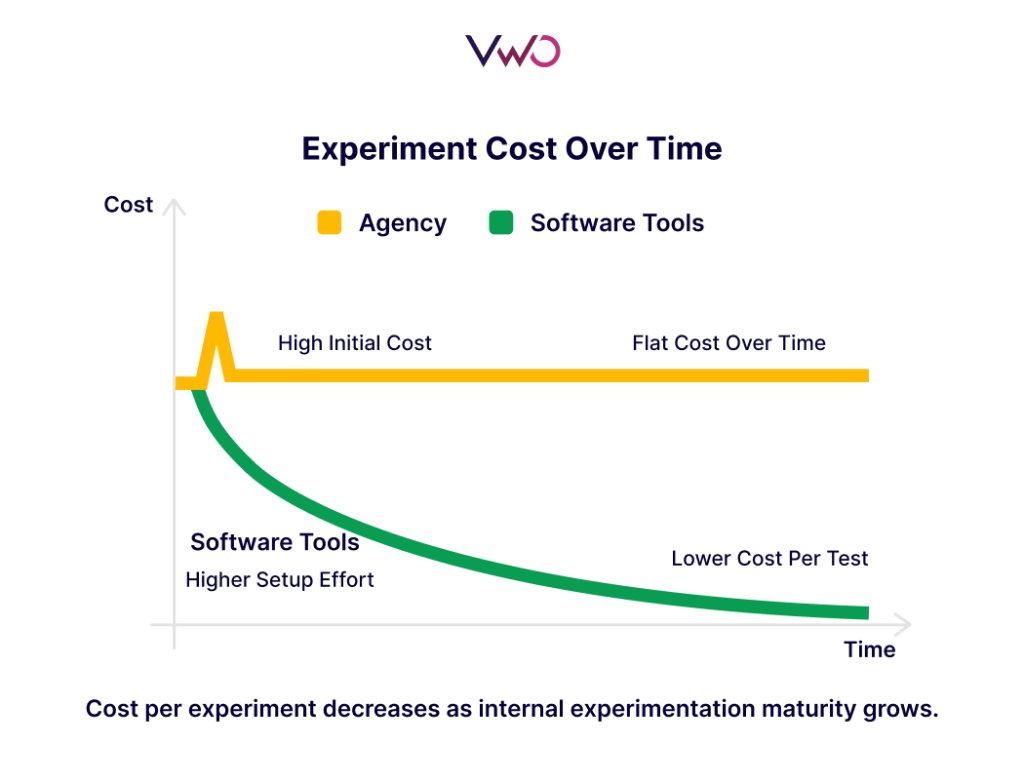
Software platforms are designed for high-volume environments. For enterprises with millions of monthly tracked users (MTUs), a tool allows for simultaneous testing across web, mobile apps, and backend server environments. Once the infrastructure is integrated, the cost per experiment decreases as the team’s proficiency grows.
Agencies, while highly skilled, are often limited by "bandwidth" and contract scope. Scaling an experimentation program through an agency typically requires increasing the retainer or hiring more billable hours. However, agencies excel in "high-stakes" environments where the complexity of a single experiment—such as a complete checkout redesign—requires a multidisciplinary team of designers and developers that the company may not have on staff.
3. Data Governance and Security
In an era of stringent data privacy regulations like GDPR and CCPA, data ownership is a critical concern. Software tools allow organizations to maintain a unified data ecosystem. By integrating testing tools with internal Customer Data Platforms (CDPs) and analytics suites (e.g., Google Analytics 4 or Adobe Analytics), companies can ensure that user data never leaves their controlled environment.

Agencies often use their own preferred stacks or third-party tools to report results. This can occasionally lead to "data fragmentation," where the insights from experiments are siloed in agency reports rather than being integrated into the company’s central data repository.
Detailed Analysis of A/B Testing Software Tools
For mature growth teams, a comprehensive experimentation platform is more than a testing utility; it functions as a feature management system that de-risks every product release.
The Infrastructure of Innovation
Modern platforms offer advanced capabilities such as feature flags and remote configuration. These allow engineering teams to "toggle" features on or off for specific user segments without deploying new code. This "controlled rollout" strategy ensures that if a new feature negatively impacts site performance, it can be killed instantly, protecting the user experience.
The Integration of Behavioral Context
Leading tools now integrate qualitative insights—such as heatmaps, clickmaps, and session recordings—directly with quantitative A/B test data. This "mixed-methods" approach allows teams to understand not just which variation won, but why users interacted with it in a certain way. For example, a session recording might reveal that a "winning" variation actually caused confusion, but users converted because they were forced to find a workaround, suggesting further optimization is possible.
The Role of Artificial Intelligence
The integration of AI into software tools has lowered the barrier to entry. AI-powered "copilots" can now generate test hypotheses based on goal parameters, automate the creation of copy variations, and even predict which user segments are most likely to respond to a specific offer. This automation allows smaller internal teams to punch above their weight class, performing complex multivariate testing that previously required a large agency team.
Detailed Analysis of A/B Testing Services
Hiring an agency is often the fastest route to high-impact results for organizations that possess a significant budget but lack the technical headcount to manage a full-scale program.
Immediate Expertise and "Appetite" Building
An agency brings a "ready-made" team of strategists, developers, and analysts. They arrive with established workflows and a library of "best practices" derived from working across multiple industries. For many legacy organizations, the primary value of an agency is "organizational enablement." By delivering a series of high-ROI "wins" early in the engagement, the agency builds an internal appetite for data-driven culture, often paving the way for the eventual hire of an in-house team.
The Risk of Limited Business Context
The primary drawback of the service model is the "context gap." External partners, no matter how skilled, rarely have the same depth of understanding regarding a company’s long-term brand values, product roadmap, or internal technical debt as an employee. An agency might recommend a "dark pattern" (a manipulative UI tactic) that increases short-term conversions but damages long-term brand equity—a trade-off an internal team would likely avoid.
Economic Considerations and Long-Term ROI
The cost structures of these two models differ significantly. Software tools typically operate on a subscription basis (SaaS), with pricing tiers based on features and the volume of tracked users. This makes the cost predictable and allows the ROI to compound as the internal team becomes more efficient.
Agency pricing is usually tied to a monthly retainer or a project-based fee. While the upfront cost is higher, the "time to value" is often shorter. However, the ROI of an agency is linear; it lasts only as long as the contract is active.

Total Cost of Ownership (TCO) Analysis
- Software: Includes license fees + internal salaries (Product Manager, Developer, Designer) + training time.
- Service: Includes agency retainer + internal "point of contact" salary + occasional tool licenses (if the agency requires them).
Industry benchmarks suggest that for companies with over 500,000 monthly visitors, the TCO of an internal team using a robust software tool eventually becomes more favorable than a full-service agency retainer, primarily due to the speed of iteration and the retention of intellectual property.
Case Study: Behavioral Insights in Action
The practical impact of this decision is best illustrated by the Dutch energy provider Vandebron. Operating in a highly competitive market, Vandebron needed to reduce friction in its registration process. Using a unified experimentation platform, the company was able to combine behavioral analytics with A/B testing.
By analyzing session recordings, the team identified a usability issue in the "date of birth" input field on their registration form. They hypothesized that a simplified input method would reduce drop-offs. Upon running the experiment, they saw a 16.3% increase in sign-up conversions. This success was attributed to the team’s ability to act quickly on behavioral data without the lag time associated with external agency communication. This case highlights how internal ownership of a tool allows for "micro-optimizations" that might be too small for an agency’s scope but collectively drive significant revenue.
The Hybrid Model: A Growing Trend
The decision between services and software is increasingly becoming a "both/and" rather than an "either/or." Many high-growth companies adopt a hybrid model. In this scenario:
- The Company owns the Software: This ensures long-term data ownership and integration with the internal tech stack.
- The Agency provides Strategy: The agency acts as a consultant, helping to build the initial roadmap, train internal staff, and handle complex "overflow" development work.
This model allows for a gradual transition of expertise. As the internal team matures, the agency’s role shifts from "execution" to "high-level strategy," eventually allowing the company to take full control of its experimentation engine.
Conclusion and Future Outlook
The choice between A/B testing services and software tools is ultimately a choice between "renting" and "owning" innovation. For companies in the early stages of digital transformation, the speed and expertise of an agency service can provide the necessary spark to ignite a testing culture. However, as organizations scale and the complexity of their digital products grows, the need for internal control, data security, and institutional knowledge makes a dedicated software platform an essential piece of infrastructure.
As AI continues to automate the more technical aspects of experimentation—from code generation to statistical analysis—the gap between what a tool can do and what a human expert can do is narrowing. This shift suggests a future where software tools become the primary driver of experimentation, while humans (whether internal or agency-based) focus on the high-level psychological insights and strategic vision that no algorithm can yet replicate. For the modern enterprise, the goal is clear: build a system where every product decision is backed by data, ensuring that the user experience is constantly evolving to meet the demands of an increasingly discerning digital consumer.








