
 rifanmuazin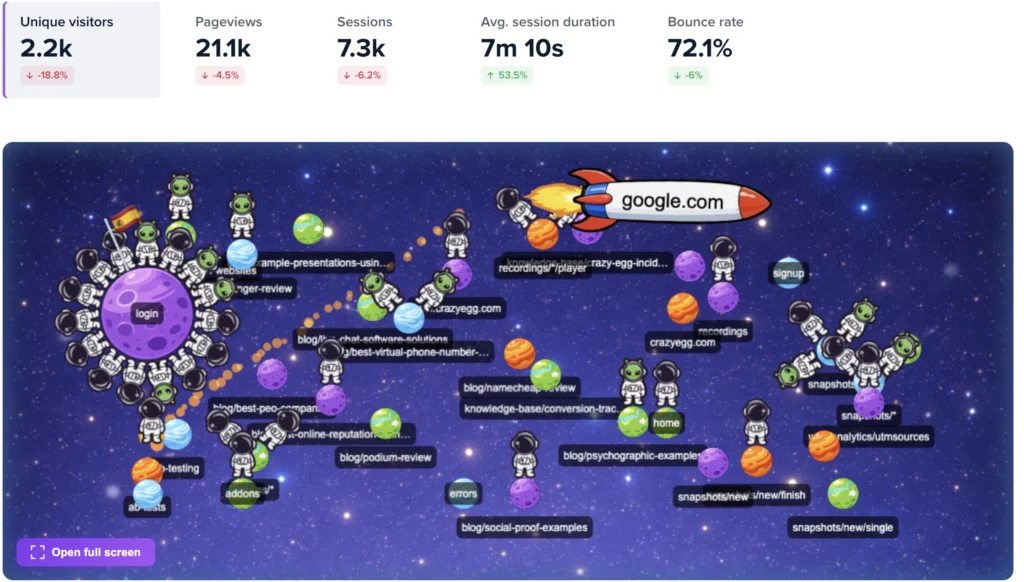
The digital optimization firm Crazy Egg has officially unveiled a new real-time data visualization tool titled Astro Map, a feature integrated into its Web Analytics suite designed to humanize abstract visitor data through an interactive, space-themed interface. This launch represents a significant shift in how web administrators and marketing professionals interact with live traffic data, moving away from traditional numerical tables and static charts toward a dynamic, representational ecosystem. By depicting website visitors as celestial characters—specifically astronauts and aliens—landing on "planets" that represent individual webpages, Crazy Egg aims to lower the barrier to entry for data interpretation while providing immediate, actionable insights into user behavior.
The Mechanics of Visual Telemetry
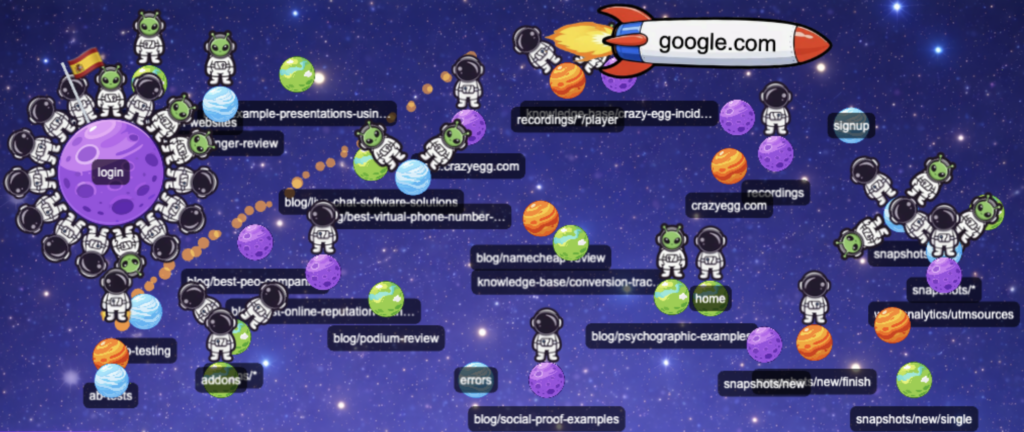
The Astro Map serves as a live dashboard where every active user session is visualized in real-time. When a user selects the "Today" date range within the Crazy Egg Web Analytics platform, the interface transitions into a cosmic map. Each visitor is assigned a unique avatar, and their journey through the site is rendered through a series of metaphors. The pages of a website are depicted as planets; as visitors move from one URL to another, their avatars migrate between these planetary bodies.
Beyond mere presence, the tool tracks specific engagement metrics through a "speech bubble" system. When a visitor performs a significant action—such as scrolling past a certain depth, clicking a call-to-action button, or triggering a conversion goal—a notification appears instantly above their avatar. Perhaps most critically for technical teams, the system also visualizes errors. If a user encounters a 404 page or a script error, the Astro Map displays this event immediately, allowing developers to witness the exact context in which a site failure occurred.
The "rocket" metaphor is utilized to represent traffic sources. When a visitor arrives from an external referrer, such as a social media platform, a search engine, or a backlink, they are shown being "dropped off" by a rocket. This provides an immediate visual sense of which marketing channels are currently driving the most active engagement without requiring the user to navigate through complex acquisition reports.
Detailed User Profiling and Granular Activity Logs
While the interface utilizes a gamified aesthetic, the underlying data remains robust and professional. By clicking on any individual avatar within the Astro Map, administrators can access a comprehensive visitor profile. This sidebar provides essential metadata, including the visitor’s geographic location (country), the device type being used (mobile, tablet, or desktop), and the specific referrer that initiated the session.
Furthermore, the tool includes a "recent activity log" for each individual. This log provides a chronological breakdown of every action the visitor has taken during their current session. This level of granularity is particularly valuable for UX designers and conversion rate optimization (CRO) specialists who need to understand the "why" behind user behavior. Seeing a visitor click back and forth between two pages before eventually converting—or dropping off—provides a narrative context that aggregate data often obscures.
Strategic Market Positioning and Accessibility
In a move that challenges the current landscape of the analytics industry, Crazy Egg has announced that the Astro Map and the broader Web Analytics suite are available at no additional cost. The feature is included for all Crazy Egg users, regardless of their subscription tier, and the company has emphasized that Web Analytics will remain 100% free for everyone.
This pricing strategy appears to be a direct response to the increasing complexity and cost of enterprise-level analytics tools. Since the industry-wide transition to Google Analytics 4 (GA4), many small to medium-sized businesses have expressed frustration with the steep learning curve and the perceived loss of intuitive real-time reporting. By offering a highly visual, free alternative, Crazy Egg is positioning itself as the accessible entry point for businesses that prioritize immediate usability over the dense, often overwhelming configurations of traditional platforms.
Historical Context: From Heatmaps to Real-Time Visualization
To understand the significance of the Astro Map, one must look at the evolution of Crazy Egg as a pioneer in the field of visual analytics. Founded in 2005 by Hiten Shah and Neil Patel, Crazy Egg was one of the first tools to popularize "heatmaps"—visual representations of where users click, move their mice, and scroll. At the time, this was a revolutionary departure from the text-heavy logs provided by early versions of Urchin (which later became Google Analytics).
Over the nearly two decades since its inception, the company has expanded its toolkit to include recordings, A/B testing, and surveys. However, the core philosophy has remained consistent: making data visual and easy to understand for non-data scientists. The Astro Map is the latest iteration of this philosophy, applying the visual logic of heatmaps to the temporal dimension of real-time traffic. It marks a transition from "what happened yesterday" to "what is happening this second."
Technical Implications for UX and Development Teams
The inclusion of real-time error tracking within the Astro Map provides a unique advantage for web development teams. In traditional analytics, an increase in error rates is often discovered hours or even days after the fact, once data has been processed and reported. With the Astro Map, a sudden influx of "Error" speech bubbles appearing over visitors on a specific "planet" (page) serves as an immediate alarm.
This allows for rapid response times. For instance, if a company launches a new product page and notices that astronauts are landing but immediately displaying error bubbles or failing to move past the header, the technical team can investigate the live deployment instantly. This "live debugging" capability reduces the window of lost revenue during site malfunctions.
From a UX perspective, the tool facilitates a form of "virtual shoulder-surfing." Designers can watch how users navigate a new site structure in real-time, observing where they hesitate, where they click repeatedly (rage clicking), and how they flow through a funnel. This observational data is often more visceral and easier to communicate to stakeholders than a spreadsheet showing a 20% bounce rate.
Industry Reaction and Expert Analysis
Market analysts suggest that the "gamification" of data represented by the Astro Map is part of a broader trend toward "Data Democracy." As more departments within a corporation—from sales to customer support—require access to web insights, tools must become more intuitive.
"The challenge with modern analytics isn’t a lack of data; it’s a surplus of it," says digital marketing consultant Marcus Thorne. "Most business owners don’t have time to build custom explorations in GA4. They want to see if their latest Instagram post is actually sending people to the site right now, and they want to see if those people are getting stuck. Crazy Egg’s Astro Map turns a chore into an observation, which is a powerful psychological shift for a busy entrepreneur."
However, some data purists argue that visual representations can sometimes oversimplify complex user journeys. While an astronaut moving between planets is easy to grasp, it may not capture the nuance of multi-touch attribution or cross-device behavior as effectively as a dedicated attribution model. Nevertheless, the consensus remains that for top-of-funnel monitoring and immediate site health checks, visual tools offer a speed of comprehension that tables cannot match.
Broader Impact on the Analytics Landscape
The launch of Astro Map comes at a time when the global web analytics market is projected to reach significant heights, driven by the increasing necessity of digital transformation. According to industry reports, the demand for real-time analytics is growing at a compound annual growth rate (CAGR) of over 20%.
Crazy Egg’s decision to keep these features free is likely to disrupt the mid-market segment. By removing the financial barrier, they are encouraging a wider adoption of visual analytics. This could force other competitors to reconsider their feature gating and pricing structures. Furthermore, the focus on "real-time" reflects the accelerating pace of digital commerce, where a delay in data processing can mean the difference between a successful flash sale and a missed opportunity.
Chronology of Development and Future Outlook
The development of the Astro Map follows a series of updates to the Crazy Egg platform over the last 18 months, aimed at modernizing the backend infrastructure to support high-velocity data streaming. The company has moved toward a more integrated experience where heatmaps, recordings, and now real-time analytics live within a single, unified dashboard.
Looking forward, the technology powering the Astro Map could potentially be expanded to include predictive modeling. For example, future iterations might use machine learning to highlight which "astronauts" are most likely to convert based on their current real-time behavior, or to automatically flag "alien" figures that exhibit bot-like patterns.
As of today, the Astro Map is fully deployed and accessible to the global user base. It stands as a testament to the idea that data does not have to be dry or intimidating to be powerful. By turning the website into a galaxy and the visitors into explorers, Crazy Egg has provided a new lens through which the digital world can be viewed—one that is as informative as it is engaging. This launch reaffirms the company’s position as a leader in user experience and a persistent innovator in the ever-evolving field of web telemetry.








