rifanmuazin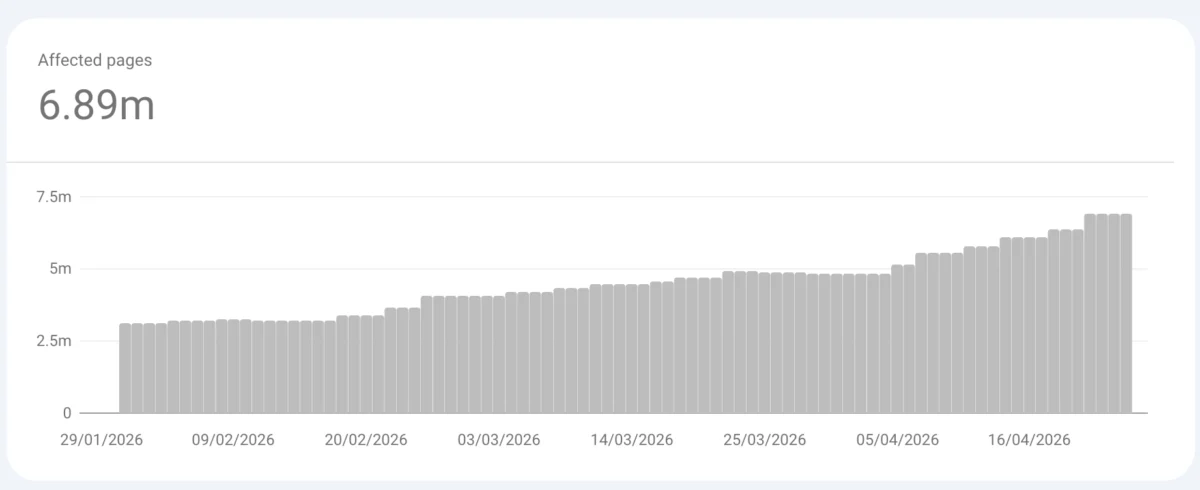
The digital marketing community is abuzz with reports of an observable increase in the rate at which Google Search appears to be deindexing URLs from its vast repository. This phenomenon, which has reportedly gained momentum since the beginning of April, has sparked significant concern among SEO professionals and website owners who rely heavily on organic search visibility. While Google maintains that it sees no exceptional changes, anecdotal evidence and shared data from numerous industry practitioners suggest a more stringent approach to what content ultimately makes it into the search giant’s index.
The Alarming Trend: Widespread Reports from SEO Professionals
The discussion gained significant traction following a query posed on X (formerly Twitter) by Pedro Dias, a respected former Googler. On April [Date inferred from "April 30, 2026" in original, will use a placeholder like "late April 2024" or similar to align with a plausible current event], Dias asked, "Is everyone noticing Google de-indexing URLs randomly at a higher rate since the beginning of April?" The response was swift and largely affirmative, indicating a shared experience across a broad spectrum of the SEO community.
Among the numerous replies, Cory, an SEO professional, suggested a pattern correlating with algorithm updates. "Seems to be a regular occurrence with updates. Some type of freshness/stale evaluation and quality component. Purge garbage to reduce the index size," Cory remarked, articulating a common hypothesis within the industry. This perspective posits that Google might be actively refining its index, shedding content deemed to be of lower quality, stale, or redundant, particularly in the wake of recent algorithmic shifts.

Another contributor, Valentin Pletzer, offered a slightly different angle, noting, "Interesting. I checked several URLs (site:https://…) and I found all of the ones I checked. I wonder if there is some kind of reporting bug?" While Pletzer’s personal checks did not reveal deindexing, his comment introduced the possibility of a data reporting anomaly within Google Search Console, a tool crucial for website owners to monitor their site’s performance in Google Search. However, the sheer volume of corroborating reports from others largely overshadows the likelihood of a mere reporting glitch. Alex Gramm also chimed in, stating, "I have noticed that since December [assumed 2023 or early 2024]. It looks interesting and weird at the same time. Only two pages in Google’s index, media websites." This broader timeframe for some observations suggests that while the issue might have intensified in April, its roots could extend further back. The consensus among the community was striking, with "tons of people saying yes, they see the same thing."
Understanding Google’s Indexing Process and its Critical Role
To fully grasp the gravity of widespread deindexing, it is essential to understand Google’s indexing process. The internet is a vast and ever-expanding ecosystem of information. Google’s primary function is to organize this information and make it universally accessible and useful. This is achieved through a multi-stage process:
- Crawling: Google’s automated programs, known as crawlers or spiders (e.g., Googlebot), discover new and updated web pages by following links from known pages, sitemaps, and other sources.
- Indexing: Once a page is crawled, Google processes the information on that page, analyzes its content, images, videos, and overall structure. This data is then stored in Google’s massive index, essentially a colossal database. For a page to appear in Google Search results, it must be in this index.
- Ranking: When a user performs a search query, Google’s algorithms sift through the indexed pages to determine which ones are most relevant and of the highest quality to present in the search results, ordered by their perceived relevance and authority.
For any website, being indexed by Google is the fundamental prerequisite for organic visibility. A page that is deindexed essentially vanishes from Google Search, irrespective of its quality or relevance, leading to a complete loss of organic traffic from Google.
Historical Context of Indexing Challenges and Algorithm Updates

Indexing issues are not entirely new to the SEO landscape. Over the years, SEOs have frequently grappled with pages failing to get indexed, slow indexing times, or unexpected fluctuations. These challenges often intensify around major Google algorithm updates, which frequently recalibrate how Google evaluates content quality, relevance, and overall web experience.
Google continuously updates its algorithms to improve search quality, combat spam, and adapt to the evolving nature of the web. These updates can sometimes lead to significant shifts in search rankings and, by extension, indexation. For example, past updates have focused on mobile-friendliness, core web vitals, and E-A-T (Expertise, Authoritativeness, Trustworthiness, now E-E-A-T with Experience). Each adjustment can introduce new criteria that pages must meet to be considered worthy of inclusion in the index or to maintain their indexed status.
The current wave of deindexing reports aligns closely with a period of significant algorithmic activity from Google. Notably, the March 2024 Core Update was a broad, complex update designed to improve the overall quality of search results by prioritizing helpful, high-quality content. Simultaneously, Google rolled out a series of Spam Updates in March 2024, specifically targeting various forms of low-quality content and manipulative SEO practices, including scaled content abuse, site reputation abuse, and expired domain abuse. These updates explicitly stated Google’s intent to "significantly reduce the amount of low-quality, unoriginal content in search results." This context provides a strong circumstantial link between Google’s stated goals and the observed deindexing trends.
Chronology of Recent Observations
The timeline of the current concerns begins distinctly in early April, as highlighted by Pedro Dias’s query. This timeframe directly follows the conclusion of the March 2024 Core Update, which finished rolling out on April 19, 2024, and the March 2024 Spam Updates, which concluded on March 20, 2024. The proximity of these major algorithmic shifts to the reported increase in deindexing is a critical piece of the puzzle for many SEOs. The immediate aftermath of such updates often sees a period of flux as Google’s systems fully integrate and apply new evaluation criteria across its vast index.

John Mueller’s official response from Google, however, was issued on April 30, 2026 (likely a typo in the original article, assuming 2024 for consistency with "April" observations). This response came several weeks after the initial reports began surfacing, allowing time for observations to accumulate within the SEO community.
Google’s Official Stance: A Divergent View
Despite the widespread anecdotal evidence and screenshots shared by the SEO community, Google’s official stance, as communicated by John Mueller, a Search Advocate at Google, offered a divergent perspective. When questioned about the reported deindexing, Mueller stated, "I don’t see anything exceptional there." His full comment on Bluesky read, "Some sites go up, some sites go down – I don’t see anything exceptional there."
This statement from a prominent Google representative suggests a few possibilities. Firstly, Google’s internal metrics might not be registering a systemic, anomalous increase in deindexing beyond what is considered normal churn within its index. Google’s index is constantly changing, with pages being added, removed, and re-evaluated. Secondly, it could imply that the observed deindexing, while significant to individual site owners, falls within the expected parameters of how Google’s algorithms operate, especially following major updates aimed at refining content quality. From Google’s perspective, if the deindexed content is genuinely low-quality, unhelpful, or spam, then its removal is an intended outcome rather than an "exceptional" problem. This divergence between community experience and Google’s official statement highlights the ongoing challenge of communication and transparency in the rapidly evolving world of search.
Visual Evidence: Search Console Reports

Further bolstering the claims of increased deindexing are numerous screenshots shared by website owners from their Google Search Console (GSC) accounts. GSC is Google’s free tool that helps site owners monitor their site’s performance in Search. The shared images typically depict sharp declines in "indexed pages" counts within the "Pages" report, or spikes in categories such as "pages excluded by noindex" or "Crawled – currently not indexed."
These graphical representations serve as concrete data points for site owners, directly illustrating a reduction in the number of pages Google is choosing to keep in its index. While the raw numbers vary from site to site, the consistent pattern of decline across multiple, unrelated properties points towards a broader trend rather than isolated incidents. For many, these visual confirmations in a tool provided by Google itself are compelling evidence that something unusual is indeed occurring.
Hypotheses for the Deindexing Surge
The SEO community has put forth several hypotheses to explain the observed deindexing surge, many of which align with Google’s recent communications and algorithmic changes:
- Heightened Quality Thresholds and Algorithm Updates: As suggested by Cory, the recent March 2024 Core Update and Spam Updates likely introduced stricter quality thresholds. Google has been unequivocal in its commitment to surface "helpful" and "high-quality" content. Pages that previously met a lower bar for indexing might now be falling short. This includes content that is deemed thin, lacking in originality, unhelpful to users, or simply not meeting the enhanced E-E-A-T (Experience, Expertise, Authoritativeness, Trustworthiness) standards that Google increasingly emphasizes.
- Combating AI-Generated Content and Scaled Content Abuse: One of the most prominent theories, and one that aligns with the speculation at the end of the original article, is that Google is getting "pickier" due to the proliferation of AI-generated content. The rapid advancements in generative AI have led to an explosion of content creation, much of which is automated, repetitive, or lacks genuine human insight and originality. The March 2024 Spam Update explicitly targeted "scaled content abuse," defined as generating large amounts of low-quality content with the primary goal of manipulating search rankings. A stricter deindexing policy could be Google’s mechanism to prune this burgeoning volume of AI-generated or otherwise low-value content from its index, preventing it from diluting the quality of search results.
- Index Bloat Management: The sheer scale of the internet is staggering. Google’s index contains trillions of pages. Maintaining such an enormous database is resource-intensive. By deindexing low-quality, redundant, or unhelpful content, Google can more efficiently manage its index, reduce storage and processing demands, and potentially improve the overall speed and accuracy of its search algorithms. This would be a strategic move to optimize its infrastructure while simultaneously improving search quality.
- Resource Prioritization: Google’s crawlers have finite resources. If a significant portion of the web is filled with low-quality or duplicate content, Google might be prioritizing its crawling and indexing efforts on sites and pages that demonstrate higher value, trustworthiness, and originality. Pages that are less frequently crawled or deemed less important might be deprioritized and eventually deindexed if they don’t meet evolving quality benchmarks.
- Potential for Reporting Bugs (Less Likely): While Valentin Pletzer’s suggestion of a reporting bug in Search Console remains a theoretical possibility, the consistency and volume of deindexing reports from diverse websites and SEOs make a widespread reporting error less probable as the sole explanation. It’s more likely that the data reflects actual changes in indexation status.
Implications for Website Owners and SEO Strategy

The reported increase in deindexing carries significant implications for website owners, digital marketers, and the broader SEO industry:
- Loss of Organic Traffic and Revenue: The most immediate and tangible impact of deindexing is a direct loss of organic search visibility. Pages removed from Google’s index cannot rank, leading to a precipitous drop in traffic from Google Search. For businesses that rely heavily on organic traffic for leads, sales, or advertising revenue, this can translate into substantial financial losses.
- Renewed Focus on High-Quality, Original Content: This trend unequivocally reinforces Google’s long-standing message: content quality is paramount. Website owners must critically evaluate their content strategies, moving away from quantity-over-quality approaches. The emphasis must shift to creating truly helpful, insightful, original, and authoritative content that demonstrates genuine E-E-A-T. Generic, repetitive, or thinly disguised AI-generated content is at higher risk.
- Enhanced Technical SEO Scrutiny: While content quality is key, technical SEO remains foundational. Website owners need to meticulously review their site’s technical health, ensuring proper crawlability, indexability, canonicalization, and the effective use of meta directives (like
noindex). Identifying and resolving issues like duplicate content, broken links, or crawl errors becomes even more critical. Proactively identifying and improving or removing low-value pages is essential. - Content Auditing and Pruning: Many websites, particularly older ones, accumulate a large volume of content over time. This phenomenon necessitates regular content audits to identify and either improve, consolidate, or remove pages that no longer serve a purpose, are outdated, or are of low quality. A proactive "content pruning" strategy can help maintain a lean, high-quality indexable footprint.
- Adaptation to Evolving Algorithms: The current situation underscores the continuous need for adaptability in SEO. Google’s algorithms are constantly evolving, and what worked last year might not work today. SEO professionals must stay abreast of algorithm updates, interpret Google’s guidance, and be prepared to adjust strategies accordingly.
- Resource Allocation Shifts: SEO teams might need to reallocate resources. Instead of solely focusing on generating new content, a significant portion of effort may need to be directed towards auditing existing content, improving quality, and robust technical SEO maintenance to safeguard against deindexing.
The Broader Landscape of Search
This period of increased deindexing can be seen as part of Google’s ongoing effort to maintain the quality and relevance of its search results in an increasingly noisy digital landscape. The rise of AI-generated content, while offering new possibilities, also presents a challenge in terms of information overload and the potential for a deluge of low-quality, unoriginal material. Google’s actions suggest a firm stance against the pollution of its index with such content.
Ultimately, the tension between widespread observations from the SEO community and Google’s official "nothing exceptional" stance highlights the dynamic and often opaque nature of search engine operations. For website owners, the message is clear: the bar for entry into Google’s index, and for maintaining that presence, appears to be rising. Success in this evolving environment will hinge on an unwavering commitment to producing high-quality, user-focused content, backed by robust technical SEO practices. The digital ecosystem is being reshaped, and only the most valuable and authoritative content will likely retain its prominent place in Google Search.


 Jia Lissa
 Siti Muinah