
 rifanmuazin
In the increasingly competitive digital landscape, capturing audience attention and building a robust email list has become a cornerstone of sustainable business growth. A compelling lead magnet is not merely an optional extra but a critical strategic asset, transforming passive website visitors into engaged prospects. Data consistently shows that a basic sign-up form with no incentive converts at approximately 2%, a figure that dramatically leaps to an average of 6.5% with the introduction of a lead magnet. This represents a staggering 325% increase in subscribers, marking the fundamental difference between incremental list growth and a dynamic, continuously expanding audience base.
Many small businesses mistakenly believe that creating an effective lead magnet necessitates the arduous task of writing an entire ebook. This perception is a significant barrier to implementation. In reality, a lead magnet encompasses anything of sufficient value that a visitor is willing to exchange their email address for it. This can range from a simple discount or a practical checklist to a useful template, personalized quiz results, or even a free trial. The format itself is less critical than its relevance and utility; the most effective offer is precisely what a business’s specific audience will genuinely find valuable and readily use. The strategic challenge, therefore, shifts from whether to use a lead magnet to which format will best serve the business’s objectives and resonate most powerfully with its target demographic. This article delves into the diverse landscape of lead magnet formats, dissecting their effectiveness and outlining best practices for implementation.
The Strategic Imperative of Email Marketing and Lead Generation
In an era dominated by fluctuating social media algorithms and ever-increasing advertising costs, email marketing remains one of the most reliable and highest-ROI channels for businesses. Unlike rented audiences on social platforms, an email list is a proprietary asset, allowing direct, unmediated communication with interested individuals. However, the challenge lies in effectively building this list amidst digital clutter. Lead magnets serve as the primary engine for inbound lead generation, offering a clear value exchange that entices visitors to opt-in. They are foundational to modern marketing funnels, guiding prospects from initial awareness to deeper engagement and eventual conversion. By providing immediate, tangible value, lead magnets establish trust and initiate a relationship, setting the stage for future nurturing and sales. This strategic approach contrasts sharply with traditional outbound methods, empowering businesses to attract rather than interrupt their ideal customers.
Defining Effectiveness: The "Little Miracle" Principle
An effective lead magnet distinguishes itself by delivering value almost instantaneously upon subscription. The benefit should be accessible and actionable in the immediate session, not deferred to a later time when the subscriber might "get around to it." Author and AWeber customer Alexandra Franzen eloquently frames the goal of every email interaction as "delivering a little miracle to their inbox." This insightful perspective provides a robust test for any potential lead magnet: can a subscriber utilize this offer within the next 30 minutes? Does it directly address a specific problem they are currently trying to solve? If the answer is affirmative, the lead magnet holds significant promise. Conversely, if the offer demands a substantial time commitment that the subscriber likely doesn’t have, a re-evaluation of its format and immediate utility is warranted. The psychological impact of immediate gratification fosters positive sentiment and significantly increases the likelihood of future engagement with subsequent email communications.
Categorizing Lead Magnets by Value Delivery and User Intent
The diverse range of lead magnets can be broadly categorized based on their primary mode of value delivery and the immediate intent of the subscriber. Prioritizing formats that offer quicker utility often correlates with higher welcome email engagement rates.
I. High-Impact, Instant-Value Offers
These formats are designed for rapid conversion, particularly appealing to audiences where price or immediate access is a key decision factor. They require minimal consumption effort from the subscriber.
-
Discounts and Coupons:
- Who this works for: E-commerce businesses, retailers, restaurants, and service providers with fixed-price offerings.
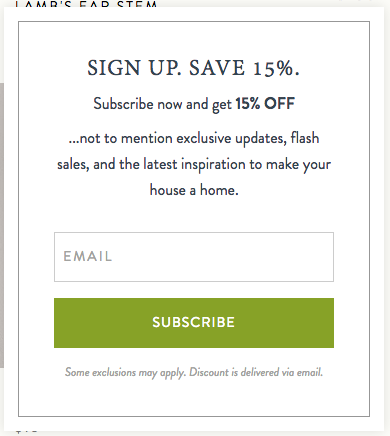
- Mechanism: A direct financial incentive, such as "Get 15% off your first order when you join our list," provides immediate, measurable value. The subscriber receives a benefit usable right away, and the business gains an email address linked to clear purchase intent. This leverages the psychological principles of urgency and perceived savings.
- Why it works: The value is concrete, universally understood, and instantly redeemable. There is no cognitive load or time delay between subscribing and receiving the benefit, leading to high conversion rates, often exceeding 10-15% for well-placed offers. For instance, a local coffee shop offering a free drink or a clothing retailer providing 20% off a first purchase capitalizes on the moment of highest intent, converting visitors who are already considering a purchase.
-
Giveaways and Contests:
- Who this works for: Retail, e-commerce, consumer brands, and local businesses aiming for rapid audience growth.
- Mechanism: Subscribers enter to win a prize by providing their email address, often with bonus entries for social sharing. This format can rapidly expand a list, particularly when amplified through social media. However, careful prize selection is crucial; the prize should appeal specifically to the ideal customer, ensuring lead quality. A general prize might attract many entrants but few qualified prospects.
- Why it works: The sharing mechanism fosters organic reach, creating viral potential. A thoughtfully designed giveaway can generate significant list growth in a short period. For example, a fitness studio offering a free month of classes or a home goods brand giving away a product bundle ensures that entrants are already interested in the core offering, thus qualifying them as valuable leads. Industry data suggests contest conversion rates can range from 20-35% with effective promotion.
-
Free Trials and Demos:
- Who this works for: SaaS businesses, subscription products, and service businesses with clearly defined scopes of work.
- Mechanism: The product or service itself serves as the lead magnet. Subscribers don’t download a document; they directly experience the offering. For software and subscription services, a trial subscriber is significantly more likely to convert into a paying customer than a cold lead who simply downloaded an informational asset.
- Why it works: This strategy demonstrates high confidence in the product, building trust. The barrier to entry is low, allowing prospects to assess value firsthand. A project management tool offering a 14-day free trial or a marketing consultant providing a free 30-minute strategy call captures leads already expressing genuine interest, moving them further down the sales funnel.
II. Actionable Resources for Immediate Application
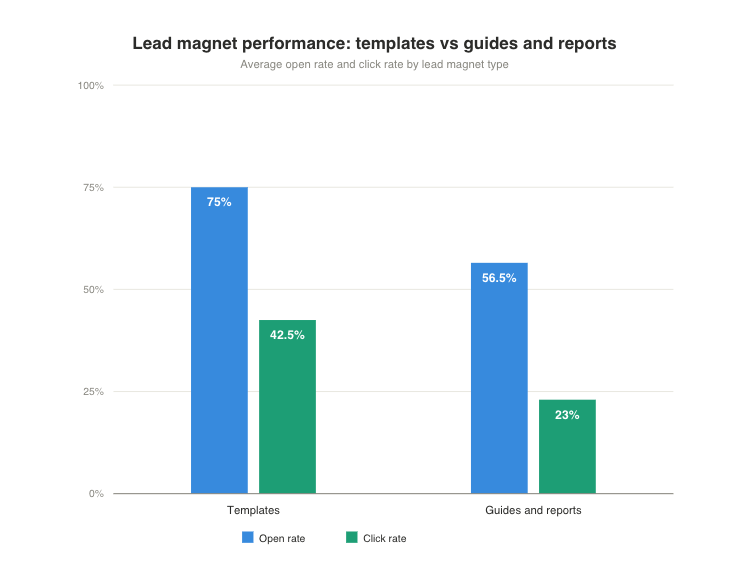
These formats provide tangible tools or information that subscribers can immediately put into practice, often outperforming purely knowledge-based content in initial engagement. AWeber’s internal data, spanning over 42,000 welcome email sends, highlights this trend: template-based lead magnets averaged a 75% open rate and a 42.5% click rate, significantly higher than the 56.5% open rate and 23% click rate observed for guides and reports.
-
Templates:
- Who this works for: Any business whose audience needs help with specific tasks: writing, planning, organizing, designing, or presenting.
- Mechanism: Subscribers download a pre-formatted structure designed for immediate use. The welcome email becomes a direct fulfillment of an immediate need.
- Why it works: Templates save time and effort. AWeber’s own email marketing planning template achieved a 76% open rate and 47% click rate across 3,000+ sends, while their 45-email templates offer saw 74% opens and 38% clicks across 28,700+ sends. The perceived value of saving 20 minutes on an existing task often outweighs that of a lengthy guide. Examples include a social media manager offering caption templates, a financial coach providing a budget spreadsheet, or a wedding photographer sharing a shot list template.
-
Checklists and Cheat Sheets:
- Who this works for: Nearly all small business categories, including coaches, consultants, service providers, retailers, health and wellness practitioners, and home services.
- Mechanism: These concise, one-page documents simplify complex processes into actionable steps. They act as decision-support tools, removing the need for subscribers to make numerous independent choices.
- Why it works: They offer immediate utility and demonstrate expertise without requiring extensive reading. Each item on the list reinforces the provider’s understanding of the subscriber’s situation. Examples include "10 things to check before launching a website," "What to do the week before an event," or "The questions to ask when hiring a photographer"—all simple, specific, and instantly useful.
-
Workbooks and Worksheets:
- Who this works for: Coaches, educators, consultants, health and wellness businesses, or anyone guiding subscribers through a process or decision-making journey.
- Mechanism: Workbooks are essentially expanded checklists with prompts, providing a structured space for subscribers to actively engage with a framework. This active participation leads to deeper learning and retention than passive reading.
- Why it works: An 8-10 page PDF guiding a planning exercise can be created relatively quickly and delivers structured thinking typically found in paid coaching sessions. Examples include a business coach’s 90-day goal-setting workbook, a therapist’s weekly check-in worksheet, or a nutritionist’s meal planning workbook.
-
Resource Lists and Toolkits:
- Who this works for: Coaches, consultants, educators, service providers, and bloggers whose audiences are seeking tools, resources, or services.
- Mechanism: A curated list of recommended resources saves subscribers the time and effort of conducting their own research. The value lies in the curation and the expertise behind the selection. Focus on quality and specificity over sheer quantity.
- Why it works: Specificity drives value. A generic "marketing tools" list is easily ignored, but "The seven tools I use to run my one-person consulting business" is highly shareable and establishes authority. Examples include "The apps every bakery owner should know," "My go-to vendors for event planning," or "The exact tools I use to run a remote team of five."
III. Engaging Formats for Deeper Relationship Building
These formats require a greater time investment from the subscriber but foster a more profound relationship, often leading to increased trust and commitment.
-
Quizzes and Assessments:
- Who this works for: Coaches, consultants, educators, health and wellness businesses, and service providers where the optimal solution depends on the subscriber’s specific situation.
- Mechanism: Quizzes promise personalization, offering results tailored to individual answers. This immediate, customized feedback is highly engaging. Crucially, assessments also provide invaluable segmentation data from the moment of opt-in, allowing for hyper-targeted follow-up.
- Why it works: The promise of personalized insight makes the opt-in prompt highly compelling, leading to conversion rates between 20% and 40%, depending on the perceived personalization. Examples include a financial coach’s "What’s your money personality?" quiz, a personal trainer’s "What’s your fitness starting point?" assessment, or a marketing consultant’s "Which content type fits your business?" quiz.
-
Challenges:
- Who this works for: Fitness, wellness, productivity, creative, education, and any business focused on behavior change.
- Mechanism: A multi-day commitment (e.g., a 5-day writing challenge, a 7-day meal prep challenge, a 30-day fitness habit). Subscribers consciously opt into a structured, time-bound experience. This filters for highly motivated individuals.
- Why it works: Challenges generate both list growth and social proof, as participants often share their progress publicly. Each daily email builds rapport and establishes the business as an authority. Examples include a yoga instructor’s 7-day morning movement challenge or a copywriter’s 5-day email writing challenge, both building relationships before any direct offer is made.
-
Mini-Courses Delivered by Email:
- Who this works for: Educators, coaches, consultants, or anyone teaching a skill or methodology.
- Mechanism: A multi-day email sequence, where each email delivers a bite-sized lesson. This format doubles as a nurture sequence, setting engagement expectations from the outset.
- Why it works: It transforms passive subscribers into active learners. By the end of the course, participants have invested time in consuming the content and are more likely to trust the provider and take the next step. Each lesson provides a compelling reason to open the next email, fostering consistent engagement. Examples include a business coach’s "5 days to your first paying client" or a graphic designer’s "Learn Canva in 5 emails."
IV. In-Depth Knowledge for Informed Decision-Making
These formats are best suited for audiences in a research phase, evaluating complex options, or requiring extensive context before making a significant decision.
- Guides, Reports, and Ebooks:
- Who this works for: Businesses targeting subscribers in research mode, B2B audiences, or industries with high-consideration purchases where extensive knowledge is required.
- Mechanism: These are the most traditional and common lead magnet formats but often not the fastest-converting. AWeber’s data for a small business email marketing report (4,900+ sends) showed a 54% open rate and 21% click rate, while a landing page guide (5,100+ sends) achieved 59% opens and 25% clicks. This suggests a lower sense of urgency; subscribers often intend to "get to it later."
- Why it works: A guide is effective when it contains unique data, proprietary frameworks, or information genuinely unavailable elsewhere. Specificity and depth are crucial to prevent it from becoming a forgotten bookmark. Examples include a recruiting firm’s "The 2026 Salary Guide for Tech Roles" or an accountant’s "The Small Business Tax Prep Checklist," both offering substantial, specialized information.
Architecting Your Lead Magnet Delivery: A Technical Overview

Regardless of the chosen format, the delivery mechanism for a lead magnet typically follows a consistent, automated workflow. Platforms like AWeber allow businesses to build and manage this process without requiring advanced coding knowledge.
- Build Your Landing Page: This dedicated web page is where visitors will encounter your offer and complete the sign-up form. Its design should be focused: one clear offer, one compelling headline, one simple form, and one primary call to action. Minimize distractions to maximize conversion.
- Create Your Sign-Up Form: The form is the gateway. Best practice dictates asking only for an email address unless additional information is absolutely essential for segmentation or personalization. Each additional field can significantly reduce conversion rates. Crucially, configure the form to automatically tag new subscribers based on which lead magnet they opted into. This tag is vital for subsequent segmentation and personalized communication.
- Apply Tags for Segmentation: The tags assigned at sign-up are critical for routing subscribers into appropriate follow-up sequences. A subscriber who downloaded a "beginner’s checklist" should receive different nurturing content than one who opted for an "advanced course." Email marketing platforms often provide visual workflow automations to easily build these segmented paths without complex technical setup.
- Set Up Your Welcome Email Automation: The moment a subscriber opts in, an automated welcome email is triggered, delivering the lead magnet. For PDFs, link directly to the file. For discount codes, embed them directly in the email body. For challenges or mini-courses, this initial email serves as "Day One" of the sequence. This entire setup can often be completed in under 20 minutes and then runs automatically, ensuring immediate value delivery.
The Anatomy of a High-Converting Lead Magnet
While conversion rates for lead magnets can fluctuate between 5% and 35%, this variance is rarely due to luck. High-performing lead magnets consistently share several key characteristics:
- Solve One Specific Problem: General advice rarely resonates. A lead magnet like "10 Marketing Tips" is a topic, but "5-Minute Email Template That Books Discovery Calls" is a concrete solution to a specific problem. Specificity makes the offer immediately relevant and compelling.
- Demonstrate Your Unique Process: The most effective lead magnets offer a glimpse into your unique methodology or framework. A template built around your proprietary system or a checklist reflecting your expert thought process provides a taste of working with you, building trust and differentiation.
- Require Minimal Time Investment: The faster a subscriber can derive value, the more likely they are to open the welcome email, utilize the offer, and trust subsequent communications. For many audiences, a one-page checklist will outperform a 20-page guide due to its immediate usability.
- Match Your Paid Offering’s Value Level: The lead magnet should align with the perceived value of your paid products or services. A $5,000 consulting service requires a more substantial and sophisticated lead magnet than a $29 online course. A mismatch can create doubt rather than build trust.
- Target Audience Relevance: Deeply understanding your ideal customer’s pain points, aspirations, and current stage in their buying journey is paramount. A lead magnet must directly address these needs to be truly effective, ensuring that you attract the right subscribers, not just any subscribers.
Strategic Selection: Choosing the Optimal Lead Magnet
The ultimate goal in selecting a lead magnet is not merely to maximize sign-up volume but to attract subscribers who are most likely to convert into paying customers. This requires a strategic approach:
- Solve One Specific Problem: Reiterate the importance of hyper-focus. A lead magnet attempting to appeal to everyone helps no one. "Email marketing for small businesses" is a broad topic; "A checklist for writing your first welcome email" is a specific, actionable lead magnet.
- Match the Format to Subscriber Intent: Consider what the subscriber is trying to accomplish right now. Someone preparing to launch a product needs a checklist or template. Someone evaluating whether to hire a coach might benefit from an assessment. A new visitor looking to save money needs a discount code. The format must logically follow the user’s immediate intent.
- Build for Immediate Use, Not Eventual Learning: Prioritize offers that deliver value within the first 30 minutes of subscription. Templates, checklists, workbooks, and discount codes all satisfy an immediate need, leading to higher welcome email click rates and fostering early engagement. Lengthy guides and courses, while valuable, often require a time commitment that busy subscribers rarely have readily available.
- Use Your Lead Magnet as a Segmentation Signal: Leverage the choice of lead magnet as powerful data. Tagging subscribers based on the specific offer they chose provides insight into their immediate interests and pain points. This enables highly personalized follow-up content, moving beyond generic broadcasts and significantly improving the relevance and effectiveness of your email campaigns. For instance, a subscriber who downloads a "website launch checklist" can be nurtured with content related to website development, hosting, or SEO, while someone who opts for a "social media content calendar" would receive different, tailored information.
- Consider A/B Testing: Don’t assume one lead magnet will work for all segments or perpetually. Regularly A/B test different formats, headlines, and calls to action to optimize performance and identify what resonates most effectively with your evolving audience.
Frequently Asked Questions
-
What is the best lead magnet for a service business?
For service businesses, a checklist or an assessment typically serves as the strongest starting point. An offer like "10 questions to ask before hiring a [type of provider]" not only positions your business as an expert but also provides immediate utility to the subscriber. It acts as a pre-qualification tool; someone downloading a hiring checklist is actively seeking the service you provide. Ebooks often underperform for service businesses because the purchasing decision is fundamentally relationship-based, requiring trust and expertise demonstration, rather than solely information-based.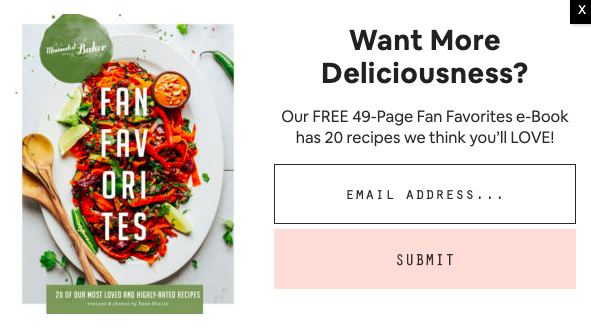
-
What is the best lead magnet for an e-commerce business?
For e-commerce, a discount or a first-purchase offer is generally the highest-converting lead magnet. Its value is immediate, concrete, and requires no reading or complex engagement from the subscriber. They save money on something they are already considering buying. While effective for immediate conversion, it’s crucial to pair this offer with a short, engaging welcome sequence that introduces your brand story, product benefits, and unique selling propositions to build loyalty beyond just discount-motivated purchases. -
Should I use one lead magnet or multiple?
It’s advisable to start with a single, well-matched lead magnet. This approach yields cleaner data, simplifies delivery, and allows you to validate its effectiveness. Once you’ve confirmed that the initial offer converts well and attracts the desired audience behavior, you can strategically introduce additional offers targeting different segments of your audience or distinct stages of their buyer’s journey. When running multiple lead magnets, always ensure subscribers are tagged according to the offer they chose, enabling highly personalized and relevant follow-up content. -
Does a discount count as a lead magnet?
Absolutely. A discount, a free shipping offer, or a first-purchase incentive functions precisely as a lead magnet. It facilitates the exchange of tangible value for an email address, just like a checklist or a template. For e-commerce and retail businesses, such offers frequently outperform content-based lead magnets due to their immediate and concrete value proposition. -
What is the difference between a lead magnet and an opt-in incentive?
There is no substantive difference; the terms "lead magnet," "opt-in incentive," "content upgrade," and "sign-up offer" are often used interchangeably to describe the same fundamental exchange: a business provides something of value, and in return, the visitor provides their email address. The format, quality, and strategic alignment of the offer are far more significant than the specific terminology used.
In conclusion, lead magnets are far more than mere freebies; they are sophisticated tools for strategic growth, customer qualification, and relationship cultivation. By understanding the diverse range of formats, prioritizing immediate value delivery, and meticulously aligning the offer with audience intent, businesses can transform their email list building efforts from a slow trickle into a powerful current. The ongoing commitment to delivering "little miracles" to the inbox, coupled with robust automation and intelligent segmentation, ensures that each new subscriber represents not just a number, but a genuine opportunity for sustained engagement and long-term success.









