
 rifanmuazin
The marketing technology landscape is currently experiencing a significant shift, driven by businesses seeking more transparent, user-friendly, and cost-effective solutions. While platforms like Dotdigital have long served as robust marketing automation tools for mid-market to enterprise B2C brands, their inherent complexity, opaque pricing structures, and perceived customer support challenges are prompting a growing number of organizations to explore alternatives. This comprehensive analysis delves into the reasons behind this migration and evaluates a range of competitors tailored for various business sizes and strategic objectives.
The Evolving MarTech Landscape and Dotdigital’s Position
For years, Dotdigital has been recognized for its powerful cross-channel marketing automation capabilities, strong data management features, and deep CRM integrations. It has effectively positioned itself as a sophisticated platform for larger B2C entities requiring extensive customization and high-volume campaign management. However, the rapid evolution of the MarTech sector has introduced a plethora of agile, specialized, and often more accessible tools. This has created a competitive environment where ease of use, predictable costs, and responsive support are increasingly prioritized, especially by growing businesses and those with lean marketing teams.
Industry analysts observe that the demand for marketing automation has never been higher, with a projected market size exceeding $14.1 billion by 2026. This growth is fueled by businesses striving to personalize customer experiences, optimize conversion funnels, and build stronger brand loyalty across multiple touchpoints. However, the very tools designed to achieve these goals can become a hindrance if they are overly complicated or financially unpredictable.
Key Drivers Behind the Search for Dotdigital Alternatives

Despite Dotdigital’s comprehensive feature set, user feedback consistently highlights several recurring pain points that compel teams to seek different solutions. These frustrations are not unique to Dotdigital but are indicative of broader challenges faced by enterprise-level software in an increasingly agile business environment.
-
Pricing Opacity: A primary concern for many potential and existing users is Dotdigital’s lack of publicly disclosed pricing. Unlike many modern SaaS platforms that offer tiered pricing readily available on their websites, Dotdigital requires businesses to request a personalized quote. This process can be time-consuming and creates uncertainty, making it difficult for teams to budget effectively or compare costs swiftly. Trustpilot reviews, for instance, include accounts of prospective clients struggling to obtain pricing information for over a week, highlighting a significant barrier to entry and a source of frustration for those accustomed to immediate transparency. Market analysts suggest that opaque pricing models deter potential clients, particularly small to medium-sized enterprises (SMEs), who value predictability and ease in financial planning.
-
Steep Learning Curve and Technical Demands: Dotdigital’s extensive capabilities, while powerful, often come with a significant learning curve. The platform can be challenging to navigate without dedicated technical expertise, prompting smaller teams or those without in-house developers to seek more intuitive alternatives. Reviewers on platforms like Capterra have noted difficulties in setting up integrations without relying heavily on APIs, contrasting with other platforms offering more streamlined, user-friendly integration processes. Similarly, G2 users have described specific functionalities, such as SMS program options, as "very intricate and confusing to set up." This complexity means that beyond the software cost, businesses must factor in additional investments in training, specialized personnel, or agency support, which can inflate the total cost of ownership considerably. Industry reports indicate that ease of adoption and implementation is a critical factor for SMEs in selecting MarTech solutions, as resources for extensive training are often limited.

-
Customer Support Quality: User experiences regarding Dotdigital’s customer support have also been a point of contention. Several Trustpilot reviews describe slow response times, a lack of urgency, and limited flexibility from support teams. Instances of "vague email replies" and an unwillingness to engage in direct phone conversations have been reported, even when users are attempting to expand their accounts. Such issues can significantly impact operational continuity, especially when technical problems arise, forcing users to independently find solutions after prolonged waits. Customer experience experts emphasize that responsive and proactive support is paramount for modern businesses, as it directly impacts productivity and user satisfaction.
A Side-by-Side Analysis of Leading Dotdigital Alternatives
To address these challenges, businesses are increasingly turning to a diverse ecosystem of marketing automation platforms. The following section provides a detailed comparison of eight leading alternatives, evaluated based on their features, pricing, ease of use, and ideal fit for various business models. This analysis draws from hands-on testing and aggregation of user sentiment across prominent review platforms.
1. Omnisend: The Ecommerce Powerhouse
- G2 Rating: 4.6/5
- Best for: Ecommerce businesses
- Pricing: Free plan available; paid plans start at $16/month.
- Overview: Omnisend is purpose-built for e-commerce, integrating email, SMS marketing, and push notifications into a unified platform. Its key differentiator lies in its revenue-driven automations, such as pre-built abandoned cart, welcome series, and post-purchase flows, which are designed to be easily deployed without extensive technical knowledge. Its seamless integrations with major e-commerce platforms like Shopify and WooCommerce, alongside robust segmentation based on purchase history and browsing behavior, make it an attractive option for online retailers seeking direct impact on sales. Industry experts frequently highlight Omnisend’s deep integration capabilities and focus on e-commerce-specific workflows as a major draw for online retailers looking for efficiency and measurable ROI.
- Comparison to Dotdigital: Omnisend offers significantly easier setup for e-commerce-specific automations, which in Dotdigital often require considerable technical configuration. For brands prioritizing predictable costs and automations directly linked to store data, Omnisend presents a more agile and cost-effective alternative.
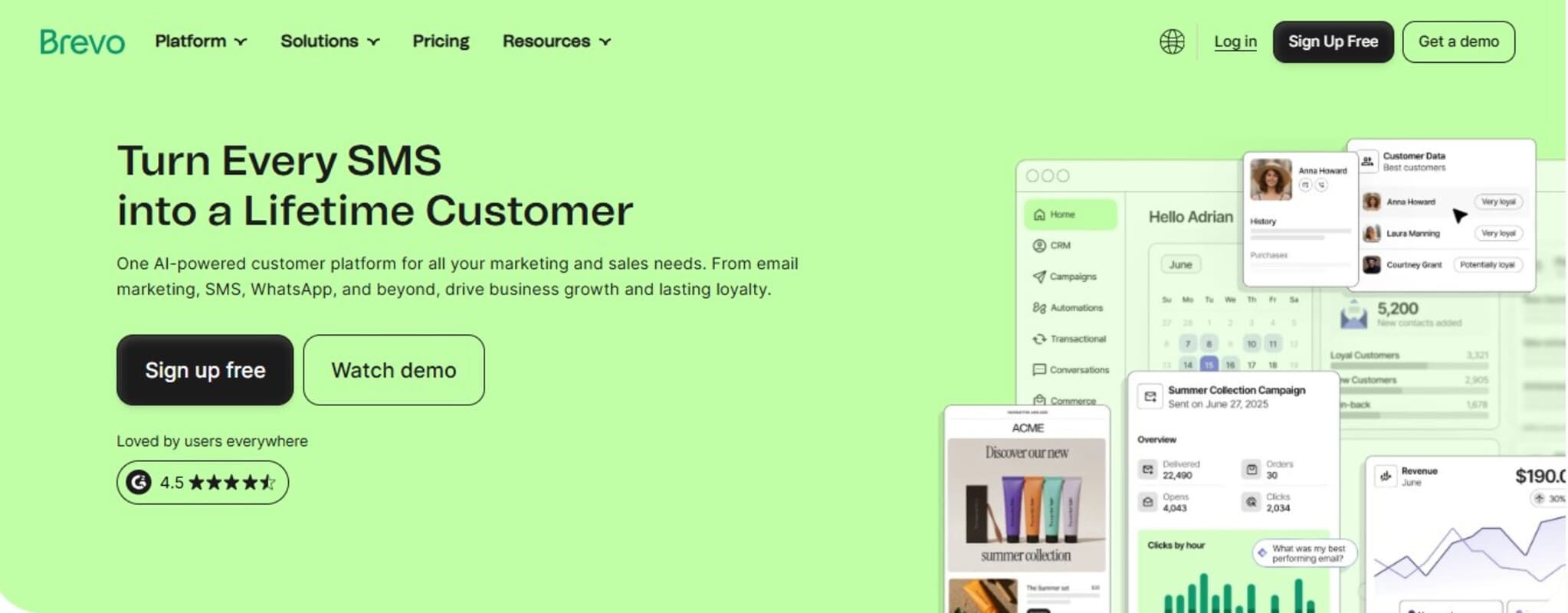
2. Brevo (formerly Sendinblue): Integrated Contact Management with CRM
- G2 Rating: 4.5/5
- Best for: Contact management with CRM
- Pricing: Free plan available; paid plans start at $9/month.
- Overview: Brevo stands out for its comprehensive multichannel marketing capabilities combined with a built-in CRM. It supports email, SMS, WhatsApp, and live chat, making it suitable for teams that need to align sales pipeline tracking with marketing efforts. Its drag-and-drop marketing automation builder is praised for its ability to create workflows geared towards specific business goals, from engagement to revenue generation. The integrated CRM facilitates advanced segmentation, even on its free tier, offering considerable value.
- Comparison to Dotdigital: Brevo offers a comparable suite of email marketing features at a generally lower and more transparent price point, appealing to businesses seeking cheaper alternatives without sacrificing core functionalities. However, its SMS pricing can vary by country and message volume, which is a consideration for heavy SMS users.
3. Mailchimp: The Entry Point for Email Marketing Beginners
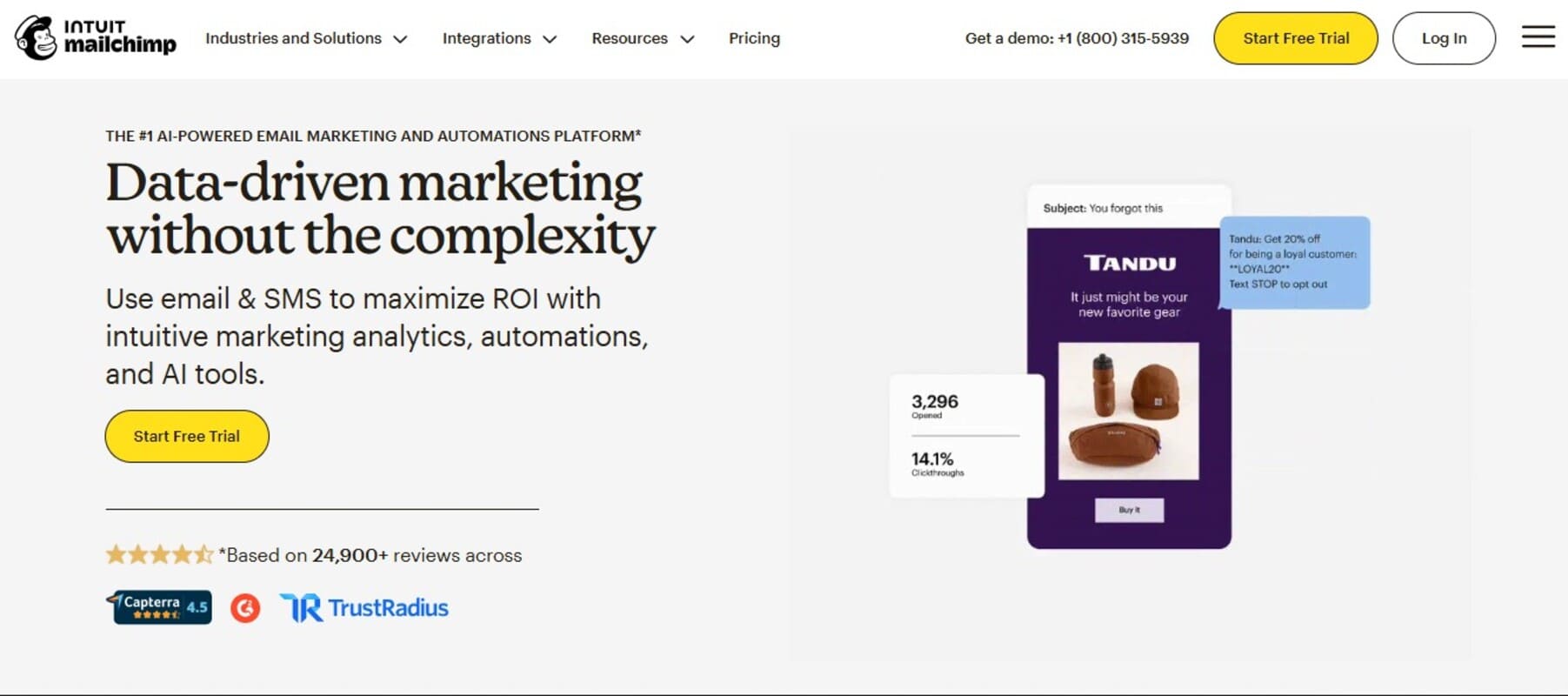
- G2 Rating: 4.3/5
- Best for: Email marketing beginners
- Pricing: Free plan available; paid plans start at $13/month.
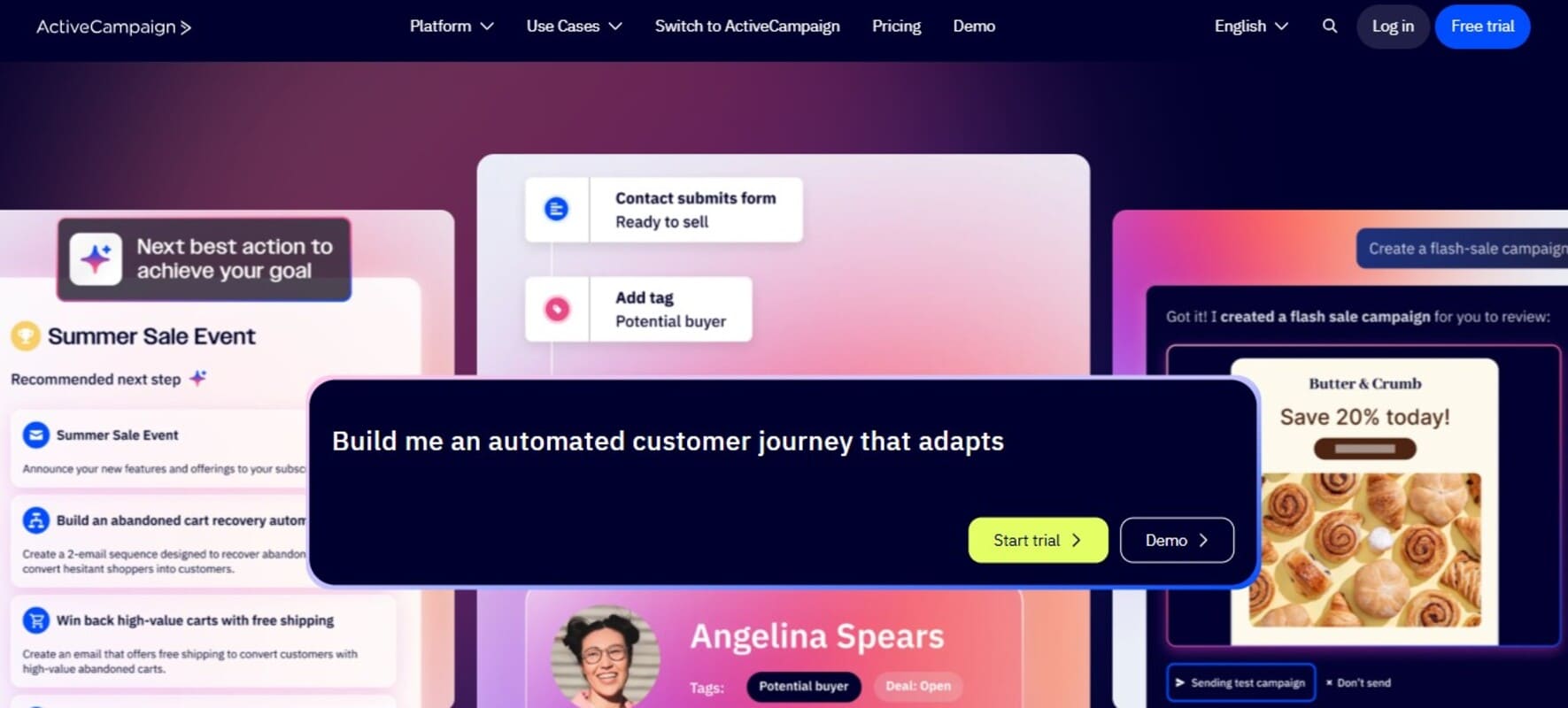
- Overview: Mailchimp is renowned for its user-friendly interface and efficient onboarding process, making it an ideal choice for businesses new to email marketing. It provides a wide array of modern email templates and integrates with platforms like Shopify. While excellent for foundational email campaigns, its advanced segmentation and automation features are less robust compared to enterprise-grade platforms.
- Comparison to Dotdigital: Mailchimp’s free plan, while generous for basic email, lacks marketing automation, a core strength of Dotdigital. It is not designed for the complex workflows that Dotdigital users typically rely on, making it more suitable for businesses taking their first steps in email marketing rather than migrating from a sophisticated platform.
4. MailerLite: Streamlined for Small Businesses
- G2 Rating: 4.6/5
- Best for: Small businesses and creators
- Pricing: Free plan available; paid plans start at $10/month for 500 contacts.
- Overview: MailerLite offers a budget-friendly email marketing solution with a clean interface, perfect for small businesses and independent creators. Beyond essential email automation and campaign tools, it uniquely includes a website builder, which can be beneficial for creating simple online stores. Its dashboard provides immediate, intuitive access to all features, simplifying campaign setup.
- Comparison to Dotdigital: MailerLite’s transparent and cost-effective pricing stands in stark contrast to Dotdigital’s opaque model. Its ease of use is a significant advantage, removing the need for external support during setup. However, MailerLite’s marketing automation is less advanced, with limitations in features like branching logic and conditional filters, which are standard in Dotdigital’s higher tiers.
5. HubSpot Marketing Hub: The All-in-One Enterprise Solution
- G2 Rating: 4.4/5
- Best for: Large businesses needing a comprehensive marketing tool
- Pricing: Free plan available; paid plans start at $15/month (Starter tier).
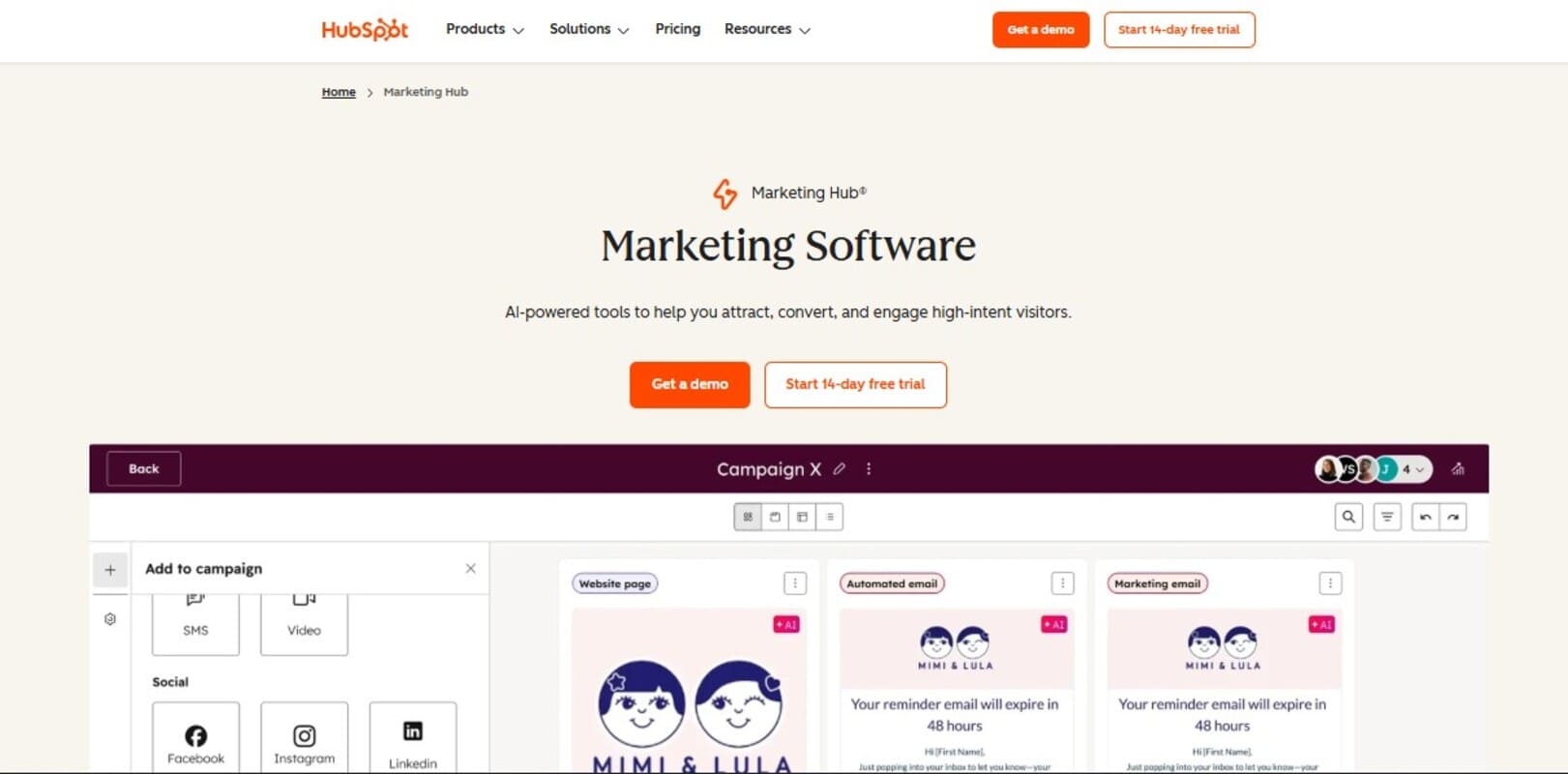
- Overview: HubSpot Marketing Hub is a sprawling, all-in-one platform designed primarily for enterprises and B2B companies. It encompasses email, advertising, landing pages, SEO, social media management, and analytics, all integrated with the HubSpot CRM. This platform is ideal for organizations seeking a unified stack to manage marketing, sales, and customer service. Its capabilities are extensive, yet the dashboard remains organized, offering quick guides for swift onboarding.
- Comparison to Dotdigital: HubSpot goes significantly beyond Dotdigital’s focus on cross-channel marketing automation, incorporating social media advertising, SEO tools, content management, and account-based marketing natively. For B2B teams or larger organizations requiring a genuinely unified marketing, sales, and service ecosystem, HubSpot’s breadth of features provides considerable value.
6. ActiveCampaign: Advanced Automation for B2B and B2C
- G2 Rating: 4.4/5
- Best for: Both B2B and B2C businesses
- Pricing: 14-day free trial; paid plans start at $15/month (billed annually).
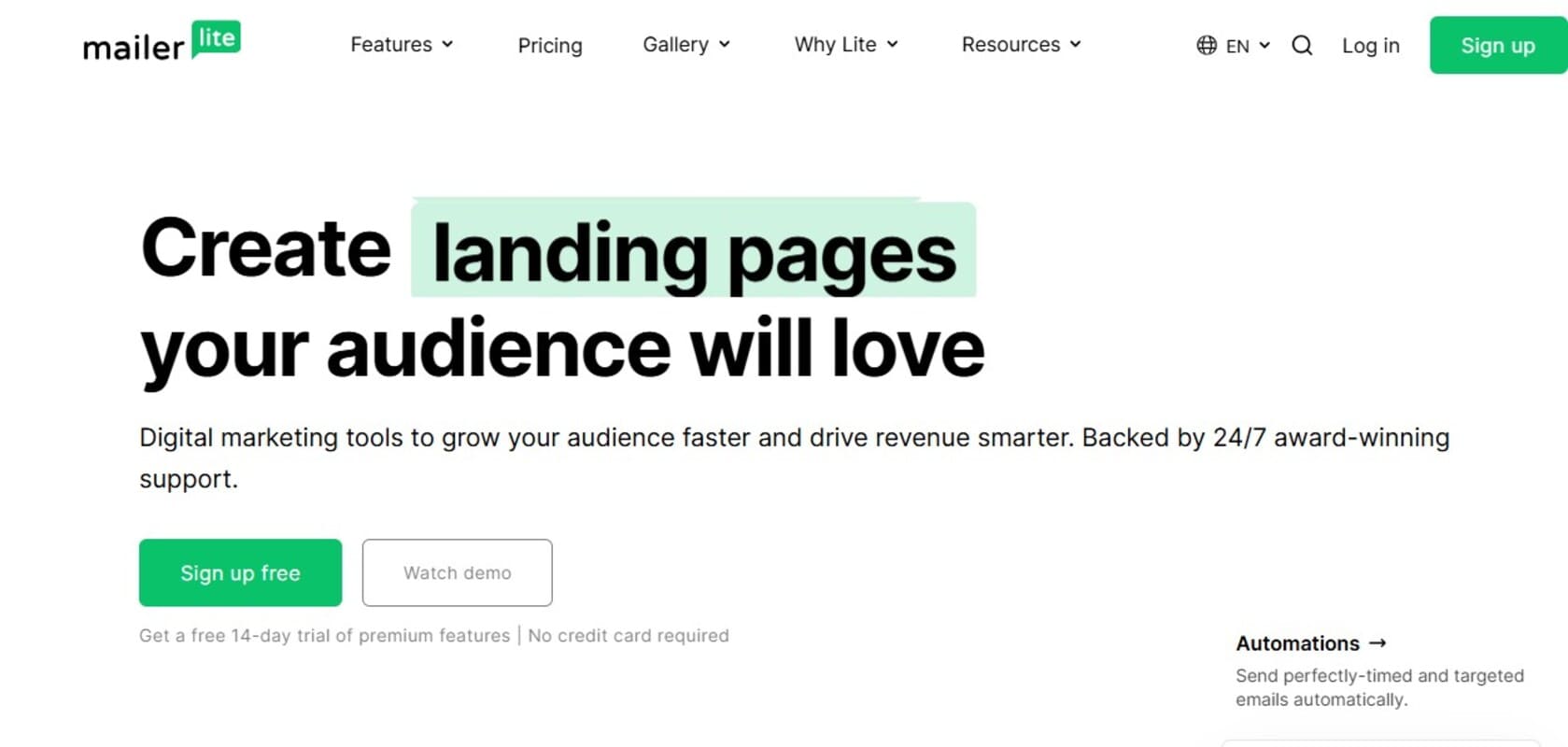
- Overview: ActiveCampaign excels in customer lifecycle marketing, offering advanced automation, segmentation, and CRM tools to personalize experiences across the entire customer journey. It supports sophisticated workflows combining email, SMS, and WhatsApp, allowing for split and conditional triggers based on granular customer behavior and preferences. While it requires an investment of time to master, its robust features deliver powerful customization.
- Comparison to Dotdigital: Both platforms offer email and SMS automation, but ActiveCampaign extends its capabilities to include sales and e-commerce automation directly. It also provides an integrated CRM, reducing the reliance on separate CRM integrations that Dotdigital often necessitates, offering a more consolidated approach for many businesses.
7. EmailOctopus: For Personalized Email Campaigns on a Budget
- G2 Rating: 4.2/5
- Best for: Personalized email marketing
- Pricing: Free plan available; Pro plan starts at $10/month for 500 subscribers.
- Overview: EmailOctopus is a powerful yet affordable email marketing platform focusing on essential email functionality. It does not offer the breadth of channels like SMS or live chat found in other alternatives, making it best suited for startups, creators, and small businesses that primarily need strong email campaign management. Its quick setup, drag-and-drop builder, and template library allow for rapid campaign deployment.
- Comparison to Dotdigital: EmailOctopus is significantly lighter and easier to manage than Dotdigital, making it a better fit for teams that do not require enterprise-level features or extensive cross-channel automation. However, it cannot match Dotdigital’s deep data integrations or its comprehensive multichannel capabilities.
8. Constant Contact: The User-Friendly Interface Champion
- G2 Rating: 4.2/5
- Best for: User-friendly interface, small businesses
- Pricing: 14-day free trial; paid plans start at $12/month.
- Overview: Constant Contact is a well-established email marketing platform celebrated for its exceptional ease of use. It is a popular choice for small businesses and individuals with limited technical expertise, thanks to its intuitive interface and hundreds of pre-designed email templates covering various needs from sales to holiday promotions. The platform also offers SMS, social media, and event marketing features.
- Comparison to Dotdigital: Constant Contact directly addresses Dotdigital’s challenges of complexity and onboarding friction. It offers a minimal learning curve, negating the need for agency or developer support during setup. However, it lacks the advanced segmentation, multivariate testing, and complex marketing operations features found in Dotdigital, making it more suitable for businesses prioritizing simplicity over deep functionality.
Strategic Considerations for Marketing Technology Decisions
The divergence in user experience and feature sets among these platforms underscores a critical trend in the MarTech industry: the move towards solutions that balance power with usability and cost-effectiveness. The "right" platform is increasingly defined by a business’s specific stage of growth, operational complexity, budget constraints, and in-house technical capabilities.
- For Enterprise Teams: Platforms like Dotdigital and HubSpot Marketing Hub remain highly relevant for large organizations with substantial budgets, dedicated technical teams, and complex, multi-faceted marketing operations that demand extensive customization and deep data integration.
- For E-commerce Businesses: Specialized platforms like Omnisend offer a compelling alternative by providing tailored automations and integrations that directly impact online sales, often with a clearer ROI and more predictable pricing.
- For Small to Mid-Sized Businesses (SMBs) and Startups: The market has seen a surge in user-friendly and affordable options such as MailerLite, Mailchimp, Constant Contact, and EmailOctopus. These tools democratize marketing automation, allowing smaller teams to execute sophisticated campaigns without the overhead of enterprise software.
- For Businesses Needing Integrated CRM and Advanced Automation: Brevo and ActiveCampaign present robust solutions that bridge marketing and sales, offering comprehensive customer lifecycle management and sophisticated workflow builders.
Implications for the Marketing Technology Sector
The ongoing evaluation of platforms like Dotdigital and the increasing adoption of its alternatives highlight several key implications for the broader marketing technology sector:
- Demand for Transparency: Opaque pricing models are becoming less tenable in a market that values transparency and predictable budgeting. Vendors that clearly outline costs and feature tiers are gaining a competitive edge.
- Prioritization of Usability: The emphasis on intuitive interfaces and reduced learning curves reflects a shift towards empowering marketing teams to manage campaigns independently, minimizing reliance on IT departments or external agencies.
- Specialization vs. Generalization: While all-in-one platforms appeal to some, there is a strong demand for specialized solutions that deeply cater to specific industries (e.g., e-commerce) or functional needs (e.g., email-only).
- Customer Support as a Differentiator: In an increasingly crowded market, exceptional and responsive customer support is no longer a luxury but a fundamental expectation, playing a crucial role in user retention and satisfaction.
- Integration Ecosystems: The ability of platforms to seamlessly integrate with other critical business tools (CRMs, e-commerce platforms, analytics dashboards) is paramount, creating a cohesive and efficient operational environment.
Conclusion: Making an Informed Decision
Choosing the optimal marketing automation platform requires careful consideration of a business’s unique needs, resources, and strategic goals. While Dotdigital offers immense power for large, technically proficient enterprises, the market now provides a wealth of agile, cost-effective, and user-friendly alternatives.
Businesses are advised to conduct thorough due diligence, leveraging free trials and comprehensive feature comparisons to align platform capabilities with their specific marketing objectives. For e-commerce businesses, Omnisend consistently emerges as a strong contender, offering built-in email and SMS marketing, pre-built, revenue-driving automations, and advanced segmentation tailored specifically for online stores. Reports indicate that brands leveraging such specialized e-commerce platforms often achieve impressive results, with some generating an average ROI of $79 for every dollar spent, underscoring the value of a well-matched marketing technology stack. The shift towards more accessible, transparent, and user-centric solutions is not merely a trend but a fundamental recalibration of expectations within the marketing technology landscape.









