rifanmuazin
Trust is the bedrock of every business-to-business transaction, and its importance has reached unprecedented levels. New research from LinkedIn underscores this, with a staggering 94% of marketers acknowledging trust as the linchpin of B2B success. As purchasing decisions progress from initial interest to firm commitment, the question of trust intensifies. Buyers begin to scrutinize the reliability of guidance offered, demand concrete evidence to support claims, and increasingly consider their own accountability once a choice is made. This evolving landscape necessitates a strategic shift in how B2B brands build and maintain credibility throughout the entire customer journey.
This exploration into the dynamics of B2B trust builds upon foundational principles. Previous analyses have delved into understanding the core challenges and objectives of B2B buyers, and how integrated marketing strategies can foster consistent brand presence across the complex buyer’s journey. This segment specifically addresses the critical juncture where buyers determine which voices and information sources to believe. The brands that excel in this arena understand that trust is not a static achievement but rather a continuous process, deliberately nurtured and reinforced during pivotal moments that shape decisions.
The escalating complexity of B2B marketing, characterized by extended sales cycles and an ever-expanding array of communication channels, amplifies the pressure to earn and sustain buyer confidence. This is not due to a sudden surge in buyer concern for trust, but rather because marketers have fewer opportunities to rectify missteps when confidence erodes. When a buyer’s trust falters, the window for recovery narrows considerably.
The State of B2B Thought Leadership in 2026: A Practitioner’s Perspective
The report, Answer Engine: The State of B2B Thought Leadership in 2026, offers a practitioner-centric view of this paradigm shift. It illuminates how marketing teams are adapting their strategies in response to heightened buyer scrutiny and increasingly fragmented purchasing journeys. The findings reveal a significant disconnect between the recognized importance of thought leadership and its consistent application across the full marketing funnel.

Marketers Adapt to Heightened Scrutiny and Evolving Buyer Expectations
The report’s insights highlight a strategic recalibration by marketers to navigate an environment where credibility must withstand rigorous evaluation across the pre-decision, decision, and post-sale phases. A near-universal consensus exists among respondents, with 97% asserting that thought leadership is indispensable for achieving full-funnel success. However, a concerning trend emerges: fewer than half of these marketers consistently extend their thought leadership efforts beyond the initial acquisition stage into the later phases of the buyer’s journey, where reassurance and reinforcement are paramount.
This strategic gap becomes particularly evident as B2B marketing programs mature. A substantial one-third of marketers cite limited visibility into funnel performance as a primary impediment to their success. Another third points to an over-reliance on a limited set of communication channels. These constraints collectively hinder the ability of brands to sustain a cohesive narrative over time and to convincingly demonstrate that the guidance provided remains steadfast as buyers move closer to making significant commitments.
Where Trust Fractures in the B2B Buying Journey
The fragmentation of the buyer’s journey, coupled with increased scrutiny, creates critical points where trust can break down. Traditional B2B marketing often focuses heavily on top-of-funnel awareness and lead generation, leaving a void in the middle and bottom of the funnel where complex decisions are made and justifications are required. This is particularly true in industries with long sales cycles, such as enterprise software, financial services, or industrial manufacturing, where buyers may spend months or even years researching and evaluating solutions.
Consider the typical B2B buyer today. They are likely well-informed, having access to a vast amount of information online. They are also risk-averse, understanding that a poor decision can have significant financial and operational consequences for their organization. Consequently, they are looking for partners, not just vendors. They seek assurance that a company not only offers a superior product or service but also possesses deep expertise, a reliable track record, and a commitment to their long-term success.

The report’s findings suggest that while marketers recognize the importance of thought leadership, their execution often falls short in addressing these deeper buyer needs. The pressure to demonstrate ROI can lead to a short-term focus, prioritizing activities that generate immediate leads over those that build enduring trust. This can result in a scenario where a prospect is impressed by initial marketing content but becomes hesitant when faced with the need for detailed validation or ongoing support during critical evaluation phases.
High-Performing Teams Cultivate Trust Proactively
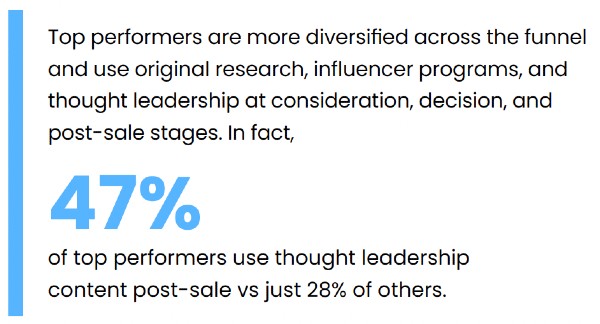
In contrast to their less successful counterparts, high-performing B2B teams proactively reinforce trust at multiple touchpoints throughout the buyer’s journey, rather than treating it as a one-time acquisition. The research indicates a significant correlation between high marketing ROI and the strategic deployment of thought leadership during decision-making and post-sale stages. Specifically, 47% of high-ROI marketers extend thought leadership into post-sale engagement, compared to only 28% of lower-performing peers. This consistent pattern suggests a deliberate effort to solidify buyer confidence not only before the deal is signed but also afterward, when proof points and ongoing support remain crucial.
This extended engagement post-sale is a critical differentiator. It transforms a transactional relationship into a partnership. For instance, a software company that provides ongoing educational content, best practice guides, and access to user communities after a client signs a contract not only helps that client achieve optimal results but also reinforces their decision and builds loyalty. This can lead to valuable testimonials, case studies, and referrals, creating a virtuous cycle of trust and growth.
The implications of this finding are profound. It suggests that the most successful B2B marketers understand that the buyer’s journey does not end at the point of sale. Instead, it transitions into a phase of implementation, adoption, and ongoing value realization. By continuing to provide valuable thought leadership during this phase, companies can mitigate churn, foster deeper client relationships, and ultimately drive greater long-term revenue.
The Architecture of Trust: How Leading Brands Reinforce Credibility
Leading B2B brands do not rely on serendipity to build trust; they engineer it. They understand that trust is not a passive byproduct of brand awareness but an actively constructed system. This system is reinforced with meticulous care, particularly during moments when buyers are actively evaluating options, justifying their decisions to stakeholders, or seeking validation that they have made the optimal choice. The patterns observed in the Answer Engine report, corroborated by extensive practical experience, illuminate the key strategies employed by these high-performing organizations.
Fortifying Credibility with Actionable Evidence
True credibility takes root when ideas are not merely presented but are robustly supported by evidence that buyers can readily reference and rely upon. Original research, data-driven insights, and comprehensive market analyses provide a tangible structure to thought leadership, anchoring it in something more enduring than ephemeral opinion. This bedrock of evidence empowers buyers to not only understand complex concepts but also to articulate and defend their strategic decisions internally, a critical step in many B2B procurement processes. For example, a manufacturing technology provider might publish detailed white papers on the ROI of their machinery, supported by independent testing data and case studies demonstrating efficiency gains.
Integrating Human Voices into Critical Evaluation Stages
Trust is profoundly amplified when buyers engage with authentic human voices, transcending the limitations of static brand messaging. The perspectives of recognized industry experts, satisfied customers, and trusted partners inject invaluable real-world context that cannot be replicated by content alone. The authentic voices of B2B influencers and creators offer buyers a crucial sense of whether the underlying thinking behind an idea reflects genuine experience and sound judgment. This is especially vital when buyers are rigorously testing claims, comparing competing solutions, or seeking to understand the practical implications of a proposed strategy. Imagine a financial services firm that features video testimonials from long-standing clients detailing how the firm’s advisory services have navigated market volatility, providing a level of reassurance that a corporate brochure cannot match.
Sustaining Presence Beyond the Transaction
The significance of trust does not diminish once a deal is finalized. Brands that proactively continue to offer relevant, valuable guidance after the point of sale foster a sense of ongoing support for buyers as they embark on implementation and strive to achieve desired outcomes. This sustained presence signals that the relationship extends far beyond the immediate transaction and that the trusted guidance relied upon during the evaluation phase remains pertinent and applicable throughout the client’s journey. For instance, a cybersecurity firm that provides regular threat intelligence updates and best practice recommendations to its clients post-implementation demonstrates a commitment to their ongoing security posture, reinforcing the initial trust placed in their expertise.
Minimizing Friction Through Unwavering Consistency
Consistency plays a quiet yet indispensable role in the long-term cultivation of trust. When a brand’s narrative remains coherent and unwavering across diverse channels and throughout all stages of the buyer’s journey, prospects and clients can dedicate less mental energy to reconciling conflicting messages and more to building confidence in their chosen path. A familiar and consistent narrative, delivered reliably, becomes inherently easier to trust as decisions progress towards commitment and beyond. This applies to everything from marketing messaging and sales interactions to customer support and product updates. A consistent brand voice and value proposition across all touchpoints creates a predictable and reassuring experience for the buyer.
Building a Robust Trust System: A Strategic Imperative
Trust systems are not developed instantaneously; they are meticulously constructed through repeated exposure, consistent reinforcement, and unwavering follow-through as buyers navigate the progression from initial consideration to firm commitment and subsequent engagement.
- Identify Confidence Lapses: Begin by meticulously examining the buyer’s journey to pinpoint moments where prospects or clients exhibit hesitation, pose more demanding questions, or require internal justification for their decisions. These are the critical junctures where trust requires deliberate reinforcement.
- Underpin Guidance with Evidence: Ground all advisory content in rigorous research and data-informed insights. This provides buyers with a durable foundation upon which they can rely and to which they can refer as their decision-making process unfolds.
- Incorporate Human Validation: Introduce expert perspectives, authentic customer testimonials, and valuable partner insights to provide reassurance during crucial evaluation phases and to validate the credibility of your offerings.
- Ensure Continuity Through Critical Stages: Maintain a consistent and coherent narrative that extends through the decision-making and post-sale stages. This continuity minimizes friction and reinforces buyer confidence that the guidance they initially trusted remains relevant and applicable.
- Measure Trust Holistically: Shift focus from solely measuring trust at the point of conversion. Instead, evaluate trust over time by tracking engagement metrics, continued participation, and the development of long-term relationships, which offer far more accurate indicators of genuine trust than isolated, one-time actions.
Trust: The Bridge from Clarity to Confidence
Clarity empowers buyers to comprehend their available options. Trust, however, is the catalyst that empowers them to commit. When the guidance provided withstands rigorous scrutiny, when the brand narrative remains steadfast through pivotal moments, and when credible individuals stand behind the shared ideas, buyers are equipped with the confidence necessary to move forward with conviction.
The implications for B2B marketers are clear: a strategic, long-term investment in building and nurturing trust is no longer a competitive advantage but a fundamental requirement for sustained success. This involves not only the creation of high-quality content but also a commitment to delivering that content consistently, supported by evidence, and validated by human voices, across every stage of the buyer’s journey.
For organizations seeking to deepen their understanding of these dynamics and to implement effective strategies for reinforcing trust, the report Answer Engine: The State of B2B Thought Leadership in 2026 offers comprehensive insights into how leading B2B marketers are successfully navigating these challenges and building enduring credibility during the moments that most profoundly shape buyer decisions. Furthermore, to translate these insights into actionable strategies for elevating a company to "Best Answer Brand" status, the Best Answer Marketing Playbook provides a practical roadmap for implementing these principles effectively.