
 rifanmuazin
Digital commerce has evolved from a simple presence-based economy to a high-stakes environment where the difference between a 2% and a 3% conversion rate can dictate the long-term solvency of a multi-million dollar enterprise. As customer acquisition costs (CAC) continue to climb across platforms like Meta and Google, brands are increasingly turning inward, focusing on Conversion Rate Optimization (CRO) to maximize the value of existing traffic. The SHIP model—Scrutinize, Hypothesize, Implement, and Propagate—has emerged as a foundational framework for organizations seeking to move beyond "gut-feeling" adjustments and toward a data-driven methodology that yields compound growth.
The primary challenge facing modern marketing teams is not a lack of ideas, but a lack of prioritization. Research indicates that a significant majority of A/B tests fail to produce a statistically significant lift, often because teams focus on low-impact aesthetic changes rather than systemic friction points. By implementing a rigorous optimization rhythm, companies can transform their websites from static digital brochures into dynamic, high-performing sales engines.
The SHIP Model: A Lifecycle of Continuous Optimization
Successful conversion optimization is rarely the result of a single "silver bullet" change. Instead, it follows a cyclical rhythm designed to produce both immediate revenue lifts and long-term institutional knowledge. The SHIP model provides a structured environment for this evolution.
The process begins with the Scrutinize phase, where teams gather quantitative and qualitative data to identify where and why visitors are exiting the funnel. This leads to the Hypothesize phase, where initial observations are transformed into testable theories. Following this is the Implementation phase, where A/B or multivariate tests are deployed. Finally, the Propagate phase ensures that the learnings from both winning and losing tests are shared across the organization to inform future product development and marketing strategies.
This continuous loop creates a compound effect. When a team improves the conversion rate by just 5% every month through iterative testing, the year-over-year impact results in an nearly 80% increase in total conversions.
Phase 1: The Scrutinize Methodology
The Scrutinize phase is arguably the most critical component of the SHIP model. Many marketers fall into the trap of "testing for the sake of testing," deploying changes based on trends or competitor actions. The Scrutinize phase acts as a safeguard against this inefficiency by demanding evidence-based identification of friction points.
Experts suggest viewing a website not as a collection of pages, but as a sales conversation. When a visitor fails to convert, it is an indication that the conversation has broken down. To identify the point of failure, teams must utilize two distinct data streams:
Quantitative Analysis: The "What"
Using tools like Google Analytics 4 (GA4) or Adobe Analytics, teams must pinpoint high-friction areas. Key metrics include:
- High Exit Rate Pages: Identifying where users are most likely to abandon the site.
- Funnel Drop-offs: Mapping the journey from landing page to checkout to see where the largest percentage of users disappear.
- Device-Specific Performance: Comparing conversion rates between mobile and desktop to identify technical or layout-related disparities.
Qualitative Analysis: The "Why"
While quantitative data shows where the fire is, qualitative data explains what started it. This involves:

- Heatmaps and Session Recordings: Observing how users interact with specific elements.
- User Polling and Surveys: Asking visitors directly about their hesitations or what information they found lacking.
- Usability Testing: Watching live users attempt to complete a task on the site to identify cognitive load and physical blockers.
Distinguishing Between Bugs, Usability, and Conversion Issues
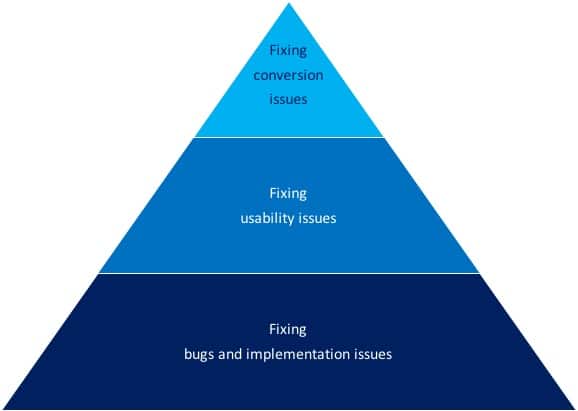
A common pitfall in the CRO industry is the conflation of user experience (UX) and conversion optimization. While they are related, they are not identical. A conversion rate audit typically uncovers three distinct categories of issues that require different responses.
Bugs are technical failures, such as a broken "Add to Cart" button or a form that fails to submit on specific browsers. These are not items for A/B testing; they are items for immediate repair. Usability issues refer to the ease of use—how intuitive the navigation is or how clearly the site architecture is laid out.
Conversion issues, however, are psychological. They relate to persuasion, trust, and motivation. A website can be perfectly functional and easy to use (high usability) but still fail to convert because it does not adequately address user fears, uncertainties, or doubts (FUDs). Every usability issue is a conversion issue, but a site free of usability issues can still suffer from poor conversion rates if the value proposition is weak or social proof is absent.
The Architecture of a Concrete Hypothesis
Once a problem is identified, the team must develop a hypothesis. The SHIP model distinguishes between an "initial hypothesis" and a "concrete hypothesis."
An initial hypothesis is a preliminary idea, such as: "Adding social proof will increase trust and conversions." While this is a good starting point, it lacks the specificity required for scientific testing.
A concrete hypothesis is a predictive statement that includes the data source, the proposed change, and the expected outcome. For example: "Based on qualitative data from exit surveys indicating users are skeptical of brand longevity, adding a ‘Trusted by 50,000+ Customers’ badge to the homepage will increase visitor trust and improve conversion rates by 10%."
A concrete hypothesis must be:
- Testable: It must be something that can be measured.
- Goal-Oriented: It must aim to solve a specific problem.
- Educational: It must provide a learning opportunity, regardless of whether the test wins or loses.
The Evolution of Prioritization Frameworks
With dozens or even hundreds of potential test ideas, teams must use a framework to decide what to build first. Several industry-standard models have paved the way for modern prioritization.
The PIE Framework
Developed by Widerfunnel, PIE stands for Potential, Importance, and Ease. It asks: How much improvement can be made on this page? How valuable is the traffic to this page? And how difficult is it to implement this test? While popular for its simplicity, PIE is often criticized for being too subjective, as "Potential" is frequently based on a marketer’s intuition rather than hard data.
The PXL Framework
Created by CXL, the PXL framework attempted to remove subjectivity by using a binary scoring system (Yes/No) across a variety of criteria. It asks specific questions: Is the change above the fold? Is it a change to copy? Is it addressing a problem found in user testing? This model forces teams to prioritize ideas that are grounded in research.

The Hotwire Framework
Introduced by Pauline Marol, this model emphasizes strategic fit. It evaluates how a test aligns with broader business objectives and the specificity of the problem. This ensures that the CRO program is not operating in a vacuum but is supporting the company’s overarching goals.
The Invesp Weighted Prioritization Model
To further refine the selection process, the Invesp framework introduces a weighted scoring system that accounts for the complexity of the digital environment. This model recognizes that a single research opportunity can be addressed through multiple hypotheses, each with different implementation costs and expected impacts.
The Invesp model evaluates items based on 11 distinct criteria, with weighted averages applied to the most critical factors. For instance, a research opportunity discovered through multiple methods (e.g., both GA4 data and user recordings) receives a higher score than one found through a single source.
The scoring also considers the type of change:
- Adding or Removing an Element: High impact (3 points).
- Replacing an Element: Moderate impact (2 points).
- Changing Location or Emphasis: Lower impact (1 point).
Furthermore, the model assigns weight to the page’s importance within the funnel. A change on the checkout page or a high-traffic landing page is automatically prioritized over a change on an "About Us" or "FAQ" page, as the former has a more direct line to revenue.

Strategic Implications and Industry Impact
The shift toward structured CRO models like SHIP reflects a broader trend in the tech industry: the move from "growth hacking" to "growth engineering." As digital markets mature, the "low-hanging fruit" of simple color changes and catchy headlines has largely been picked. Modern optimization requires a deep understanding of behavioral economics and statistical significance.
Industry leaders like Chris Goward have noted that there are no standard rules for which pages to prioritize, as every business exists in a unique competitive environment. "The priority rating you give each of your potential test pages will depend on this unique business environment," Goward states. This sentiment highlights why rigid, one-size-fits-all frameworks are being replaced by flexible, weighted models.
The long-term impact of a disciplined CRO program extends beyond the immediate lift in revenue. It fosters a culture of experimentation and data-literacy within an organization. When teams stop arguing over opinions and start looking at test results, the speed of innovation increases.
Conclusion: The Future of Conversion Science
As artificial intelligence and machine learning begin to integrate with CRO tools, the SHIP model and its associated prioritization frameworks will become even more vital. AI can help identify patterns in the "Scrutinize" phase faster than a human analyst, but the human element remains essential for crafting the "Hypothesis" and ensuring that "Propagation" aligns with the brand’s core values.
In an era where consumer attention is the most scarce resource, the ability to systematically remove friction and enhance persuasion is a significant competitive advantage. Organizations that view CRO as a core business function rather than a side project are the ones that will define the next decade of digital commerce. By moving from a "guess-and-check" approach to a rigorous, weighted prioritization model, businesses can ensure they are not just testing, but truly optimizing.








