Reynand Wu
The landscape of B2B marketing research is undergoing a significant transformation, driven by the rapid advancements in artificial intelligence. Recently, a gathering of several hundred B2B marketing leaders discussed the emerging role of AI-powered research tools, drawing clear lines on their application and posing critical questions for evaluating their trustworthiness. The prevailing sentiment suggests that the true benchmark for synthetic research isn’t its ability to replicate expensive, time-consuming traditional studies, but rather its efficacy in surpassing the often-ad-hoc, intuition-driven baselines that many marketing teams currently rely upon.
These discussions unfolded during a series of "CMO Coffee Talk" sessions, live video conversations augmented by a dynamic Zoom chat. It was within this chat, often described as the crucible of genuine interaction, that many of the most salient points emerged. The sessions delved into innovative research methodologies, including the use of synthetic respondents, AI-moderated interviews, and simulations trained on proprietary customer data.
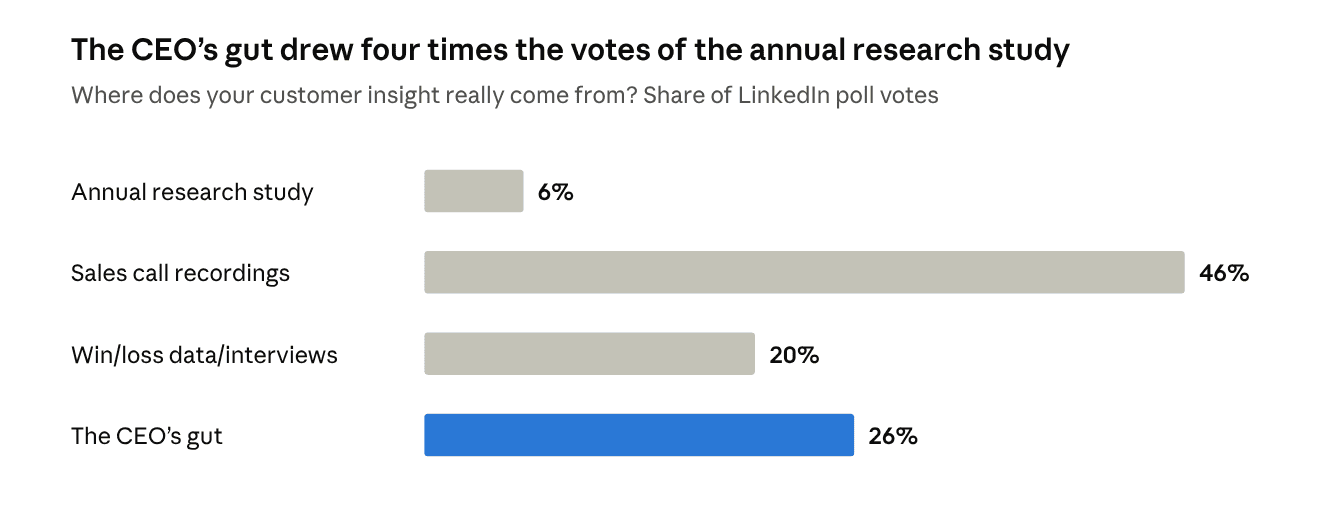
Early in these sessions, a fundamental question was posed to the assembled marketing leaders: "Where does the evidence behind your positioning and messaging decisions come from?" The responses, delivered with a blend of candor and levity, painted a vivid picture of current practices. Answers ranged from the practical ("Gong call recordings," "a survey of 300 people," "Wynter testing," "all of the above") to the humorously, yet often truthfully, relatable ("What my CEO wants"). The latter response, in particular, resonated deeply with many, highlighting the powerful influence of executive directives on strategic marketing decisions, for better or worse.
To further gauge the industry’s current research habits, a similar question was posed as a LinkedIn poll. The results mirrored the qualitative feedback from the CMO Coffee Talks, underscoring a widespread reliance on less rigorous, data-light approaches. This informal survey revealed that many B2B marketing professionals frequently base critical positioning and messaging decisions on a surprisingly small sample size – sometimes as little as a single individual’s instinct, coupled with anecdotal insights gleaned from recent sales conversations. This practice, while common, falls far short of the robust and confident insights that marketing teams aspire to achieve, insights that historically demanded significant investments in both time and financial resources, often unavailable to many organizations.
The argument is thus advanced that the appropriate metric for evaluating AI-assisted research is its ability to outperform these existing, often rudimentary, methods. For a considerable number of teams, the prospect of commissioning a comprehensive, multi-week study by a top-tier research firm has never been a realistic option. In many instances, the alternative to AI-driven insights is no research at all, leading businesses to make substantial strategic choices based on limited or entirely absent data. This reality is familiar to a broad spectrum of the B2B marketing community.
The CMOs’ Lines in the Sand: Three Critical Boundaries for AI Research
Despite the acknowledged limitations of current research practices, a degree of skepticism persists regarding the application of AI-generated insights. A common concern is that models trained exclusively on data from satisfied customers can present a skewed, overly optimistic view of the market. One CMO aptly described synthetic focus group participants as representing "next-level executive navel gazing," a sentiment that underscores the potential for AI to reinforce existing biases rather than challenge them.
However, through extensive discussion and in collaboration with the GatherHQ team, who brought valuable expertise to the sessions, the marketing leaders coalesced around three distinct and crucial boundaries for the application of AI in research:
-
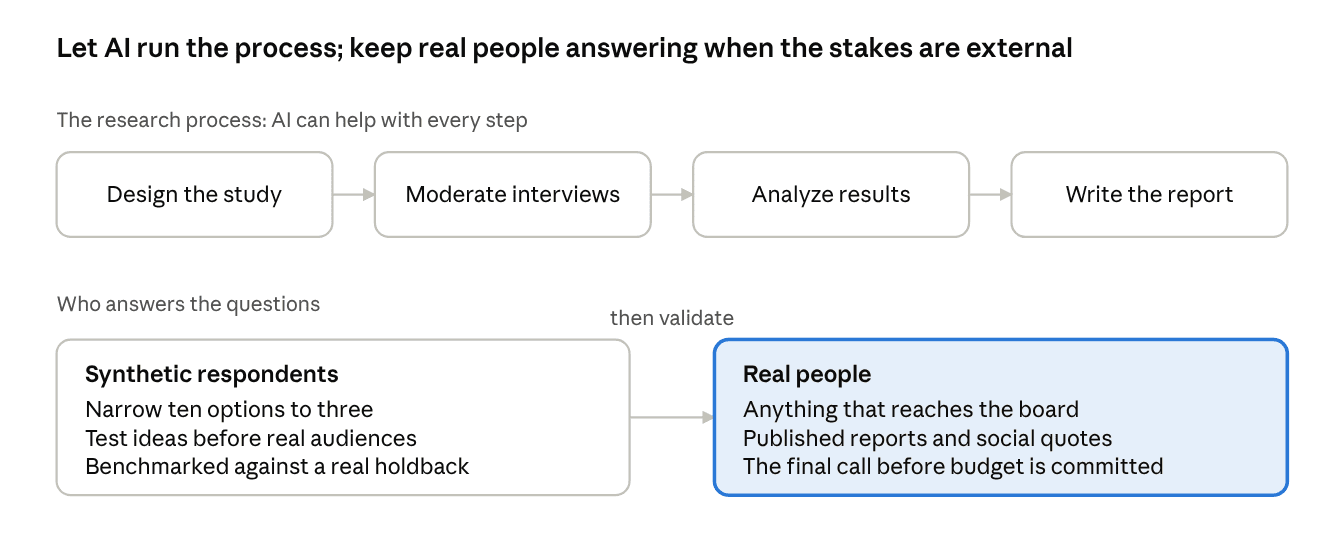
Preserve Human Respondents for High-Stakes Deliverables: For any research findings destined for presentation to the board of directors or for direct use in customer-facing communications, the integrity of human respondents must be maintained. While AI can be a powerful tool for designing studies, moderating interviews, analyzing results, and even drafting reports, the individuals providing the foundational answers should remain real people when the output is intended for executive review or direct engagement with customers.
-
Leverage Simulations for Option Refinement: Synthetic research can be highly effective in narrowing down a broad set of options. For instance, AI simulations can efficiently reduce ten potential strategic directions to a more manageable three. However, the ultimate decision-making process, particularly when significant budget allocation is involved, should still incorporate testing with actual buyers. This hybrid approach ensures that AI’s efficiency in exploration is balanced with real-world validation.
-
Exclude Synthetic Quotes from Customer-Facing Content: Every quote featured in published reports, social media collateral, or marketing materials should originate from a genuine individual. The GatherHQ team explicitly stated their policy against recommending synthetic output for customer-facing assets. This boundary emphasizes the need for authenticity and the potential reputational risks associated with misrepresenting customer sentiment through artificial quotes.
The Peril of "Garbage In, Confident Garbage Out": Data Integrity in Synthetic Research
A fundamental principle governing the effectiveness of any AI-driven research is the quality and representativeness of the data it is trained on. A synthetic persona, or any AI-generated insight, is only as reliable as the underlying data. This is precisely where a significant portion of the risk lies.
If a company’s repository of recorded customer calls predominantly features interactions with satisfied customers, the AI model will inevitably learn to reflect a market composed solely of happy clients. True representativeness, however, necessitates the inclusion of data from churned accounts, closed-lost deals, freemium users, and even individuals who have never engaged with the company’s products or services. When training AI on platforms like Gong, the model will learn from whatever data is fed into it. Therefore, ensuring comprehensive data capture, encompassing both positive and negative feedback, is paramount.
Another critical blind spot is the realm of customer behavior. Professionals with backgrounds in e-commerce have strongly argued that observable behaviors – such as performance metrics from ad campaigns, email engagement rates, clickstream data, and product usage patterns – offer far more profound insights than survey responses alone. Even subtle linguistic variations, such as the use of a period versus an exclamation point, can significantly influence survey responses. Consequently, a simulation that only models stated customer preferences while ignoring their actual behaviors is inherently incomplete and potentially misleading.
A pervasive challenge within AI research is the "loop problem." To effectively simulate a target customer profile (ICP), one must first possess a robust understanding of that ICP. However, the questions posed to such simulations risk being leading or inaccurate if they are not grounded in a comprehensive and unbiased understanding of the target audience. The most effective mitigation strategy involves anchoring simulations in verifiable behavioral data and incorporating fresh, real-world input. Furthermore, organizations must acknowledge that gaps in their understanding will likely persist and will need to be addressed through competitive intelligence and direct engagement with individuals outside their existing customer base.
Benchmarking Trust: The Critical Role of Validation
Before placing undue reliance on simulated audiences, a prudent approach involves conducting parallel studies with real participants. This "holdback" strategy allows for direct comparison between AI-generated insights and the findings from actual human feedback. Jay from GatherHQ recommended a benchmark of 85% to 90% overlap or greater between the two sets of results before considering a simulation trustworthy. He further advised the continuous execution of real research in parallel as an ongoing verification mechanism, a discipline directly borrowed from established practices in traditional statistical modeling.
It is crucial to acknowledge that even human-generated research is not infallible. A study conducted by Kantar several years ago revealed that researchers often discarded up to 38% of the data they collected due to quality concerns, including issues like survey fraud. This underscores the ongoing necessity for rigorous verification of real respondents, regardless of the research methodology employed.
Across all research vendors, whether AI-powered or traditional, three fundamental questions consistently arise:
- What is the source of the data used to train the model?
- How is the data segmented and validated for representativeness?
- What is the methodology for identifying and mitigating bias?
Obtaining written answers to these questions prior to uploading any proprietary data is a critical step in ensuring data security and research integrity.
Research as Infrastructure: Shifting from Project to Continuous Signal
The prevailing model for funding research within most organizations is project-based. This often involves commissioning an annual study, refreshing persona documents for a new product launch, or conducting a win/loss analysis sprint when sales performance declines. However, once completed, this research often languishes, becoming outdated over time without a mechanism for continuous updates or alerts. Consequently, critical decisions continue to be made based on increasingly irrelevant data.
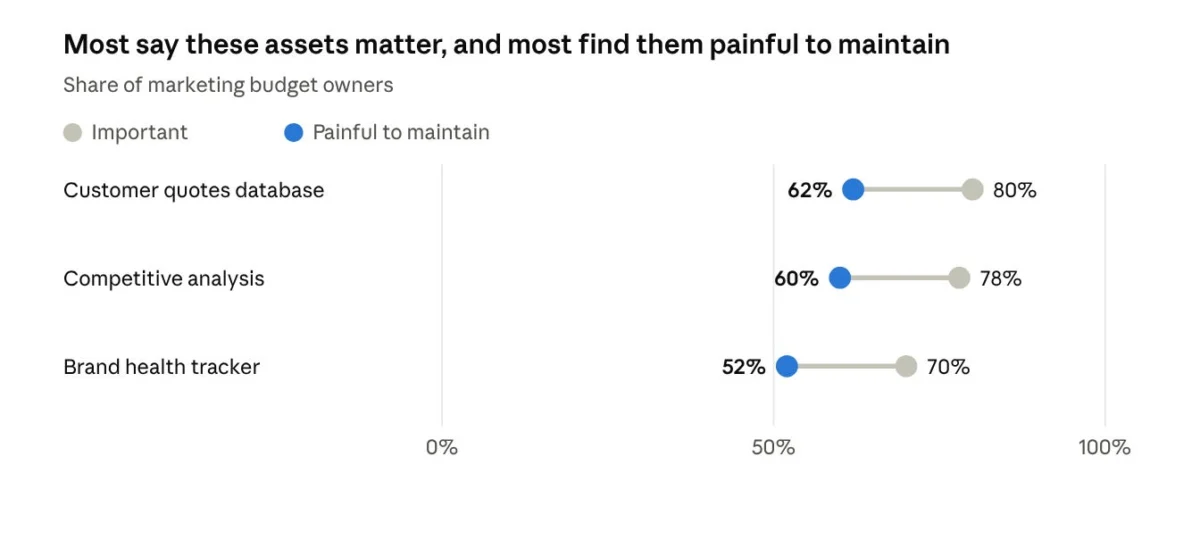
Gather’s own research indicates a significant disconnect: 80% of surveyed marketing budget owners identified a customer quotes database as important, yet 62% found it painful to maintain. This data highlights a universal understanding of the value of these assets, coupled with a persistent challenge in keeping them current. The absence of dedicated ownership, sufficient time, bandwidth, and budget frequently hinders the upkeep of these vital resources.
A similar pattern is observed in the positioning and messaging work undertaken with clients at Heinz Marketing. The initial weeks of such engagements are rarely dedicated to building entirely new frameworks; instead, they often involve the painstaking process of rebuilding and updating existing, outdated materials.
Some of the most effective strategies employed by operational leaders originate from leveraging existing data. One CMO described a practice of continuously analyzing calls from Account Executives and Customer Success Managers to maintain a dynamic ICP file. Another executive implemented a system where every customer call is summarized and logged in the CRM, with a dedicated Slack channel established for each account. This creates a continuous customer signal, forming a robust foundation upon which AI-forward research tools can build and scale.
For resource-constrained teams, this approach represents a practical and achievable starting point. The key lies in structuring existing call recordings, segmenting them deliberately to capture insights beyond those of only the most satisfied customers, and rigorously testing any analysis before acting upon it.
Mayank, a participant in an early session, concluded with a powerful statement: "Research is no longer constrained. You should be able to run as much as you need to so you can leverage customers to create better businesses."
A Practical Roadmap: Implementing AI-Forward Research
Most teams can begin by harnessing the customer signal they already possess. The challenge lies in maintaining its currency in alignment with the rapid pace of market evolution, a task where AI-forward research tools can provide significant leverage. The following five steps offer a structured approach:
- Establish a Centralized Customer Data Repository: Consolidate all customer interactions – sales calls, support tickets, product usage data, survey responses – into a single, accessible platform.
- Implement Robust Data Segmentation and Tagging: Categorize data based on customer lifecycle stage, firmographics, psychographics, sentiment, and key behavioral indicators.
- Pilot AI-Powered Analysis Tools: Experiment with AI tools for sentiment analysis, topic extraction, persona generation, and predictive modeling on your segmented data.
- Benchmark AI Insights Against Real-World Data: Conduct small-scale tests where AI findings are compared against qualitative feedback from live customer interviews or small surveys.
- Integrate AI as a Continuous Research Engine: Move beyond project-based research and establish AI-driven processes for ongoing market and customer understanding, triggering alerts for significant shifts or opportunities.
The Enduring Importance of Human Judgment
A significant concern is that teams might adopt AI as a wholesale replacement for critical thinking, rather than as a powerful collaborative partner. While a simulation can effectively identify the three most promising messages for testing, it cannot definitively dictate which message the company should ultimately champion. Crucially, the AI will not be present in the room when the board inquires about the origin of strategic numbers or projections. This ultimate judgment call, along with the associated accountability, remains firmly within the purview of human leadership. The human element of interpretation, strategic context, and ethical consideration is irreplaceable.


 Jia Lissa
 Basiran