Dwi Wanna
The competitive landscape of email marketing platforms (ESPs) continues to evolve, with businesses increasingly relying on sophisticated tools to drive engagement and revenue. A comprehensive, in-depth evaluation conducted between October and November 2026 has shed light on the comparative strengths of two industry giants, Klaviyo and Mailchimp, offering critical insights for businesses navigating their marketing technology choices. This rigorous assessment, part of a scored ESP comparison series by a competing platform (Omnisend), utilized a standardized testing methodology designed to minimize bias, ensuring a factual and objective analysis of each platform’s capabilities.
Executive Summary: Key Findings from the 2026 Evaluation

The recent review concluded that Klaviyo demonstrably outperforms Mailchimp for e-commerce businesses, particularly those operating on Shopify and dependent on automated email flows triggered by customer behavior like orders and abandoned checkouts. Klaviyo secured victory in 10 out of 15 direct comparisons, showcasing superior Shopify data synchronization and support quality. Conversely, Mailchimp emerged as the more suitable option for larger businesses managing 10,000 or more contacts and primarily focused on sending regular email campaigns, largely due to its competitive pricing at higher contact tiers and faster campaign build times.
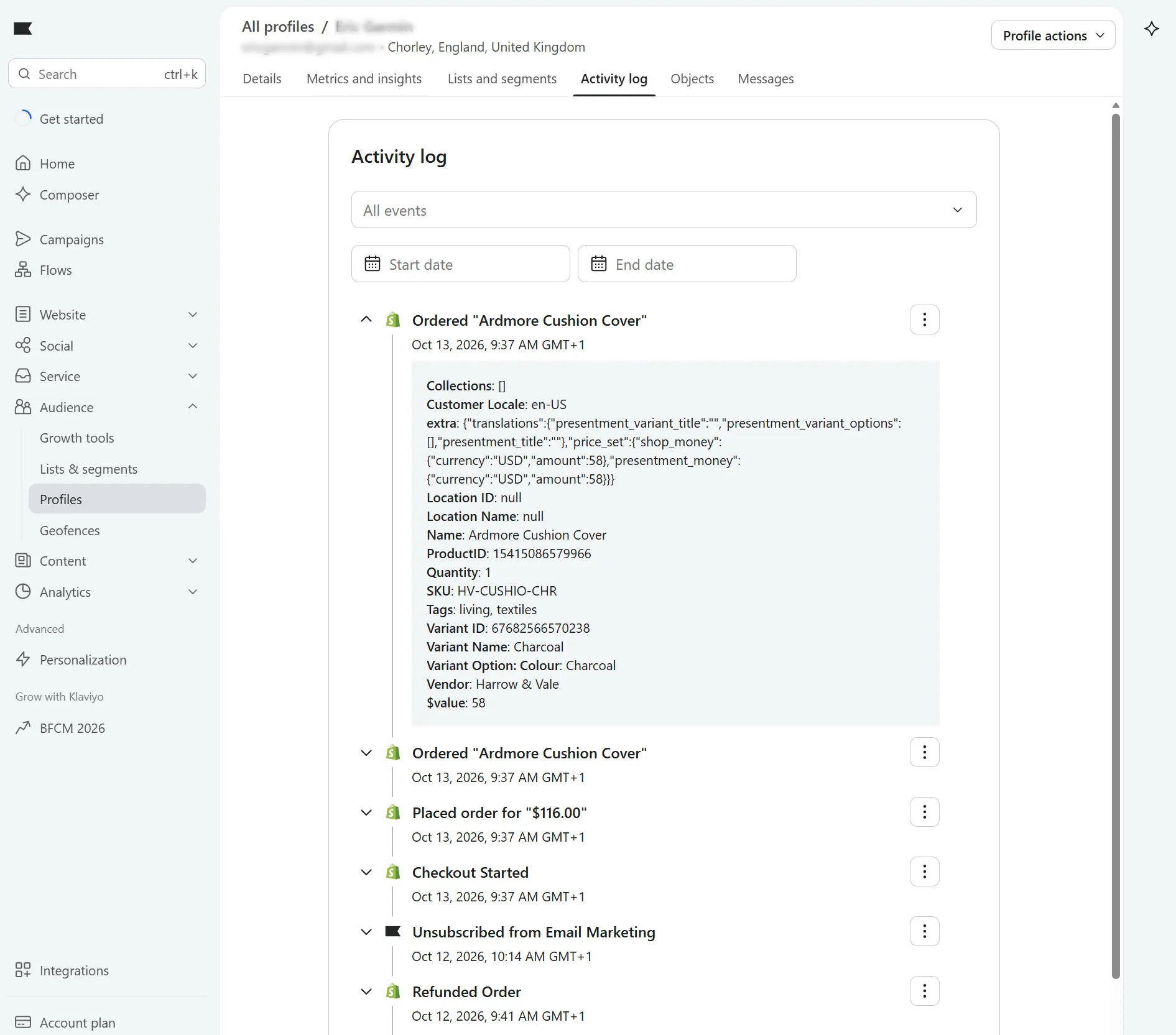
A critical distinction arose in Shopify integration: Klaviyo successfully synced all 65 test Shopify customers, whereas Mailchimp only managed to sync 14, without providing clear alerts regarding the discrepancy. While Mailchimp excelled in initial brand setup, pulling logo, colors, and fonts from a URL in just three seconds, and offered quicker segment updates (approximately 5 seconds compared to Klaviyo’s 12-14 minutes), these advantages were often overshadowed by Klaviyo’s robust e-commerce specific functionalities and reliable data handling.
The evaluation highlighted that businesses heavily reliant on dynamic customer data for segmentation and multi-channel engagement (including WhatsApp and SMS) would find Klaviyo more aligned with their strategic needs. For those prioritizing low-cost, regular newsletter-style campaigns for extensive contact lists, Mailchimp presents a compelling, budget-friendly alternative.
The Rigorous Testing Methodology: A Chronological Overview
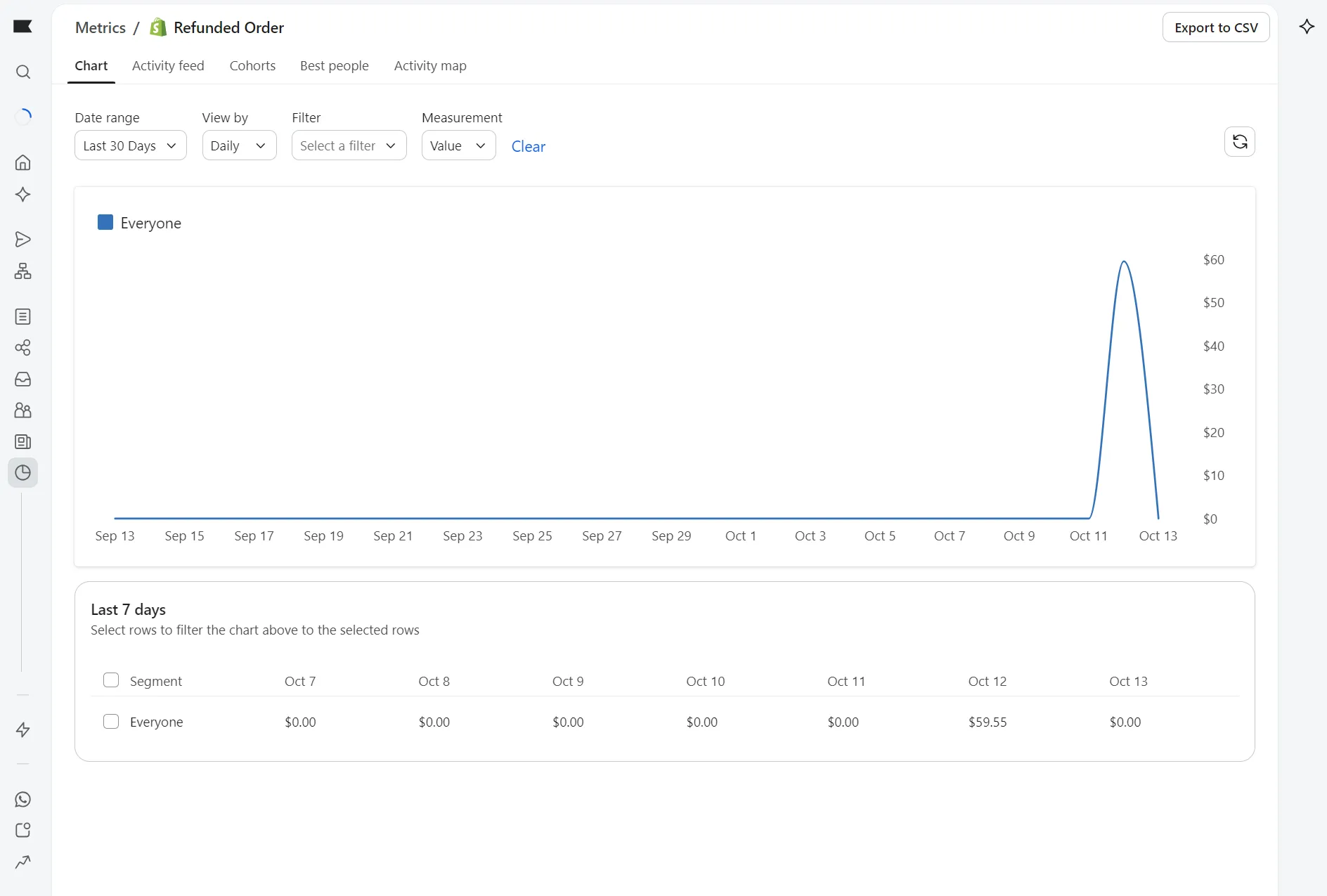
The comprehensive testing spanned several weeks, with Klaviyo’s evaluation conducted from October 12-15, 2026, and rechecked on November 9, 2026. Mailchimp’s assessment followed from October 19-30, 2026, with a subsequent recheck on November 9, 2026. Both platforms were subjected to identical testing protocols, connecting each to a dedicated Shopify development store pre-populated with 30 products, a customer list imported from CSV, 10 manually entered orders, and one test order that was subsequently refunded. Each platform also received an identical 250-contact import list.
During the contact import phase, Klaviyo imported 246 contacts, notably skipping four with valid email addresses due to invalid UK phone numbers, a detail only accessible via a downloadable error file. This early observation underscored differences in data validation and error reporting. The setup process was meticulously timed, from account creation to scheduling a campaign featuring a product block, first-name personalization, unique discount codes, and an A/B test. Shopify syncs were timed for test orders, and the consistency of checkout consent syncing was verified. For Mailchimp, it was also confirmed whether an unsubscribe event propagated back to Shopify.
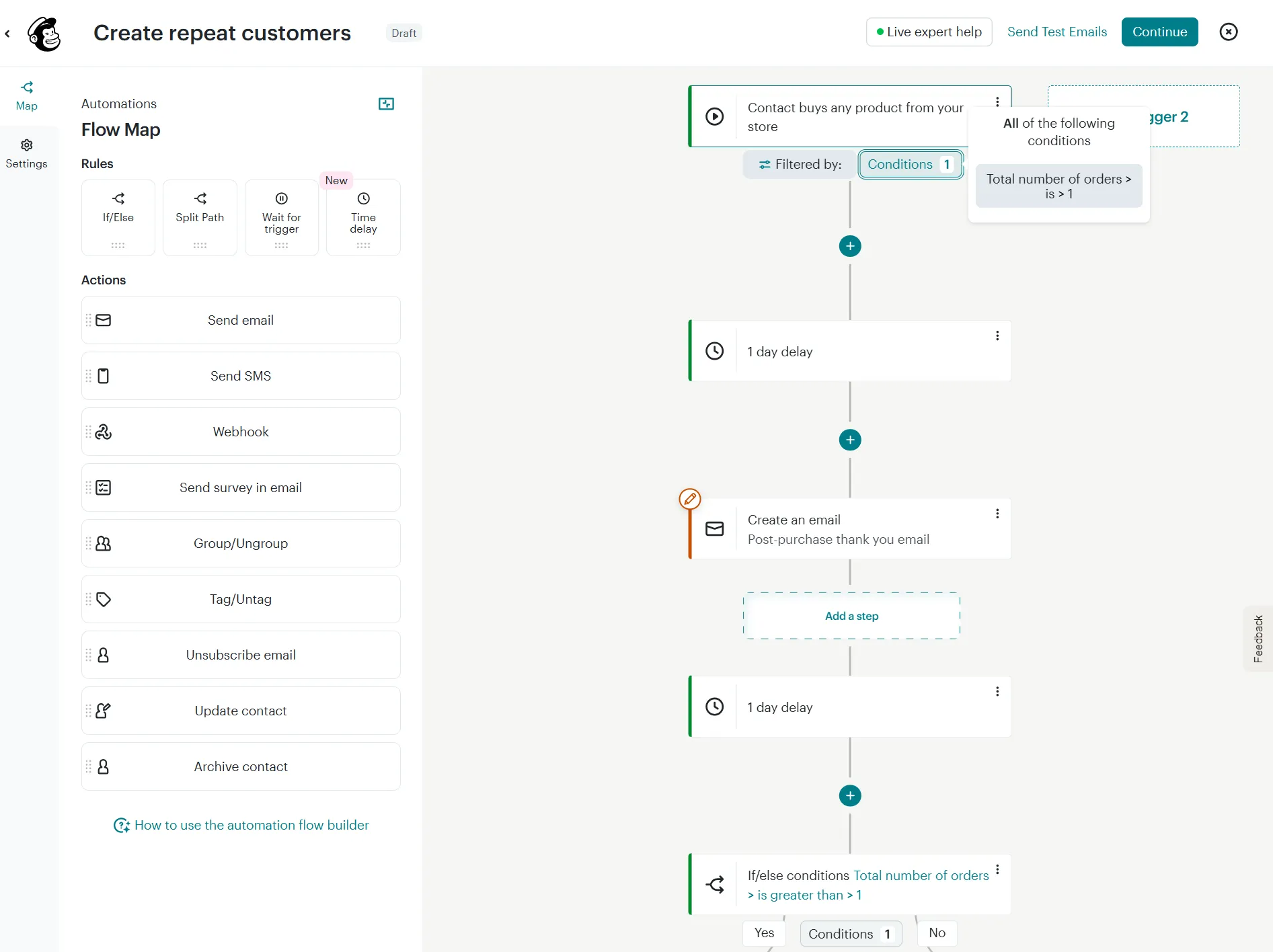
Segments for recent, repeat, high-value, and lapsed buyers were constructed, and the time taken for a new order to update the "recent-buyer" segment was recorded. A full suite of automation flows—welcome, abandoned checkout, post-purchase, win-back, and birthday—were built on both platforms, with Mailchimp additionally tested for a browse abandonment flow. Sign-up forms, including pop-ups and embedded forms, were deployed on the Shopify store. Test shoppers were guided through various scenarios: signing up via pop-ups, abandoning checkouts, and completing purchases after clicking campaign emails. Beyond email, SMS setup, push notifications, WhatsApp, and advertising audience integrations were examined, with Klaviyo successfully sending a test text, while Mailchimp required prior approval and paid credits for SMS functionality. Finally, revenue reports were meticulously cross-referenced against Shopify orders, and support responsiveness was assessed through multiple tickets and live chat interactions.
Detailed Comparison: E-commerce Integration and Data Synchronization
For businesses heavily invested in e-commerce, particularly those utilizing Shopify, the depth and reliability of data synchronization are paramount. Klaviyo demonstrated a significant advantage in this area. All 30 products and 11 store orders, including detailed line items, discounts, shipping, and tax, arrived in Klaviyo within a minute of connection. Crucially, each ordered item retained its SKU, variant, vendor, tags, and price, with order values consistently displayed in the store’s native currency (U.S. dollars). This granular data capture allows for highly specific segmentation and personalized automation, a cornerstone of effective e-commerce marketing. Variant options, such as a product’s color, were imported as distinct fields, enabling sophisticated segmentation and flow filters.
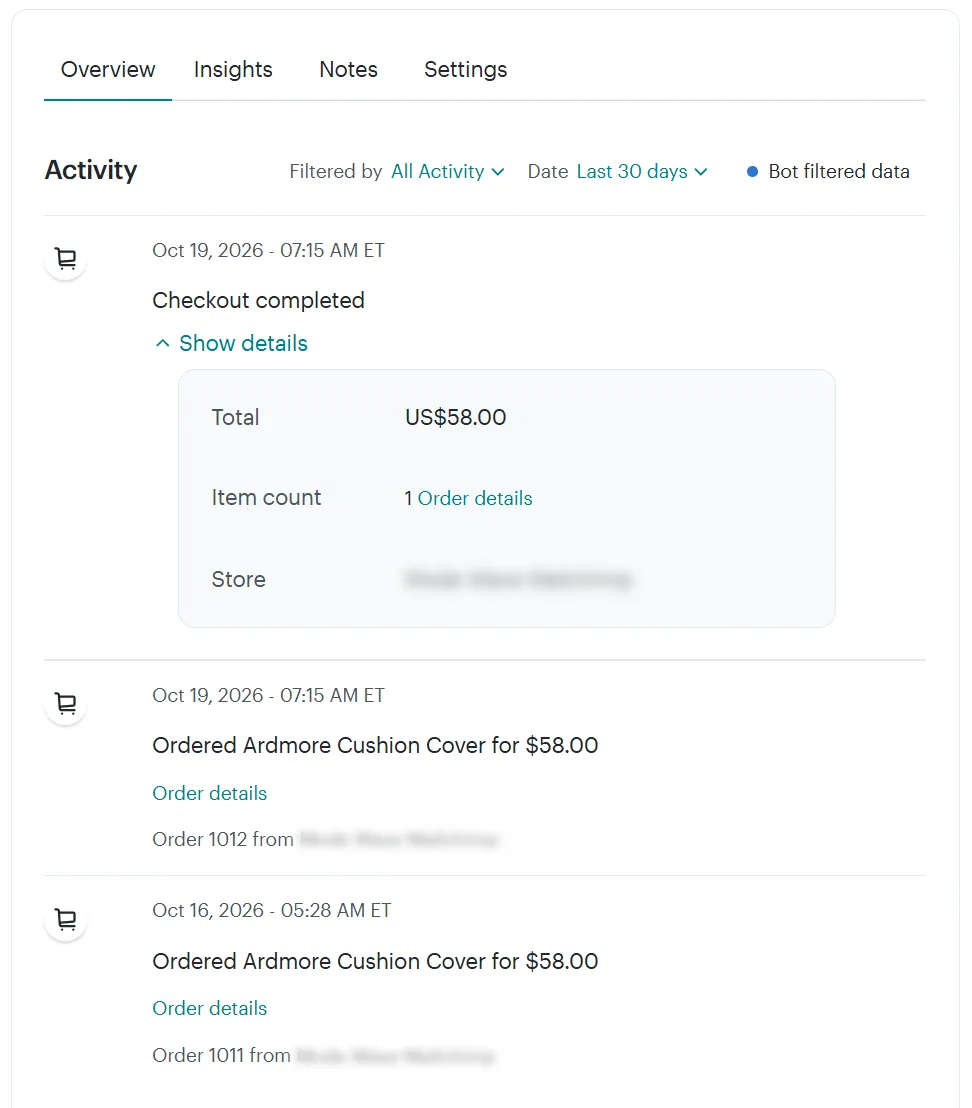
Mailchimp’s performance in this critical area was less consistent. The initial sync missed 51 of the 65 Shopify customers, with support records inexplicably showing two as "deleted" on the day of connection. A "Force Resync" 20 days later retrieved only 10 more customers, with Mailchimp rejecting 43 others due to an internal rule flagging them as having "signed up to a lot of lists very recently," a challenge exacerbated by the use of plus-sign test addresses in the evaluation. Furthermore, two buyers who explicitly checked the marketing consent box at checkout were initially categorized as "non-subscribed" in Mailchimp, requiring a manual resync 20 days later to update their status. This inconsistency and delayed synchronization could lead to missed marketing opportunities and inaccurate audience segmentation for e-commerce merchants. Mailchimp also displayed currency discrepancies, showing a $58.00 order as "£58.00" on a GBP-billed account, indicating a lack of native currency conversion.
Klaviyo’s documentation lists a more extensive array of Shopify events, particularly those occurring post-order (e.g., order fulfilled, canceled, refunded, shipment confirmed), providing a richer dataset for advanced post-purchase automations. Mailchimp, while tracking pre-purchase events like cart removals, cart views, and payment info, falls short on post-transactional data granularity.
Automation Capabilities: Abandoned Carts and Beyond
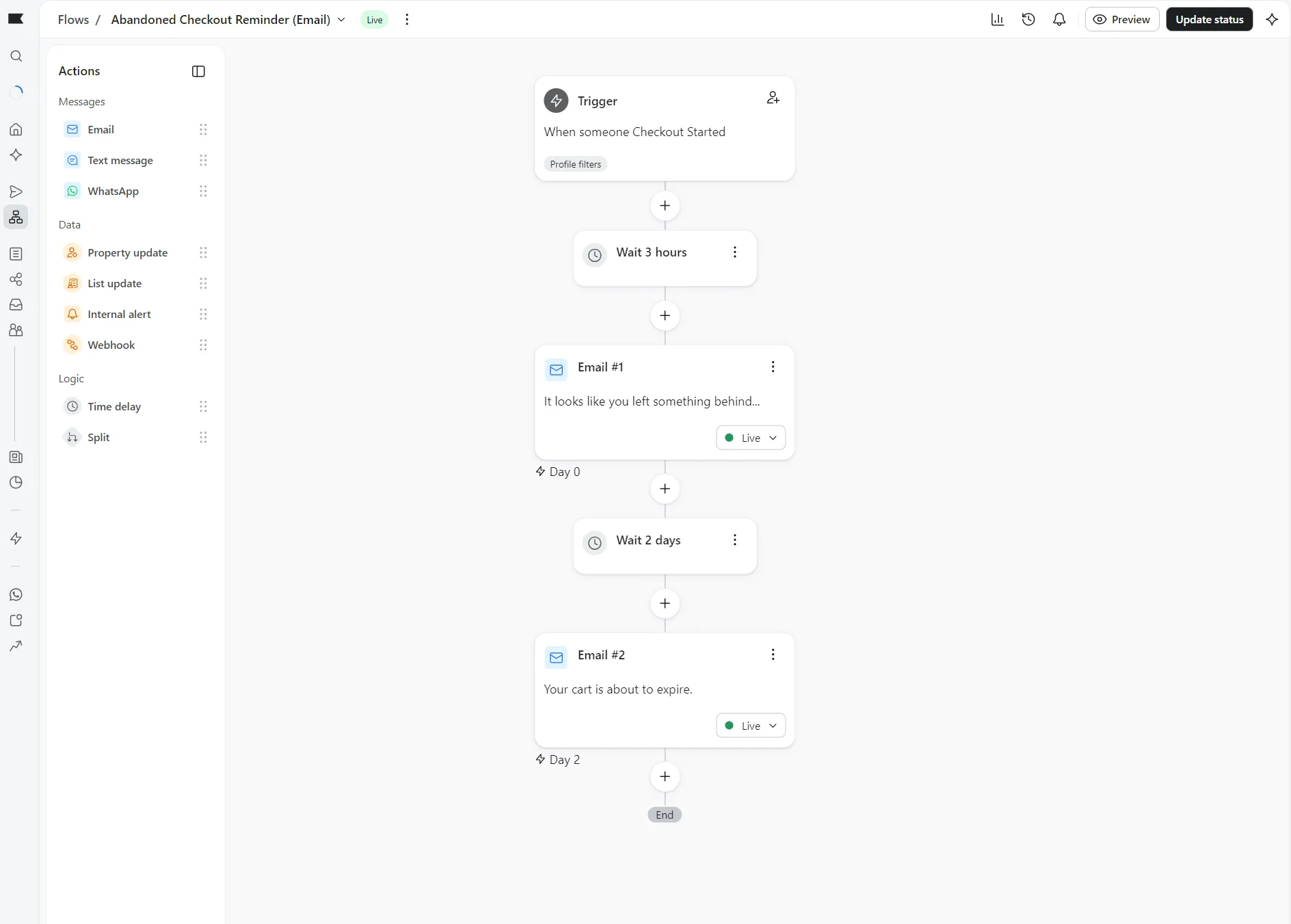
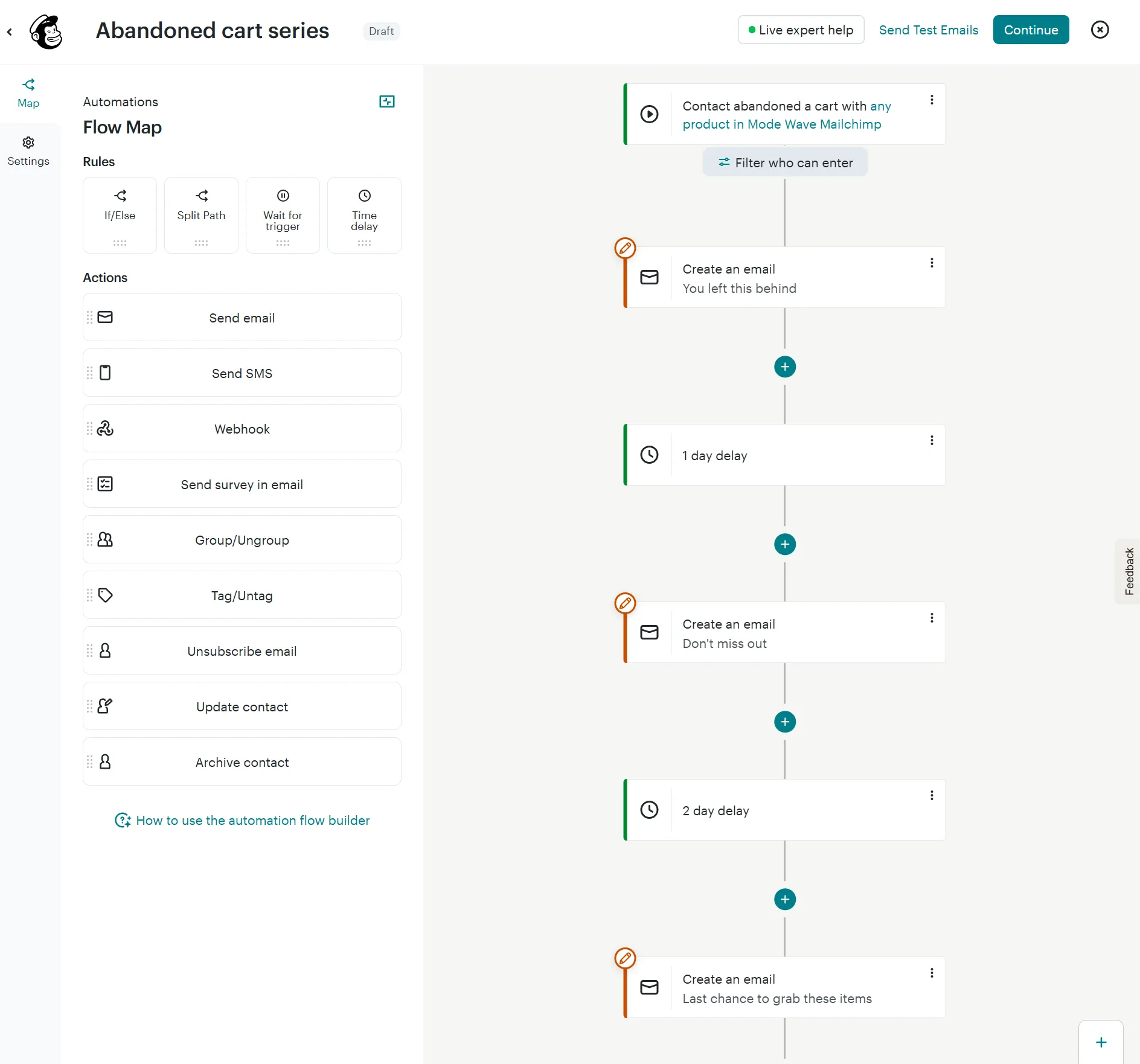
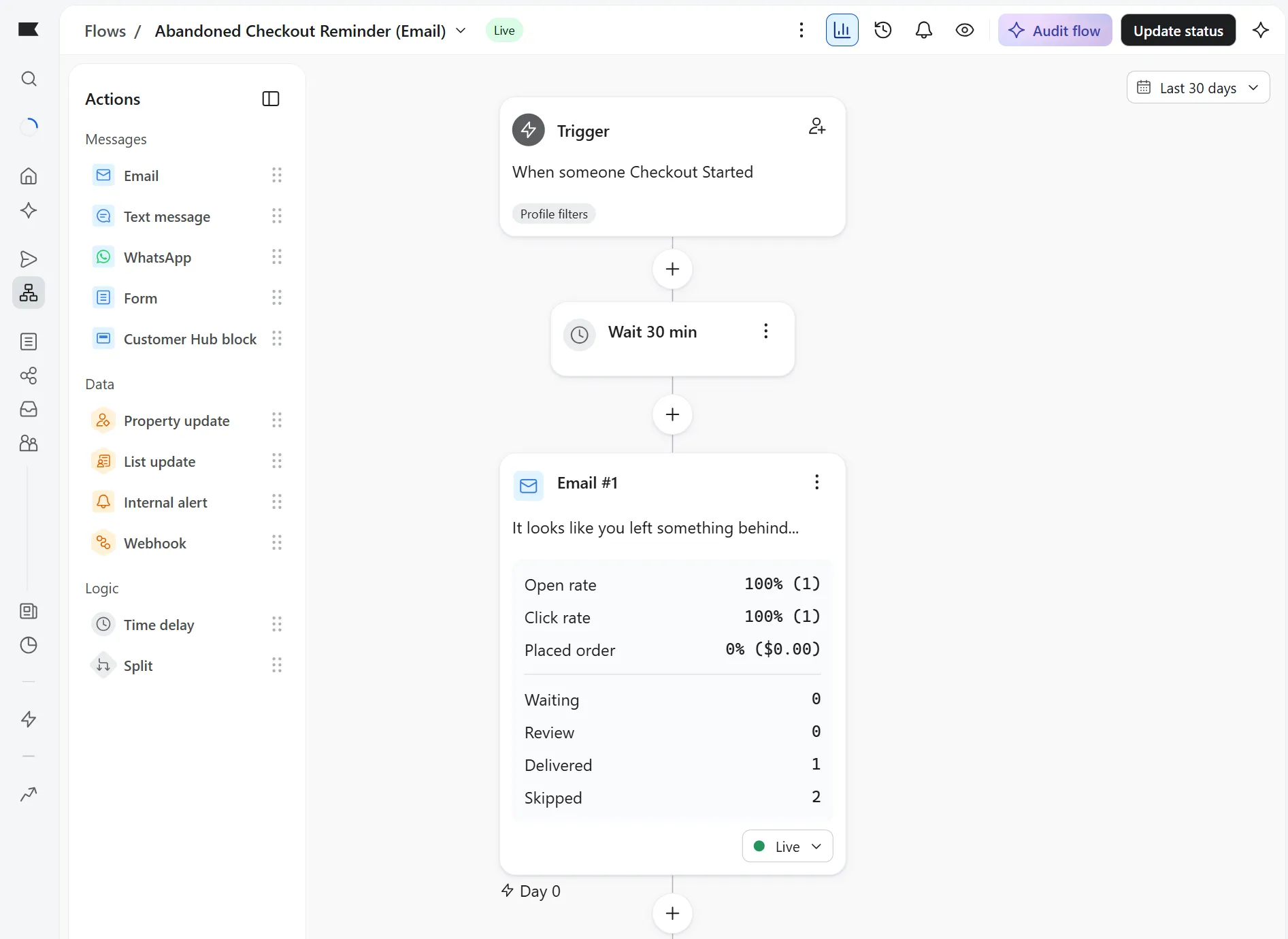
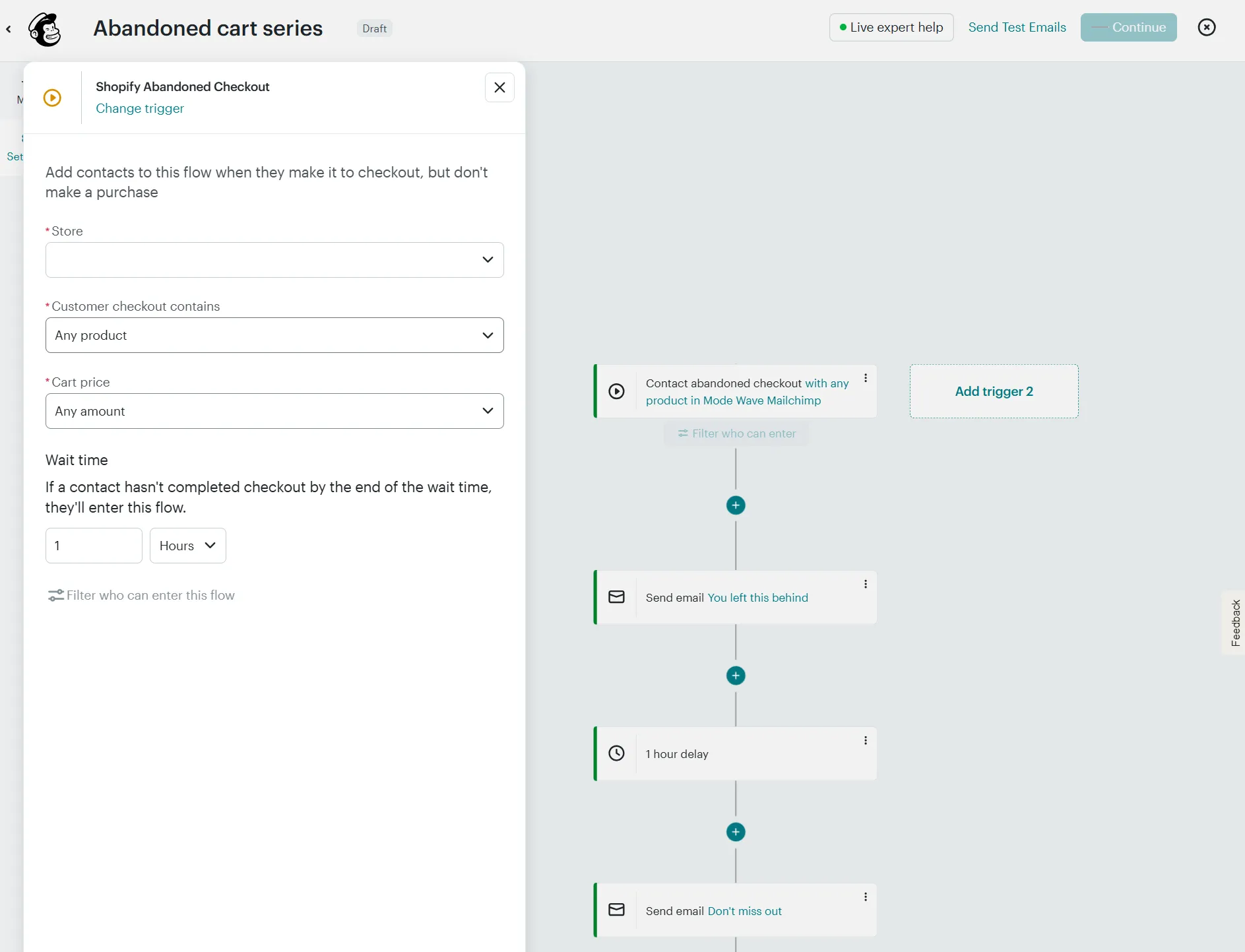
Abandoned cart and checkout recovery are vital for e-commerce revenue. Both platforms effectively handled abandoned checkout emails, linking shoppers back to their carts with items intact. However, Klaviyo offers this crucial functionality on its Free plan, while Mailchimp requires an Essentials plan, with flows limited to four steps until upgrading to Standard. Klaviyo also intelligently skipped shoppers who completed their purchase before the reminder email was due, clearly indicating the reason for the skip, thus preventing irrelevant communication. Its checkout trigger allows for precise targeting based on cart value or specific products/collections.
Mailchimp’s checkout trigger also permits filtering by product and cart price with adjustable wait times. However, it imposes a restriction where cart and checkout triggers cannot share a single flow, and its cart trigger has a fixed one-hour wait. An important note for users: Shopify’s native abandoned checkout emails should be disabled to prevent duplication when using either platform’s flows.
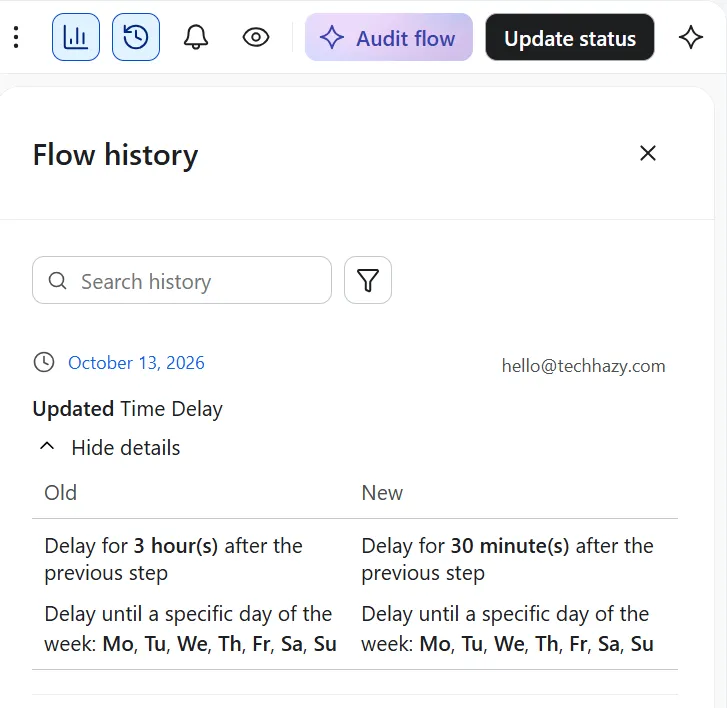
In broader automation, Klaviyo’s $20/month Email plan includes branching flows, a feature Mailchimp reserves for its Standard plan. Klaviyo’s post-purchase flow successfully emailed both new buyers in the test, while Mailchimp failed to email two buyers who opted into marketing, without providing an explanation. Mailchimp’s browse abandonment flow successfully sent the viewed product to the tester, though the trigger wait time was inconsistent with settings. Klaviyo offers a "Smart Sending" frequency cap (16 hours), a feature not found in Mailchimp, preventing email fatigue. Klaviyo also maintains a detailed flow change history, allowing for restoration of earlier versions, a critical feature for managing complex automations.
Pricing Structures and Value Proposition
Pricing is a significant factor for businesses, and the evaluation revealed distinct philosophies. Mailchimp Essentials consistently costs less than Klaviyo’s Email plan across all tested list sizes. For example, at 500 contacts, Essentials is $13/month compared to Klaviyo’s $20/month. At 10,000 contacts, Essentials is $110/month against Klaviyo’s $150/month. However, Mailchimp’s Essentials plan features significant limitations, including a cap of four steps for automations, making it less suitable for sophisticated e-commerce needs.
Mailchimp’s Standard plan, which offers more advanced features like branching flows, generally matches Klaviyo’s pricing at contact tiers up to 5,000 ($20-$100/month). Beyond this, Mailchimp Standard becomes more cost-effective, costing $135/month at 10,000 contacts (vs. Klaviyo’s $150) and $310/month at 25,000 contacts (vs. Klaviyo’s $400). Mailchimp’s Premium plan, starting at $350/month for up to 10,000 contacts, is consistently more expensive than Klaviyo at every tier.
A key difference in billing concerns unsubscribed contacts: Klaviyo bills only for "active profiles" (those it can email), excluding unsubscribed or suppressed contacts. Mailchimp, however, bills for every stored contact, including unsubscribed ones, only excluding archived, cleaned, or deleted contacts. This means businesses with growing lists and high unsubscribe rates could face higher costs on Mailchimp if not actively archiving contacts. Mailchimp also charges per audience, so a contact in two audiences counts twice towards the bill.
Both platforms offer various add-ons. Mailchimp sells SMS as a monthly add-on (e.g., 1,000 SMS credits for $20/month) and transactional emails in blocks. Klaviyo’s Email plan includes $5/month of mobile messaging and Composer usage, with a range of optional add-ons for reviews, social marketing, customer hubs, helpdesks, AI customer agents, and advanced data platforms, which can significantly increase monthly expenditure.
User Experience: Setup, Builders, and Segmentation
Setup and Brand Integration: Klaviyo proved marginally quicker to set up, taking 32 minutes and 23 seconds from account creation to campaign scheduling, two minutes faster than Mailchimp. Klaviyo also connected to a store and imported contacts faster. However, Mailchimp excelled in brand setup, automatically pulling logo, colors, and fonts from a URL in just three seconds. Klaviyo required manual input for brand elements.
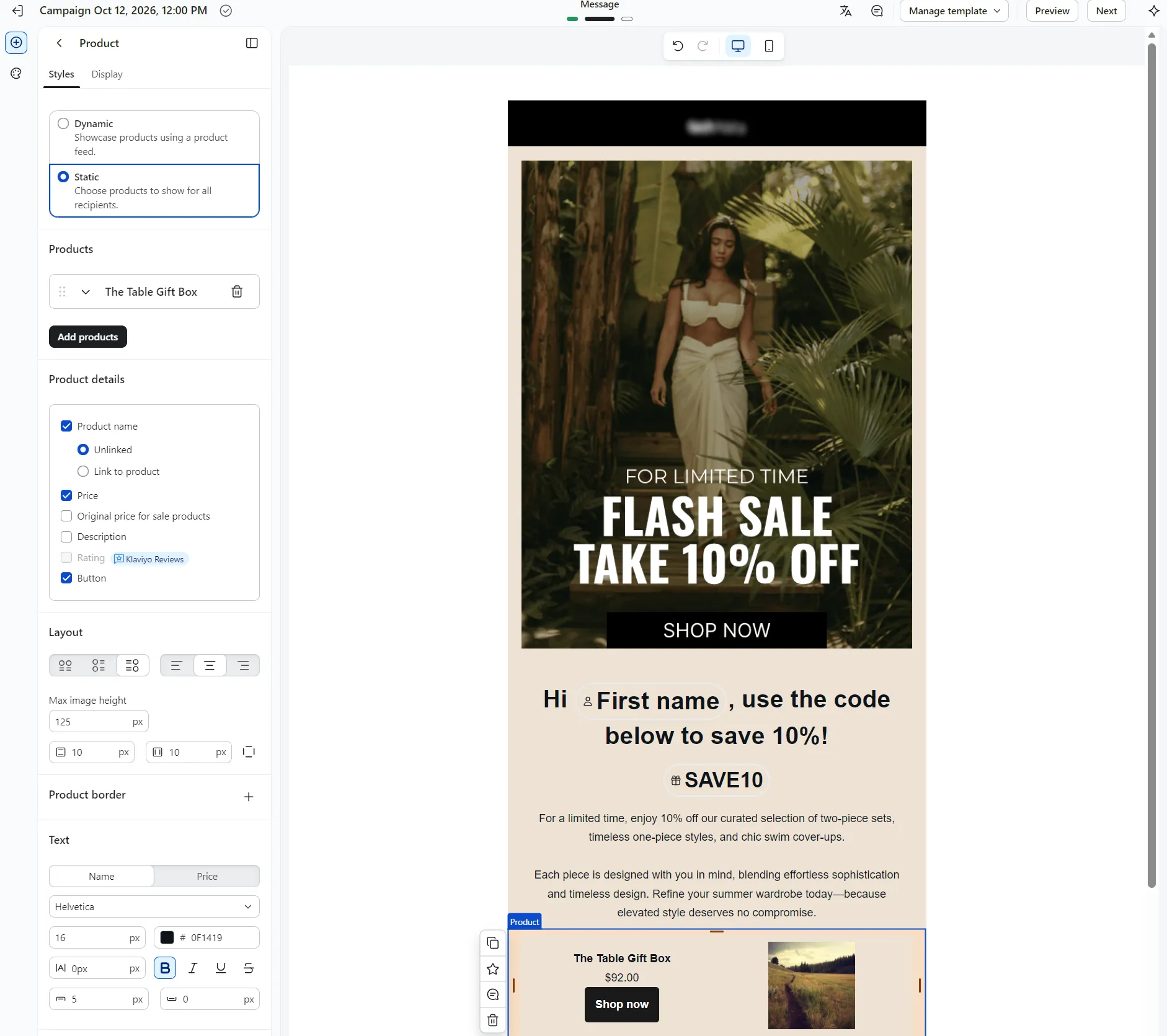
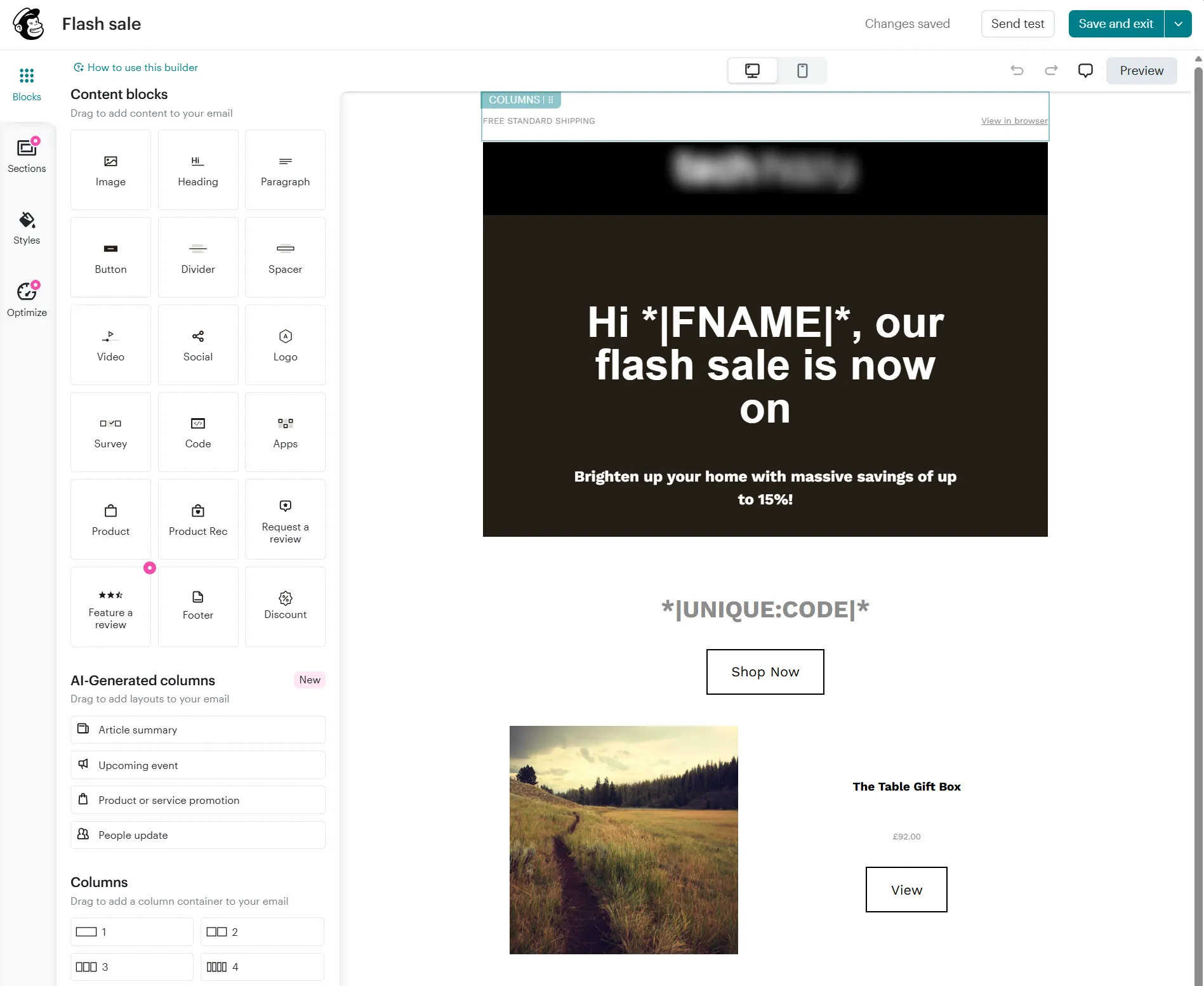
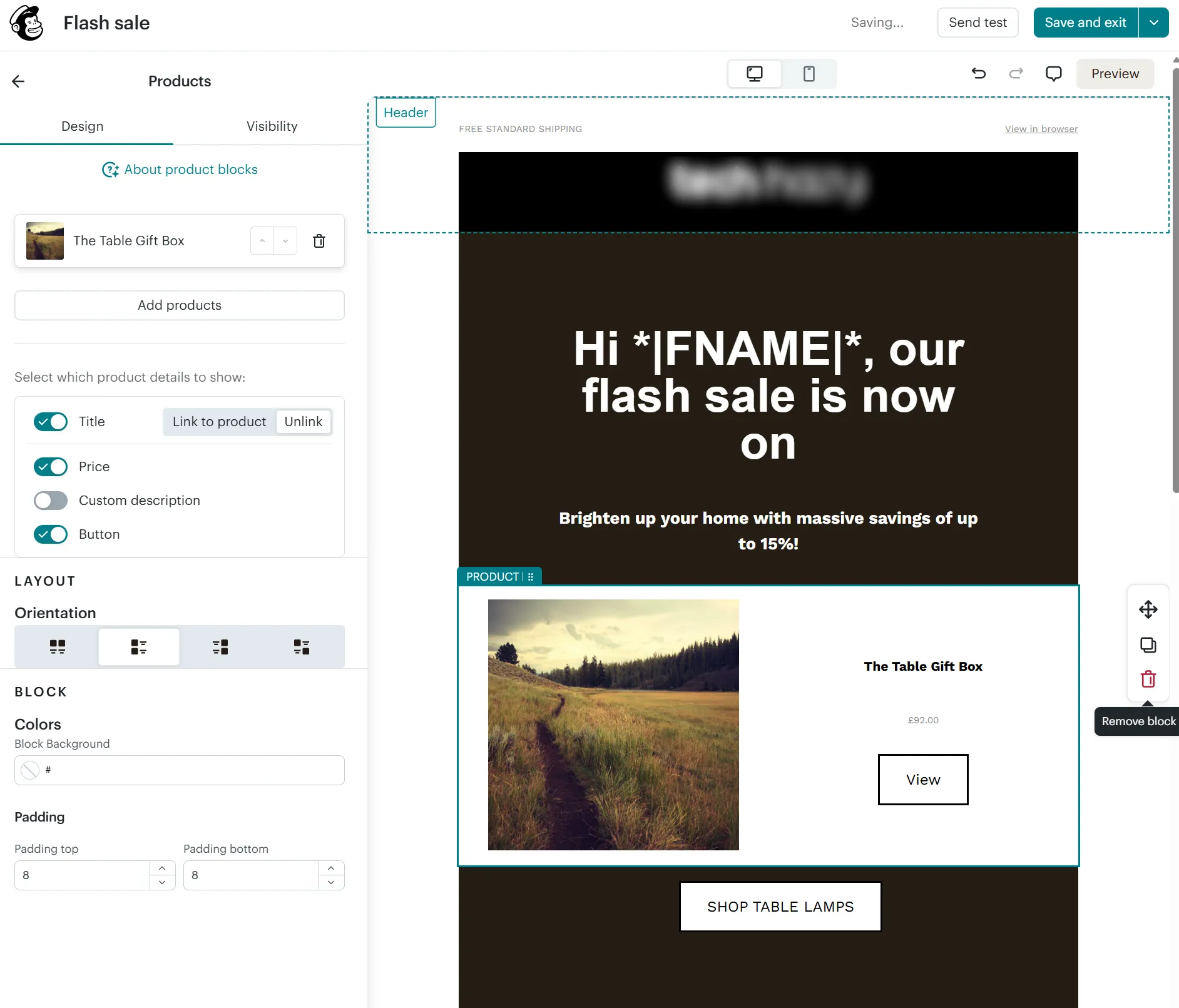
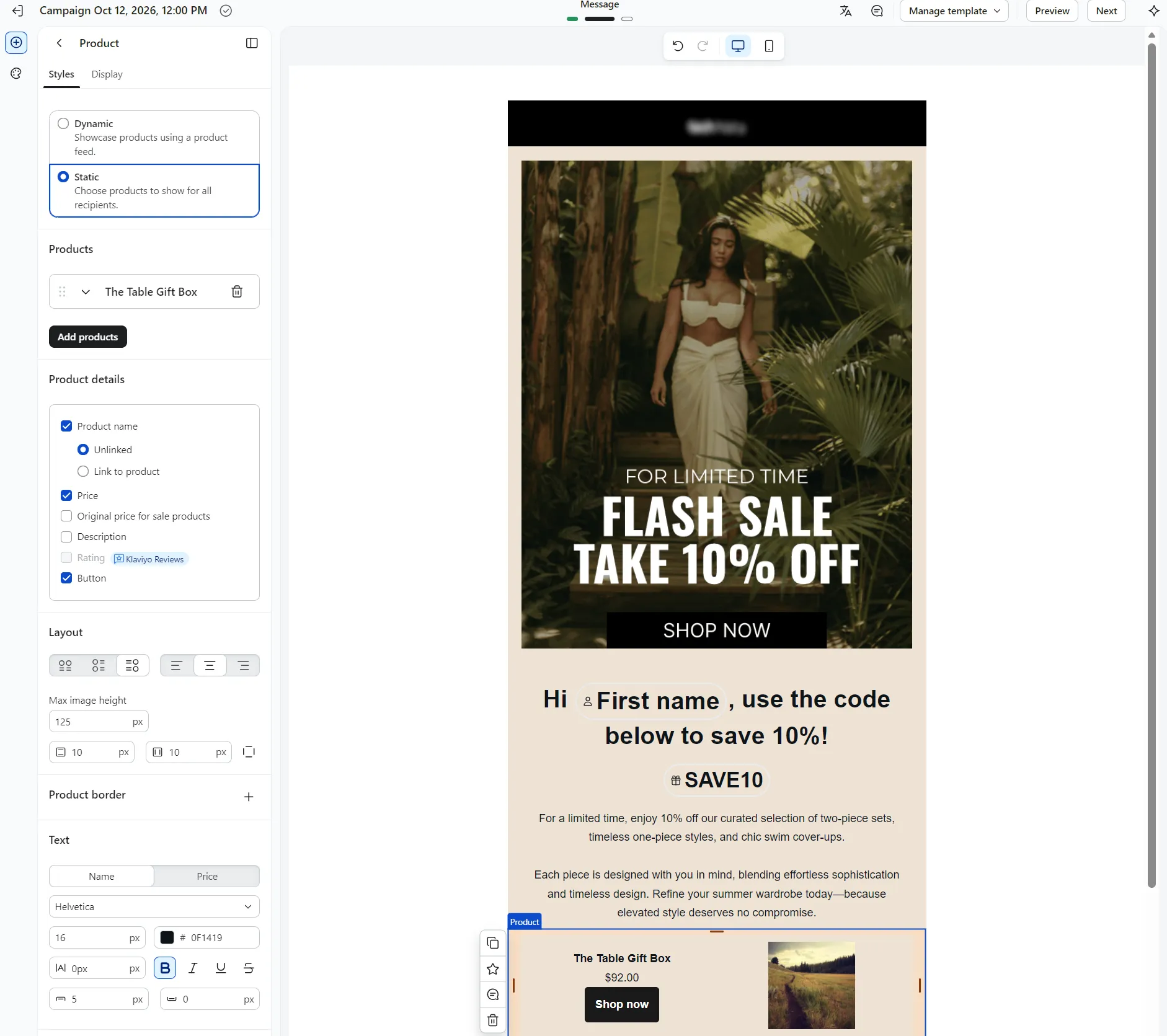
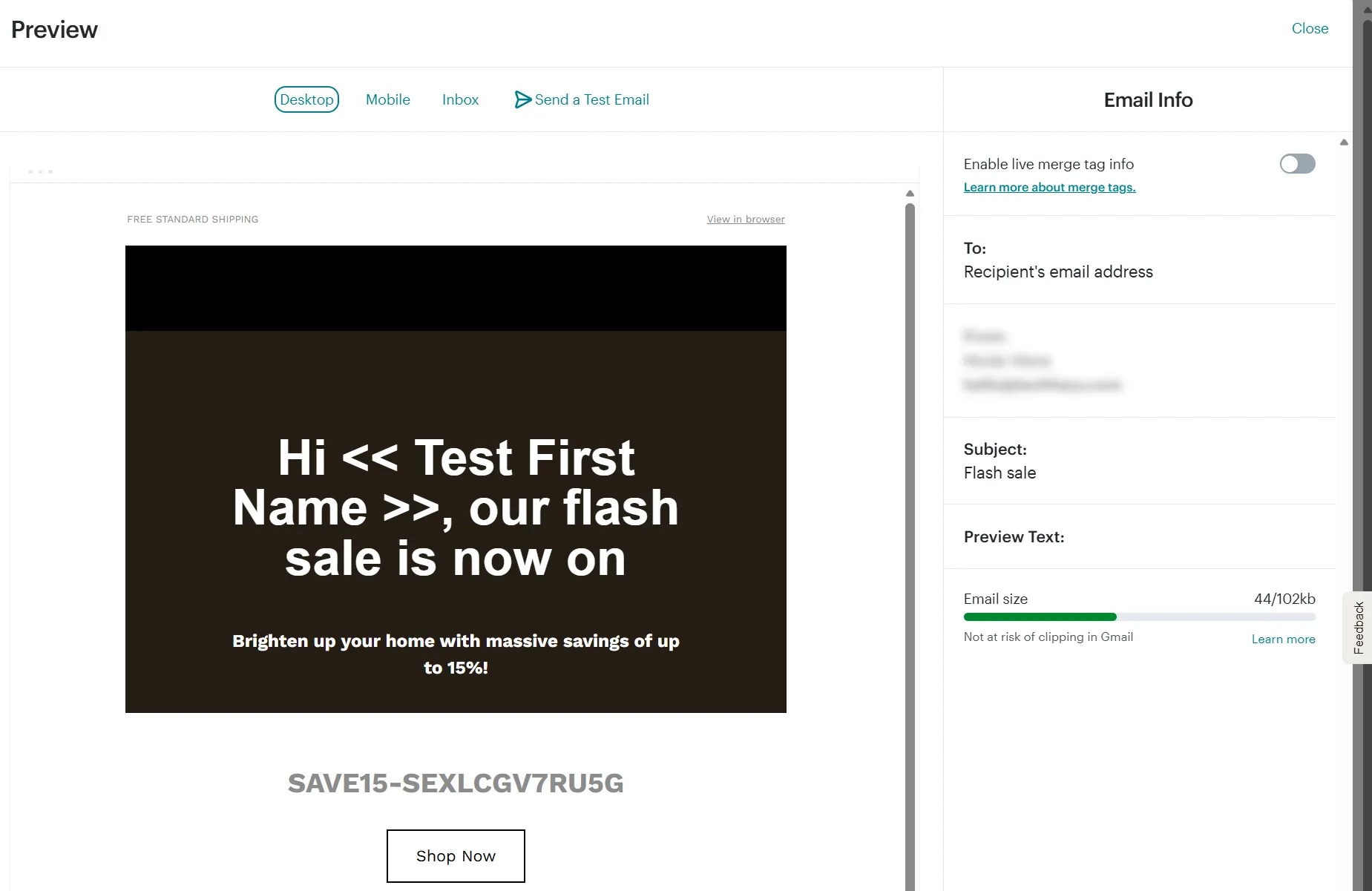
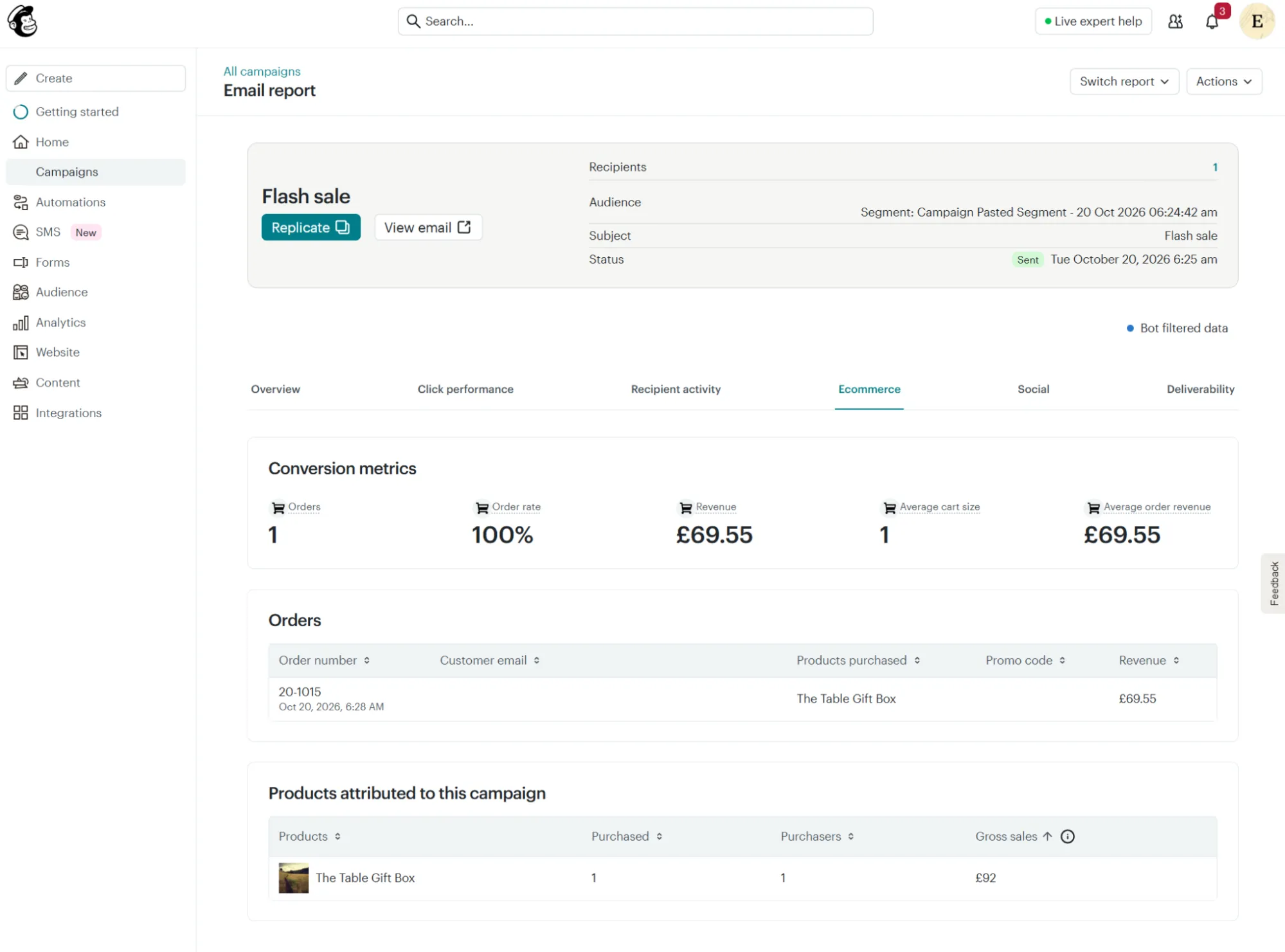
Email Builders: Mailchimp’s email builder was faster, completing a campaign in just over five minutes compared to Klaviyo’s 13.5 minutes. Mailchimp’s "Email Optimizer (Beta)" on Standard and above plans provides pre-send suggestions. A notable limitation in Mailchimp is the inability to A/B test emails containing discount code blocks, a feature available in Klaviyo. Both offer a wide array of templates (Mailchimp over 300, Klaviyo over 160). Mailchimp’s product block accurately pulled items but again struggled with currency display, showing £92.00 for a $92.00 product. Klaviyo’s coupon block required unique codes to finish generating before appearing, adding to build time.
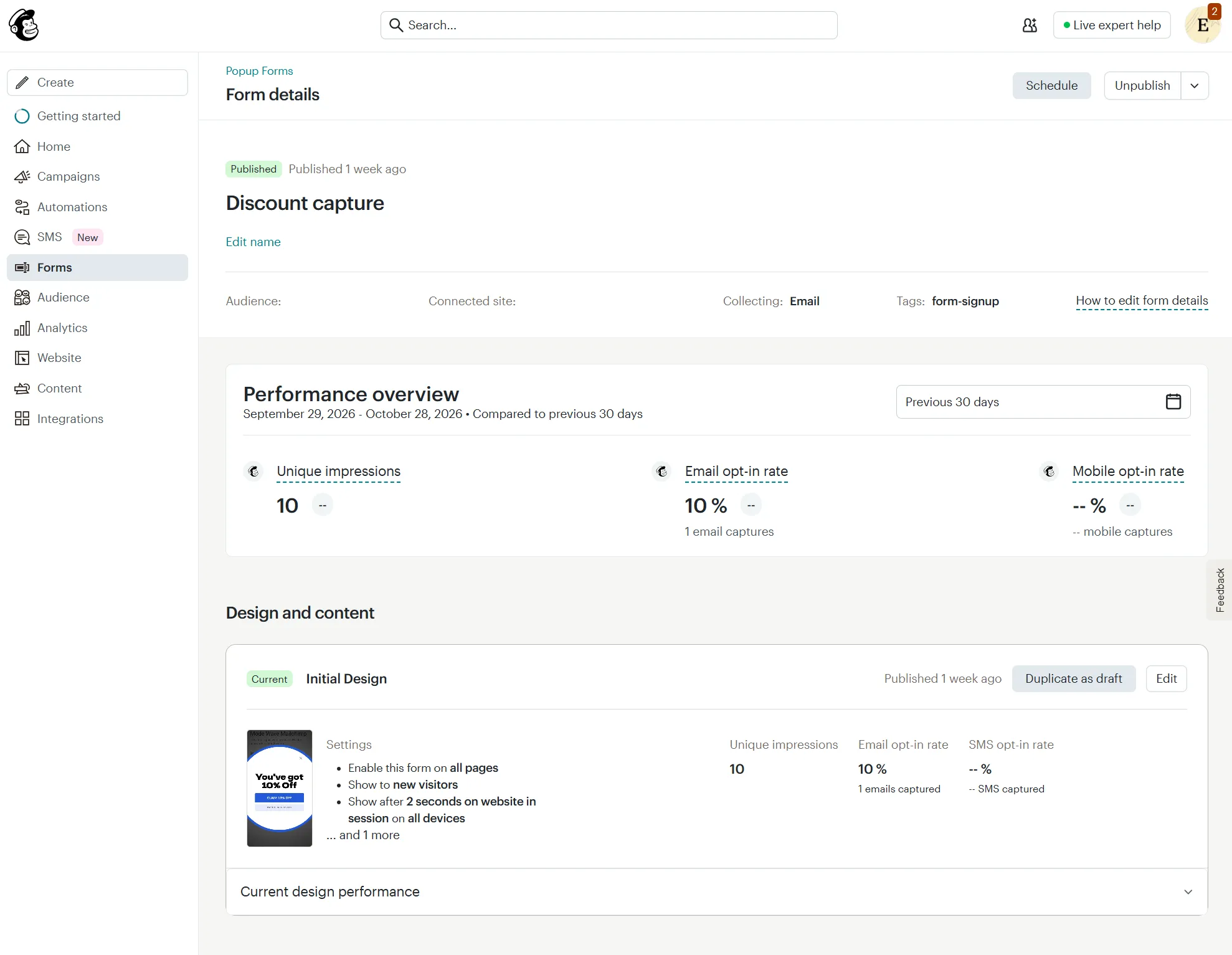
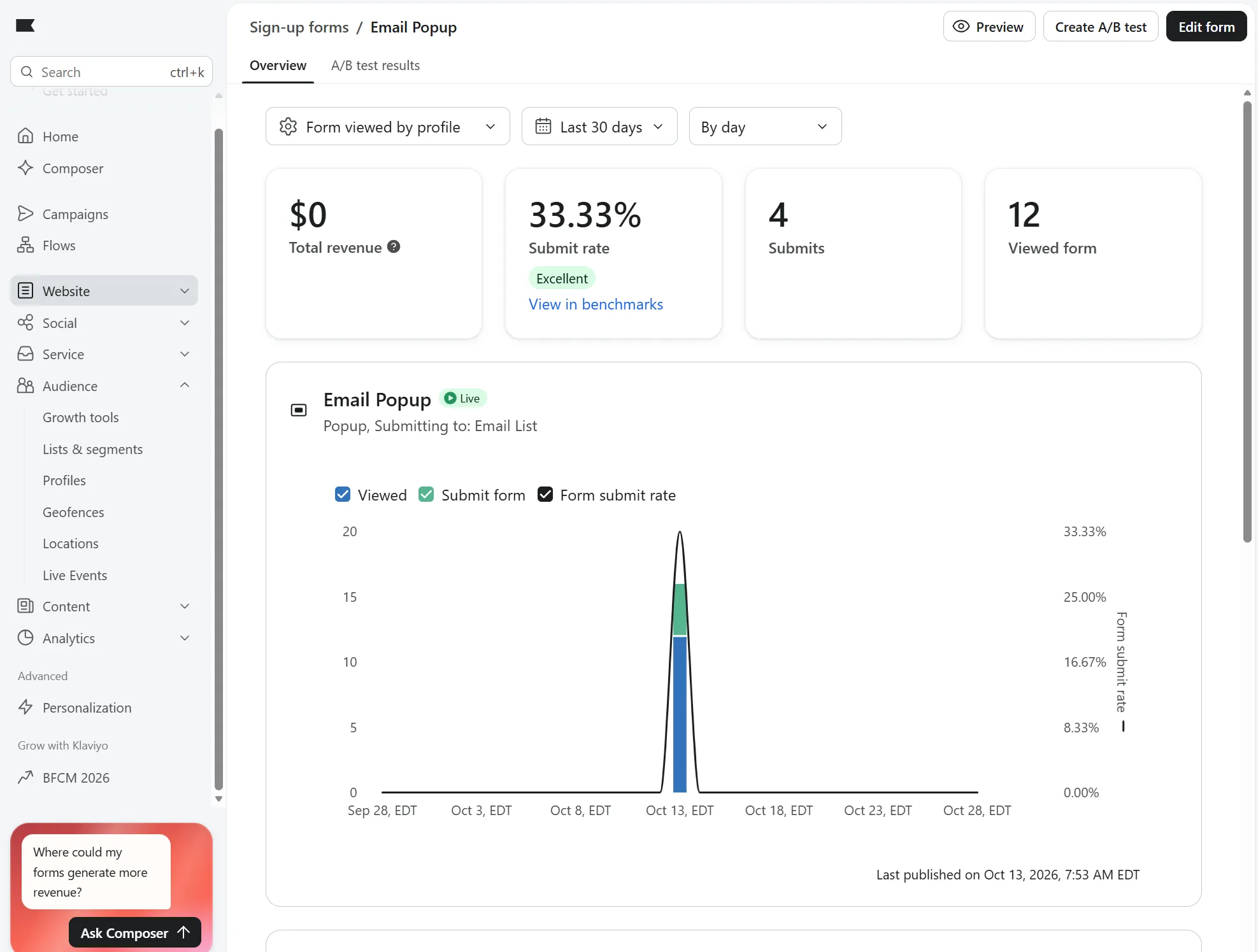
Forms and Pop-ups: Klaviyo offers better reporting for forms and pop-ups, benchmarking submit rates and displaying associated revenue. Mailchimp compares opt-in rates against the previous 30 days. Both integrated seamlessly with Shopify via app embeds. Klaviyo uses double opt-in by default and includes bot protection, which blocked some test sign-ups using plus-sign addresses. Mailchimp’s pop-up immediately added testers and displayed discount codes without a confirmation step.
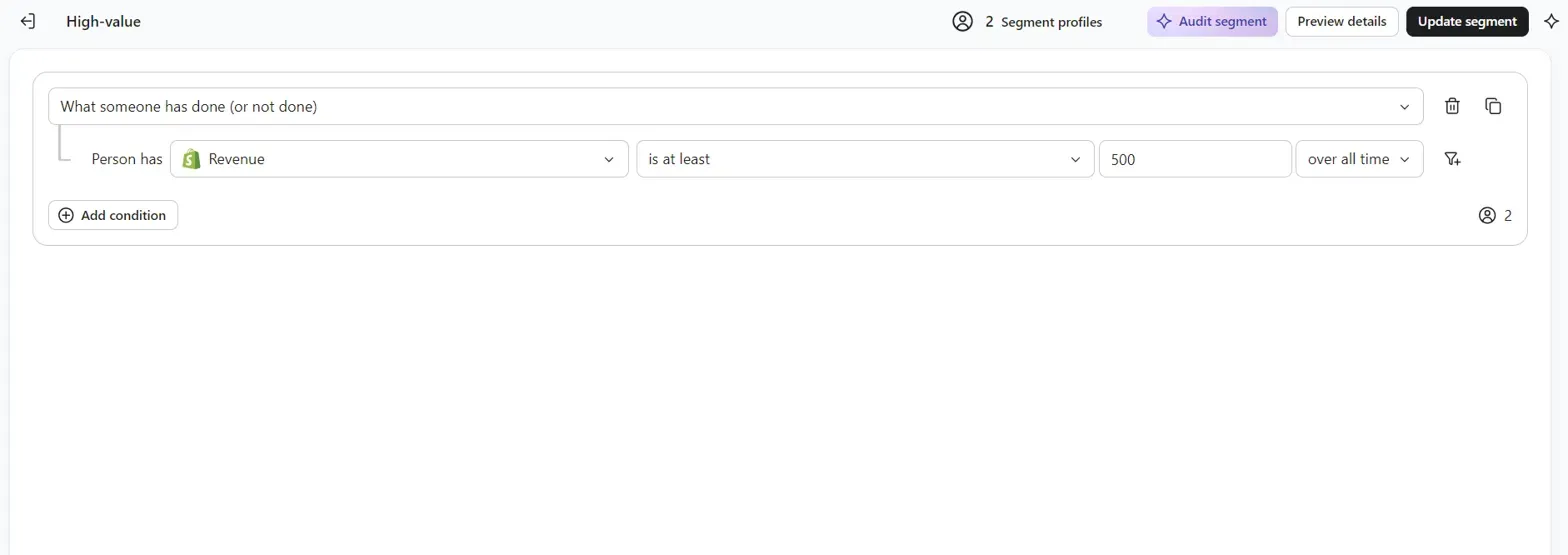
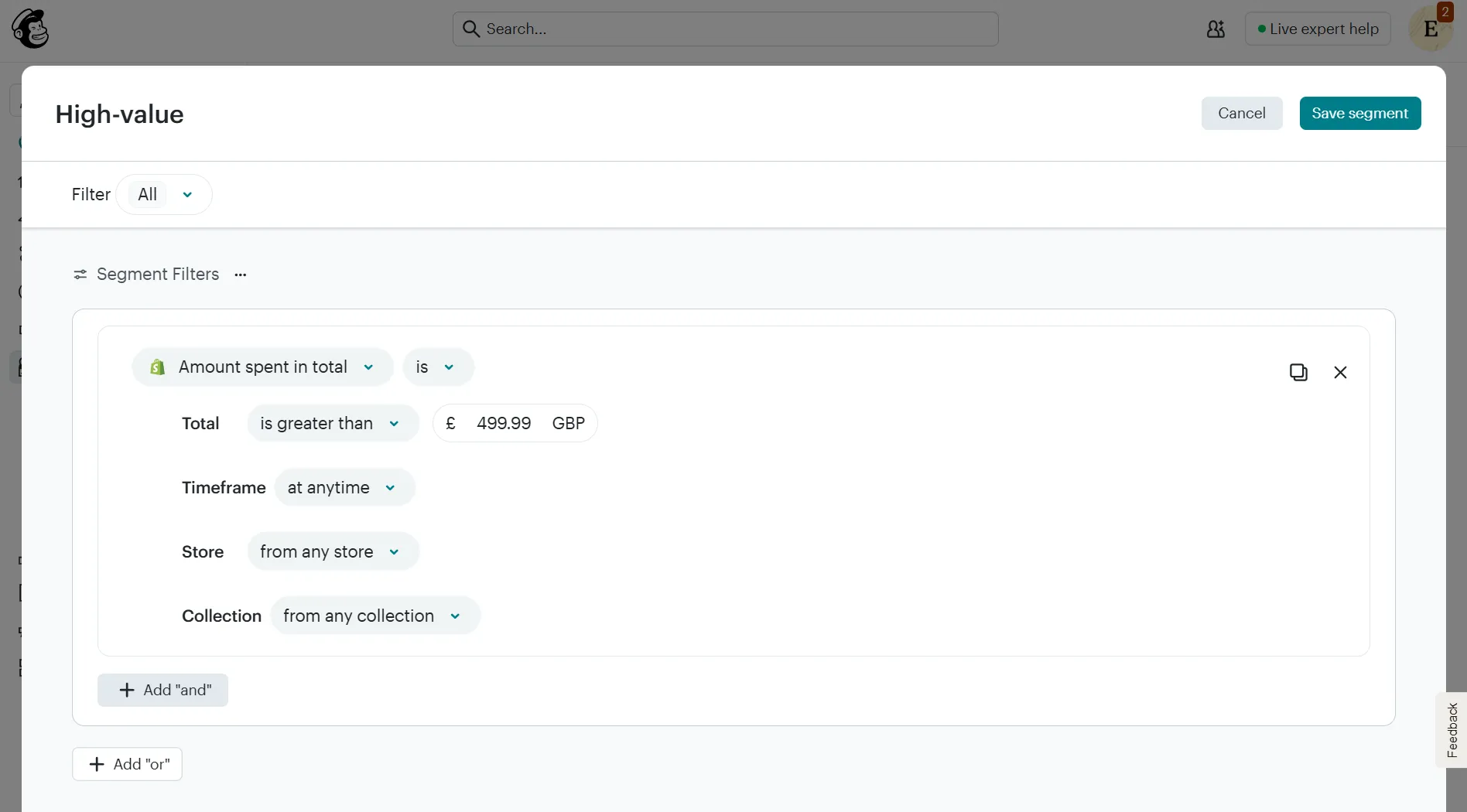
Segmentation: Klaviyo offers superior segment detail at the entry level, allowing up to 100 conditions on its $20/month Email plan, significantly more than Mailchimp’s 10-condition limit on Free and Essentials plans. Standard and Premium Mailchimp plans remove this cap and add nested logic. Mailchimp updated segments for new orders in about five seconds, whereas Klaviyo took 12-14 minutes. Klaviyo’s templates for recent and repeat buyers were robust, though its repeat segment counted a refunded order. Mailchimp’s repeat segment correctly excluded refunded orders. For spend-based segmentation, Klaviyo’s "Revenue" metric was precise, while Mailchimp’s "Amount spent in total" lacked a "greater than or equal to" operator and displayed currency incorrectly. Klaviyo’s Email plan includes predictive conditions, though they require substantial historical data (500+ customers, 180 days of order history) to become available.
Multi-Channel Engagement and AI Capabilities
Klaviyo stands out for its native multi-channel capabilities, offering WhatsApp, app push, and Rich Communication Services (RCS) alongside SMS within its flows. Its Email plan includes a base amount of messaging spend. Mailchimp sells SMS as an add-on to paid plans, with no SMS on its Free plan, and does not natively support WhatsApp, app push, or RCS. For Meta Ads, both platforms can sync lists and segments as custom audiences, but Klaviyo’s comprehensive integration across multiple channels offers a more unified customer journey.
Regarding AI tools, Klaviyo’s K:AI suite, centered around "Composer," appears more comprehensive. Composer can draft entire flows from a single prompt, analyze data, and audit existing marketing assets. All Klaviyo plans include $5 of monthly Composer usage. Mailchimp’s AI features, such as "Write with AI," "AI-generated layouts," "Email Optimizer," and "AI-powered flow templates," are largely phased rollouts and often tied to higher-tier plans (Standard and up). Mailchimp’s "Analytics AI" answers performance questions, though it initially lagged in reporting during testing. Klaviyo’s "Predictive analytics" integrates directly into segment conditions, offering advanced insights for audience targeting.
Revenue Reporting and Attribution
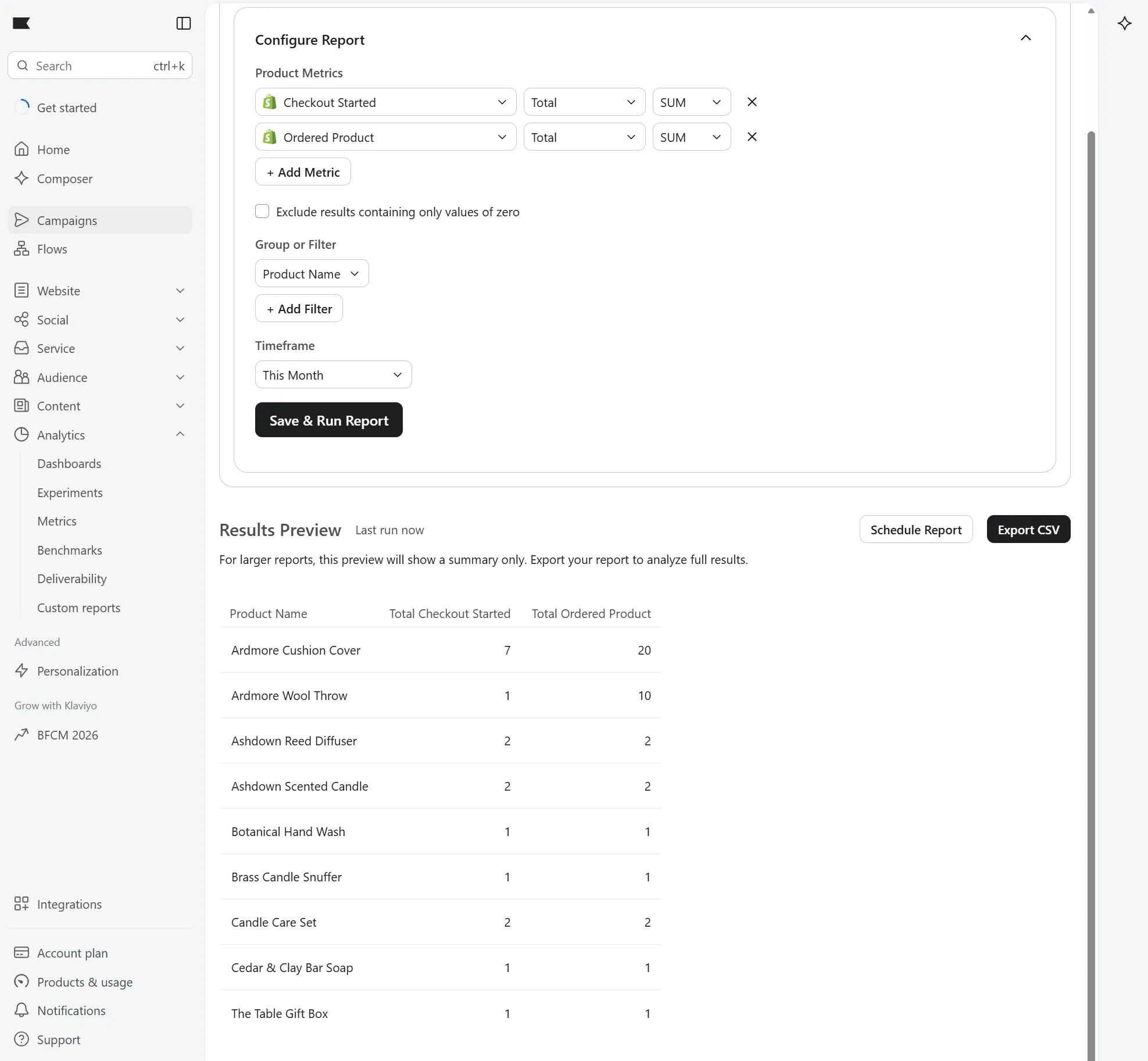
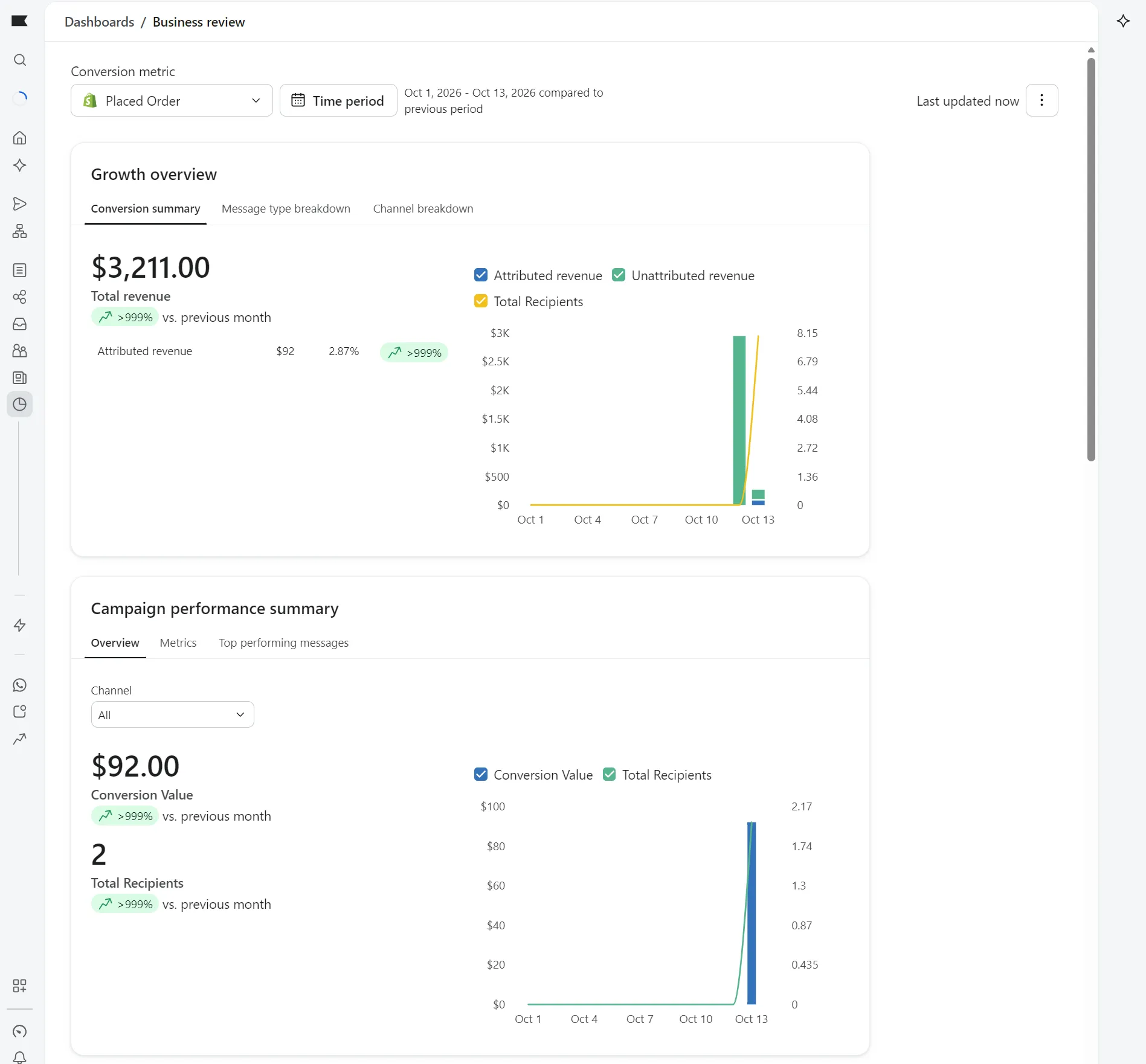
Klaviyo’s revenue reporting proved more accurate for Shopify stores, consistently reporting all test orders in U.S. dollars and precisely matching Shopify totals, including separate metrics for refunds. Klaviyo’s "Sales by Product Name" report, one of 48 custom report templates, provided granular insights into product performance. Mailchimp, while attributing test orders to the correct emails, took up to 3.5 hours to credit an order and converted store revenue to British pounds (GBP) on a UK-billed account, leading to currency discrepancies. Its campaign report also inconsistently displayed prices across different sections. Mailchimp’s custom reports (Standard and Premium) allow filtering by campaign or date but lack product-level reporting, a key e-commerce requirement.
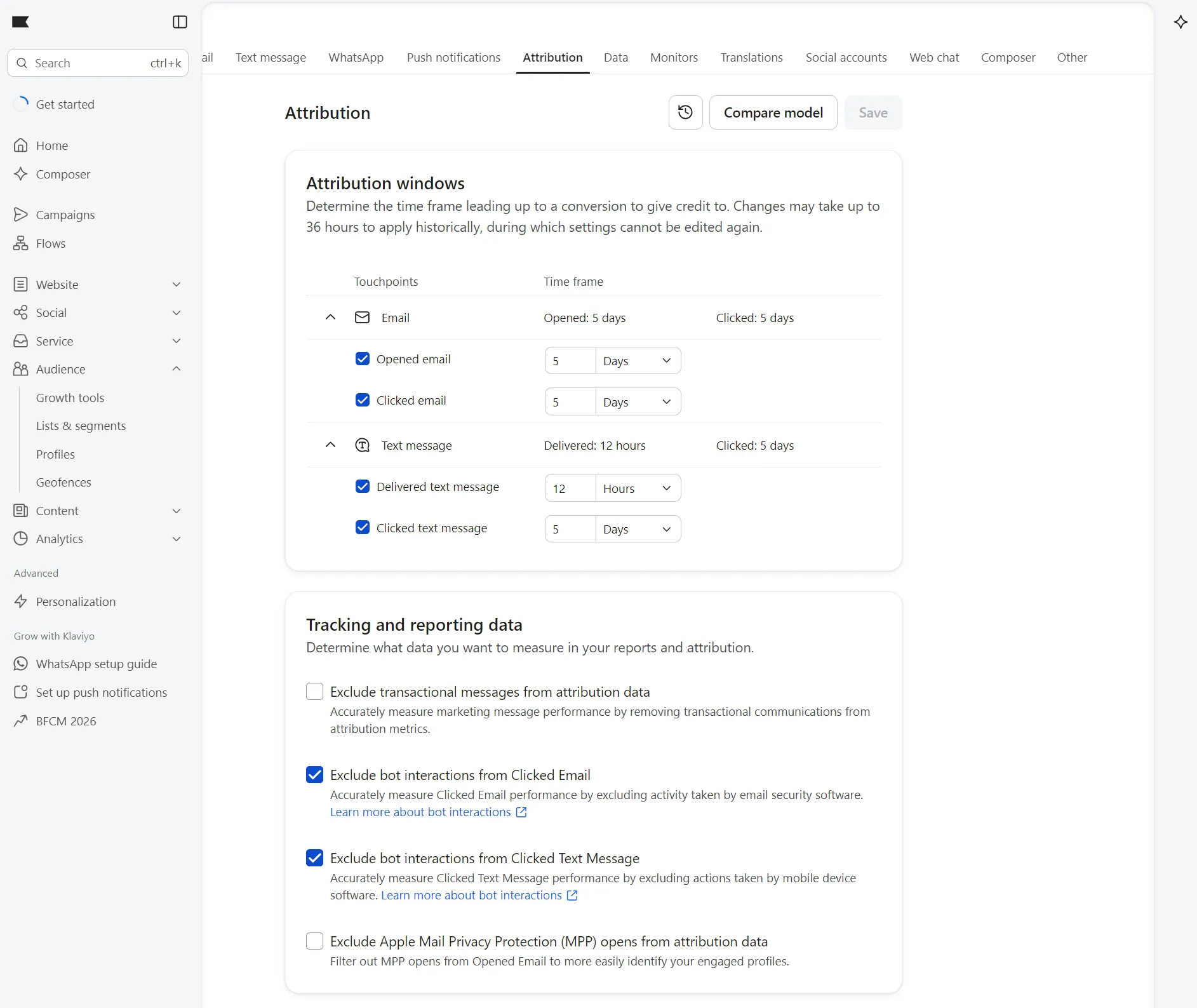
Both platforms utilize last-touch attribution, though with different default windows (Mailchimp: 30 days, Klaviyo: 5 days), impacting how sales are credited. Klaviyo offers multi-touch attribution as part of its "Personalization" add-on. Mailchimp’s "Conversion insights" and "Customers" tabs (Standard and Premium) provide predictive analytics on purchase likelihood and churn risk, similar to Klaviyo’s predictive segment conditions and Personalization add-on.
Support Responsiveness and Quality
Mailchimp delivered quicker initial responses to support inquiries, with a median first human response time of 24 minutes compared to Klaviyo’s 30 minutes. However, Klaviyo demonstrated superior resolution rates, answering every ticket and chat. Mailchimp, in contrast, took approximately 17 days to respond to one technical ticket (despite follow-ups) and left two out of five live chats unanswered, indicating inconsistencies in support quality. Both platforms restrict human live chat and email support to paid plans or initial trial periods. Klaviyo offers 24/7 email and 24/5 live chat on paid plans, with faster options under professional packages. Mailchimp provides 24/7 email and live chat on paid plans, with phone and priority support reserved for its Premium tier.
Broader Impact and Implications: Strategic Choices for Businesses
The findings of this comprehensive evaluation underscore a clear divergence in the strategic positioning of Klaviyo and Mailchimp. Klaviyo is meticulously engineered as an e-commerce-first platform, offering unparalleled depth in Shopify integration, granular customer data tracking, and sophisticated automation tailored to online retail. Its ability to sync all customer data, accurately track revenue, and provide branching flows even on its entry-level paid plan makes it an indispensable tool for businesses whose revenue is intricately linked to automated, data-driven customer journeys. The native multi-channel support, including WhatsApp, further solidifies its position for modern e-commerce brands seeking holistic engagement strategies.
Mailchimp, while a robust and user-friendly platform, appears to cater to a broader audience, with its strengths lying in ease of campaign creation, efficient brand integration, and cost-effectiveness for managing large contact lists. Its tiered feature gating means that advanced e-commerce functionalities like branching automations and unlimited segment conditions are reserved for higher-priced plans, which might dilute its value proposition for rapidly scaling online stores. The observed inconsistencies in Shopify data sync and currency conversion also present potential challenges for e-commerce businesses requiring precise financial reporting and customer journey mapping.
For a new e-commerce store on Shopify, the choice between these two platforms hinges on immediate and future needs. If the business model heavily relies on personalized, automated flows triggered by browsing and buying behavior, and requires seamless integration with multi-channel messaging, Klaviyo offers a more robust and scalable solution from the outset. The investment in Klaviyo’s Email plan is justified by the advanced capabilities it unlocks, directly impacting conversion rates and customer lifetime value.
Conversely, for businesses with established large contact lists, primarily focused on regular newsletter campaigns, and operating with tighter budget constraints, Mailchimp, particularly its Standard plan, presents a highly competitive option. Its faster campaign build times and lower cost at higher contact volumes can be advantageous. However, such businesses must be prepared to manage potential data synchronization nuances and consider Mailchimp’s limitations in native multi-channel support and advanced e-commerce automation.
When to Consider Moving from Mailchimp to Klaviyo
The evaluation strongly suggests that businesses whose revenue critically depends on ensuring every new buyer receives post-purchase emails, and who require detailed tracking of every product view and checkout start, should consider migrating to Klaviyo. The test revealed that Mailchimp’s inconsistent syncing of opt-in customers meant two new buyers missed critical post-purchase emails, a potentially significant revenue loss. Klaviyo’s consistent logging of customer activity provides a reliable foundation for highly personalized and timely communications.
When to Remain with Mailchimp
Businesses primarily focused on sending campaigns and requiring only basic welcome and abandoned checkout flows may find Mailchimp sufficient. Its efficiency in campaign creation and competitive pricing for large lists (especially Mailchimp Standard at 10,000+ contacts) make it an attractive option. Mailchimp’s pop-up builder, with 119 templates and targeting options, is also a strong point for lead capture.
Considering Alternatives: Omnisend’s Position
For businesses seeking a balance of functionality and cost-effectiveness, Omnisend emerges as a notable alternative. At 10,000 contacts, Omnisend’s Standard plan is priced at $132/month, positioning it competitively against Klaviyo’s Email plan ($150/month) and Mailchimp Standard ($135/month). Omnisend offers 24/7 live chat support and its Customer Lifecycle Map, based on RFM (Recency, Frequency, Monetary value) analysis, across all plans. Omnisend also provides a free migration service for businesses with 250 or more contacts, promising to import contacts and rebuild assets, including flows and segments, within five business days. Its strength lies in quick setup of segments, flows, and reports, underpinned by a native Shopify integration, making it a compelling choice for e-commerce brands looking for efficient, integrated marketing.
Frequently Asked Questions
-
Is Klaviyo more expensive than Mailchimp?
Yes, Klaviyo typically costs more at the entry level. Its $20/month Email plan is $7 more than Mailchimp Essentials, which has limitations on automation flows. Mailchimp Standard, which offers comparable automation features, matches Klaviyo’s price up to 5,000 contacts but becomes more cost-effective from 10,000 contacts upwards.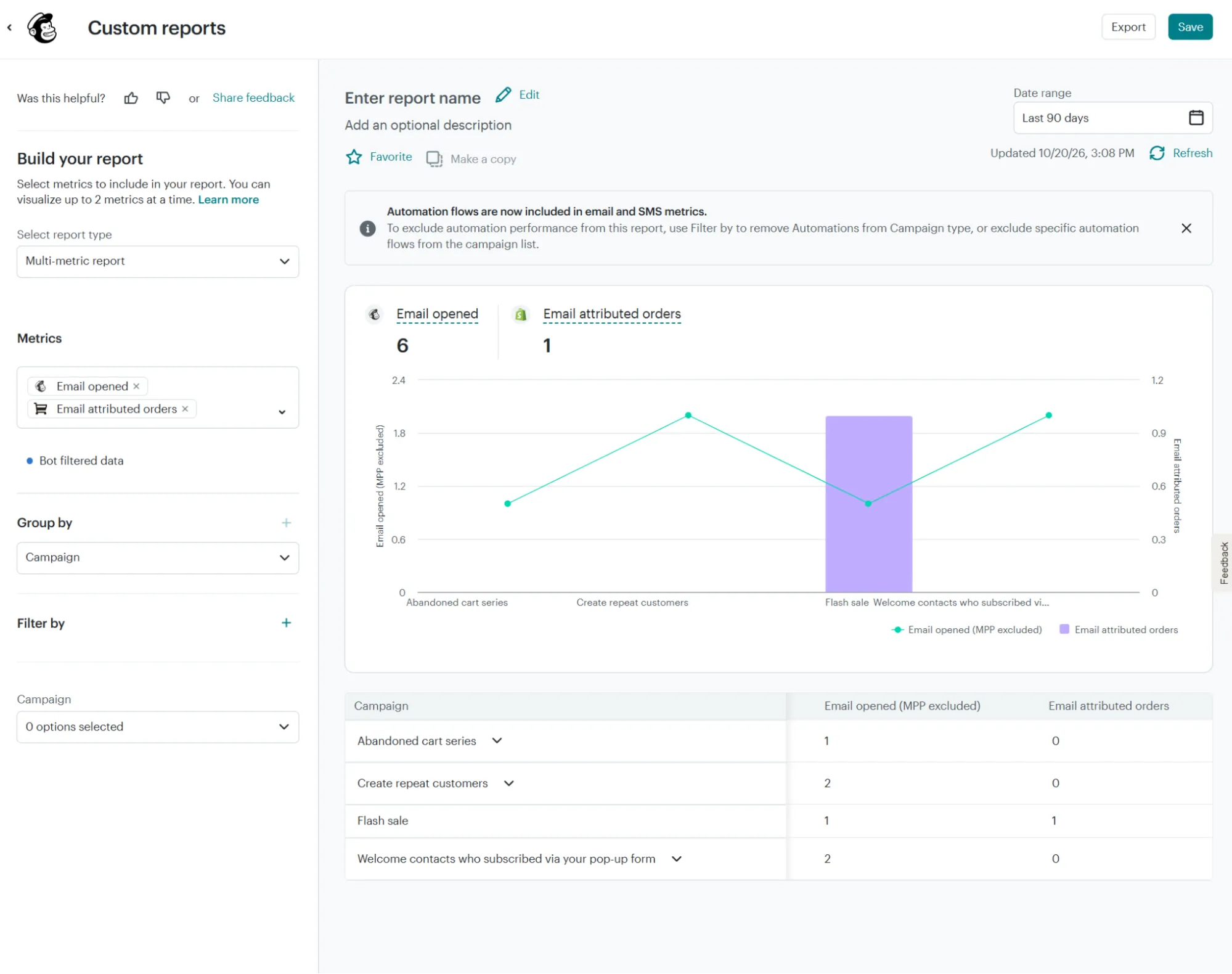
-
What’s the main difference between Klaviyo and Mailchimp?
The core difference is their primary focus: Klaviyo is explicitly e-commerce-first, designed for deep integration with online stores like Shopify to power automated, data-driven marketing. Mailchimp is campaign-first, catering to broader marketing needs with a strong emphasis on ease of use for general email campaigns, though it has expanded its e-commerce capabilities. -
Do Klaviyo and Mailchimp both work with Shopify?
Yes, both Klaviyo and Mailchimp offer dedicated Shopify apps for integration. During testing, Klaviyo’s onboarding and installation for Shopify took 4 minutes and 13 seconds, while Mailchimp’s took 7 minutes and 39 seconds.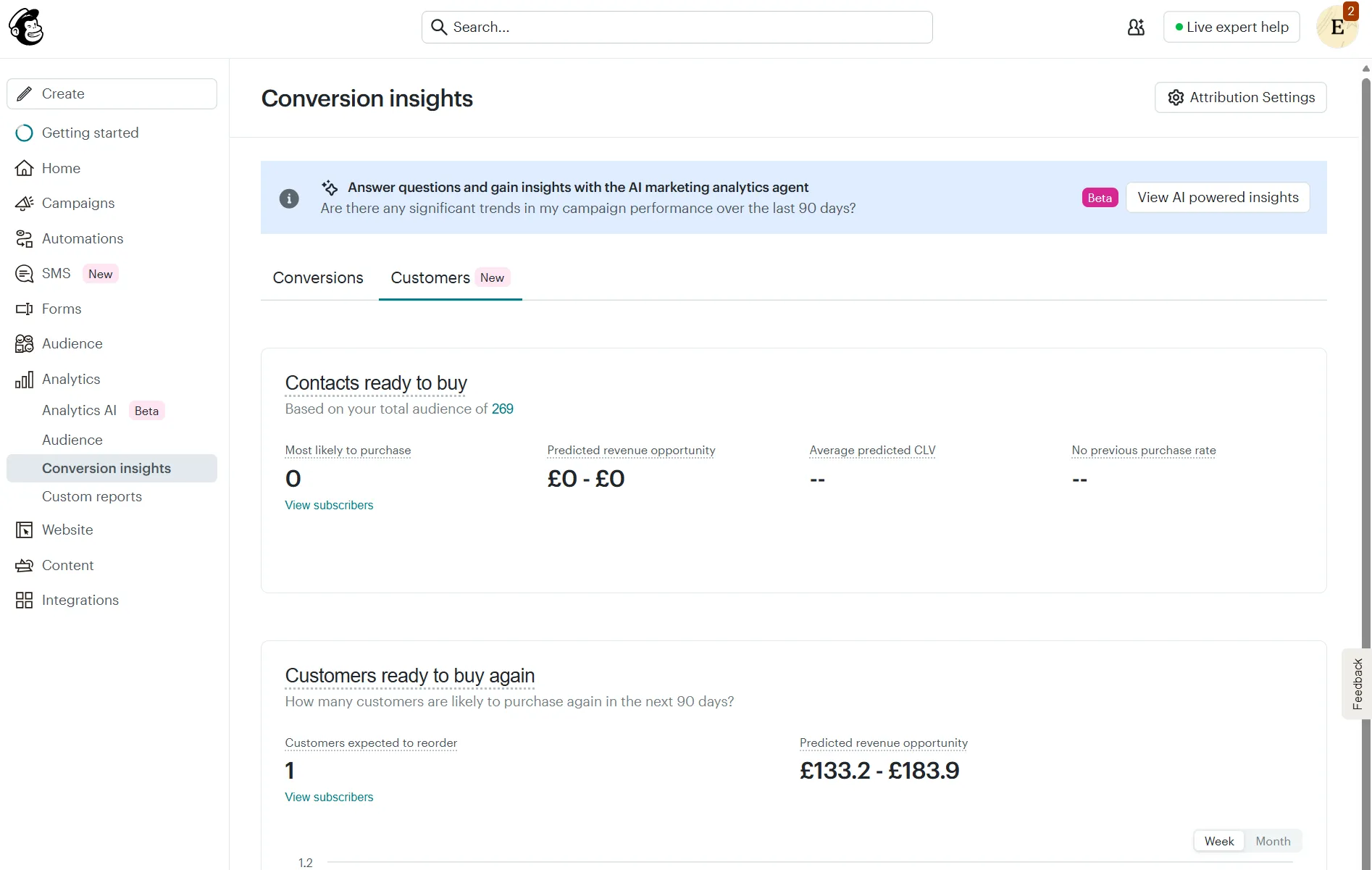
-
What are Klaviyo’s weaknesses compared with Mailchimp?
Klaviyo charges extra for social media marketing, and its Email plan is more expensive than Mailchimp’s Standard plan at 10,000 contacts and above. In testing, Klaviyo’s segments updated slower (12-14 minutes vs. Mailchimp’s 5 seconds), and its brand setup required manual input, unlike Mailchimp’s automated URL import. -
Is a free plan enough to test Klaviyo or Mailchimp properly?
No, neither free plan is sufficient for a comprehensive test of e-commerce automation. Klaviyo’s Free plan limits users to three live automated messages, while Mailchimp’s Free plan offers no automations at all. Essential e-commerce flows like welcome and abandoned checkout would exceed these limitations or require paid plans.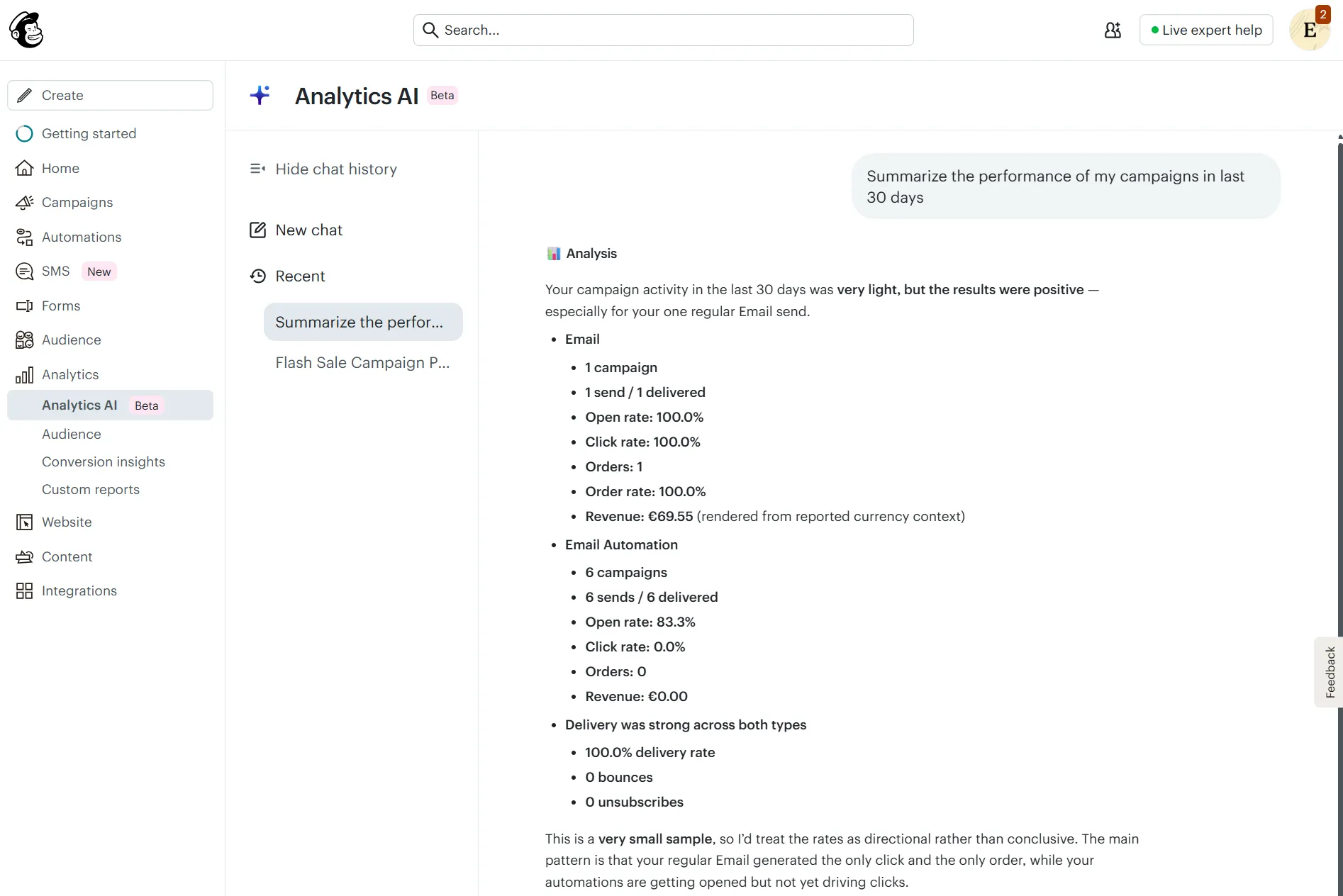
-
Is Mailchimp’s cheapest paid plan enough for an e-commerce store?
Mailchimp Essentials (the cheapest paid plan) is generally not enough for sophisticated e-commerce needs. It caps automation flows at four steps and lacks advanced features such as branching flows, generative AI (beyond basic layouts), dynamic content, custom reports, send time optimization, and predictive or advanced segmentation, which are crucial for optimizing e-commerce marketing.

 Nila Kartika Wati
 Nana Muazin