Raul Delapena Setiawan
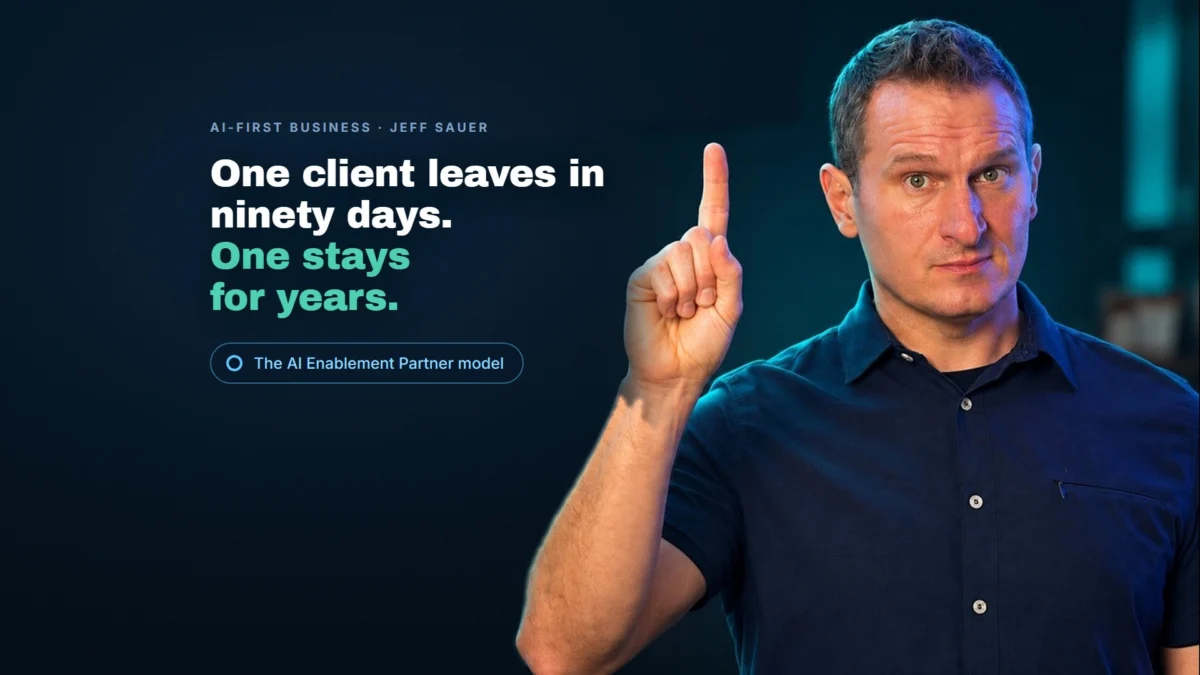
The rapid proliferation of generative artificial intelligence has created a paradoxical challenge for digital service providers: while the demand for AI implementation is at an all-time high, the longevity of client engagements is increasingly fragile. Industry data suggests that many AI-focused projects suffer from a "one-and-done" cycle, where clients exit immediately after the initial deployment, leaving consultants in a perpetual state of lead generation. Jeff Sauer, a veteran digital marketing strategist and agency founder who scaled an eight-figure business before transitioning to professional coaching, has identified a structural shift in the market that addresses this instability. By moving away from traditional project-based billing toward an "AI Enablement Partner" model, consultants can secure long-term revenue while providing the continuous technical oversight that modern AI systems require.
The Structural Fragility of Project-Based AI Services
In the current technological landscape, the traditional agency retainer model is facing a crisis of perceived value. Historically, retainers were built on the premise of maintaining static systems or providing ongoing creative labor. However, AI infrastructure is inherently volatile. Unlike legacy software, AI models such as OpenAI’s GPT series or Anthropic’s Claude are subject to frequent updates, deprecations, and shifts in performance parameters.
When a consultant builds an automation system for a client, that system is often tied to specific API versions or model behaviors. If a model is retired—as was the case with several early iterations of Claude and GPT-4—the client’s automated workflows may break or degrade in quality. Most small to medium-sized enterprises (SMEs) do not have internal staff dedicated to monitoring model announcements or technical documentation. Consequently, a "finished" project can become a liability within months if not actively managed. Sauer notes that approximately one-third of agency clients who terminate engagements cite a "lack of perceived value over time." In the AI sector, this lack of value is often a direct result of systems becoming obsolete due to the rapid pace of external innovation.
Categorizing the AI Market: DIYers vs. Enablement Clients
To solve the retention issue, service providers must distinguish between two primary client archetypes. This classification determines the long-term viability of the business relationship and the appropriate pricing strategy.
The DIYer: The Inspiration-Seeker
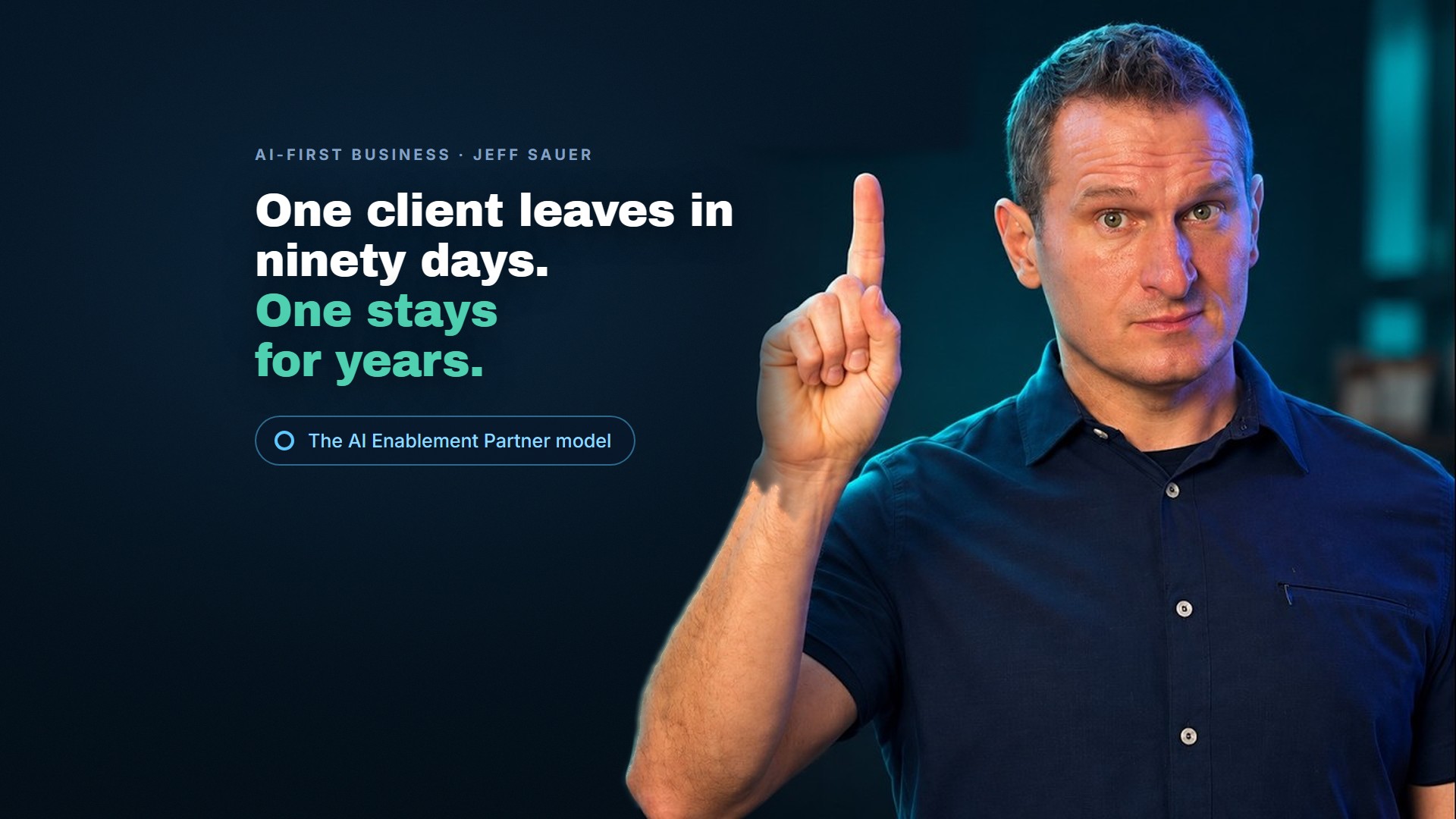
The first category consists of "Do-It-Yourself" clients. These are often entrepreneurs or technical leads who are personally interested in AI but lack the initial direction to begin. They hire consultants as a "fuse lighter"—a source of inspiration and initial training. Once these clients understand the prompt engineering or automation frameworks required, they take the implementation in-house. While these engagements can be high-intensity and provide significant upfront value, they rarely last beyond 90 days. For an agency, a portfolio dominated by DIYers leads to high churn and eventual burnout.
The AI Enablement Client: The Outcome-Seeker
The second category represents the "AI Enablement" client. This group recognizes the transformative power of AI but has no desire to manage the technical execution. They prioritize business outcomes over technical knowledge. For these clients, the barrier to AI adoption is not a lack of interest, but a lack of time and a reluctance to increase headcount. Hiring a full-time Chief AI Officer (CAIO) is a cost-prohibitive measure for most SMEs, involving significant salaries, benefits, and organizational complexity. The Enablement Partner fills this gap as a "fractional" expert—providing high-level strategy and execution at a fraction of the cost of a full-time executive hire.
Chronology of the 90-Day AI Enablement Framework
The transition from a one-off consultant to a long-term partner requires a structured onboarding process. Sauer proposes a 90-day arc designed to move the client from initial skepticism to verified ROI.
Phase 1: Alignment and Discovery (Days 1–30)
The first month is dedicated to "meeting the client where they are." This involves an audit of existing workflows and identifying the highest-leverage opportunities for automation. The goal is to move beyond AI "lingo" and focus on specific business pain points, such as lead generation bottlenecks or content production delays.
Phase 2: Execution and Minimum Viable Project (Days 31–60)
The second month focuses on the delivery of a tangible project. This is the "proof of concept" phase. By building a functional AI tool—such as an automated CRM update system or a custom data dashboard—the consultant demonstrates that AI is a practical utility rather than a theoretical concept.
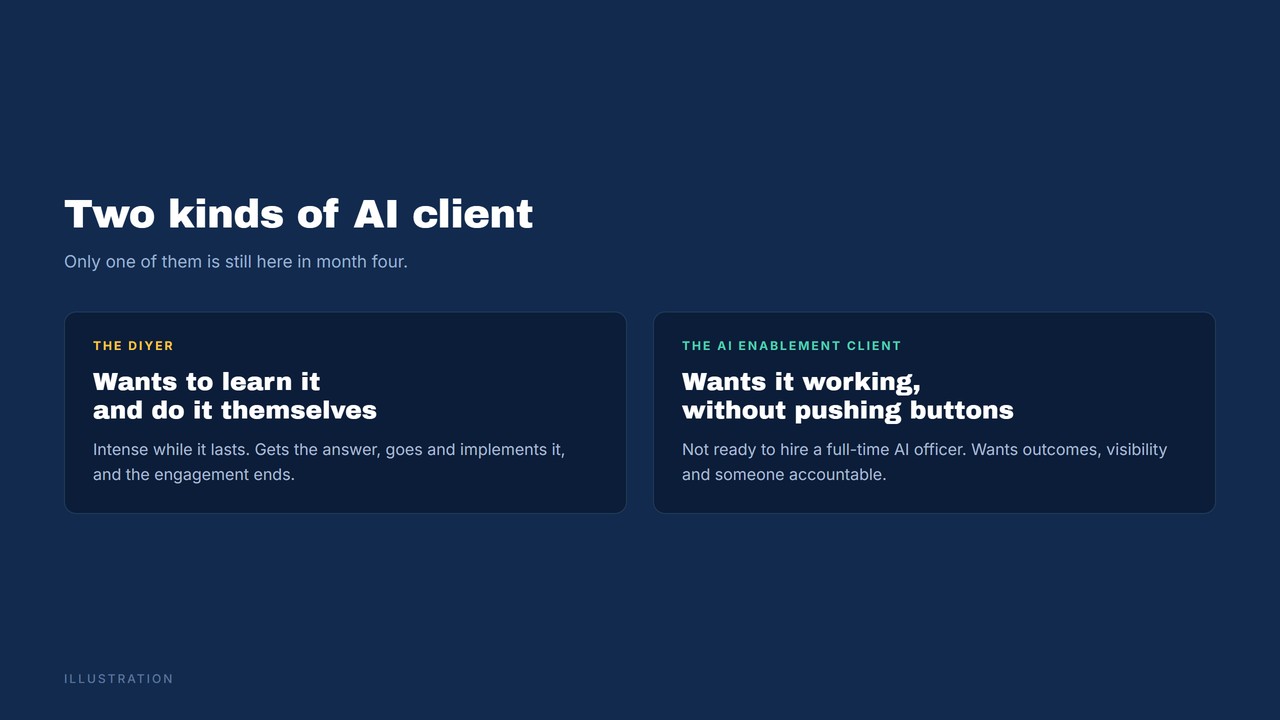
Phase 3: Validation and Transition (Days 61–90)
The final month of the initial engagement is used to provide empirical proof of performance. The consultant tracks the time saved, the cost reduced, or the revenue generated by the new AI systems. This phase is critical for converting the relationship into a long-term retainer. At the 90-day mark, the client either takes over the system (reverting to a DIY status) or, more commonly, realizes that the ongoing maintenance and evolution of the system require the consultant’s continued involvement.
Financial Analysis and Pricing Strategies
The AI Enablement model shifts the pricing conversation from "hours worked" to "accountability provided." In this framework, the partner is not paid for being available; they are paid for the continuous success of the AI implementations.
Market data suggests that fractional AI roles can command significant monthly fees depending on the complexity of the business and the scale of the implementation.
- Small-Scale Implementations: $2,000 to $4,000 per month. Suitable for solopreneurs or small teams needing basic workflow automation.
- Mid-Market Partnerships: $5,000 to $8,000 per month. Involves embedding AI across multiple departments, such as sales, marketing, and operations.
- Enterprise-Level Fractional Support: $10,000 to $15,000+ per month. Requires high-level strategic oversight and integration with complex legacy systems.
For a consultant or small agency, maintaining a roster of five to ten such clients can generate annual revenues between $180,000 and $420,000. This model provides the financial stability necessary to stay ahead of AI trends, which in turn increases the value provided back to the client.
Supporting Data: The Economic Advantage of Fractional AI
The shift toward fractional enablement is supported by broader economic trends in the professional services sector. According to a 2023 report on the "Fractional Economy," companies are increasingly moving away from massive agency contracts in favor of specialized, agile partners.
Furthermore, the cost of AI implementation has plummeted. Projects that previously required a team of data scientists and months of development can now be executed by a single expert using low-code automation tools and LLMs. This "cost advantage" allows consultants to deliver high-value results while maintaining healthy margins. The client benefits from getting projects off their "to-do" list that were previously deemed too expensive or complex to tackle.
Broader Implications for the Professional Services Industry
The rise of the AI Enablement Partner signals a fundamental change in how expertise is sold. As AI continues to democratize technical skills, the value of "knowing how to push the buttons" will diminish. The real value will lie in "knowing which buttons to push" and being accountable for the results.
This model also creates an "unexpected upside" for service providers: specialization through execution. By working as an enablement partner, consultants often discover niche needs within their client base. For example, a marketing consultant might find themselves becoming an expert in AI-driven web development or CRM architecture. These specialized skills, honed through real-world application, become the foundation for a unique market position that is difficult for competitors to replicate.
Conclusion and Strategic Outlook
The next 24 months will likely see a consolidation in the AI consulting space. Generalists who offer one-time setups will face increasing competition and downward pricing pressure as tools become more user-friendly. Conversely, those who position themselves as long-term Enablement Partners will find themselves embedded in their clients’ core operations.
The 90-day method provides a roadmap for this transition. By focusing on accountability over availability and outcomes over hours, consultants can escape the "hunter-gatherer" cycle of project work. As the ground continues to move under the foundations of modern business, the most valuable asset a company can have is a partner who is dedicated to keeping their AI systems functional, relevant, and profitable. For the service provider, this is the path to a sustainable, high-margin business in the age of automation.


 rifanmuazin
 Evan Lee Salim