Suro Senen
The landscape of digital marketing is perpetually in flux, yet few elements are as foundational and simultaneously vulnerable as an organization’s email list. Far from a static asset, an email database is a living, breathing entity that undergoes constant change and, crucially, decay. Factors such as job changes, abandoned inboxes, and domain expirations contribute to an estimated annual decay rate of 20-30% for most email lists. This inherent volatility means that neglecting email list hygiene is not merely a passive oversight; it actively undermines marketing efforts, leading to a cascade of detrimental consequences. In the fiercely competitive and increasingly regulated digital environment of 2026, robust email list quality and consistent verification are no longer merely advantageous—they are the unequivocal baseline for any marketer aiming for their messages to land, resonate, and perform.
The Evolving Landscape of Email Marketing: A Chronology of Necessity
Email marketing has traversed a significant journey since its inception, evolving from rudimentary bulk messaging to a sophisticated, data-driven discipline. In the early 2000s, the "Wild West" era of email saw a proliferation of unsolicited messages, prompting the introduction of legislation such as the CAN-SPAM Act in the United States in 2003. This marked a pivotal shift towards regulating commercial email, demanding clear identification of sender, opt-out mechanisms, and honest subject lines. While CAN-SPAM established basic ground rules, the mid-2010s ushered in an era where engagement metrics became paramount. Marketers moved beyond sheer volume, focusing on segmentation, personalization, and fostering genuine connections with subscribers. This period also saw the rise of more sophisticated Email Service Providers (ESPs) and advanced analytics tools, making email performance a measurable component of overall marketing strategy.
The late 2010s brought a seismic shift with the enactment of stringent global data privacy regulations. The General Data Protection Regulation (GDPR) in the European Union in 2018, followed by the California Consumer Privacy Act (CCPA) in 2020, fundamentally reshaped how organizations collect, store, and process personal data, including email addresses. These regulations placed a heavy emphasis on explicit consent, data accuracy, and the right to be forgotten, elevating data quality from a technical concern to a legal imperative. Concurrently, mailbox providers (MBPs) like Gmail, Outlook, and Yahoo dramatically enhanced their spam filtering capabilities, leveraging artificial intelligence and machine learning to detect and block suspicious sending patterns. This escalating sophistication of spam filters, coupled with the rising tide of sophisticated bot attacks designed to generate fake sign-ups and compromise systems, has created an environment where the margin for error in email marketing has shrunk to an unprecedented degree. Industry analysts consistently highlight that maintaining a pristine sender reputation is now a delicate balancing act, requiring continuous vigilance and proactive measures. By 2026, as the industry continues to mature and regulations tighten further, email verification has solidified its status as an indispensable "table stakes" requirement for marketers to ensure their emails cut through the noise and reach their intended recipients.
The Core Mandate: Why Email Verification is Indispensable
At its heart, email verification is the process of confirming that an email address is valid, active, and safe to send to. For marketing leaders, this foundational step is critical not only for protecting brand reputation but also for safeguarding substantial campaign investments. However, the modern approach to email verification extends far beyond a simple syntax check. It involves a sophisticated, multi-layered analysis of an address’s authenticity and associated risk factors before any email is even attempted. This comprehensive process typically scrutinizes several key attributes:
- Syntax Validation: Ensuring the email address adheres to standard formatting rules (e.g., presence of "@" and a domain).
- Domain Validation: Confirming that the domain exists and is configured to receive emails.
- MX Record Check: Verifying the Mail Exchange records to ensure the domain has a valid mail server.
- SMTP Connection and User Verification: Attempting to connect to the mail server to confirm the user account exists, often without sending an actual email.
- Spam Trap and Bot Detection: Identifying addresses known to be spam traps or associated with malicious bot activity.
- Temporary/Disposable Email Detection: Flagging addresses from services that provide temporary, self-destructing email accounts.
- Greylisting Detection: Identifying servers that temporarily reject emails from unknown senders, which can impact deliverability.
By acting as a critical filter between an organization’s database and its "send" button, email verification proactively safeguards the entire email marketing program. It ensures that every communication effort is directed towards genuine, engaged prospects, thereby optimizing resource allocation and maximizing the potential for meaningful interactions.
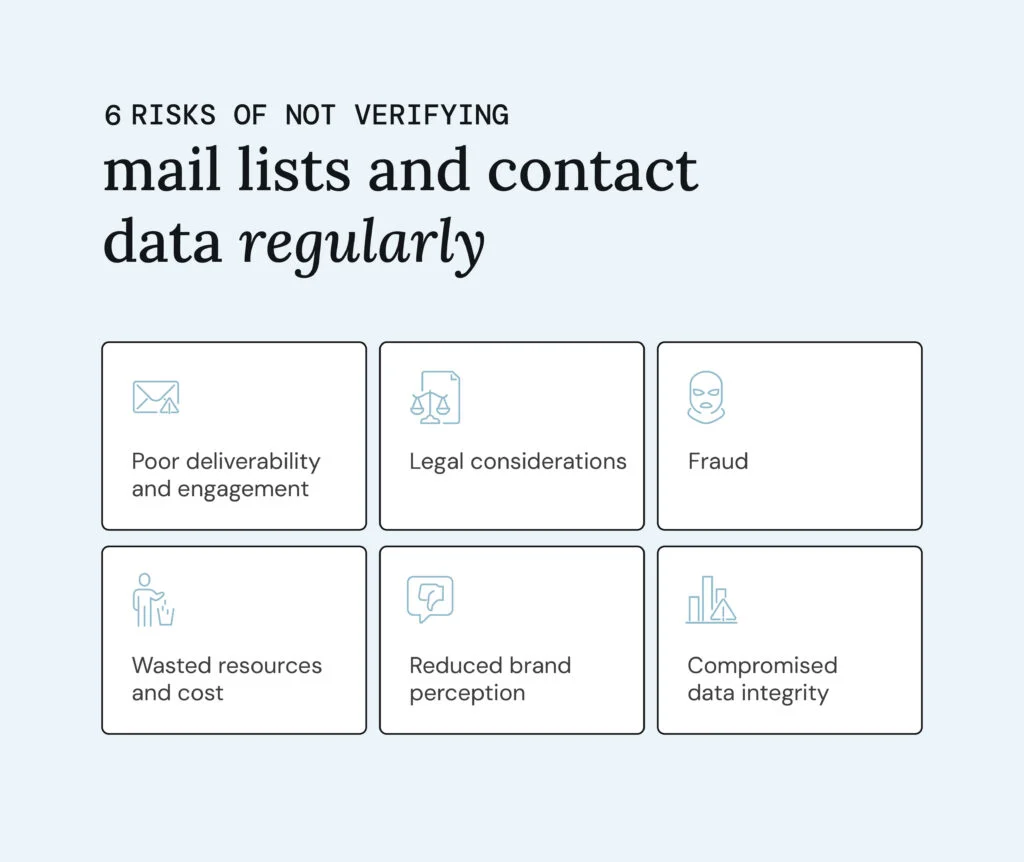
Six Critical Risks of Neglecting Email List Hygiene
Failing to regularly verify email lists in the current digital climate exposes organizations to a multitude of severe risks, impacting everything from immediate campaign performance to long-term brand equity and legal standing. Marketing executives increasingly acknowledge that neglecting this seemingly technical task can have profound strategic implications.
1. Decimated Deliverability and Engagement
One of the most immediate and frustrating consequences of a poor email list is the significant degradation of deliverability. High bounce rates, which occur when emails are sent to invalid or non-existent addresses, serve as a potent red flag to mailbox providers. These providers interpret a high bounce rate as an indicator of a low-quality sender, potentially categorizing the sender as untrustworthy or even spammy. The result is often that carefully crafted campaigns are diverted directly to the spam folder, never reaching their intended audience. Industry data underscores this challenge: despite best efforts, approximately one in every seven legitimate emails already fails to reach the inbox, even for valid subscribers. Neglecting list validation merely compounds this risk.

Beyond bounce rates, a compromised sender reputation – encompassing both IP address and domain reputation – has a ripple effect. Once a domain is associated with spam-like behavior, it becomes increasingly difficult for any emails from that domain, even those to legitimate and engaged contacts, to reach the inbox. This directly impacts critical engagement metrics such as open rates, click-through rates, and ultimately, conversion rates. When emails consistently fail to reach the inbox, subscribers are unable to engage with content, leading to a cycle of declining engagement and further damage to sender reputation. Regular validation, conversely, is proven to improve email deliverability by ensuring messages are sent only to real, active contacts, who are far more likely to engage with the brand.
2. Navigating the Complex Web of Legal and Regulatory Compliance
In an era of heightened data privacy awareness, maintaining a clean and verified email list is not just good practice; it’s a legal imperative. Organizations operating globally or interacting with customers across different jurisdictions must contend with a patchwork of stringent regulations. The GDPR mandates explicit consent for data processing and requires organizations to maintain accurate and up-to-date personal data. Sending unsolicited emails to unverified addresses, or holding onto outdated personal data, can constitute a breach of these principles, potentially leading to substantial fines—up to €20 million or 4% of annual global turnover, whichever is higher, under GDPR. Similarly, the CCPA grants California consumers significant rights over their personal information, including the right to know and delete. Sending to unverified contacts complicates consent management and demonstrates a lack of due diligence regarding consumer data. In the US, the CAN-SPAM Act, while less stringent than GDPR, still requires accurate sender information, clear opt-out mechanisms, and prohibits misleading headers.
Email verification acts as a crucial first line of defense in consent management. By ensuring that only valid, opted-in addresses are on a list, organizations can better demonstrate compliance with these regulations, protecting themselves from costly legal penalties and the inevitable reputational damage that follows public infractions. Legal practitioners emphasize that proactive data hygiene is paramount for establishing trust and transparency with consumers, which is a cornerstone of ethical marketing practices.
3. The Rising Threat of Fraud and Bot Infiltration
The digital landscape is constantly under siege from sophisticated fraudulent activities, and email lists are a prime target. Fake email sign-ups, often orchestrated by automated bots filling out web forms, pose a significant and growing risk to organizations. These bots can inflate lead counts with bogus data, skewing performance metrics and leading to wasted marketing budgets on non-existent prospects. Beyond immediate marketing impact, bots can exploit free trials, consume valuable server space, and degrade the quality of service for legitimate users, driving up operational costs.
More insidiously, large volumes of fake email data can corrupt analytics and machine learning models, making it harder to accurately identify genuine security threats or understand true customer behavior. In some cases, fake profiles can be leveraged to gather sensitive data from real users through social engineering tactics or to disseminate malicious software and misinformation. A robust email verification process, particularly at the point of sign-up, is a powerful deterrent against bot traffic. It acts as a gatekeeper, preventing fraudulent entries from infiltrating the database and ensuring that marketing efforts are directed solely towards genuine, high-potential prospects. Cybersecurity experts warn that a clean email database is significantly more resilient to penetration and exploitation by malicious actors.
4. Exorbitant Costs and Wasted Marketing Spend
Neglecting email verification has a direct and tangible impact on an organization’s marketing budget. Most Email Service Providers (ESPs) employ pricing models that are based either on the total number of contacts stored in the database or the volume of emails sent per month. When a significant portion of a list comprises invalid or non-existent email addresses, organizations are effectively paying to store and send messages to recipients who will never receive them. Consider a large-scale campaign targeting hundreds of thousands of contacts; even a modest percentage of invalid emails can translate into thousands of dollars wasted on messages that contribute nothing to ROI.
Beyond these direct costs, there are substantial indirect resource and cost implications. Marketing teams spend valuable time and effort crafting content, designing campaigns, and analyzing performance data, only for these efforts to be diluted by bad data. The internal costs associated with tracking down invalid email addresses, cleaning lists manually, or dealing with deliverability issues can be significant, draining resources and impacting team morale. A clean, verified email list ensures that every penny of the marketing budget is allocated efficiently, targeting real individuals who have the potential to engage and convert, thereby maximizing ROI potential and streamlining internal operations.
5. Erosion of Brand Perception and Trust
Organizations invest considerable time, effort, and creativity into developing compelling email campaigns designed to enhance brand image and foster customer loyalty. However, all this meticulous planning can be undone in an instant by poor email verification practices. When emails consistently land in recipients’ spam folders, it creates a profoundly negative association with the brand. Spam folders are universally linked with unsolicited, low-quality, or even fraudulent content. If a brand’s communications are perpetually routed to this digital wasteland, that perception quickly takes hold, irrespective of the actual quality or value of the content.
This constant association with spam can significantly damage brand perception, eroding brand equity and undermining customer trust. Once mailbox providers begin to flag a domain for spam-like behavior, recovering a positive sender reputation and restoring deliverability becomes an arduous, time-consuming, and often costly process. This negative perception can deter potential customers, diminish existing customer loyalty, and make future marketing endeavors considerably more challenging. Maintaining a pristine inbox presence is therefore crucial for preserving brand integrity and ensuring that marketing messages contribute positively to the customer’s overall brand experience.
6. Compromised Data Integrity and Flawed Strategic Decisions
Ultimately, the efficacy of any email marketing strategy is inextricably linked to the quality and reliability of its underlying data. If contact data is unreliable, the domino effect can be devastating across the entire marketing ecosystem. Inaccurate data leads to flawed segmentation, meaning messages are sent to the wrong audience or fail to resonate due to incorrect targeting. This, in turn, renders personalization efforts ineffective, as the fundamental data points required for tailored content are incorrect.
Furthermore, compromised data integrity skews analytics and reporting. A/B tests yield unreliable results, campaign performance metrics become distorted, and insights derived from customer behavior are fundamentally flawed. This distorted picture can lead marketing leaders to make poor strategic decisions, allocating resources based on erroneous assumptions about audience engagement or campaign effectiveness. Bad data permeates through CRM systems, impacting sales outreach, customer service interactions, and ultimately, the overall customer experience. Email verification keeps the data foundation solid, ensuring that every subsequent layer of marketing strategy – from segmentation to personalization to performance analysis – is built upon accurate, trustworthy information, enabling truly data-driven decision-making.
Strategic Approaches to Robust Email Data Quality
Given the critical importance of email verification, organizations cannot afford a passive approach. Instead, the most effective teams implement a multi-layered strategy combining proactive measures with continuous monitoring. There is no single "perfect" solution, but rather a combination of best practices:
- Real-Time Verification at Point of Entry: Implementing verification tools directly into web forms, sign-up pages, and checkout processes. This prevents bad data from entering the database in the first place, blocking bots and identifying invalid addresses before they become a problem.
- Batch Verification for Existing Lists: Regularly processing existing email databases through an automated verification service. This helps to identify and remove stale, invalid, or risky addresses that have accumulated over time due combating the natural decay of lists.
- Integrate with CRM and ESP Platforms: Ensuring that verification processes are seamlessly integrated with customer relationship management (CRM) systems and Email Service Providers (ESPs). This allows for automated cleaning and maintenance, keeping all connected systems synchronized with accurate data.
- Regular Audits and Monitoring: Beyond automated tools, establishing a schedule for manual audits of list segments, monitoring bounce rates and engagement metrics closely, and adjusting strategies based on performance insights.
- Consent Management Best Practices: Reinforcing clear opt-in processes, double opt-in where appropriate, and transparent privacy policies to ensure all collected emails are legitimately acquired.
Leveraging automated email verification services, such as Validity’s BriteVerify, allows organizations to implement both batch and real-time strategies effectively. This comprehensive approach establishes a robust defense against the insidious spread of false email data, contributing significantly to a more reliable, efficient, and trustworthy communication ecosystem.
Beyond Mitigation: Unlocking Business Advantages Through Verified Data
The combined risks of poor email list validation underscore a clear message: proactive data hygiene is not just about avoiding penalties or improving deliverability; it’s a strategic opportunity. Organizations that embrace a rigorous approach to email verification can transform potential liabilities into significant competitive advantages.
A verified email list forms the framework for stronger branding, as messages consistently reach their intended audience in the inbox, reinforcing a professional and trustworthy image. It leads to fewer technical failures, reducing the incidence of hard bounces and minimizing the time and resources spent troubleshooting deliverability issues. Most importantly, it results in less wasted budget, ensuring that every dollar spent on email marketing contributes directly to engaging real prospects and generating measurable ROI.
By viewing the assessment and cleaning of email databases as an opportunity, organizations can gain a fresh perspective on their customer base. With fewer "dead ends" and a clearer picture of active, engaged subscribers, marketing teams can build more efficient, robust, and precisely targeted email marketing plans that rely on concrete, actionable data. This precision allows for highly effective personalization, leading to deeper customer relationships and increased customer lifetime value. Marketing thought leaders consistently emphasize that in a data-driven world, the quality of your data is directly proportional to the quality of your insights and the effectiveness of your strategies. In time, an organization’s email marketing communications can evolve into something consumers genuinely anticipate and value, fostering a deeper level of trust and loyalty.
Conclusion: The Future of Email Marketing is Built on Trust and Accuracy
The dynamic nature of email lists, coupled with escalating regulatory demands and increasingly sophisticated digital threats, has irrevocably cemented email verification as a non-negotiable component of modern digital marketing. From safeguarding deliverability and ensuring legal compliance to protecting against fraud, optimizing resource allocation, preserving brand perception, and maintaining data integrity, the implications of a clean email list are far-reaching and fundamental to business success. In the competitive landscape of 2026 and beyond, businesses that prioritize robust email list hygiene will not only avoid the costly pitfalls of neglect but will also unlock enhanced efficiency, stronger customer relationships, and a decisive competitive edge. The future of email marketing is not merely about sending messages; it’s about building trust and fostering genuine connections, a feat achievable only through unwavering commitment to data accuracy and verification.

 Neng Nana

 Layla Zulfa