Muslim

As the global retail landscape prepares for the 2026 holiday season, the role of influencer marketing has shifted from a peripheral promotional tool to a central pillar of high-conversion commerce. With Black Friday 2026 set for November 27, marketing departments are facing an increasingly complex digital environment where timing, platform-specific behavior, and creator selection can determine the success of an entire fiscal quarter. Data derived from an extensive analysis of 508,000 Black Friday posts by U.S. creators—and a broader study of 1.2 million posts worldwide—reveals that the most successful campaigns are those that move beyond the "one-off post" mentality and embrace a rigorous, multi-month operational checklist.
The 2025 season provided a blueprint for these upcoming shifts. Last year, approximately 26% of all creator content during the holiday week was published on Black Friday itself, creating a massive surge in noise and competition. Furthermore, the data suggests a significant disconnect between brand expectations and creator execution: 60% of Instagram creators posted about Black Friday only once, missing the opportunity for sustained engagement and retargeting. For 2026, brands are advised to formalize post counts within contracts and align their platform choices with the specific engagement patterns of creator tiers.
The Strategic Chronology of the 2026 Holiday Season
Success in the creator economy requires a lead time that mirrors traditional supply chain planning. For the 2026 cycle, the campaign lifecycle is divided into seven distinct phases, beginning nearly a full quarter before the first discount goes live.
Phase 1: Strategic Planning and Budget Allocation (Late August to September)
The planning phase, scheduled for late August to late September, is where the foundational KPIs are established. Rather than focusing on "vanity metrics" such as likes or views, performance-driven brands are prioritizing discount code redemptions, cost per acquisition (CPA), and return on investment (ROI).

Economic context for 2026 suggests that consumers are increasingly looking for value, making "product seeding" a vital component of the budget. Analysis shows that Black Friday posts featuring gifted products earned 4.73% engagement per view on Instagram—more than double the 2.10% average. A strategic budget for 2026 should be split four ways: creator fees, product seeding, paid social boosts for top-performing content, and a reserve fund for last-minute opportunities.
Phase 2: Creator Selection and Tier Analysis (Late September to October)
The selection process must be completed by late October. The 2025 data highlights a stark difference in platform performance based on creator size. On Instagram, "nano" and "micro" influencers (1,000 to 10,000 followers) led in engagement across every category, including fashion (3.37%) and beauty (3.07%). Conversely, YouTube performance favored larger channels, with those having 100,000 to 1 million subscribers outperforming smaller creators in tech, home, and fitness categories.
Brands are encouraged to look past follower counts and examine the quality of audience interaction. Comments asking about specific product details—such as shipping times, shades, or sizing—are the primary indicators of a "buying" audience rather than a "passive" one.
Phase 3: Outreach and Relationship Building (October 16 to October 30)
The window for outreach is narrow. By mid-October, top-tier creators are already beginning to fill their holiday calendars. The 2025 data study found that 46% of Instagram posts and 64% of TikTok posts mentioning Black Friday were published before the actual "Cyber Week" began. This suggests that a contract signed in mid-November is already too late to capture the early-bird consumer segment.
Phase 4: Finalizing Contracts and Briefs (October 30 to November 13)
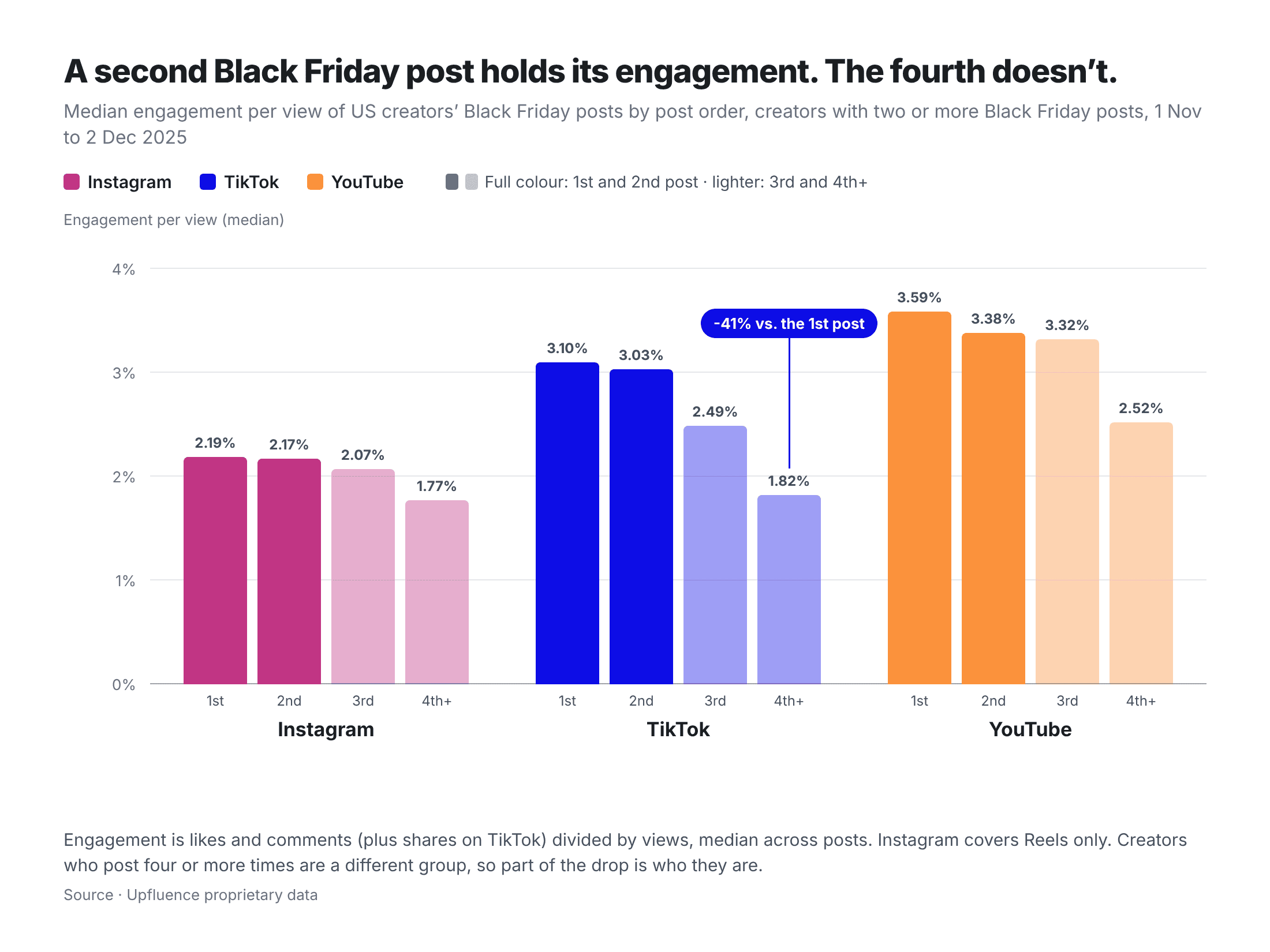
The most critical takeaway from recent data is the "Rule of Three." While 60% of creators naturally post only once, engagement data shows that a second post maintains nearly the same engagement rate (2.2% on Instagram; 3.1% on TikTok). However, engagement begins to decline significantly after the fourth post. Therefore, the 2026 recommendation is to contract for exactly two or three high-quality posts per creator.
Phase 5: Approvals and Legal Compliance (November 13 to November 20)
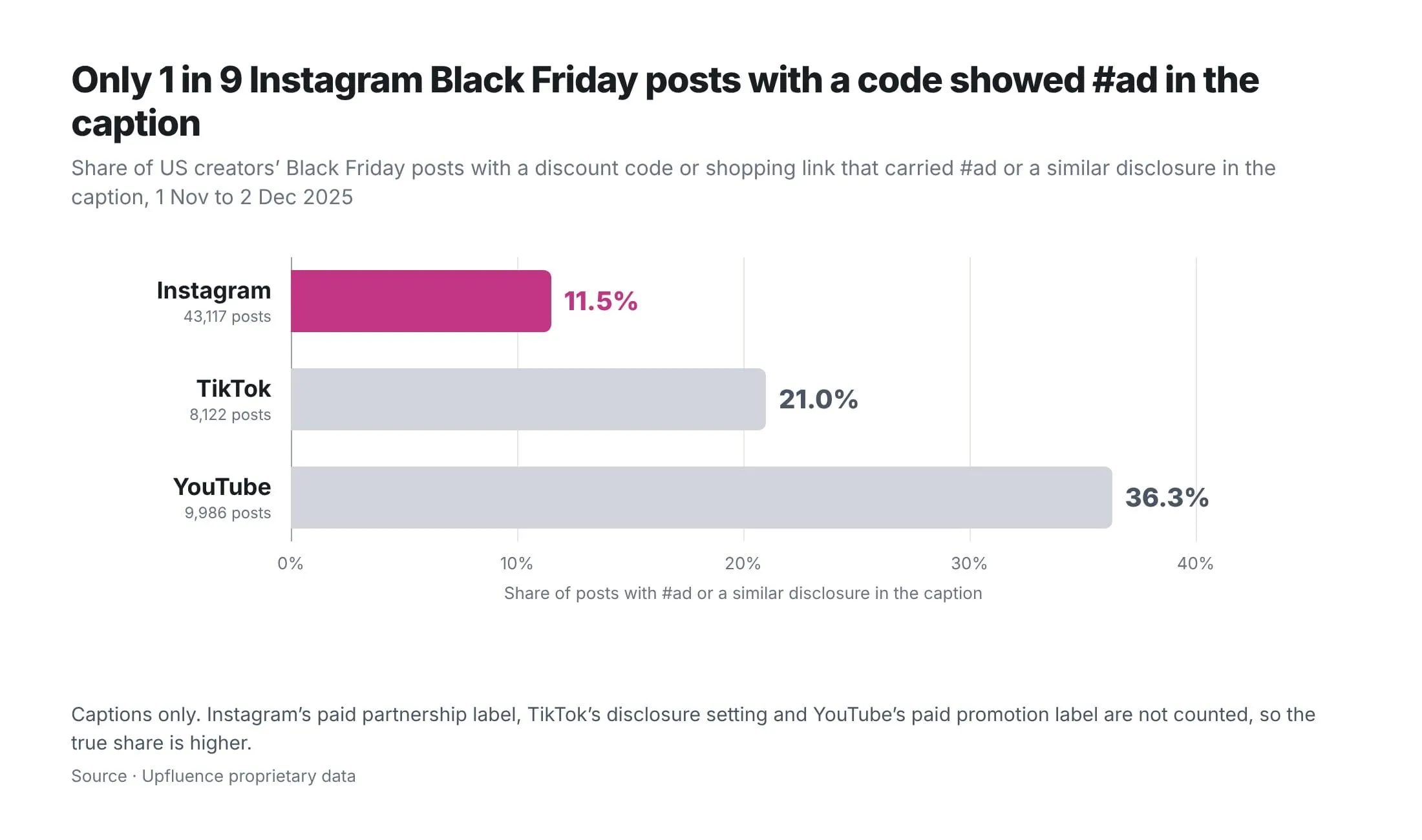
This phase is often the most overlooked by marketing teams. In 2025, only 11.5% of Instagram Black Friday posts containing a discount code or shopping link included a clear disclosure such as #ad or #sponsored in the caption. This lack of transparency poses a significant legal risk as the Federal Trade Commission (FTC) continues to tighten regulations on social media endorsements. Brands must mandate that #ad appears in the first line of the caption to ensure compliance and maintain consumer trust.
Phase 6: The "Go-Live" Execution (November 23 to November 30)
The final week of November represents the peak of the creator surge. In 2025, Instagram posts jumped from 16,000 on the Wednesday before Thanksgiving to 35,000 on Black Friday. TikTok, however, showed a flatter distribution, with steady posting from Monday through Saturday. For 2026, brands should utilize TikTok for the "pre-hype" phase and concentrate Instagram efforts on the high-intensity Friday window.
Phase 7: Post-Mortem and Retention (December 1 to December 14)
The campaign does not end at midnight on Cyber Monday. A two-week post-mortem period is required to calculate total ROI, including the cost of gifted products. The goal of this phase is to identify the top 10% of performers and transition them into long-term brand ambassadors for the 2027 season.
Platform-Specific Performance Data
To optimize spend, brands must understand where their specific niche performs best. The following engagement data from the 2025 season serves as a benchmark for 2026 projections:
- Fashion: Smaller Instagram creators (1K-10K) achieved 3.37% engagement, while large YouTube channels (100K-1M) reached 4.35%.
- Beauty: YouTube remains the dominant platform for tutorials and hauls, with mid-to-large channels averaging 4.80% engagement per view.
- Tech: This category saw the highest success on YouTube, where long-form reviews provided the necessary context for high-ticket purchases, averaging 3.71% for large channels.
- Social Commerce: TikTok has become the leader in integrated shopping. 69.5% of TikTok Black Friday posts worldwide featured a shoppable link, compared to just 10.9% on Instagram.
Implications for the 2026 Retail Market
The broader implications of this data suggest that the "Black Friday" concept is evolving into a "Black November" creator-led event. The extreme concentration of posts on Black Friday itself means that organic reach is more difficult to achieve than ever. Brands that fail to utilize "whitelisting" (putting ad spend behind creator posts) will likely find their content buried by the sheer volume of the 55,000+ posts expected on the peak day.
Industry analysts also point to the rising importance of "authenticity" in disclosure. While only a small fraction of creators used #ad in 2025, the study found that the share of posts with proper disclosure increased by 16% on Instagram and 26% on YouTube in the first half of 2026. This trend indicates that both creators and audiences are becoming more comfortable with the commercial nature of social media, provided the partnership is transparent.
Addressing the "Late-Start" Scenario
For brands that miss the August planning window, the 2026 strategy must pivot to "quality over quantity." A late-start campaign should focus on existing relationships—creators who already know the brand and require minimal onboarding. By cutting the scope of the campaign but maintaining the rigor of the approval and disclosure process, brands can still capture a portion of the holiday market. However, the data remains clear: the highest ROI is reserved for those who begin their outreach at least six weeks before the first snowflake falls.
In conclusion, the 2026 Black Friday season will be defined by strategic timing and platform alignment. By following a structured 7-phase checklist and leveraging the engagement advantages of specific creator tiers, brands can navigate the most competitive shopping window of the year with data-backed confidence. The shift from a single-post tactic to a multi-post, multi-platform strategy is no longer optional—it is the new standard for global retail excellence.

 Basiran

 Azzam Bilal Chamdy