The landscape of document intelligence in South Asia has undergone a significant transformation with the release of Sarvam Vision 2.1, a multimodal model designed to resolve a persistent technical dilemma in Optical Character Recognition (OCR). For decades, enterprise organizations operating in India have been forced to navigate a restrictive trade-off: they could either deploy models with high structural intelligence capable of parsing complex English layouts, or utilize script-specific engines that recognized regional languages but failed to understand document context. Sarvam Vision 2.1 represents the first unified solution that maintains high-fidelity structural parsing while achieving fluency across 22 official Indian languages, effectively eliminating the barrier between layout analysis and linguistic accuracy.
The Structural and Script Dichotomy in Indian Enterprise
To understand the impact of Sarvam Vision 2.1, one must examine the operational hurdles faced by Indian industries. Financial institutions, insurance providers, and government departments handle millions of documents daily that are rarely uniform. An invoice processed by a regional logistics firm may contain headers in English, line items in Hindi, and handwritten annotations in Marathi, all organized within a complex grid. Prior to this release, automation teams had to "daisy-chain" multiple models. An English-centric model like GPT-4o or Gemini might successfully identify the table structure but fail to transcribe the Devanagari text accurately. Conversely, specialized Indic OCR tools could read the characters but would lose the spatial relationships, effectively flattening a ledger into an incoherent string of text.
Sarvam Vision 2.1 introduces a sophisticated extraction layer that moves beyond simple transcription. By integrating structural understanding directly into the vision-language architecture, the model can perform "Key-Value Pairing" and "Table Parsing" across multiple scripts. For a finance team, this means the model does not just read a number; it understands that the number represents a "Tax Amount" because it is situated at the intersection of a specific row and column, regardless of whether the labels are in English or Tamil.
Technical Evolution and Chronology of Development
The journey toward Sarvam Vision 2.1 is rooted in the broader mission of Sarvam AI, a startup founded by veterans of the Indian AI ecosystem who previously contributed to AI4Bharat. The development of this model follows a series of incremental releases aimed at addressing the "Indic data gap."
In late 2023 and early 2024, the Indian AI landscape was primarily dominated by large language models (LLMs) that treated Indian languages as secondary priorities. Sarvam AI began its trajectory by focusing on efficient, sovereign AI development, starting with the release of OpenHathi and later the Sarvam-1 model. The realization that text-only models were insufficient for the "paper-heavy" reality of Indian business led to the pivot toward Vision-Language Models (VLMs).
The development of version 2.1 involved a radical shift in training methodology. Recognizing that synthetic data often fails to capture the nuances of real-world handwriting and degraded paper, the Sarvam team utilized video sources to train the model on the temporal flow of writing. This approach allowed the model to understand how characters are formed in scripts like Malayalam or Bengali, leading to a breakthrough in extracting handwritten data into structured digital fields—a capability previously considered the "holy grail" of Indic OCR.
Benchmarking Performance: A Statistical Deep Dive
The efficacy of Sarvam Vision 2.1 is validated through a rigorous comparison across three major benchmarks: the newly released Indic-OCR-Bench, the community-standard olmOCR-Bench for English, and OmniDocBench v1.6 for structural fidelity.
The Indic-OCR-Bench
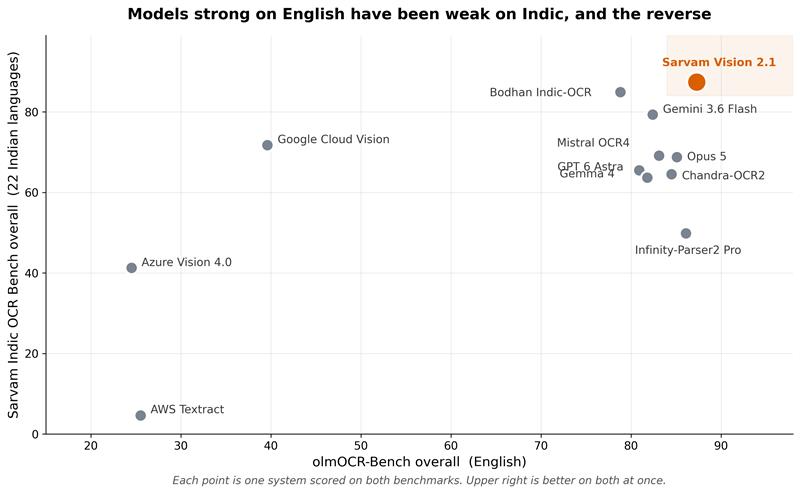
In an effort to promote transparency, Sarvam AI released the Indic-OCR-Bench on Hugging Face, comprising 6,909 samples. This dataset spans all 22 official languages and includes documents dating back to the year 1800. The performance metrics highlight a stark contrast between Sarvam and its competitors. While Google Cloud Vision has long been the incumbent for Indic script recognition, it lacks modern layout intelligence. In contrast, models like Infinity-Parser2 Pro excel at English layouts but see their performance collapse to approximately 49.83% when faced with Indic scripts. Sarvam Vision 2.1 is currently the only model positioned in the "upper right quadrant" of performance, maintaining high scores in both structural parsing and script recognition.
olmOCR-Bench (English Performance)
On the olmOCR-Bench, which tests English document parsing across categories such as arXiv mathematics, multi-column pages, and degraded scans, Sarvam Vision 2.1 achieved an overall score of 87.3. This places it ahead of global heavyweights:
- Sarvam Vision 2.1: 87.3
- Infinity-Parser2 Pro: 86.1
- Opus 5: 85.1
- Gemini 3.6 Flash: 82.4
- GPT-6 Astra: 81.8
The model particularly dominated in the "Tables" and "Math" categories, scoring 91.9 and 90.5 respectively. However, it showed relative weakness in "Old Scans" (55.3), trailing behind Infinity-Parser2 Pro (58.0), indicating that heavily degraded historical documents remain a challenge for the entire industry.
OmniDocBench v1.6 (Structural Fidelity)
OmniDocBench measures how well a model preserves the original structure of a document using Text Edit Distance and Table TEDS (Tree Edit Distance-based Similarity). In this arena, Sarvam Vision 2.1 secured the second-place position globally with a score of 94.97, narrowly trailing PaddleOCR-VL 1.6 (96.01). Notably, Sarvam achieved the best Text Edit Distance (0.0289) and the highest Formula CDM score (0.988), proving its superior ability to transcribe text and complex mathematical notations accurately, even if its table structure recognition was slightly outperformed by PaddleOCR.
Identifying Limitations: The Santhali and Kashmiri Gap
Despite its broad success, Sarvam AI has been transparent about the model’s limitations. In specific regional languages, the model still lags behind specialized engines. In Santhali, for instance, Sarvam Vision 2.1 scored 53.91, while the specialized Bodhan Indic-OCR achieved 68.30. Similarly, in Odia, the model was narrowly edged out by Gemini 3.6 Flash.
The most significant hurdle remains Kashmiri, where Sarvam’s score of 54.82—while the highest among all tested models—reflects the extreme difficulty of digitizing the script. These gaps underscore the ongoing need for diverse data collection, particularly for languages with limited digital footprints or complex calligraphic traditions.
Architectural Innovations and Deployment
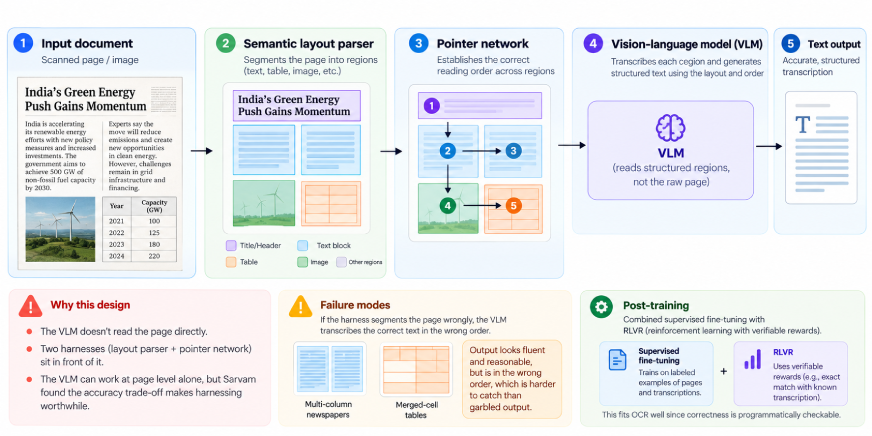
The architecture of Sarvam Vision 2.1 is built to handle the high-resolution requirements of document processing. Unlike standard VLMs that might downsample an image and lose the detail of small footnotes or dense table cells, Sarvam utilizes a high-resolution encoder paired with a layout-aware decoder.
For developers and enterprises, Sarvam has streamlined the integration process through two primary API endpoints:
- Digitise: This endpoint is optimized for full-page conversion, maintaining the layout and flow of the original document. It is intended for archiving textbooks, reports, and legal documents.
- Extract: This endpoint focuses on intelligence. It identifies key-value pairs and form fields, allowing a system to automatically ingest data from a handwritten insurance claim or a printed tax form without human intervention.
The availability of a "Document Intelligence Playground" further lowers the barrier to entry, allowing non-technical stakeholders to test the model’s capabilities against their specific organizational documents before committing to a full-scale API integration.
Implications for the Indian Digital Economy
The release of Sarvam Vision 2.1 arrives at a critical juncture for the "Digital India" initiative. As the government pushes for the digitization of land records, court proceedings, and healthcare data, the ability to process multilingual documents at scale is a matter of national productivity.
In the fintech sector, the model is expected to drastically reduce the cost of Know Your Customer (KYC) processes. Currently, many firms rely on manual data entry for regional ID cards or handwritten address proofs. Automating this pipeline with a model that understands both the script and the structure of the ID card could reduce processing times from hours to seconds.
In the legal and historical sectors, the ability to parse documents from the 19th century opens new doors for researchers and legal professionals. While "old scans" remain a difficult category, the 55.3% accuracy achieved by Sarvam represents a usable baseline for assisted digitisation, where AI handles the bulk of the transcription and humans perform final verification.
Conclusion: A New Standard for Sovereign AI
Sarvam Vision 2.1 is more than a technical update; it is a statement on the necessity of localized AI development. By outperforming global models on their own benchmarks while simultaneously mastering the complexities of the Indian linguistic landscape, Sarvam AI has demonstrated that "sovereign AI" can be synonymous with "state-of-the-art AI."
While global models will continue to improve, the specific needs of the Indian market—characterized by a mix of printed and handwritten text, multiple scripts on a single page, and a variety of structural formats—require a focused approach. Sarvam Vision 2.1 has set a new benchmark for what businesses should expect from document intelligence, signaling an end to the era where regional language support was a secondary feature rather than a core capability. As the model continues to evolve, the focus will likely shift toward closing the gap in minority languages like Santhali and further refining the recognition of degraded historical archives, bringing the goal of a fully digitized, multilingual India closer to reality.