In the rapidly evolving digital landscape of 2026, social media competitor analysis has transcended a mere tactical exercise to become a strategic imperative for brands seeking to maintain relevance and competitive edge. This practice involves systematically tracking and evaluating the social media performance of other entities within a given market category, subsequently leveraging these insights to refine and optimize one’s own digital strategy. It operates not as a clandestine surveillance mission but as a foundational method for establishing performance baselines, identifying industry norms, discerning successful strategies, and pinpointing areas ripe for innovation and improvement.

Distinguishing Social Media Analysis from Broader Market Research
While closely related, social media competitor analysis is distinct from broader market research in its focused scope. Market research typically delves into expansive areas such as customer demographics, category demand, and overarching buying behaviors, providing a macro view of the market ecosystem. In contrast, a social media competitor analysis narrows its lens specifically to the digital channels themselves. It scrutinizes the types of content competitors publish, the nuanced ways in which target audiences engage with and respond to that content, and critically, how one’s own quantitative metrics stack up against those of rivals. This granular focus ensures that strategic adjustments are directly applicable to social media operations.

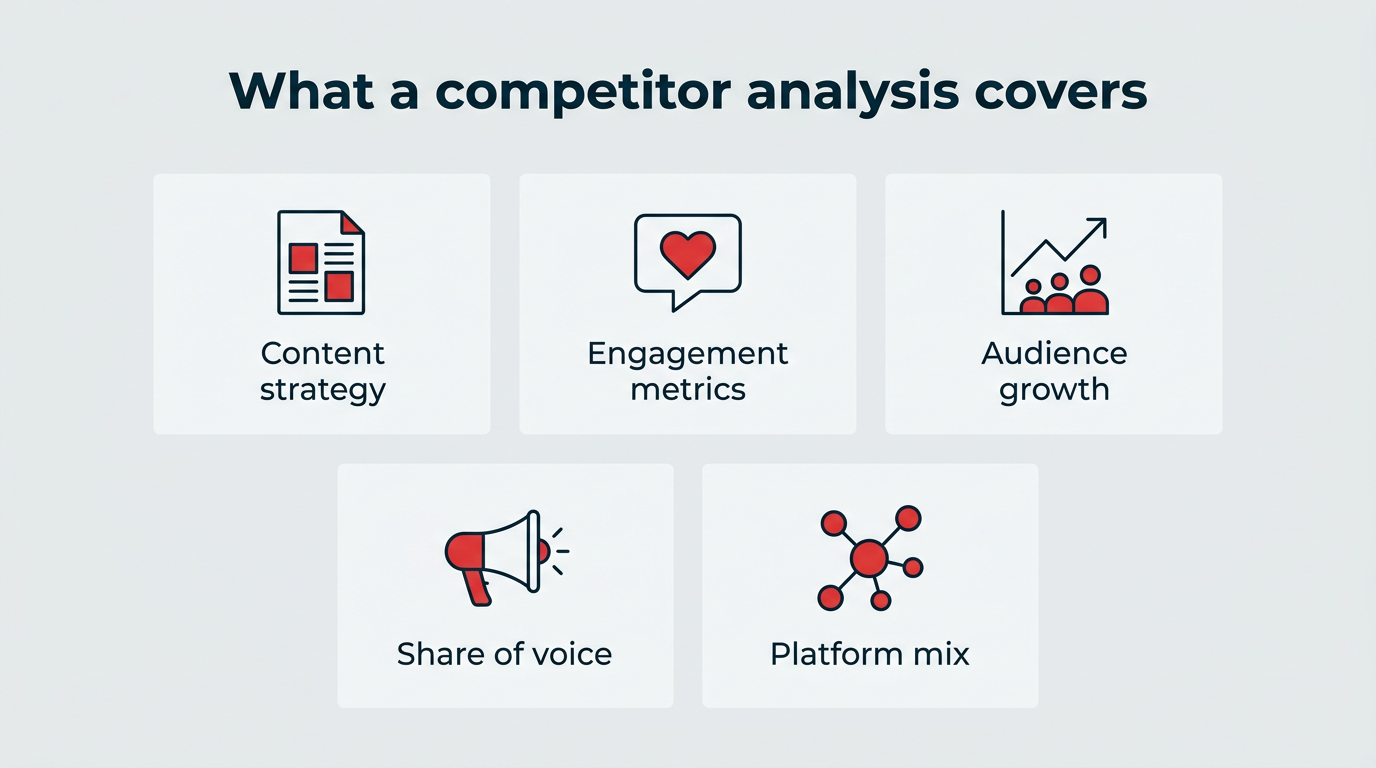
A comprehensive social media competitor analysis typically encompasses a multifaceted examination of several key dimensions:
- Content Strategy: An in-depth review of the types of content published, including formats (video, images, carousels, text), themes, tone, and messaging.
- Engagement Metrics: Analysis of likes, comments, shares, saves, and overall engagement rates to gauge audience interaction and content resonance.
- Audience Growth & Demographics: Tracking follower growth rates and, where possible, inferring audience characteristics to understand target market overlap.
- Posting Frequency & Timing: Observing the cadence and optimal times of content publication to identify patterns and potential best practices.
- Campaigns & Promotions: Monitoring specific marketing campaigns, advertisements, and promotional activities launched by competitors.
- Customer Service Interactions: Evaluating how competitors respond to customer inquiries, complaints, and comments on public platforms.
- Hashtag & Keyword Usage: Identifying prevalent and high-performing hashtags and keywords utilized by rivals to enhance discoverability.
- Share of Voice: Assessing the proportion of online discussion and mentions attributed to a brand versus its competitors within the industry.
The Strategic Imperative in a Dynamic Digital Ecosystem (2026 Perspective)
The significance of robust social media competitor analysis has amplified exponentially as digital platforms become increasingly central to consumer interaction and commerce. In 2026, with global social ad spend projected to reach an staggering $338.75 billion, the stakes for effective social media marketing have never been higher. Competitor data provides invaluable context, transforming raw internal performance numbers into meaningful, actionable insights. For instance, an engagement rate of 2% might appear modest in isolation, but its interpretation shifts dramatically if the industry average is 0.8% (indicating strong performance) or 4% (suggesting room for improvement). Without this comparative framework, distinguishing between internal content issues and broader industry shifts becomes a challenging, often speculative, endeavor.
For marketing leaders, this context is also crucial for validating strategic decisions and justifying budget allocations. Presenting performance data benchmarked against industry averages provides a compelling argument for investment and helps in setting realistic, data-backed goals. The digital landscape is in a state of perpetual flux; new formats, algorithm updates, and the proliferation of AI-generated content are rapidly reshaping social media feeds. With social media time spent projected to peak in 2026, competitor activity often serves as an early warning system, signaling emerging trends or shifts within a market category before they become widely apparent. Continuous monitoring thus becomes not just an advantage, but a necessity for agile adaptation.
Navigating the Tool Landscape: Choosing the Right Analytical Arsenal
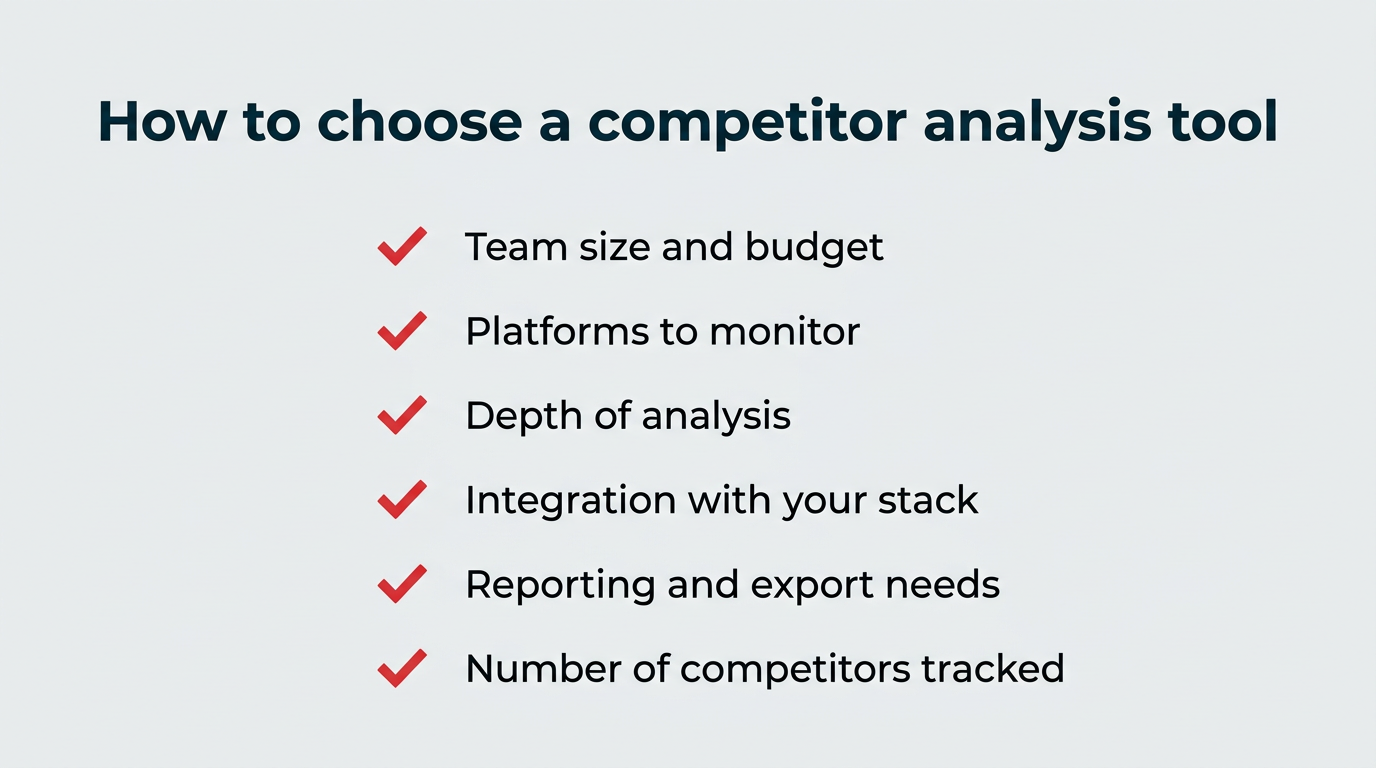
The selection of an appropriate social media competitor analysis tool is paramount, and its efficacy hinges less on an exhaustive feature list and more on its alignment with an organization’s specific needs and operational context. Before delving into individual solutions, it is prudent to establish practical criteria for narrowing the field:
- Budgetary Constraints: Determining the financial resources available for subscription fees.
- Team Size & Expertise: Assessing the technical proficiency and headcount of the marketing team to ensure effective tool utilization.
- Platform Coverage: Identifying which social media networks are critical for analysis, as platform support varies significantly among tools.
- Reporting & Analytics Depth: Evaluating the need for basic benchmarking versus deep dive analytics, sentiment analysis, and customizable reports.
- Integration Capabilities: Considering how well the tool integrates with existing social media management platforms or other marketing software.
- Ease of Use: Prioritizing user-friendly interfaces to minimize training time and maximize adoption.
Prominent Tools for Social Media Competitive Analysis
A diverse array of tools exists, each offering unique strengths tailored to different organizational sizes and analytical objectives. Here’s an overview of some leading platforms:
-
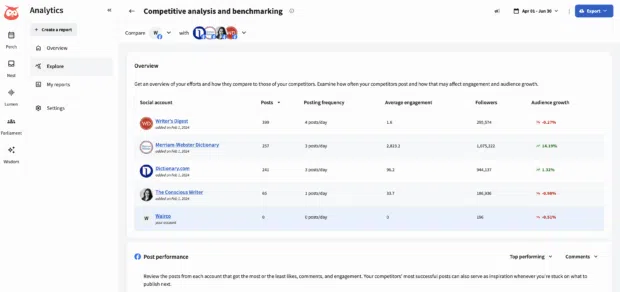
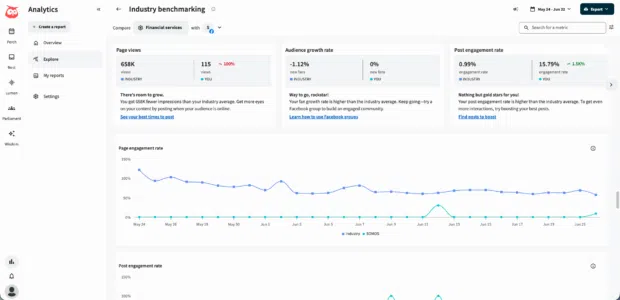
Perch by Hootsuite: An integral component of the Hootsuite Social OS, Perch offers comprehensive content planning, publishing, and analytics functionalities. It enables teams to manage their social content workflow holistically, from scheduling to performance analysis across major networks like Facebook, Instagram, X (formerly Twitter), LinkedIn, TikTok, and Bluesky. Its integration with Hootsuite’s ecosystem means competitor data is seamlessly connected to broader social media management efforts. Lumen, an embedded insights and listening app, extends the view into wider conversations, while Wisdom allows for plain-language data queries.
- Best For: Mid-sized to enterprise teams requiring a unified solution for social media management and competitor analysis.
- Platforms: Facebook, Instagram, X, LinkedIn, TikTok, Bluesky (feature-dependent).
- Starting Price: $99/user/month (Standard plan).
- Limitation: Competitor analysis reports primarily cover X, Facebook, and Instagram, requiring TikTok-first teams to rely more on industry benchmarking.
-
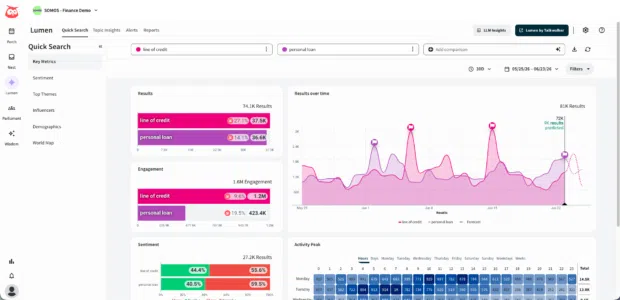
Brandwatch: A powerful consumer intelligence tool, Brandwatch excels in offering deep competitive analysis features, most notably its clear visualization of social share of voice. Share of voice quantifies a brand’s proportion of online mentions relative to its competitors, a critical metric in understanding market presence.
- Best For: Enterprises focused on deep consumer insights and comprehensive share of voice analysis.
- Platforms: X, Instagram, Facebook, Reddit, blogs, forums.
- Pricing: Contact for pricing.
- Limitation: Designed for enterprise research teams, potentially offering more complexity than smaller teams require.
-
Sprinklr: An enterprise-level solution providing extensive competitor analysis across Facebook, X, Instagram, and YouTube. Sprinklr analyzes competitor content, recurring themes, post categories, and sentiment, offering a granular view of rival strategies.
- Best For: Large organizations needing multi-platform insights and sentiment tracking.
- Platforms: Facebook, Instagram, X, YouTube.
- Pricing: Contact for pricing.
- Limitation: Lacks LinkedIn or TikTok competitor coverage, and implementation typically requires specialized support.
-
SEMrush: While predominantly recognized for its SEO and digital marketing capabilities, SEMrush offers robust social competitor analysis features. It allows tracking and comparison of competitor performance on Facebook, Instagram, X, and LinkedIn. Its strength lies in deep data analysis and reporting, though its expansive feature set can present a steep learning curve for beginners whose primary focus is solely social media.

- Best For: Integrated marketing teams seeking to combine SEO and social media insights.
- Platforms: Facebook, Instagram, X, LinkedIn.
- Starting Price: $139.95/month (Pro plan, billed monthly).
- Limitation: Social features are secondary to SEO, potentially leading to a steeper learning curve for social-only users.
-
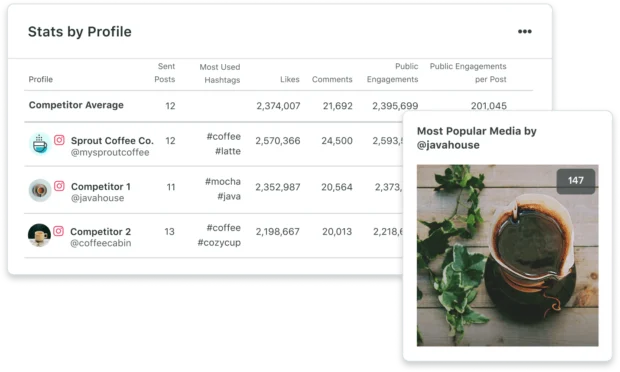
Sprout Social: Offers a comprehensive suite of competitor analysis tools, facilitating benchmarking and performance comparison as part of a streamlined reporting workflow. It also incorporates social listening for identifying key keywords and hashtags.
- Best For: Mid-sized to large teams prioritizing advanced analytics and reporting.
- Platforms: Facebook, Instagram, X (for competitor analysis features; wider platform supports more).
- Starting Price: $199/seat/month (Standard plan).
- Limitation: Limited report customization options and per-seat pricing can accumulate rapidly for larger teams.
-
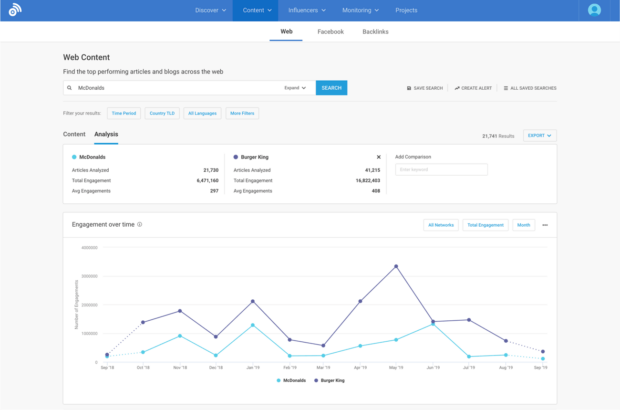
BuzzSumo: Primarily a content marketing tool, BuzzSumo includes valuable competitor analysis features, particularly strong for Facebook. It tracks key competitor metrics across the web, allowing analysis of engagement based on post type, length, and publication time. It’s excellent for uncovering top-shared content via keyword searches and identifying popular platforms within specific niches.

- Best For: Content-focused teams, especially those with a primary emphasis on Facebook.
- Platforms: Facebook (primary) and web-wide content.
- Starting Price: $199/month.
- Limitation: Limited coverage beyond Facebook, making it more effective as a supplementary tool.
-
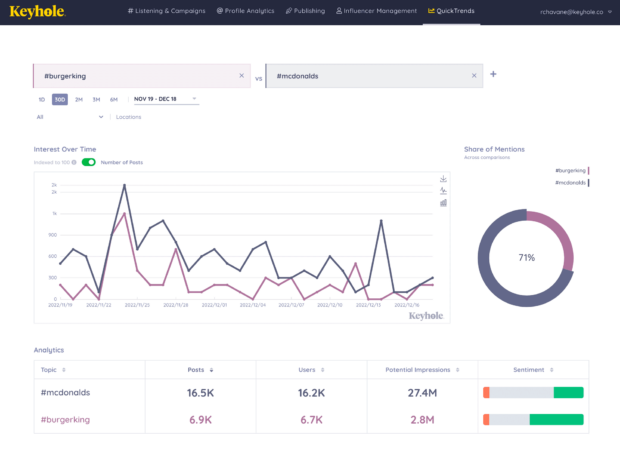
Keyhole: Specializes in hashtag and keyword tracking, offering free search tools to identify platforms where a hashtag appears, along with top referring sites and accounts. Paid plans unlock more detailed competitive analytics and benchmarking, particularly useful for campaign and influencer monitoring.
- Best For: Campaign and influencer marketing teams needing robust hashtag and keyword tracking.
- Platforms: X, Instagram, Facebook, YouTube, web sources.
- Pricing: Free search tools; contact for paid plans.
- Limitation: Strongest for hashtags and campaigns, with less comprehensive account-level benchmarking.
-
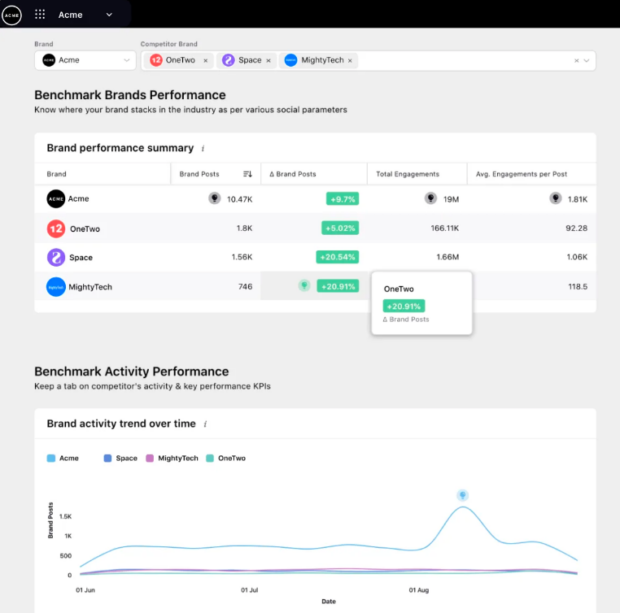
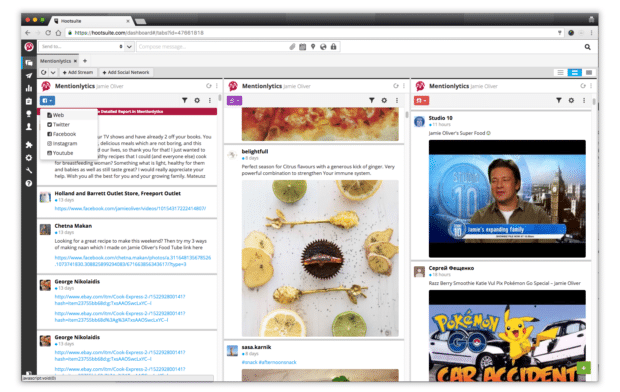
Mentionlytics: A social media monitoring tool that enables tracking of mentions for brands, competitors, or keywords across X, Instagram, Facebook, YouTube, Pinterest, and various web sources. Its sentiment analysis feature is particularly valuable for understanding public perception.
- Best For: Small to mid-sized teams focused on brand monitoring and sentiment analysis.
- Platforms: X, Instagram, Facebook, YouTube, Pinterest, web sources.
- Pricing: Publicly listed on Mentionlytics’ pricing page.
- Limitation: More monitoring-centric than benchmarking-centric, leading to lighter competitor performance reporting.
-
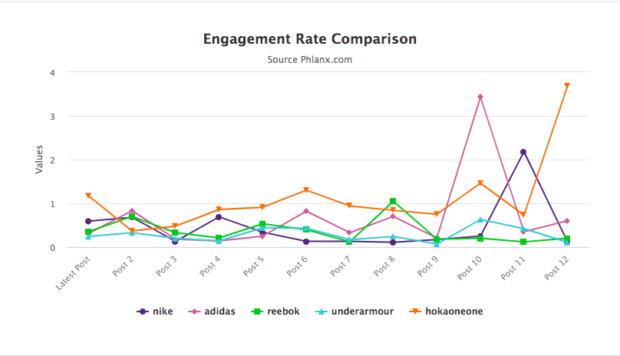
Phlanx: Offers a straightforward dashboard for tracking engagement and comparing performance on platforms like Instagram, YouTube, X, and Twitch. While useful for quick comparisons, its benchmarking is limited primarily to engagement rates.
- Best For: Creators and solo marketers needing quick engagement comparisons.
- Platforms: Instagram, YouTube, X, Twitch.
- Pricing: Free tools available.
- Limitation: Focuses solely on engagement rate, lacking comprehensive reporting or historical trend analysis.
-
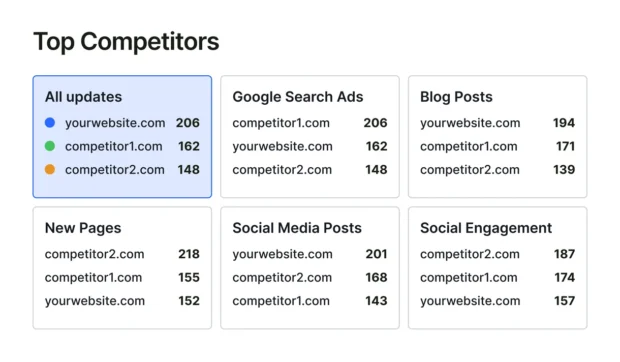
Later: Provides Instagram engagement rate benchmarking against industry averages for accounts with similar follower counts, along with weekly reports on top-performing industry hashtags. While it has expanded to include multi-network scheduling and competitive benchmarking, its core strength remains Instagram-focused.
- Best For: Instagram-focused marketing strategies.
- Platforms: Instagram (primary), with additional networks supported for social media management and benchmarking.
- Pricing: Publicly listed on Later’s pricing page.
- Limitation: Competitor benchmarking is deepest for Instagram, and less robust than dedicated analytics platforms for other networks.
-
Social Blade: A free tool for high-level competitor performance tracking on YouTube, Instagram, TikTok, Twitch, and Facebook. It monitors metrics like follower growth, post volume, and engagement, also assigning a "grade" based on its internal ranking system.
- Best For: Creators and small businesses requiring free, surface-level performance tracking.
- Platforms: YouTube, Instagram, TikTok, Twitch, Facebook.
- Pricing: Free, with paid tiers available.
- Limitation: Offers only surface-level metrics, without content or sentiment analysis.
-
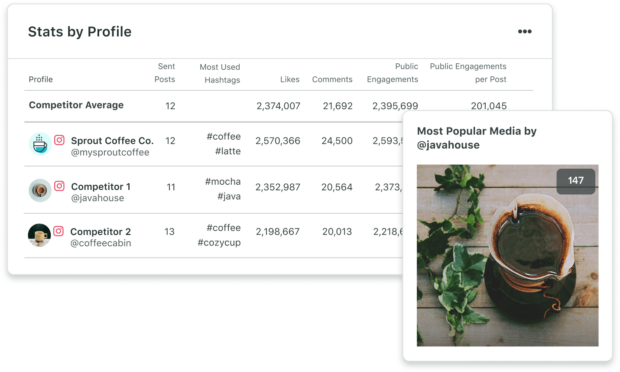
Similarweb: Primarily known for traffic analysis, Similarweb also offers valuable social media capabilities. It enables tracking of social media traffic trends for competitors across platforms like Facebook, Instagram, and YouTube, providing insights into how social media contributes to the overall customer journey.
- Best For: Analytics and growth teams aiming to understand social traffic within the full customer journey.
- Platforms: Facebook, Instagram, YouTube, web sources.
- Pricing: Contact for pricing.
- Limitation: Traffic-focused, offering limited post-level social performance data.
A Seven-Step Framework for Strategic Insight
Once a suitable tool is selected, the process of conducting a social media competitor analysis becomes a repeatable, structured endeavor.
- Identify Your Competitors: Begin by identifying three distinct categories of competitors: direct rivals offering similar products/services, indirect competitors addressing the same customer pain points through different means, and aspirational brands that represent future growth targets. Aim for a manageable list of five to ten accounts to derive meaningful patterns without data overload.
- Choose Which Platforms to Analyze: Prioritize social networks where the target audience is most active, rather than attempting to cover every platform competitors utilize. Data from reputable sources (e.g., Pew Research indicating 84% of U.S. adults use YouTube and half use Instagram) can inform these decisions. For exploring new channels, preliminary social media market research can validate audience presence before commitment.
- Collect Your Data: Establish a consistent date range, typically the last 30 to 90 days, and collect identical metrics for every account to ensure valid comparisons. Utilize a customizable competitive analysis template to consolidate data, whether collected manually or exported from tools.
- Analyze Content Strategy and Performance: Move beyond raw numbers to discern underlying patterns. Identify high-performing content formats, optimal posting frequencies, recurring themes, and posts that significantly outperformed others. This qualitative analysis is crucial for understanding why certain content resonates.
- Benchmark Against Your Own Metrics: Directly compare collected competitor data with internal performance metrics over the same timeframe, using consistent definitions. A unified analytics dashboard simplifies this comparison. The objective is not necessarily to "win" every metric but to clearly identify areas of strength, weakness, and the magnitude of any gaps.
- Identify Gaps and Opportunities: Scrutinize the data for potential gaps in the market or opportunities for differentiation. These often manifest as underutilized formats, unanswered audience questions, neglected platforms, or unmet customer service expectations that your brand could address.
- Document Findings and Adjust Your Strategy: Systematically record all findings, outline proposed strategic adjustments, and define the metrics to be tracked in subsequent analysis cycles. Integrate these insights into the overarching social media strategy, ensuring that competitive intelligence directly informs actionable decisions. A concise, recurring summary proves more valuable than an exhaustive, one-off report that goes unreferenced.
Key Performance Indicators: The Metrics That Matter
While a plethora of metrics exist, a focused approach tracking a select few consistently yields the most actionable intelligence. These core KPIs drive strategic decisions:
| Metric | What it Measures | Why it Matters |
|---|---|---|
| Engagement rate | Interactions relative to followers or reach | Fairly compares content quality across accounts of varying sizes, indicating true audience resonance. |
| Follower growth rate | Percentage change in audience over a period | Reveals which brands are effectively expanding their reach and gaining market traction. |
| Posting frequency | Number of posts published per week or month | Helps ascertain if strong results stem from sheer volume or superior content quality. |
| Share of voice | Your share of category conversation versus competitors | Tracks overall brand visibility and influence beyond owned channels, encompassing organic mentions. |
| Content performance by format | How video, carousels, images, and text posts perform | Guides strategic allocation of production time and budget towards formats that yield the best results. |
| Audience sentiment | Whether mentions are positive, neutral, or negative | Surfaces competitor pain points or areas of dissatisfaction that your brand could address or leverage. |
| Response time | How quickly competitors reply to comments and messages | Establishes service expectations and identifies opportunities for superior customer care. |
| Hashtag performance | Which tags drive reach and engagement | Aids in expanding content reach beyond existing followers and tapping into relevant conversations. |
Consistent tracking of these metrics over time generates invaluable trend lines, offering far greater utility than isolated snapshots.
Translating Intelligence into Competitive Advantage
Competitor intelligence is not an end in itself but a means to achieve sustained competitive advantage. Its effective application can manifest in several critical ways:
- Set Realistic Goals: Understanding competitor performance establishes a pragmatic baseline for setting achievable performance goals. This is particularly valuable when launching new accounts or expanding onto new platforms, where historical internal data is scarce. Even for established presences, competitor insights temper expectations and inform aggressive yet attainable targets.
- Analyze Your Results Versus Competitors’: Contextualizing internal performance against competitor data is crucial. An unexpected dip or surge in metrics can be accurately interpreted – is it an internal content issue or a broader industry trend? This discernment guides appropriate strategic responses, whether adjusting content mix or reacting to algorithm changes.
- Discover New Ideas and Inspiration: Competitive intelligence tools centralize competitors’ top-performing content, offering a streamlined view of what resonates within the industry. This facilitates staying abreast of emerging trends, memes, hashtags, and formats. The goal is not imitation but adaptation, learning from successful strategies to inform unique brand approaches, especially in areas like influencer marketing.
- Define What Makes Your Brand Different: Analyzing competitors sharpens the understanding of one’s own unique selling proposition (USP). By identifying competitor strengths and weaknesses, a brand can articulate its distinctive value, shaping its social media presence and overall brand identity. Continuous monitoring also provides an early warning system against competitors encroaching on your unique market space.
- Understand Your Audience: Competitor analysis tools offer profound audience insights. Beyond gauging potential audience size within a niche, they reveal how audiences engage with competitor content, providing clues for one’s own content strategy. This includes understanding preferred content types, engagement drivers, and even audience demographics. Hashtag analysis further illuminates audience personas and potential brand positioning opportunities.
- Expand Your Reach with Keywords and Hashtags: High-performing competitor content often reveals keywords and hashtags that effectively extend reach beyond existing followers. Beyond obvious hashtags, a deeper dive into competitor content can uncover specific phrases driving discoverability, informing both social media marketing and social SEO strategies. Market research and trend analysis can further identify nascent keywords for proactive adoption.
- Perform a SWOT Analysis: Competitor data forms the bedrock of a robust SWOT (Strengths, Weaknesses, Opportunities, Threats) analysis. While strengths and weaknesses are internal, opportunities and threats emerge from the external environment, often illuminated by competitive insights.
- Strengths: Areas where your brand outperforms competitors on social media.
- Weaknesses: Areas where competitors demonstrate superior performance or engagement.
- Opportunities: Unmet audience needs, underutilized platforms, or content gaps identified through competitor analysis.
- Threats: Competitors gaining significant market share, innovative content strategies, or shifts in audience sentiment that could impact your brand.
Social media competitive analysis tools provide much of the necessary data, simplifying the process of understanding a brand’s standing within its ecosystem.
In conclusion, social media competitor analysis is no longer a peripheral activity but a core discipline for any brand committed to sustained growth and relevance. By continuously monitoring, evaluating, and adapting based on competitive intelligence, organizations can set realistic goals, refine strategies, innovate content, and ultimately, secure their position in the dynamic and highly competitive digital landscape of 2026 and beyond. This ongoing strategic vigilance is the cornerstone of agile and effective social media marketing.