In an era defined by rapid digital transformation and the proliferation of Software-as-a-Service (SaaS) solutions, organizations globally are grappling with the complexities of managing increasingly fragmented technology landscapes. Tech stack consolidation, the strategic process of reducing the number of software tools an organization employs and standardizing operations on a smaller, more integrated set of systems, has emerged as a critical imperative for modern businesses. This initiative extends far beyond mere cost-cutting; it fundamentally aims to unify data, enhance operational efficiency, improve customer experience, and fortify an organization’s strategic agility in a competitive marketplace.
The Proliferation of SaaS and the Rise of Tool Sprawl
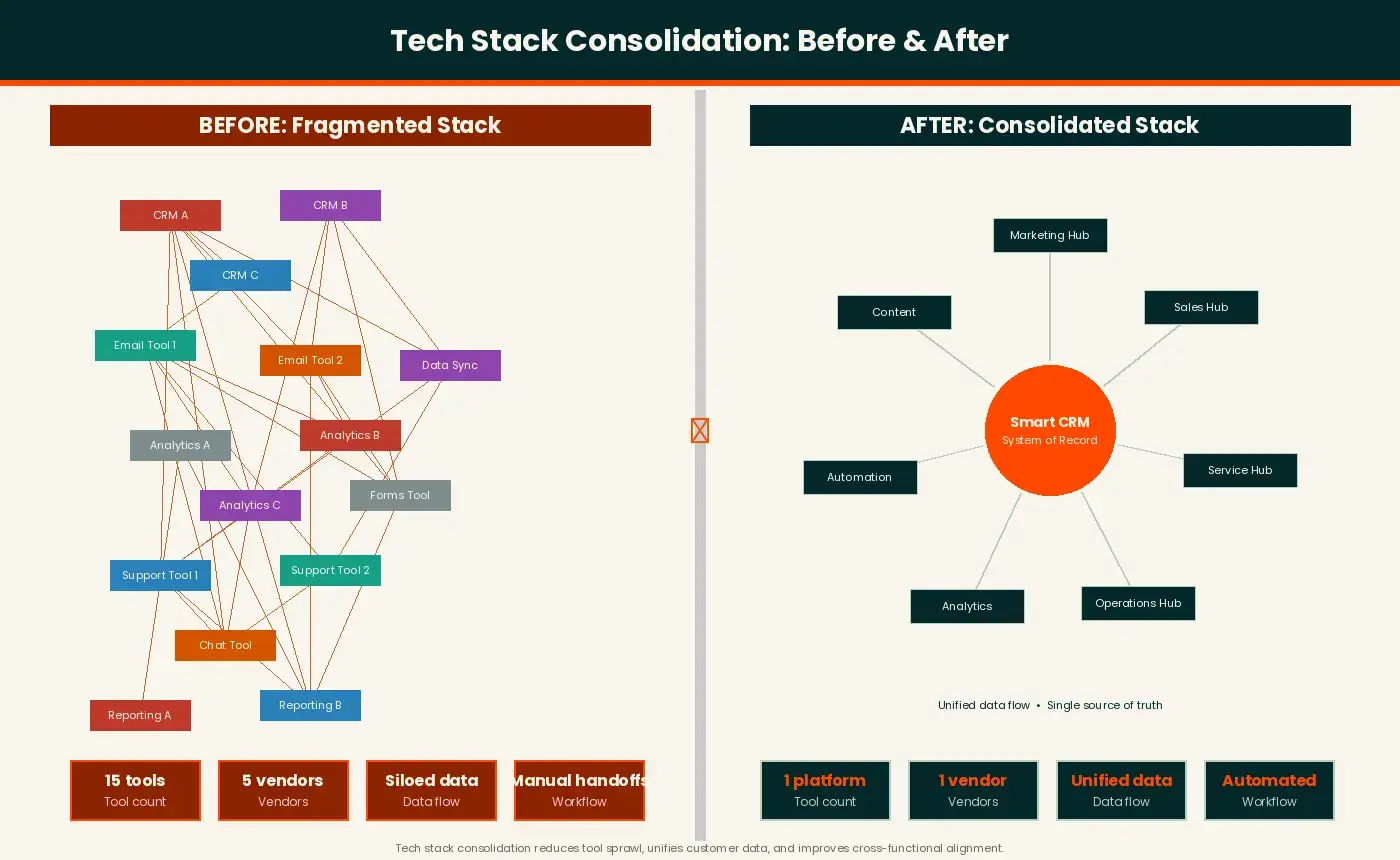
The last decade has witnessed an unprecedented surge in SaaS adoption. Easy accessibility, subscription-based models, and departmental autonomy in procurement have led to a decentralized acquisition of software tools. While initially empowering individual teams with specialized functionalities, this organic growth has inadvertently cultivated "tool sprawl" – a condition characterized by a high number of redundant, underutilized, or poorly integrated applications. Gartner, a leading research and advisory company, has consistently highlighted that despite a drive towards efficiency, IT spending on software continues to climb, often exacerbated by the sheer volume of disparate tools. This sprawl creates significant challenges: data silos, inconsistent reporting, manual data entry, integration failures, and increased cybersecurity vulnerabilities. Customer-facing teams, for instance, often struggle with fragmented customer data residing in different systems, forcing them to manually reconstruct context for every customer interaction, from marketing to sales to service. This inefficiency directly impacts customer satisfaction and operational overhead.
A Strategic Imperative: Beyond Cost Savings
While cost reduction through eliminating redundant subscriptions is an undeniable benefit, the primary driver for tech stack consolidation is the strategic advantage gained from a unified and integrated technological ecosystem. The foundation of successful consolidation invariably lies in establishing a robust Customer Relationship Management (CRM) system of record. This single platform serves as the authoritative source for all customer data, powering workflows across departments and providing a consistent, 360-degree view of every customer.
When customer data is centralized, reporting becomes more accurate and timely, enabling quicker, data-driven decisions. Automation, which often falters across disparate systems, can then span the entire customer journey, from initial lead nurturing to post-sale support. Crucially, the customer experience itself sees a marked improvement as representatives are equipped with complete context, eliminating the frustrating need for customers to repeat information. This shift from managing symptoms of tool sprawl to addressing its root causes is a defining characteristic of effective consolidation.

Benefits Across Key Business Functions
The ripple effects of a consolidated tech stack are profound, touching every corner of an organization:
- Marketing: A streamlined marketing technology (martech) stack significantly reduces the time spent on reconciling data discrepancies and allows marketing teams to focus more on campaign strategy and execution. Improved attribution models emerge as all customer touchpoints feed into a single platform. Automation — from lead nurturing to scoring and lifecycle stage changes — operates seamlessly across the entire funnel, optimizing conversion paths.
- Sales: Sales representatives, working from a unified CRM, no longer need to toggle between multiple applications to grasp a prospect’s history. Pipelines, activity logs, communication sequences, and vital notes are all housed in one accessible location. This comprehensive data environment leads to more accurate forecasting and a more efficient sales cycle, empowering reps to close deals faster.
- Service: Support teams gain immediate access to the full customer record, including purchase history, past conversations, and open deals, directly within their helpdesk interface. This contextual richness accelerates issue resolution, minimizes customer frustration from repeated inquiries, and elevates overall service quality.
- Operations, Finance, and IT: Beyond the customer-facing teams, the back-office functions also reap substantial rewards. Vendor consolidation simplifies procurement processes, streamlines contract management, and allows finance departments to better reconcile software spend against actual utilization. For IT, a reduced attack surface enhances cybersecurity posture, and operations teams spend less time maintaining complex, custom integrations, freeing them to focus on higher-value strategic initiatives like process optimization and innovation.
A Phased Approach to Tech Stack Consolidation
Successful tech stack consolidation is a methodical undertaking, requiring careful planning and execution. It typically unfolds in several key phases:
Phase 1: Comprehensive Stack Audit (Days 1-30)
The initial and most critical step is to gain a complete understanding of the current technology landscape. This involves compiling an exhaustive inventory of every software tool utilized across the organization, including those paid for, free trials, and "shadow IT" instances acquired outside central procurement. For each tool, critical information must be documented: the owner, associated costs, renewal dates, actual utilization rates, and how data flows in and out of it. This culminates in a master tool inventory, a foundational artifact for subsequent decision-making. Analysts often recommend involving all department heads to ensure no tool is overlooked, uncovering hidden costs and interdependencies.
Phase 2: Strategic Prioritization and System Definition (Days 31-60)
Once the audit is complete, tools are grouped by category to identify redundancies, underutilized applications, and critical systems that must be retained. This phase also focuses on identifying "quick wins" – tools that are easy to retire or replace, generating early momentum and budget reallocation. Crucially, the organization must define its "system of record" for customer data. This typically involves designating a central CRM platform as the single source of truth for all customer interactions, lifecycle stages, and historical data. Establishing clear data standards—including field naming conventions, lifecycle stage definitions, and deduplication rules—is paramount to ensure data quality and seamless integration during migration. A robust CRM like HubSpot’s Smart CRM is often considered for this role due to its integrated capabilities across marketing, sales, and service.
Phase 3: Tool Selection and Migration Planning (Days 61-90)
With the system of record defined and data standards set, each existing tool is rigorously evaluated against consistent criteria: its strategic importance, cost-effectiveness, utilization, and integration capabilities with the chosen system of record. Tools that do not meet these standards or offer redundant functionality are marked for retirement. Before any tool is decommissioned, a meticulous migration plan is developed. This includes identifying data to be transferred, defining the migration strategy (e.g., phased, big bang), conducting user acceptance testing (UAT), and establishing robust rollback procedures. Phased rollouts, often by department or use case, help mitigate risks and allow for early issue detection.

Phase 4: Execution, Enablement, and Governance (Beyond 90 Days)
The execution phase involves the actual migration of data and workflows to the new, consolidated platform. This must be accompanied by comprehensive training and enablement programs for affected teams. Adoption tracking—measuring active users, feature utilization, data completeness, and workflow completion rates—is essential to confirm the success of the transition and prevent reversion to old habits.
Post-consolidation, establishing strong governance mechanisms is critical to prevent future tool sprawl. This includes:
- A Formal Intake Process: All new software requests, even free trials, must pass through a standardized review process to assess business case, cost, integration needs, and potential redundancies.
- Category Ownership: Assigning specific owners to each software category ensures accountability for renewals, utilization reviews, and new requests.
- Renewal-based Review Cadence: Regular, often quarterly, reviews tied to contract renewal windows allow for proactive assessment of tool value and utilization.
- Documented Standards: Data standards, integration requirements, and an approved vendor list must be easily accessible and integrated into onboarding for new hires across relevant departments.
- Living Tool Inventory: The master inventory from Phase 1 must be continuously updated, serving as the organization’s governance record and baseline for future optimization cycles.
Navigating Common Challenges
Despite the clear benefits, tech stack consolidation is not without its hurdles:
- Stakeholder Resistance: Teams often develop familiarity and loyalty to existing tools, making them resistant to change. Addressing this requires clear communication of benefits, involving key users in the planning process, and providing robust training and support.
- Legacy Edge Cases: Some niche tools may perform a very specific function not easily replicated elsewhere. The solution is to evaluate their genuine utilization and integration capabilities; if critical, they may be documented as deliberate exceptions, otherwise, alternative solutions within the core platform should be explored.
- Integration Gaps: Assumptions about system compatibility can prove false, leading to unexpected custom integration work. Thorough due diligence and proof-of-concept testing are crucial during the planning phase.
- Contract Timing: Being mid-contract for a tool slated for retirement can be a financial impediment. Strategies include negotiating early termination, assigning the remaining contract to another entity if possible, or leveraging the contract term to plan a seamless transition.
- Dirty Data: Migrating poor-quality data simply transfers the problem. A rigorous data cleansing process, including deduplication and standardization, must precede any migration.
- Lack of Alignment: Failing to involve procurement, security, and finance stakeholders early can lead to downstream issues. Cross-functional collaboration is vital throughout the process.
Broader Implications and Future Outlook
The implications of successful tech stack consolidation extend beyond operational efficiencies. An agile, integrated technology environment enhances an organization’s competitive advantage by fostering innovation, improving time-to-market for new products and services, and enabling a deeper understanding of customer needs. Companies that effectively consolidate their tech stacks are better positioned to adapt to market shifts, scale operations, and deliver superior customer experiences.
While the initial consolidation effort may take several months, ranging from three to twelve depending on organizational size and complexity, it is not a one-time project. It transitions into an ongoing process of governance and continuous optimization, ensuring that the technology stack remains lean, efficient, and aligned with evolving business objectives. By prioritizing platforms with open APIs and documented partner ecosystems, and negotiating data portability terms, organizations can mitigate the risk of vendor lock-in, maintaining flexibility and control over their digital infrastructure. Ultimately, tech stack consolidation is a continuous journey towards a more intelligent, integrated, and impactful technological foundation.